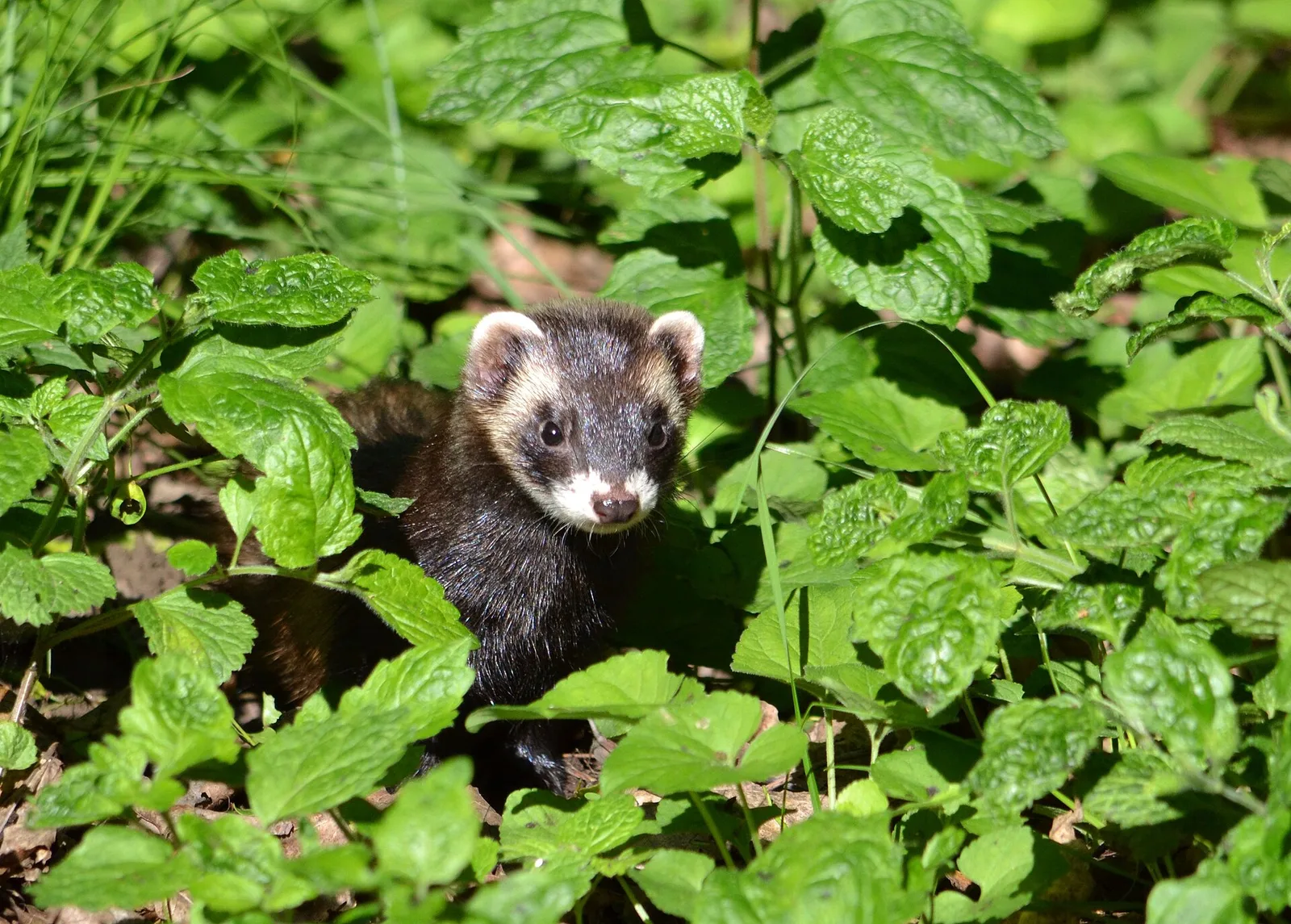
European polecat
The wild ferret that Europe named for its smell
Mustela putorius
Also called Western polecat, Forest polecat, Black polecat, Foumart, Fitch
Living individuals or members of this group exist today. This does not mean they are safe from extinction.
Meet the european polecat
The European polecat is a dark, stocky mustelid with a pale face mask that hunts frogs, voles and rabbits by night. It ranges across Europe and northern Morocco, it is the wild ancestor of the ferret, and the IUCN lists it as Least Concern.
Images of the european polecat


Lifespan in the wild
5 to 6 years
Weight
0.65 to 1.5 kg
Length
29 to 46 cm
Fact file
European polecat
- Location
- Europe west of the Urals; Rif Mountains, Morocco
- Habitat
- Temperate forest, Wetlands, Grassland, Rivers and lakes
- Diet
- Carnivore
- Prey / food
- Frogs, toads, voles, rats, rabbits, birds, eggs
- Predators
- Few; a beech marten has killed one
- Lifestyle
- Nocturnal and solitary
- Group name
- Solitary
- Name of young
- Kit
- Gestation
- About 42 days
- Litter size
- 5 to 10 kits
- Population
- Common across Europe; no global count
- Biggest threat
- Road deaths and rodenticide poisoning
- Distinctive feature
- A dark mask across a pale face
- Colour
- Blackish brown with cream underfur
- Skin type
- Fur
Size
Next to a person
Measurements
Size and speed
- Length
- 29 to 46 cm head and body; males 35 to 46, females 29 to 39.4
- Length, male
- 35 to 46 cm
- Length, female
- 29 to 39.4 cm
- Tail
- 8.4 to 16.7 cm
- Weight
- 0.65 to 1.5 kg middle Europe; females from 650 g, males to 1.5 kg
- Weight, male
- 1 to 1.5 kg
- Weight, female
- 650 to 815 g
Typical adult ranges. Source: Wikipedia.
Life cycle
Lifespan
- In the wild5 to 6 years
- In captivityUp to 11.1 years
- 011.1 years
The pale bar is the record. Source: AnAge.
Appearance
Colour and coat
- Primary colours
- blackish browncream
- Secondary colours
- blackwhite
- Skin type
- fur
- Male and female
- Males are much larger than females. Animal Diversity Web says a male can weigh twice as much and be a third longer, and the male skull is heavier and broader.
Life cycle
Mating and family
- Mating system
- polygynous
- Social structure
- solitary
- Breeding
- one litter of five to ten kits each year, born in May or early June
Polecats mate from March to June, and the female gives birth after about 42 days. A litter holds five to ten kits, born blind at 9 to 10 grams. They are weaned from three weeks and leave their mother at two to three months, when they are full sized. They can breed at about six months. A wild polecat lives about 5 to 6 years.
Classification
Taxonomy
- Kingdom
- Animalia
- Phylum
- Chordata
- Class
- Mammalia
- Order
- Carnivora
- Family
- Mustelidae
- Genus
- Mustela
- Species
- Mustela putorius
Conservation
Red List status
- LC
- NT
- VU
- EN
- CR
- EW
- EX
Least Concern on the IUCN Red List
Range
Recorded in 22 countries
- Austria
- Belgium
- Switzerland
- Czech Republic
- Germany
- Denmark
- Spain
- France
- United Kingdom
- Croatia
- Italy
- Lithuania
- Luxembourg
- Netherlands
- New Zealand
- Poland
- Portugal
- Romania
- Russia
- Sweden
- Slovenia
- Ukraine
Habitat layer: temperate broadleaf and mixed forest, temperate conifer forest, boreal forest and taiga, tropical grassland, savanna and shrubland, temperate grassland, savanna and shrubland, flooded grassland and savanna, mangrove.
Countries from 1,295 wild records on GBIF (iNaturalist research grade), filtered and checked by hand. Country shapes: Natural Earth. Habitat: RESOLVE Ecoregions 2017, CC BY 4.0. Basemap: Natural Earth.
Habitats
Three things to know
- 1
Every domestic ferret descends from this one wild species.
- 2
It paralyses frogs with a bite and stores them alive for later.
- 3
Its Latin name putorius means stench.
Did you know
Seven more facts
- 1
Charles Oldham found at least 20 spellings of the polecat's name in two English counties.
- 2
The polecat can breed with the steppe polecat, the ferret and the European mink.
- 3
A mother cat can suckle and raise polecat kits.
- 4
The Dumfries Fur Fair sold 600 polecat pelts in 1831 and none in 1869.
- 5
A wild polecat bolts rats from their holes better than a ferret does.
- 6
Only 3.8% of rural British schoolchildren could recognise a polecat in a photograph.
- 7
Early Irish settlers in north Wales are said to have kept polecats as pets.
Field notes
How it looks and acts
Field notes
Distinguishing features
- A dark mask across the eyes on a pale face.
- Blackish brown guard hairs over cream underfur that shows on the flanks.
- Dark brown ears with a white edge.
- A short, compact body on short legs.
- A short tail, about a third of the body length.
- Black legs, throat and belly.
Field notes
Unique adaptations
- Strong jaws and large teeth let it kill rabbits heavier than itself.
- Anal glands hold a foul fluid for defence and for marking.
- Partly webbed hind toes help it swim.
- A thick winter coat with dense underfur keeps it warm.
- A keen nose lets it hunt in the dark.
Field notes
Interesting behaviours
- It hunts at night along stream banks for frogs.
- It digs rodents out of their burrows in dry forest.
- It caches frogs and toads during seasonal gluts.
- It rests by day in hollow logs, burrows, barns and brush piles.
- It kills more poultry than it can eat and drags the rest away.
Field notes
Temperament
- Shy of people and quick to hide.
- Nervous and unsociable as an adult, so hard to tame.
- Fierce in defence of a litter.
Field notes
Communication
- A fierce growl when angry.
- A squeak when distressed.
- A low mewling call between a mate or mother and kits.
- Scent from the anal glands marks the range.
Ecology
Ecological role
The polecat is a mid-sized predator that keeps rodent and amphibian numbers in check across European farmland and wetland.
- It is an important predator of small mammals.
- By eating male frogs it lowers the rate of polyandry in frog populations.
- It competes with the American mink and the steppe polecat for prey.
- It probably spreads a few seeds through the fruit that young animals eat.
Stories
Myths and legends
- In English tradition, the polecat stood for promiscuity and was hurled as an insult on the Elizabethan stage.
- In Welsh tradition, polecats were thought to march to the Tregaron bog each spring to feast on frogs.
- In rural British tradition, the polecat chews the ears off sleeping sheep.
- In Scottish tradition, it is a smelly night thief that raids the cowshed and the henhouse.
- In medieval European tradition, it is said to have served as a witch's familiar.
People
Relationship with humans
People
Living alongside us
People tamed the polecat into the ferret more than 2,000 years ago to bolt rabbits and rats. They also trapped and farmed it for fitch fur and killed it as a poultry thief. Britain persecuted it harder than any other mustelid, then protected it, and it is now spreading back. It kills chickens and can carry rabies, but it also controls rodents.
- It is shy of people and runs rather than fights.
- A female guarding kits may confront a person who comes too close.
- It can carry rabies and distemper in some areas.
People
Status, uses and products
- Domestication
- Wild
- As a pet
- Not suitable. The wild polecat stays nervous and unsociable as an adult and is hard to tame. Its domestic form, the ferret, is the animal people keep.
- Uses
- ferret ancestryrattingfur farmingrodent control
- Products
- fitch furpaintbrush hair
The full account
About the european polecat
The European polecat, Mustela putorius, is a dark, stocky member of the weasel family. It lives across most of Europe west of the Urals, and a separate population lives in the Rif Mountains of Morocco. It is the wild ancestor of the domestic ferret. Its name, in Latin and in half a dozen English dialects, refers to its smell. When alarmed it releases a foul liquid from glands under the tail.
Males in middle Europe weigh 1 to 1.5 kilograms, and females weigh 650 to 815 grams. The head and body measure 29 to 46 centimetres, and the tail adds 8.4 to 16.7 cm. It hunts frogs, voles, rats and rabbits by night, and it sometimes stores paralysed prey alive in its den. The IUCN lists it as Least Concern because of its wide range and large numbers. Britain persecuted it for centuries, and it is now spreading back into counties that lost it 100 years ago.
Name and taxonomy
Linnaeus named the species in 1758. The Latin putorius means stench, and it is the root of the English word putrid. The word polecat first appears in Middle English after the Norman Conquest, spelled polcat. The first half may come from the French poule, for chicken, or from the Old English word for foul. Middle English also called it the foumart, or foul marten, and Old French called it fissau. Fissau became fitchew and then fitch, which is still the trade name for its pelt. Charles Oldham counted at least 20 spellings of the name in Hertfordshire and Bedfordshire alone.
The species sits in the genus Mustela with the weasels, stoats and minks. Seven subspecies were recognised as of 2005, and the ferret is often treated as one of them, Mustela putorius furo. A 2002 review questioned whether the polecat is native to Britain at all. It noted a thin fossil record and a Welsh name, ffwlbart, borrowed from Middle English rather than from Celtic. The first British mentions come from the 14th century, in Welsh manuscripts and in Chaucer.
Evolution and relatives
The first true polecat was Mustela stromeri, a smaller animal that lived in the late Villafranchian. Modern polecat fossils from Germany, Britain and France date to the Middle Pleistocene. The species probably arose in western Europe at that time. Its closest relatives are the steppe polecat of Asia and the black-footed ferret of North America. All three probably share Mustela stromeri as an ancestor. Genetic clocks put the split from the steppe polecat at 1.5 million years ago, or at 430,000 years by another gene.
The polecat is less specialised for meat than the steppe polecat, with a simpler skull and teeth. It can breed with the steppe polecat and with the ferret, and the young are fertile. It can also cross with the European mink, but the male hybrids are sterile. Russian furriers call that hybrid khor'-tumak, and the first captive one was bred in 1978. Every line of evidence points to the polecat as the sole ancestor of the ferret, which people tamed over 2,000 years ago.
Appearance
In middle Europe a male weighs 1 to 1.5 kilograms and a female 650 to 815 grams. A male's head and body measure 35 to 46 centimetres, and a female's 29 to 39.4 cm. The tail is short, about a third of the body, at 8.4 to 16.7 cm. Animal Diversity Web says a male can weigh twice as much as a female and be a third longer. The body is more compact than in other Mustela species, and the legs are short. The skull is heavy for the animal's size, and the teeth are large and strong.
The winter fur is blackish brown, and pale yellowish underfur shows through on the flanks. The throat, chest, belly, legs and tail are black or nearly so. A dark mask crosses the eyes, and the ears are dark brown with a white edge. The summer coat is short, coarse and greyer, and it lacks the gloss of the winter fur. Colour variants occur, including albino, reddish and pale golden animals. The front claws are curved, partly retractable and 6 millimetres long, while the hind claws are 4 mm and fixed.
The hind toes are long and partly webbed, and the polecat swims well. Its fur insulates less well in water than the American mink's, and it chills in 26 to 28 minutes at 8 °C.
Habitat and range
The polecat ranges across the western Palaearctic east to the Urals. Ireland has no polecats, northern Scandinavia lacks them too, and so does most of the Balkan region. The Moroccan population lives in the Rif range, from the coast up to 2,400 metres. Its domestic form, the ferret, has gone feral in Britain, on some Mediterranean islands and in New Zealand. GBIF holds records from 57 countries, but that list includes escapes and zoo animals.
It lives in forest, meadow, abandoned fields and farmland, and it likes to be near water. It uses wetlands, forest edges and grassland with patches of scrub. It comes close to farms and villages but avoids dense towns. In Britain it is most active around rabbit warrens. By day it rests in a crevice, a hollow log, a burrow dug by a badger or fox, or a farm building. In Luxembourg, radio-tracked animals used 53 different day rests, and piles of branches, barns and sheds were the favourites.
In the alpine parts of France, altitude limits the polecat, because it does best in a Mediterranean climate. Buildings become important shelter in severe winter weather.
Diet and hunting
The polecat is a carnivore that eats small rodents first, then amphibians and birds. In the former Soviet Union its main prey is the common vole, and in river floodplains it takes water voles. In spring and winter, frogs and toads become the main food. In Switzerland and Poland, frogs and toads are the staple, and in Poland they made up 70 to 98% of the biomass in droppings. A polecat never grows fat on frogs, because they carry little energy. In central Europe the winter diet turns to birds: quail, partridge, grouse, chickens, pigeons and songbirds.
In Britain it kills brown rats and rabbits, and it can take a hare or a goose. Animal Diversity Web notes that it will pull down a rabbit much heavier than itself. It hunts by stalking, then grabs the prey and kills with a bite to the neck. The killing bite is instinctive but improves with practice. In wet forest it patrols the stream banks for frogs, and in dry forest it digs for rodents. It explores burrows, hollow logs, tree holes, rock cracks and farm buildings as it goes.
During a glut of frogs it caches food. Sometimes it bites a frog at the base of the skull, which paralyses it, and stores it alive for later. Some polecats raid beehives for honey in winter, and one was known to catch eels from a riverbank. Young animals eat more fruit and insects than adults.
Behaviour and social life
The polecat is solitary, and it lives on the ground, though it can climb. It is mainly nocturnal, but it can be active at dusk or in daylight. In Luxembourg, tracked animals were active for 62% of the night. In central Italy, males kept to the hours between 20:00 and 06:00, while females were often active by day. A female with young may forage in daylight.
Home ranges vary with season, habitat, sex and status. In Luxembourg, ranges ran from 42 to 428 hectares, with a mean of 181. Males held about 246 hectares and females about 84. Females settle in fixed areas, while males and dispersing young roam more widely. Animals of the same sex often share a range, and evidence of territorial marking is thin. In Poland, ranges stretched along streams, and a male's range could contain a whole female range.
Density is about one animal per square kilometre. A male travels 3 to 6 times as far in a night as a female. The polecat spends half of its time in only 15% of its range, which suggests that good habitat is patchy. It is less territorial than most mustelids.
Communication and senses
The polecat is usually silent. It growls fiercely when angry, squeaks when distressed, and gives a low mewling call to a mate or to its kits. Its senses are well developed, but it cannot tell colours apart. Sight is weak, and it tracks prey mainly by smell.
Like every mustelid it has a pair of anal glands that hold a strong-smelling fluid. It releases the fluid when excited or threatened, and it uses the scent to mark its range. The smell is strong enough to have named the animal in Latin, English, French and Welsh. Scent marks probably tell other polecats who is present and warn intruders away. The jaw joint is nearly a sealed hinge, so its grip holds even when the animal is lifted off the ground.
Reproduction and life cycle
The polecat breeds once a year, and there is no courtship. Mating runs from March to June in most of Europe. The male grips the female's neck and pulls her around, this rough handling triggers ovulation, and mating can last an hour. Each male mates with several females. If a litter is lost early, the female may breed again in the same season.
Gestation lasts 40 to 43 days, and the kits arrive in May or early June. A litter usually holds five to ten kits, though Animal Diversity Web gives three to seven and a record of twelve. A newborn weighs 9 to 10 grams, measures 55 to 70 millimetres, and is blind and deaf. Silky white fur covers the kits at one week, and a brown woolly coat replaces it at 3 to 4 weeks. Weaning starts at three weeks, and the adult teeth come through at 7 to 8 weeks. The kits leave their mother at two to three months, when they have reached adult size.
Females defend their young fiercely and have even faced people who came too close. Both sexes can breed in their first year, at about six months. A wild polecat lives about 5 to 6 years, and one captive animal reached 11.1 years.
Predators and threats
No predator specialises in polecats, but a beech marten has been recorded killing one. The invasive American mink competes for the same mammal prey and can drive polecats out of wetlands. The steppe polecat overlaps in diet where the two meet, but the European species eats more birds and household food. It probably kills the least weasel at times, a far smaller relative.
Most deaths caused by people are accidents, above all steel traps set for rabbits. Today, road deaths and secondary poisoning from rodenticides are the main threats. Poisoning campaigns against muskrats cut the polecat population of the Rhone-Alps region hard after the 1990s. In Britain, feral ferrets breed with wild polecats, and the crosses show white throats and feet. The polecat carries rabies in some areas, along with distemper, influenza and several parasites.
Population and conservation
The IUCN has listed the polecat as Least Concern since 2008. It is common across most of Europe. In Britain it was killed harder than any other mustelid, because it raided poultry before wire netting existed. Welsh parishes paid a bounty of 2/6 for an adult in the 1720s, and Kent parishes paid into the 19th century. The Dumfries Fur Fair sold 600 polecat pelts in 1831, 12 in 1866 and none in 1869. The slaughter eased only when gamekeeping declined between the two world wars.
Britain now protects the species under the Wildlife and Countryside Act 1981 and the Habitats Regulations. A 2015 survey found polecats back in East Anglia and South Yorkshire after 100 years of absence. Chris Packham called the return one of the great natural recoveries. France still lists it as Least Concern, but it has declined for decades and has vanished from 27 communes in Isère. In Russia the species spread north into Karelia and Finland between 1930 and 1952. Russia and Morocco still hunt it, and Ukraine lists it in its Red Data Book.
Relationship with humans
The ferret is the polecat's greatest gift to people. Aristophanes mentioned ferrets in 425 BC, and Strabo described them being set loose on the Balearic Islands to control rabbits. Because rabbits are native to Iberia and north-west Africa, the polecat was probably first tamed there. The ferret has a smaller brain and a slower gait, and it hardly ever uses its scent glands.
The wild polecat is hard to tame, because adults are nervous and unsociable. It breeds easily in captivity, and a mother cat can raise polecat kits. A wild polecat bolts rats from their holes better than a ferret, thanks to its agility. The pelt, sold as fitch, went into jackets, capes, coats and trimmings, and the tail hair made paintbrushes. Before the First World War, Russia produced more than half of the world's polecat skins. Fur farming began in Britain in the 1920s and became an industry in Finland in 1979.
The polecat kills poultry, and it may kill more than it can eat and drag the rest away. It also controls rodents, and Soviet hunters were discouraged from killing it for that reason. Alfred Brehm described a rare incident in Hesse where three polecats bit a baby. In a survey of rural British children, only 3.8% could identify a polecat in a photograph.
In culture and myth
Early English literature used the polecat as an insult, usually for a prostitute or an immoral person. In Shakespeare's The Merry Wives of Windsor, a character calls a woman a witch, a hag and a polecat in one breath. Chaucer's Pardoner's Tale of 1383 holds the first English mention of the animal. In Britain the animal became a byword for promiscuity.
Some rural people still believe that a polecat chews the ears off sleeping sheep. Another belief holds that it can kill a man by leaping on his back and biting his neck. Farmers in some regions thought that a polecat allowed to nest in a henhouse would spare the hens out of gratitude. In Wales, people believed polecats migrated each spring to the Tregaron bog to eat frogs, which is untrue. Scottish country tales cast it as a smelly night thief around cowsheds and henhouses.
Web sources link the polecat to Hermes, Dionysus and Hecate in Greek myth, but they cite no ancient text, so the link is probably modern. Medieval Europeans are said to have counted it among the familiars of witches, because it moved by night and stank. One popular site suggests that dreaming of a polecat promises a productive time ahead. Today the polecat gets little attention in British media compared with the otter and the badger.
A sentence with a dotted underline is inferred: it describes the group the animal belongs to, or is a reading of the sources, rather than a measured or reported fact about this species.
Questions
European polecat questions, answered
How big is a European polecat?
A central European male weighs about 1 to 1.5 kilograms, a female 650 to 815 grams. Body length runs 29 to 46 centimetres, with a tail of 8.4 to 16.7 cm.
What do polecats eat?
Mostly small rodents, frogs and toads, and birds. They also kill rats, rabbits, hares and geese, take eggs and carrion, and eat some fruit and insects when young or when prey is scarce.
Is a polecat the same as a ferret?
No, but they are close. The ferret is the domestic form of the European polecat, tamed more than 2,000 years ago. A dark ferret looks almost the same, but it has a smaller brain, moves more slowly and rarely uses its scent glands.
Why do polecats smell so bad?
A pair of anal glands holds a foul fluid, which the polecat releases when it is excited or threatened and uses to mark its range. The smell gave the animal its Latin name, putorius, and its old English name, foumart.
Where do polecats live?
Across most of Europe west of the Urals, but not Ireland, northern Scandinavia or most of the Balkans. A separate population lives in Morocco's Rif range. They prefer forest edges, wetlands, meadows and farmland near water.
Are polecats endangered?
No. The IUCN lists the European polecat as Least Concern, and it is common across most of Europe. Numbers have fallen in parts of France, while in Britain the species is spreading back into old territory.
Are polecats dangerous to humans?
Not in practice. They are shy and flee from people. A mother may confront someone who comes near her kits, and the species can carry rabies and distemper in some areas.
Do polecats kill chickens?
Yes. Poultry is a winter food in central Europe, and a polecat may kill more birds than it can eat and drag the rest away. In Britain this habit led to centuries of persecution before wire netting existed.
How long do polecats live?
About 5 to 6 years in the wild. One captive animal reached 11.1 years.
Are polecats nocturnal?
Mainly. Radio-tracked animals in Luxembourg spent 62% of the night active. Females with young sometimes forage by day, and in Italy females were often active at dawn and dusk.
Do polecats live in groups?
No. The polecat is solitary, and it meets others only to mate. Animals of the same sex may share a home range, and a male's range often overlaps several female ranges.
How many kits does a polecat have?
Usually five to ten, born in May or early June after 40 to 43 days. Animal Diversity Web gives three to seven as typical, with a record of twelve.
Can you keep a polecat as a pet?
It is not suitable. Adults are nervous and unsociable, and they are hard to tame. The ferret is the domestic version and the sensible choice.
Why did Britain nearly lose its polecats?
Gamekeepers and farmers killed them as poultry thieves and vermin, and parishes paid bounties for centuries. The killing eased between the two world wars, and the species is now protected and recovering.
What does the name polecat mean?
The first part may come from the French poule, meaning chicken, or from an Old English word for foul. The second part is simply cat. The animal is not a cat at all but a mustelid.
Food web
Prey and food
- frogs
- toads
- voles
- rats
- rabbits
- birds
- eggs
Food web
Predators
- few
- a beech marten has killed one
Ecological equivalents
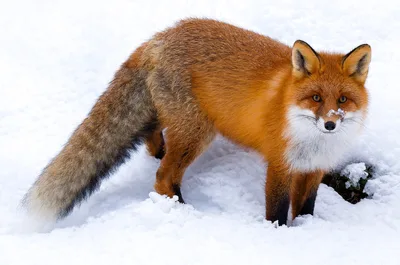
Related species on this site
Angora Ferret (same genus), Black-Footed Ferret (same genus), Cinnamon Ferret (same genus), Ferret (same genus), Least weasel (same genus), Sable Ferret (same genus), and more.
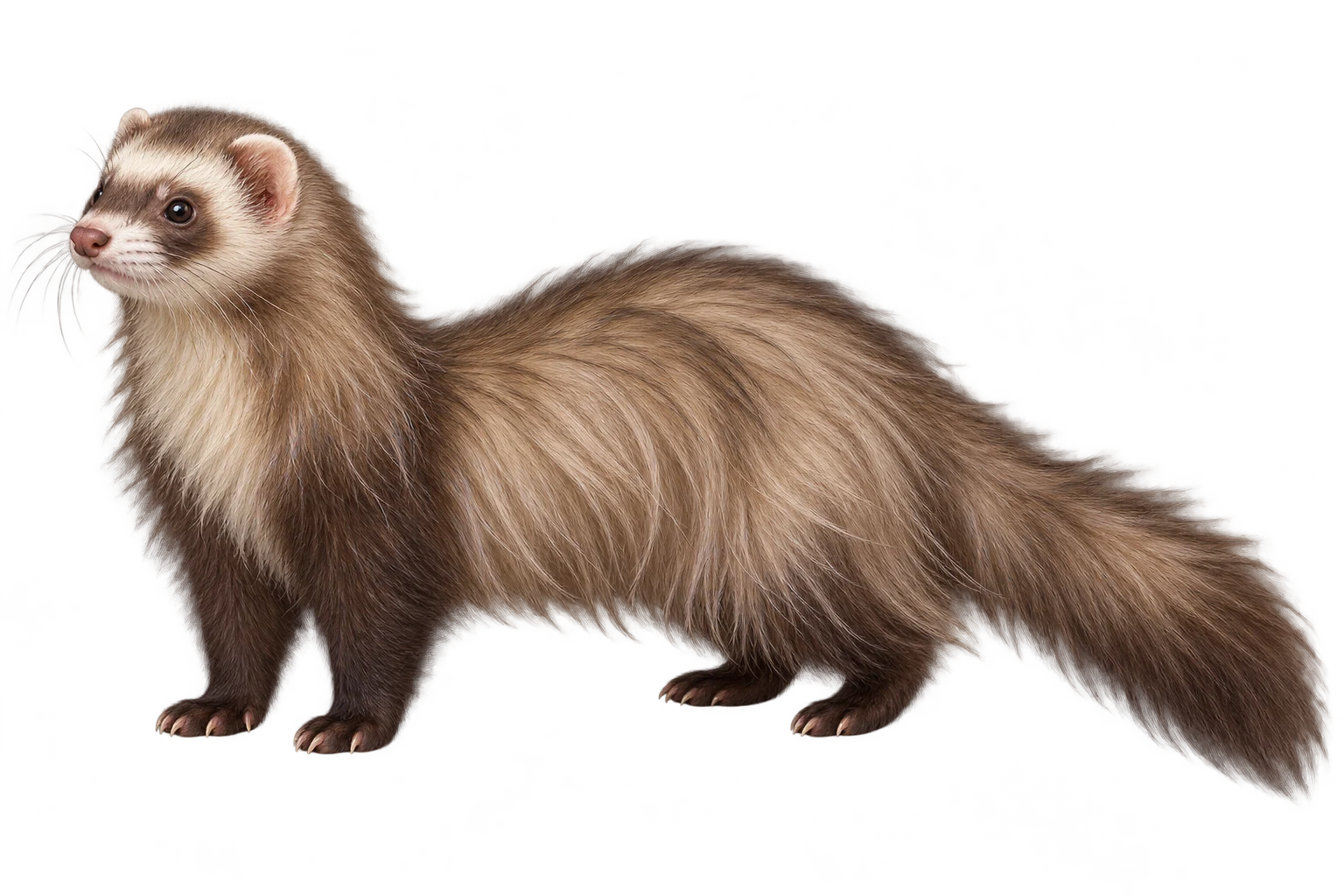
Mammals
Angora Ferret
Mustela putorius furo
Classification and source reference
LivingAI illustration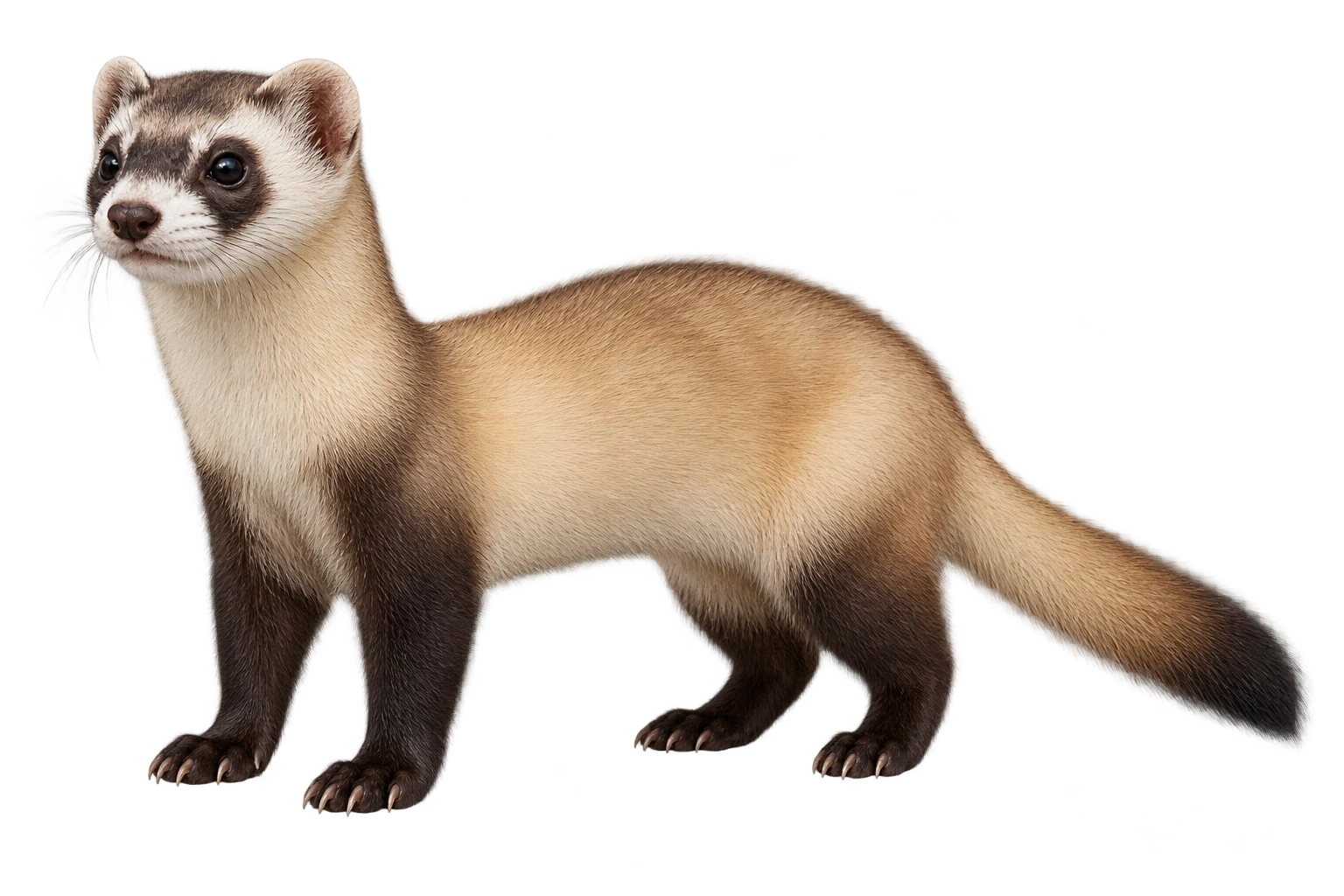
Mammals
Black-Footed Ferret
Mustela nigripes
Classification and source reference
LivingAI illustration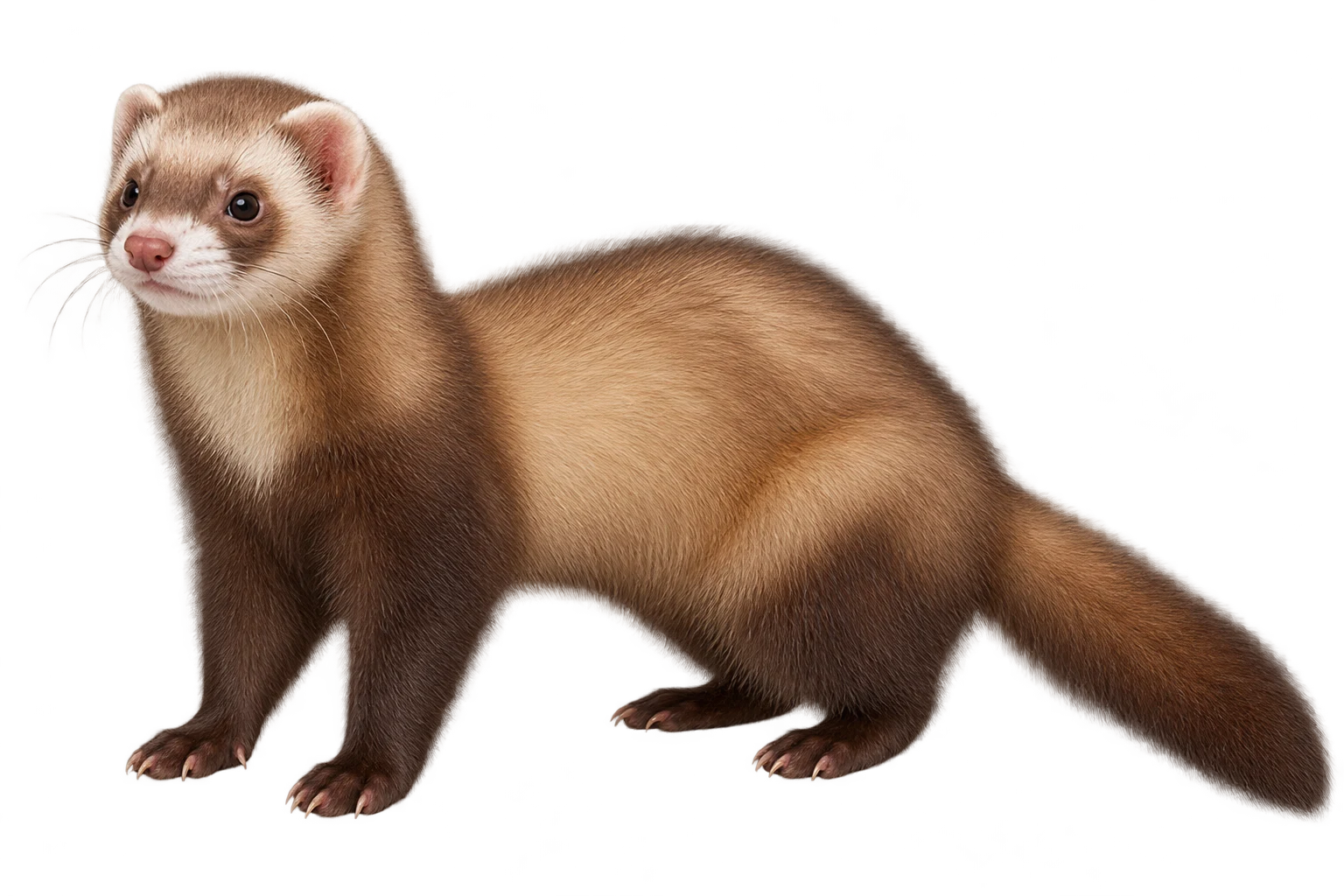
Mammals
Cinnamon Ferret
Mustela putorius furo
Classification and source reference
LivingAI illustration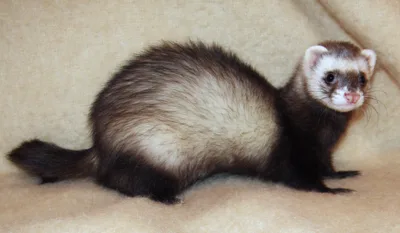
Mammals
Ferret
Mustela putorius furo
The domestic ferret is a slender carnivorous mammal kept by people.
Living LC
Mammals
Least weasel
Mustela nivalis
The least weasel is the smallest carnivore in the world, a tube-shaped hunter that follows voles and mice down their own tunnels.
Living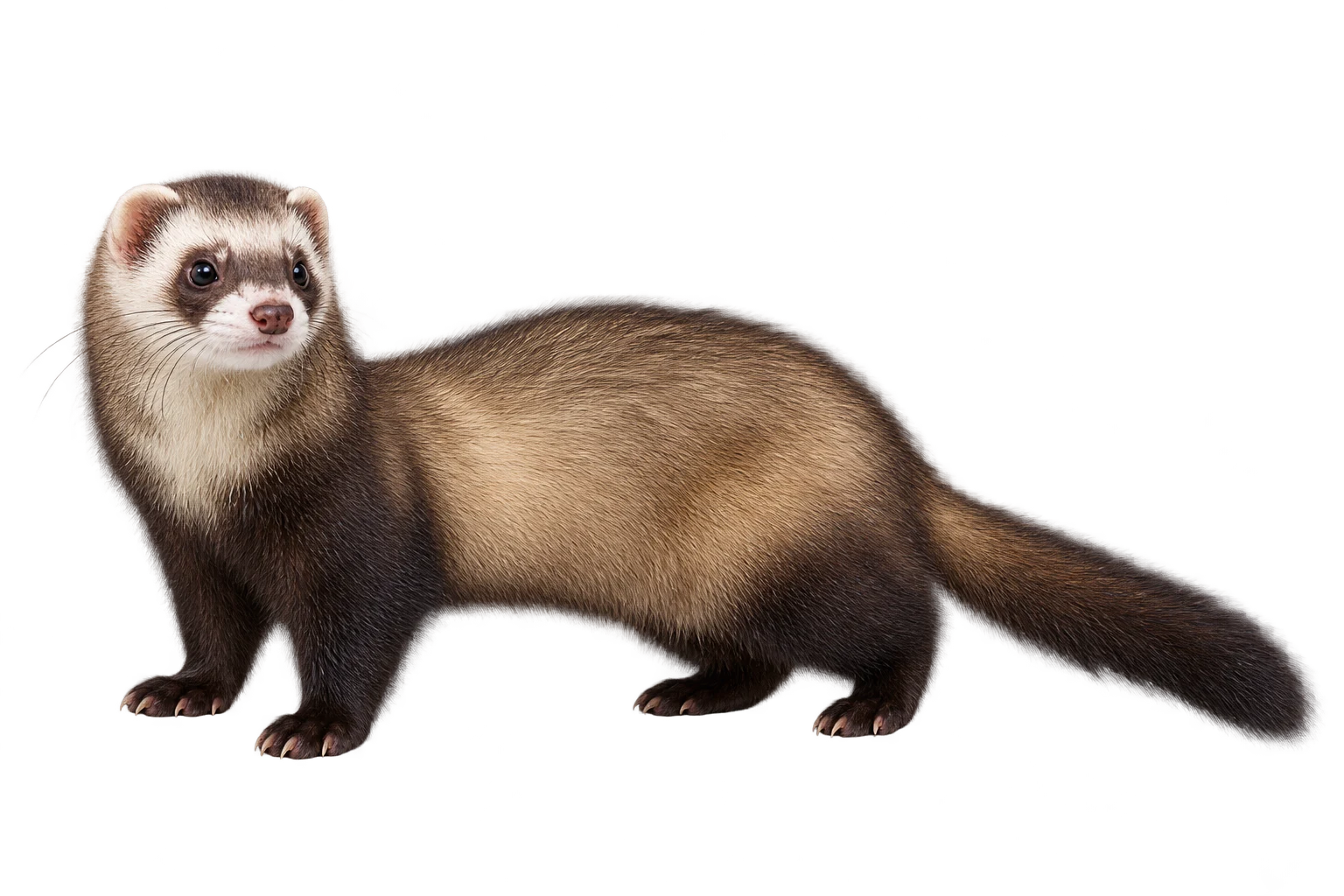
Mammals
Sable Ferret
Mustela putorius furo
Classification and source reference
LivingAI illustration