Ferret
Mustela putorius furo
Living individuals or members of this group exist today. This does not mean they are safe from extinction.
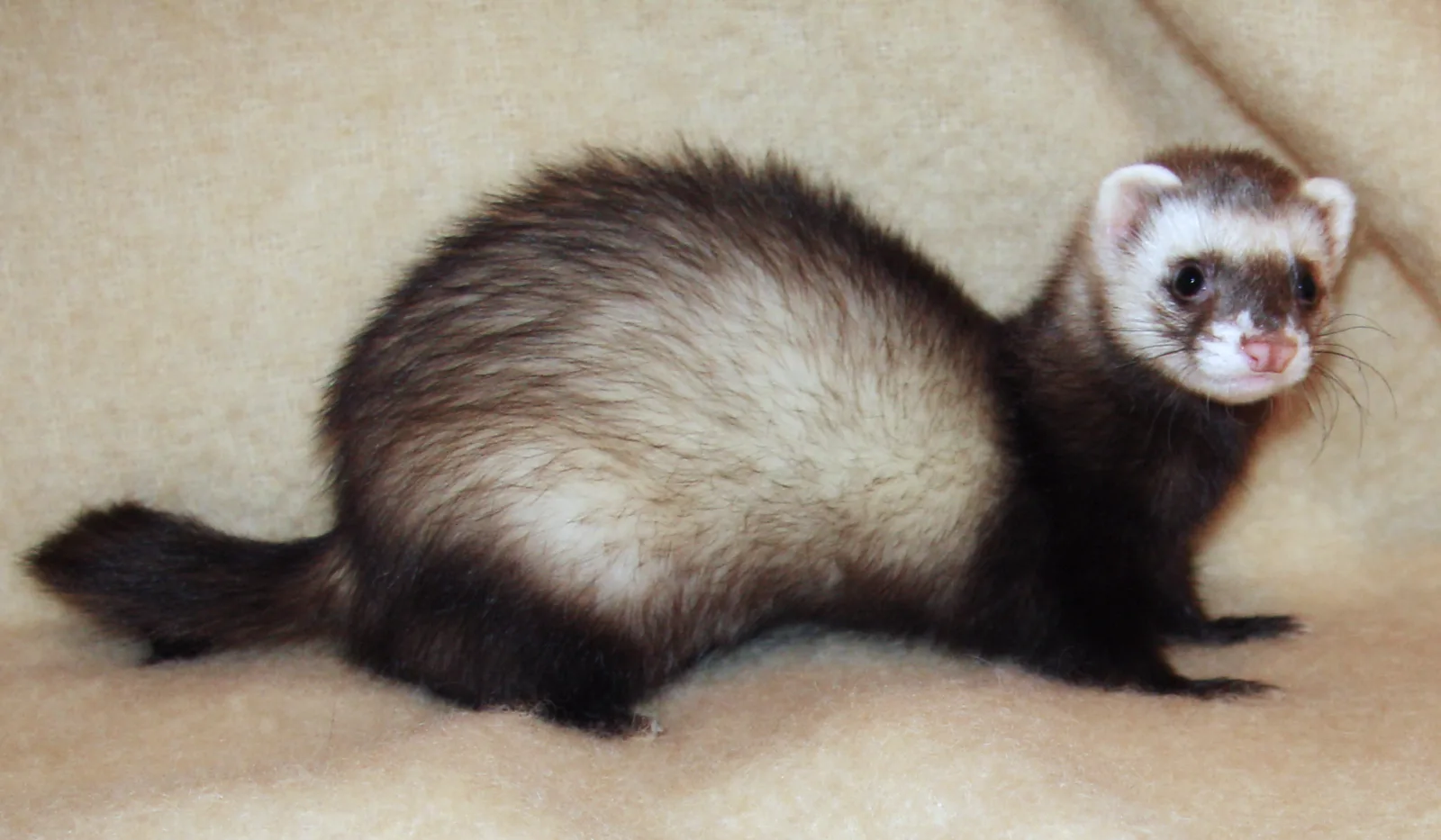
The domestic ferret is a slender carnivorous mammal kept by people. It is related to the European polecat and is distinct from the black-footed ferret.
At a glance
- Location
- Domestic ferrets occur in human households and working settings around the world. Their distribution reflects domestication, rather than a single natural wild range.
- Habitat
- Towns and cities
- Diet
- Carnivore
- Food
- Animal-based food supplies the nutrients required by this carnivore.
Classification
- Common name
- Ferret
- Browse group
- Mammals
- Scientific name or taxon
- Mustela putorius furo
- Taxon rank
- subspecies
- Order
- Carnivora
- Family
- Mustelidae
- Genus
- Mustela
- Source classification
- Mammalia
Taxonomy checked against GBIF. For breeds and hybrids, this describes the listed parent taxon.
Three things to know
- Its body is long and flexible.
- It is naturally inquisitive.
- It often has activity peaks around twilight.
Habitat and range
Domestic ferrets occur in human households and working settings around the world. Their distribution reflects domestication, rather than a single natural wild range.
Appearance and adaptations
Short limbs and an elongated trunk help a ferret move through narrow spaces. Males are generally larger than females, and domestic coat patterns vary.
Diet and behaviour
Animal-based food supplies the nutrients required by this carnivore. Ferrets investigate tunnels and hidden spaces and can be playful with companions. Resting periods occupy much of the day, and activity can adjust to household routines.
Sources
- Animal Diversity Web: Mustela putorius furo
- A–Z Animals: Ferret · Directory entry
Explore mammals
Browse all mammalsMammals
Cat
Felis catus
The domestic cat is a small carnivore with a flexible body and retractile claws.
Living LC
Mammals
Brown rat
Rattus norvegicus
The brown rat is a large, burrowing rodent that lives wherever people live.
LivingMammals
Dog
Canis lupus familiaris
The domestic dog is a social canid whose breeds vary greatly in size and appearance.
Living
Mammals
Guinea pig
Cavia
Guinea pigs are social rodents kept by people.
Living

