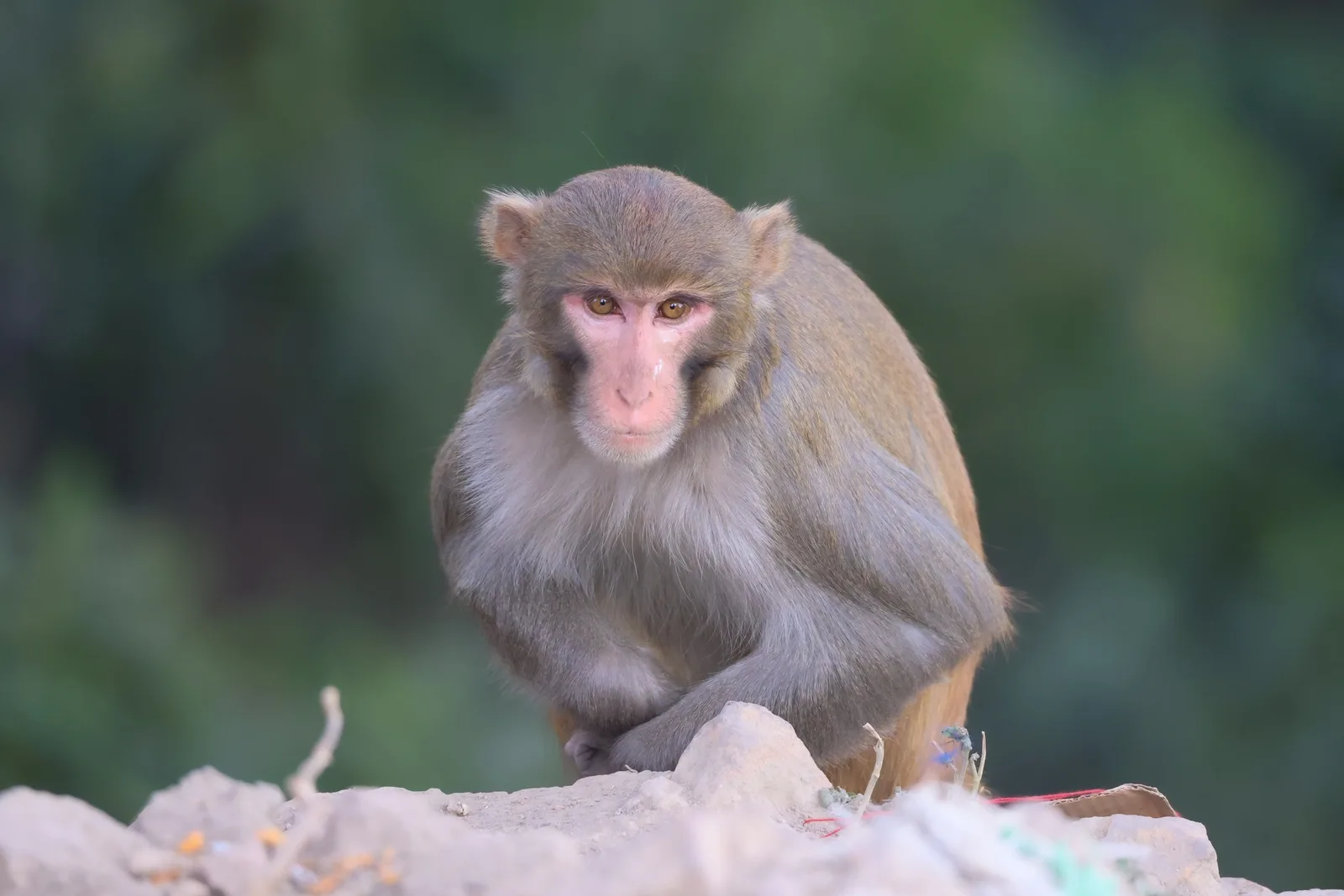
Rhesus macaque
The temple monkey that taught medicine about blood
Macaca mulatta
Also called Rhesus monkey
Living individuals or members of this group exist today. This does not mean they are safe from extinction.
Meet the rhesus macaque
The rhesus macaque is a brown monkey with a pink face that lives in large, rank-ordered troops across South and East Asia. It thrives in cities and temples as well as forests, and it is the most studied primate in medical science.
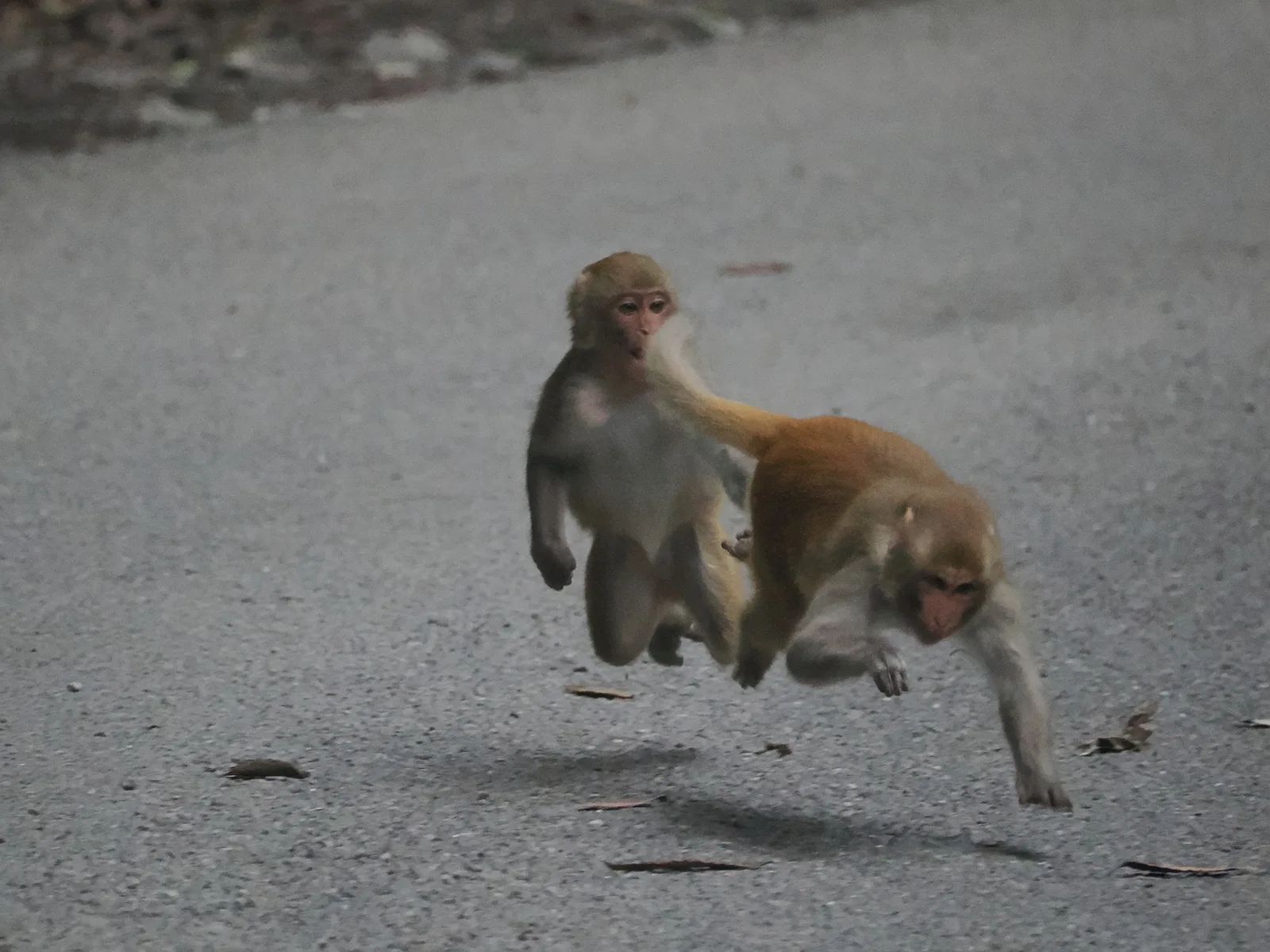
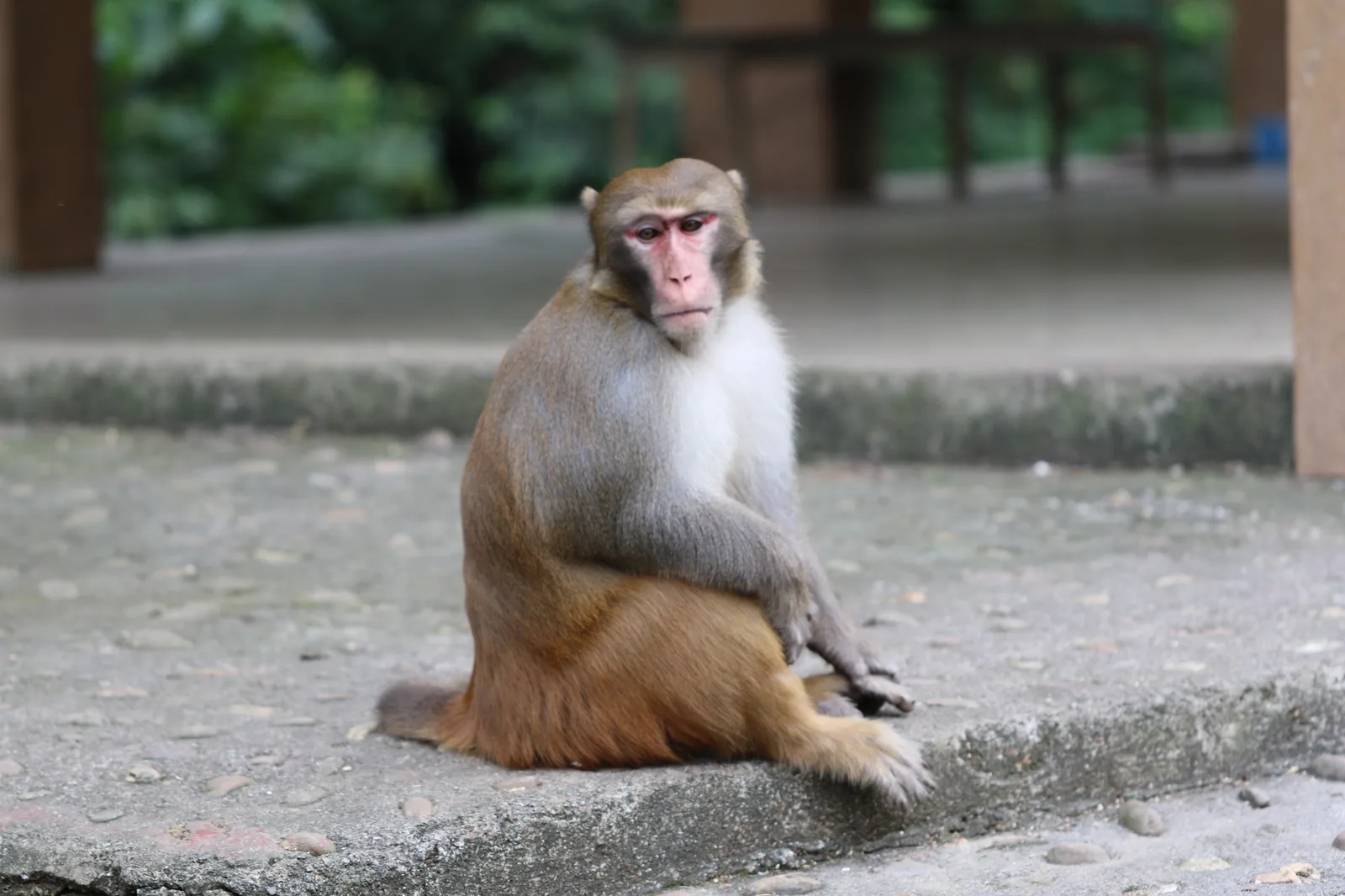
Images of the rhesus macaque
Lifespan in the wild
Up to 30 years
Weight
5.3 to 7.7 kg
Length
45 to 64 cm
Fact file
Rhesus macaque
- Location
- Afghanistan to southern China, Vietnam and Thailand
- Habitat
- Temperate forest, Grassland, Mountains, Towns and cities
- Diet
- Omnivore
- Prey / food
- Fruit, seeds, roots, bark, cereal crops, insects, eggs, human food
- Predators
- Large cats, raptors, snakes; sharks in estuaries
- Lifestyle
- Diurnal; on the ground and in trees
- Group name
- Troop
- Name of young
- Infant
- Gestation
- About 165 days
- Litter size
- 1 infant
- Population
- Large and stable; not counted across the range
- Biggest threat
- None to the species; conflict with farmers and city dwellers
- Distinctive feature
- Bare pink face and red rump on a grizzled brown coat
- Colour
- Brown or grey, paler below, pink face
- Skin type
- Fur
Size
Next to a person
Measurements
Size and speed
- Length
- 45 to 64 cm head and body
- Length, male
- About 53 cm head and body
- Length, female
- About 47 cm head and body
- Tail
- 19 to 32 cm
- Weight
- 5.3 to 7.7 kg average female to average male
- Weight, male
- 6.5 to 12 kg
- Weight, female
- About 5.5 kg
Typical adult ranges. Sources: Wikipedia, Animal Diversity Web.
Life cycle
Lifespan
- In the wildUp to 30 years
- In captivityUp to 40 years
- 040 years
The pale bar is the record. Sources: Animal Diversity Web, AnAge.
Appearance
Colour and coat
- Primary colours
- browngrey
- Secondary colours
- pinkred
- Skin type
- fur
- Male and female
- Moderate. Males are larger, about 53 centimetres and 7.7 kilograms against 47 cm and 5.3 kg for a female. Both sexes have the pink face.
Life cycle
Mating and family
- Mating system
- promiscuous, multi-male and multi-female troops
- Social structure
- troops of 20 to 200 built on ranked lines of related females
- Breeding
- one infant a year in good conditions
Troops in cold regions mate in autumn and give birth in spring. Pregnancy lasts about 165 days and produces one infant of 400 to 500 grams. The infant suckles for about a year and rides on its mother's back. Females mature at 2.5 to 3 years and males at 4.5 to 7 years. A wild macaque can live about 30 years, and a captive one reached 40.
Classification
Taxonomy
- Kingdom
- Animalia
- Phylum
- Chordata
- Class
- Mammalia
- Order
- Primates
- Family
- Cercopithecidae
- Genus
- Macaca
- Species
- Macaca mulatta
Conservation
Red List status
- LC
- NT
- VU
- EN
- CR
- EW
- EX
Least Concern on the IUCN Red List
Range
Recorded in 10 countries
- Bangladesh
- People's Republic of China
- Hong Kong
- India
- Myanmar
- Nepal
- Pakistan
- Thailand
- United States of America
- Vietnam
Habitat layer: temperate broadleaf and mixed forest, temperate conifer forest, boreal forest and taiga, tropical grassland, savanna and shrubland, temperate grassland, savanna and shrubland, montane grassland and shrubland.
Countries from 6,792 wild records on GBIF (iNaturalist research grade), filtered and checked by hand. Country shapes: Natural Earth. Habitat: RESOLVE Ecoregions 2017, CC BY 4.0. Basemap: Natural Earth.
Habitats
Three things to know
- 1
A mother's youngest daughter outranks all her older sisters.
- 2
Humans and rhesus macaques share about 93% of their DNA.
- 3
A rhesus macaque, Albert II, was the first primate in space, in 1949.
Did you know
Seven more facts
- 1
Cheek pouches let the monkey carry food away from a raid to eat in safety.
- 2
Sharks in the Ganges estuary catch macaques that swim across at low tide.
- 3
A troop that grows to 80 to 100 animals tends to split.
- 4
In northern Pakistan the monkeys live on pine needles and oak leaves through the snow.
- 5
Tetra, born in 1999, was the first cloned primate.
- 6
A Florida colony began in 1938 when a boat-tour operator released monkeys that promptly swam away.
- 7
GBIF holds records of the species from 30 countries.
Field notes
How it looks and acts
Field notes
Distinguishing features
- A bare pink face, red in adults.
- A grizzled brown or grey coat with a paler belly.
- A red rump.
- A tail of 19 to 32 centimetres, shorter than the body.
- Cheek pouches that bulge with stored food.
- A stocky build with arms a little shorter than the legs.
Field notes
Unique adaptations
- A varied diet lets it live from desert to snow line.
- Cheek pouches store food for a quick getaway.
- Strong swimming carries it across rivers.
- A tolerance of people lets it feed on handouts and rubbish in cities.
- A rich set of faces and calls keeps order in a big troop.
Field notes
Interesting behaviours
- Forages by day on the ground and in trees.
- Grooms troop mates for much of the day.
- Raids fields, gardens and houses for food.
- Presents the rump or bares the teeth to a higher-ranking animal.
- Licks dew from leaves when water is scarce.
Field notes
Temperament
- Bold and curious around people.
- Despotic within the troop, with little tolerance for lower ranks.
- Loud and active.
- Peaceful between neighbouring troops, which avoid each other.
Field notes
Communication
- A silent bared-teeth face signals submission.
- An open-mouth stare with a raised tail is a threat.
- Coos and grunts keep the troop in touch on the move.
- A shrill bark warns of danger.
- Warbles and chirps announce good food.
Ecology
Ecological role
The rhesus macaque is a common mid-sized omnivore that spreads seeds and feeds predators across South Asia.
- Fruit eating probably makes it an important seed disperser.
- It is prey for large carnivores, raptors and snakes, and for sharks in estuaries.
- It grooms langurs and sambar deer, removing parasites.
- Where introduced, as in Florida and Puerto Rico, it damages crops and native habitat.
Stories
Myths and legends
- In Hindu tradition, the monkey stands for Hanuman, the loyal warrior of the Ramayana.
- In Nepalese tradition, the monkeys of Swayambhunath guard the sacred hill.
- In Tibetan tradition, a monkey and a rock ogress were the parents of the first people.
- In Indian folk tales, the monkey is a trickster who makes off with sweets.
People
Relationship with humans
People
Living alongside us
No animal has done more for medicine than the rhesus macaque. It gave its name to the Rh blood factor and helped produce vaccines for polio, rabies and smallpox. In South Asia it lives beside people as a temple monkey, a crop raider and a city scavenger. Hindus treat it as sacred, so it is fed more often than it is harmed. Introduced colonies in Florida and Puerto Rico are now counted as invasive.
- Macaques bite and scratch people during house raids and at temples.
- The herpes B virus they carry killed a laboratory researcher in 1997.
- In 2018 a monkey in Odisha carried a baby from a house, and the child died.
People
Status, uses and products
- Domestication
- Wild
- As a pet
- Not suitable. A rhesus macaque needs a troop, bites when frightened and may carry herpes B virus, which can kill a person. Many countries ban private ownership of primates.
- Uses
- medical researchzoo exhibitiontemple animal
- Products
- None recorded
The full account
About the rhesus macaque
The rhesus macaque, Macaca mulatta, is a brown or grey monkey with a bare pink face. It belongs to the Old World monkeys and has the widest natural range of any primate apart from humans. Wild troops live from Afghanistan through India and Nepal to southern China, Vietnam and Thailand. A troop holds 20 to 200 animals, and related females form its stable core.
An adult measures 45 to 64 centimetres in head and body and weighs about 5.3 to 7.7 kilograms. It eats fruit above all, plus seeds, roots, bark, insects and whatever people leave in bins. Rhesus macaques thrive in cities, temples and farmland, and they raid crops across South Asia. Science knows this monkey better than any other primate, from the Rh blood factor to the polio vaccine. The IUCN lists it as Least Concern.
Name and taxonomy
The naturalist Eberhard Zimmermann first described the species in 1780. The name rhesus recalls a Thracian king in the Iliad, but Jean-Baptiste Audebert, who chose it, said it had no meaning. Most people simply call the animal the rhesus monkey. The genus Macaca holds the other macaques, such as the bonnet macaque of southern India. The family is Cercopithecidae, the Old World monkeys, in the order Primates.
Zoologists recognise six to nine subspecies in two groups, one from India and one from China. The Indian form carries the name Macaca mulatta mulatta. Several Chinese forms were described between 1867 and 1917. Genetic differences between populations are small, so the subspecies are not firmly settled.
Evolution and relatives
Humans and rhesus macaques share about 93% of their DNA and a common ancestor about 25 million years ago. The macaque genome was sequenced in 2007, the second non-human primate genome after the chimpanzee. Scientists compare the three genomes to work out which gene changes belong to the human line. The species has 21 pairs of chromosomes.
Fossil teeth and jaw fragments from caves near Zhoukoudian show that the species lived in northern China in the Pleistocene. Fossils from near Pyongyang in North Korea belong to the same species. Its closest relatives are the other macaques, and in southern India its range now touches that of the bonnet macaque.
Appearance
The coat is brown or grey, with a grizzled look on the back and a paler belly. The face is bare and pink, and in adults the face and the rump turn red. The hair on the head is short. The body has a wide rib cage and, on average, 50 vertebrae. The arms are a little shorter than the legs. Cheek pouches let the monkey stuff food away to eat later.
Head and body length is 45 to 64 centimetres, and the tail adds 19 to 32 cm. A typical male measures about 53 cm and weighs about 7.7 kilograms, and a typical female is about 47 cm and 5.3 kg. A large male can reach 12 kg. A newborn weighs 400 to 500 grams. On the ground the monkey walks on all fours, on the toes of the hind feet and the flat of the hands.
Habitat and range
The native range runs from eastern Afghanistan and Pakistan through India, Nepal, Bhutan and Bangladesh to Myanmar, Thailand, Vietnam and southern China. No other non-human primate covers so much ground. The species lives in grassland, dry scrub, woodland and forest, and in the Himalayas up to about 2,500 metres. It copes with desert heat and with winters well below freezing. Populations in southern China and Tibet fell sharply in the twentieth century.
Rhesus macaques move readily from the countryside into towns, where they live on handouts and rubbish. Troops in human landscapes grow larger than troops in forest. Small groups live in the crowded cities of northern India, and a troop that is moved out tends to seek another settlement. The monkey is a strong swimmer and crosses rivers with ease.
Introduced colonies live in Florida, on Morgan Island in South Carolina and on Cayo Santiago off Puerto Rico. The Florida colony began in 1938, when a boat-tour operator released monkeys near Silver Springs. He did not know that they could swim, so they left his island at once. Florida held an estimated 550 to 600 macaques in 2020. GBIF holds records from 30 countries, many of them from zoos and laboratories.
Diet and feeding
Fruit is the main food, and it also supplies much of the water in the monsoon. The monkey also eats seeds, roots, buds, bark and cereal crops. One estimate counts 99 plant species from 46 families in its diet. Animal food includes termites, grasshoppers, ants, beetles, spiders, crabs, honeycomb and birds' eggs. City troops eat human food and pick through rubbish.
In the mountains of northern Pakistan, the monkeys eat clover in summer. When snow covers the ground, they switch to pine needles and oak leaves, lose weight, and survive. Far from rivers they lick dew from leaves and drink rain from holes in trees. Cheek pouches hold food during a quick raid on a field or a bin. The animal forages through the day and drinks at streams.
Behaviour and social life
The species is active by day and moves both in trees and on the ground. A troop holds 20 to 200 monkeys, and females can outnumber males by four to one. Females stay in the troop where they were born, and each inherits her rank from her mother. Oddly, a mother's youngest daughter outranks her older sisters. Males leave the natal troop at four to five years, and an adult male earns his rank through age and experience.
The troop has a centre and an edge. The two or three oldest males sit at the centre with the top females and their young, and they decide where the troop goes. Lower-ranking males lead groups on the edge, and the youngest males at the rim raise the alarm. Rhesus society is despotic: high-ranking animals show little patience with those below them. Even so, females of one troop rarely fight, and fights between troops are rare.
Troops are not territorial, and the ranges of neighbours overlap. When two troops meet, the weaker one moves off. A troop that grows to 80 to 100 animals may split, when a set of females leaves to found a new one. Grooming fills much of the day, and the monkeys have been seen grooming langurs and even sambar deer. In one filmed case in Kanpur, a monkey revived a companion knocked out by a power line.
Communication and senses
Rhesus macaques talk with the face, the voice, the body and the hands. A lower-ranking monkey bares its teeth in silence to a superior, or grimaces and screams to turn aside an attack. It may also raise the tail and present its rump. A dominant animal threatens with a silent open-mouth stare and a stiff, raised tail.
Coos and grunts pass between troop mates on the move and before grooming. A warble or a chirp announces a rare, rich food. A single shrill bark warns of danger. Screeches, growls and pant-threats mark a fight. An infant geckers to call its mother. Like other monkeys, the species probably relies more on sight than on smell.
Reproduction and life cycle
Troops that face cold winters mate in autumn, so that births come in spring. Where the seasons are mild, mating is spread through the year. The female cycle lasts about 29 days, and she is receptive for 8 to 11 days of it. She presents her hindquarters to a male, and the skin around the tail reddens. Both sexes mate with many partners, and females prefer strangers from outside the troop.
Pregnancy lasts about 165 days, and almost every birth is a single infant. The infant weighs 400 to 500 grams and clings to its mother's belly, then rides on her back. It suckles for about a year. A female can give birth every year when food is good. Females mature at 2.5 to 3 years and usually give birth first at about four, and males mature at 4.5 to 7 years. Females reach menopause at about 25 years.
Mothers do nearly all the care, and a male does not know which infants are his. In captivity a lone male will raise an unrelated infant if no female is present. The species can live about 30 years in the wild, and one captive animal reached 40.
Predators and threats
Large cats, eagles and snakes probably take rhesus macaques, but predation is little studied. Sharks in the Ganges estuary catch monkeys that swim across at low tide. On Cayo Santiago there are no predators at all. Infants at the edge of a troop risk infanticide by males from outside.
The species as a whole faces no threat, but forest loss and farming push troops into villages. Himachal Pradesh in India allowed legal culling in 2010. Released pets of other macaque species breed into wild troops and dilute the gene pool. The population in Thailand is under local pressure.
Population and conservation
The IUCN lists the rhesus macaque as Least Concern, and it exists in large numbers. It tolerates almost any habitat, including city streets. Its range in southeast India has grown by about 3,500 square kilometres, partly because troops from towns were moved there. That spread threatens the bonnet macaque, which is native to the south. Despite the mountain of research on its behaviour, few studies count wild populations.
In practice, management now means keeping monkeys and people apart. Guards with dogs, slingshots and firecrackers drive troops from fields. Farmers plant buffer crops that monkeys do not like along the forest edge. Cities plant fruit trees in parks on the outskirts to keep troops out of homes. Translocation and contraception offer non-lethal alternatives to culling.
Relationship with humans
The rhesus macaque is the classic laboratory monkey. It gave its name to the Rh blood factor, found by Karl Landsteiner and Alexander Wiener. Research on the species produced vaccines for rabies, smallpox and polio, and drugs against HIV. Harry Harlow used rhesus infants in his maternal deprivation experiments of the 1950s. Albert II became the first primate in space in 1949, and Able came back alive from a flight in 1959. Tetra, the first cloned primate, was born in 1999, and ANDi, the first transgenic primate, in 2001.
Around farms and towns the monkey is a pest. Crop raiding costs a Nepalese farming household about 4.2% of its yearly income. In Himachal Pradesh macaques cause a large share of all crop losses, and in cities they enter houses and bite people. In 2018 a monkey carried off a baby from a house in Odisha, and the child died. Macaques carry herpes B virus, which rarely infects people but can kill when it does. Hindus regard the monkey as sacred, so many people feed it and few harm it.
In culture and myth
In Hindu tradition the monkey recalls Hanuman, the vanara hero who serves Rama in the Ramayana. In the temple towns of northern India, feeding the monkeys earns merit, and the rhesus is the usual temple monkey. At Swayambhunath in Kathmandu, the so-called Monkey Temple, local stories say the monkeys came because the hill is holy. A Tibetan origin story tells how a monkey and a rock ogress became the parents of the first people. Folk tales also cast the monkey as a trickster who steals sweets.
In the West the name entered daily speech through the Rh factor, so rhesus appears on blood-group cards worldwide. The Florida colony has its own folklore: a false story links it to the Tarzan films shot at Silver Springs. One escapee, the Mystery Monkey of Tampa Bay, dodged capture for years and inspired a song. The Florida monkeys keep local supporters who oppose their removal.
A sentence with a dotted underline is inferred: it describes the group the animal belongs to, or is a reading of the sources, rather than a measured or reported fact about this species.
Questions
Rhesus macaque questions, answered
Where do rhesus macaques live?
They live across South, Central and Southeast Asia, from Afghanistan and Pakistan through India and Nepal to southern China, Vietnam and Thailand. Introduced colonies live in Florida and Puerto Rico.
How big is a rhesus macaque?
Head and body measure 45 to 64 centimetres, with a tail of 19 to 32 cm. Adults weigh about 5.3 to 7.7 kilograms, and a large male can reach 12 kg.
What do rhesus macaques eat?
Mostly fruit, plus seeds, roots, buds, bark and cereal crops. They also eat insects, spiders, crabs and eggs. City troops eat human food and rubbish.
Are rhesus macaques endangered?
No. The IUCN lists the species as Least Concern. It is common and spreads readily, though the Thai population is under local pressure.
Are rhesus macaques dangerous?
They bite and scratch during raids on houses and at temples. They also carry herpes B virus, which is rare in people but can be fatal. Keep food out of sight and do not feed them.
How long do rhesus macaques live?
A wild macaque lives up to about 30 years. The captive record is 40 years.
Why are rhesus macaques used in research?
They are easy to keep, widely available and close to humans in body and physiology. Research on them produced vaccines for polio, rabies and smallpox, and the Rh blood factor is named after them.
What is the Rh factor?
It is a protein on red blood cells that makes a blood group positive or negative. Karl Landsteiner and Alexander Wiener found it while working with rhesus monkey blood, so they named it after the monkey.
How do rhesus macaque troops work?
A troop holds 20 to 200 monkeys. Females stay for life and inherit rank from their mothers, while males leave at four to five years old. The oldest males sit at the centre and decide where the troop goes.
Do rhesus macaques swim?
Yes, they swim well and cross rivers. The Florida colony escaped its island by swimming, and sharks in the Ganges estuary catch monkeys in the water.
How many babies does a rhesus macaque have?
One infant at a time, after a pregnancy of about 165 days. A female can give birth every year when food is plentiful.
Why are there monkeys in Florida?
A boat-tour operator released rhesus macaques near Silver Springs in 1938 to draw tourists. The colony grew, and Florida held about 550 to 600 monkeys in 2020.
Was a rhesus macaque really sent into space?
Yes. Albert II flew on a V-2 rocket in 1949, the first primate in space, and died when the parachute failed. Able returned alive from a flight in 1959.
Are rhesus macaques sacred in India?
Many Hindus link monkeys to Hanuman, the hero of the Ramayana, and feed them at temples. That respect means little is done to stop them stealing crops.
What sounds do rhesus macaques make?
Coos and grunts between friends, a shrill bark for danger, warbles for good food, and screeches, growls and screams in a fight. Infants gecker to call their mothers.
Food web
Prey and food
- fruit
- seeds
- roots
- bark
- cereal crops
- insects
- eggs
- human food
Food web
Predators
- cats
- raptors
- snakes
- sharks in estuaries
Ecological equivalents
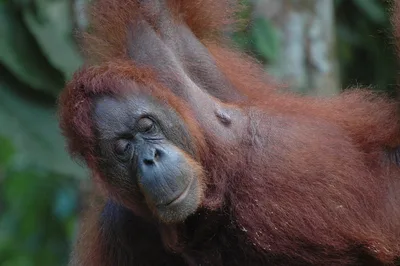
Related species on this site
Crab-Eating Macaque (same genus), Japanese macaque (same genus), Macaque (same genus), De Brazza's Monkey (same family), Douc (same family), Mandrill (same family), and more.
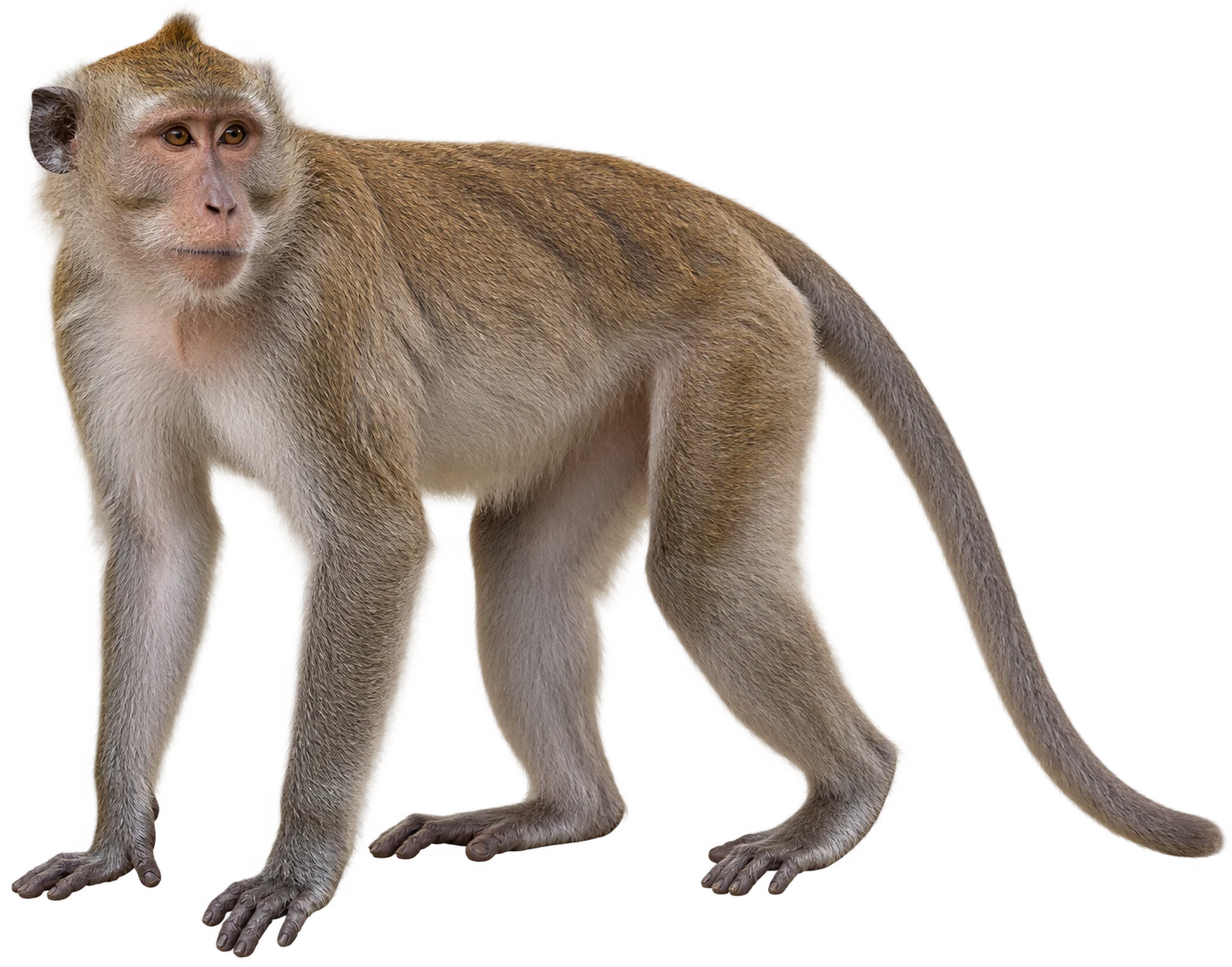
Mammals
Crab-Eating Macaque
Macaca fascicularis
Classification and source reference
LivingAI illustration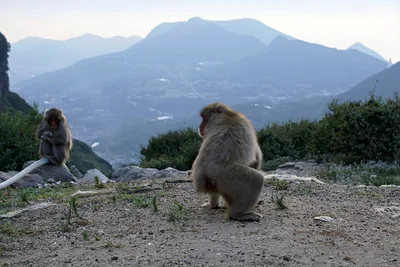 LC
Mammals
Japanese macaque
Macaca fuscata
The Japanese macaque, or snow monkey, is the only monkey native to Japan and the most northerly primate apart from people.
Living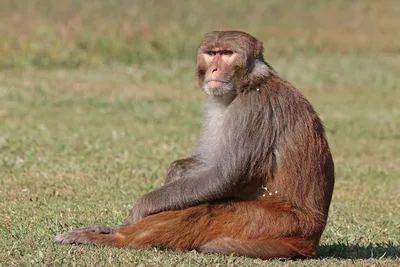
Mammals
Macaque
Macaca
Macaques are adaptable monkeys with many different species across Asia and beyond.
Living
Mammals
De Brazza's Monkey
Cercopithecus neglectus
Classification and source reference
LivingAI illustration
Mammals
Douc
Pygathrix
Classification and source reference
LivingAI illustration VU
Mammals
Mandrill
Mandrillus sphinx
The mandrill is the largest monkey and one of the most colourful mammals, with a red and blue face and a rump to match.
Living