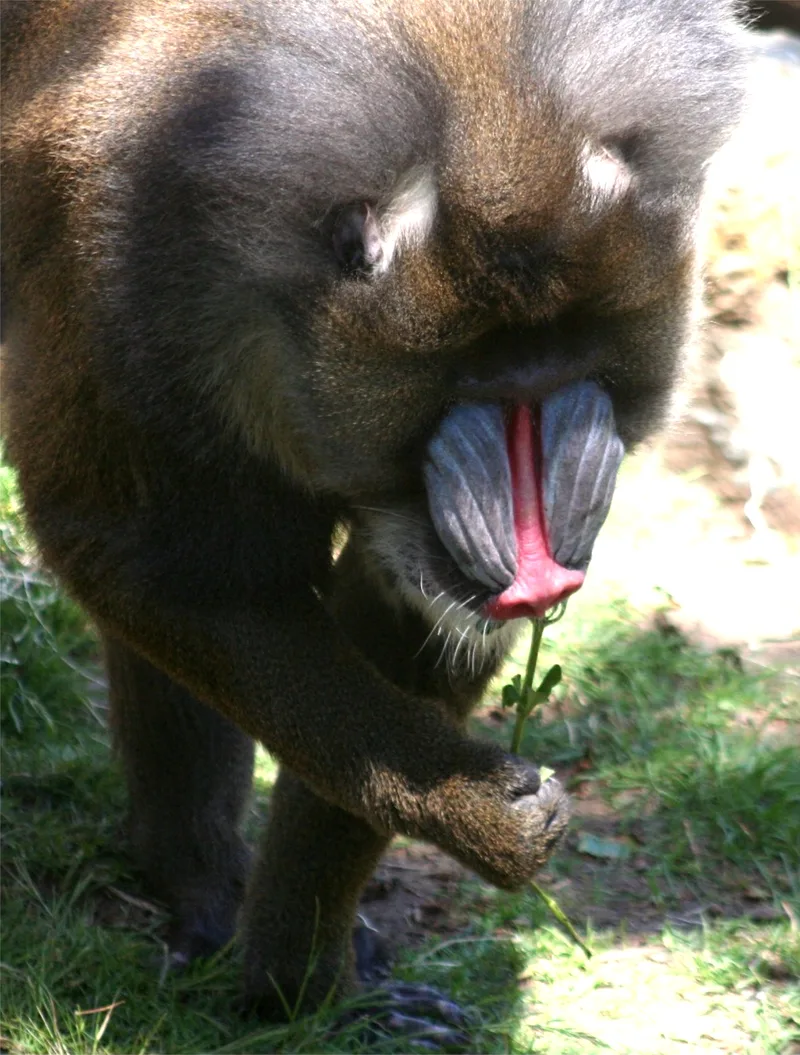
Mandrill
The biggest monkey wears the brightest face
Mandrillus sphinx
Also called Mandril
Living individuals or members of this group exist today. This does not mean they are safe from extinction.
Meet the mandrill
The mandrill is the largest monkey and one of the most colourful mammals, with a red and blue face and a rump to match. It lives on the floor of the Central African rainforest in hordes that can number hundreds.
Images of the mandrill
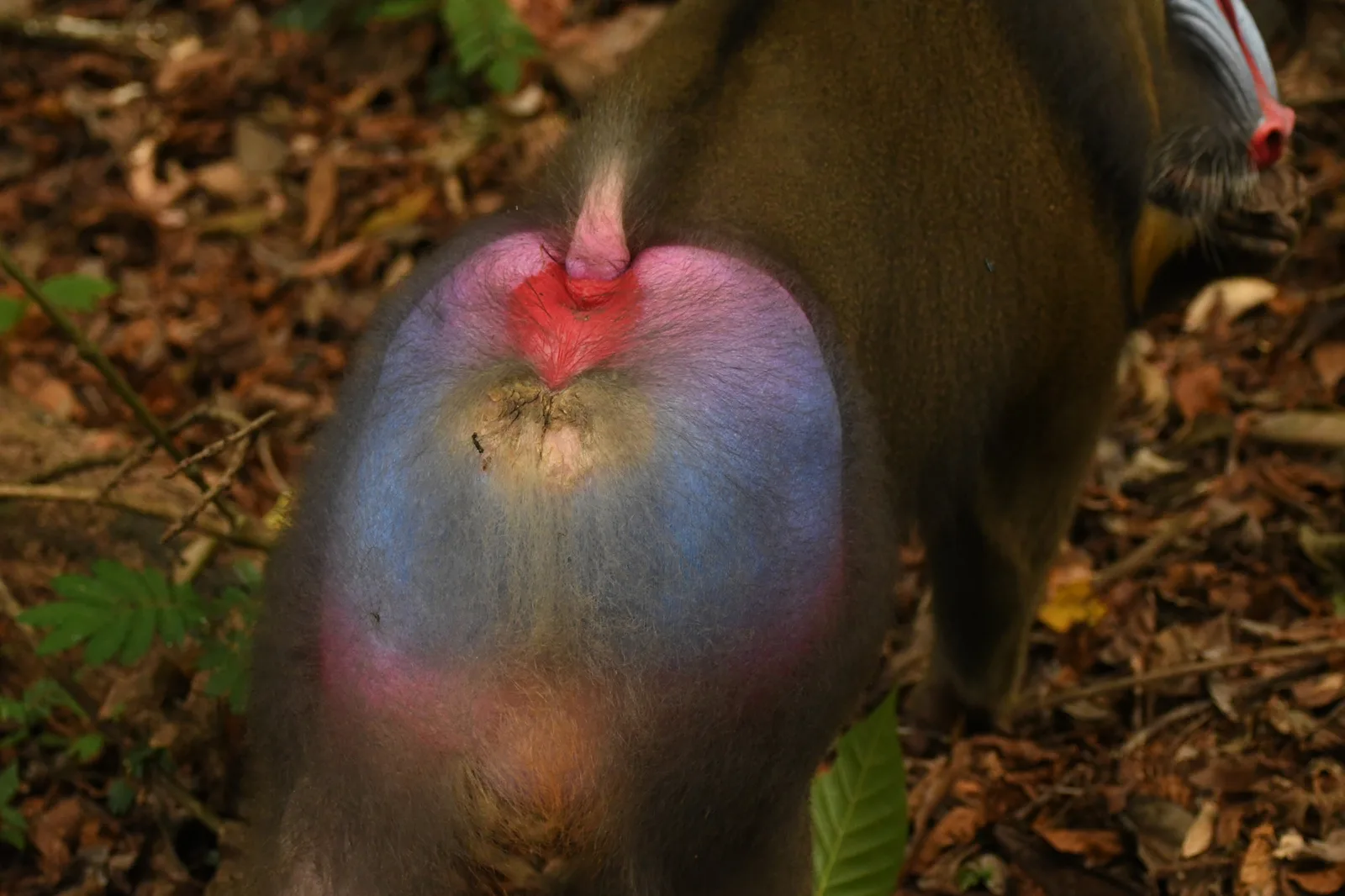
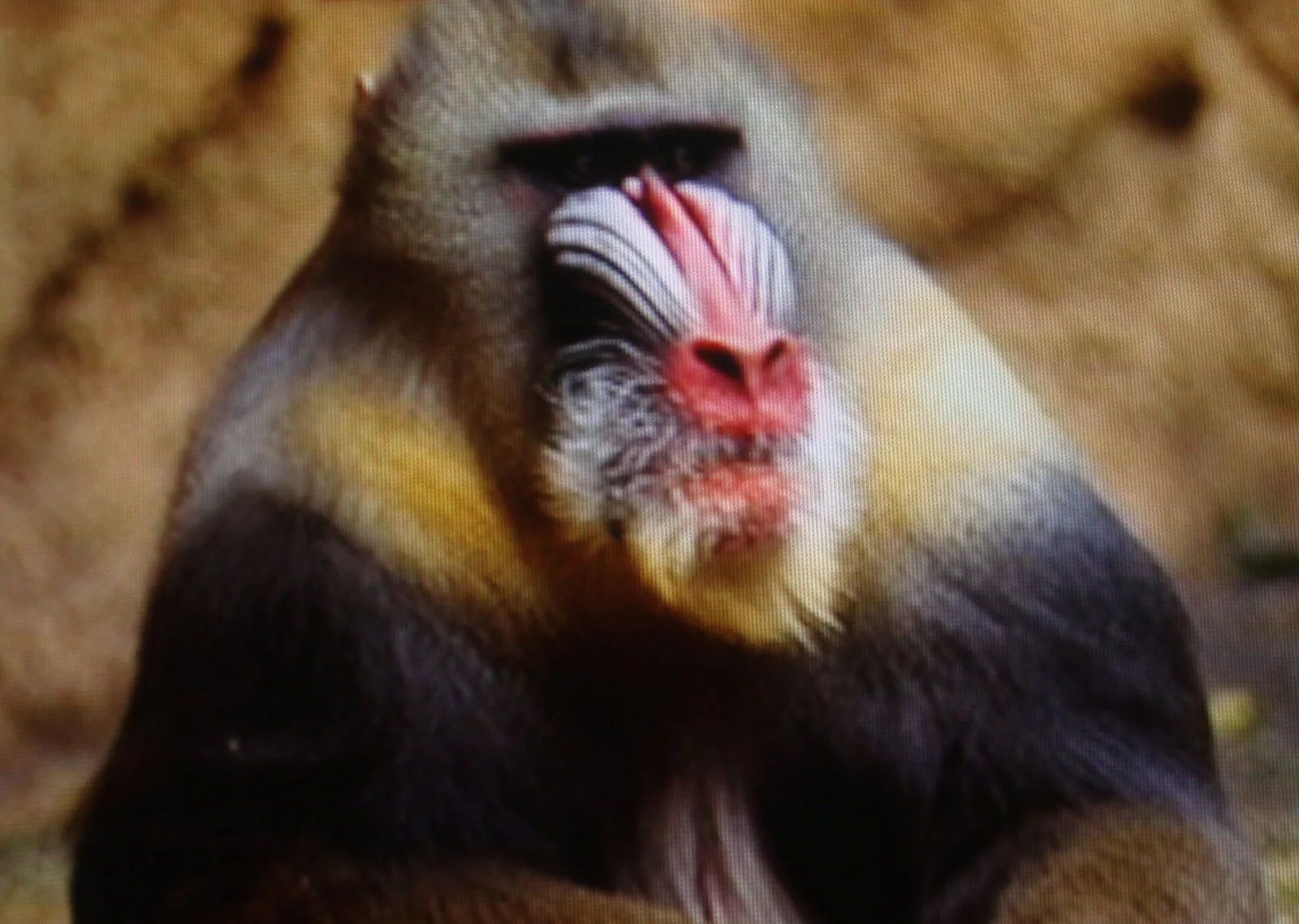
Lifespan in the wild
12 to 14 years
Weight
10 to 30 kg
Length
55 to 95 cm
Height
About 80 cm
Fact file
Mandrill
- Location
- Gabon, southern Cameroon, Equatorial Guinea, Republic of the Congo
- Habitat
- Rainforest, Temperate forest, Savanna
- Diet
- Omnivore
- Prey / food
- Fruit, seeds, leaves, ants, termites, snails, frogs, rodents, young duiker
- Predators
- Leopard, crowned eagle, African rock python, chimpanzee
- Lifestyle
- Diurnal, on the ground in large groups
- Group name
- Horde
- Name of young
- Infant
- Gestation
- About 175 days
- Litter size
- 1 infant
- Population
- Unknown; suspected to have fallen by more than 30 percent in 24 years
- Biggest threat
- Bushmeat hunting and forest loss
- Distinctive feature
- Blue ridged muzzle with a red stripe, and a red and blue rump
- Colour
- Olive brown coat, yellow beard, red and blue face
- Skin type
- Fur
Size
Next to a person
Measurements
Size and speed
- Height
- About 80 cm
- Length
- 55 to 95 cm head and body; females 55 to 70 cm, males 70 to 95 cm
- Length, male
- 70 to 95 cm
- Length, female
- 55 to 70 cm
- Tail
- 7 to 10 cm
- Weight
- 10 to 30 kg females 10 to 15 kg, males 19 to 30 kg; ADW records a male of 54 kg
- Weight, male
- 19 to 30 kg
- Weight, female
- 10 to 15 kg
Typical adult ranges. Sources: Wikipedia, Animal Diversity Web.
Life cycle
Lifespan
- In the wild12 to 14 years
- In captivity30 to 40 years AnAge verifies a female alive at 40
- 040 years
Source: Wikipedia.
Appearance
Colour and coat
- Primary colours
- olive brown
- Secondary colours
- blueredyellow
- Skin type
- fur
- Male and female
- Extreme, the greatest of any primate. Males are 70 to 95 centimetres long and weigh 19 to 30 kilograms, against 55 to 70 cm and 10 to 15 kg for females. Males have far longer canines, a hair crest and much brighter red and blue skin.
Life cycle
Mating and family
- Mating system
- polygynous; dominant males guard receptive females
- Social structure
- hordes of hundreds built on related females; adult males solitary
- Breeding
- one infant about every 405 days, mostly born January to March
Females come into season in the dry season, from June to September, and dominant males guard them. Pregnancy averages 175 days, and one infant of about 640 grams is born in the wet season. The mother carries it on her belly and weans it at about 230 days. Females first give birth between four and eight years, and males leave the horde after six. Wild animals live about 12 to 14 years, and captive ones 30 to 40.
Classification
Taxonomy
- Kingdom
- Animalia
- Phylum
- Chordata
- Class
- Mammalia
- Order
- Primates
- Family
- Cercopithecidae
- Genus
- Mandrillus
- Species
- Mandrillus sphinx
Conservation
Red List status
- LC
- NT
- VU
- EN
- CR
- EW
- EX
Vulnerable on the IUCN Red List
Range
Recorded in 3 countries
Habitat layer: tropical moist broadleaf forest, temperate broadleaf and mixed forest, temperate conifer forest, boreal forest and taiga, tropical grassland, savanna and shrubland.
Countries from 124 wild records on GBIF (iNaturalist research grade), filtered and checked by hand. Country shapes: Natural Earth. Habitat: RESOLVE Ecoregions 2017, CC BY 4.0. Basemap: Natural Earth.
Habitats
Three things to know
- 1
Hordes at Lopé National Park in Gabon average 620 animals, and one reached 845, the largest cohesive primate groups known.
- 2
Charles Darwin judged the adult male mandrill the most extraordinarily coloured mammal of all.
- 3
A male's face turns redder and his flanks fatter when he becomes the dominant animal, and both fade if he loses his rank.
Did you know
Seven more facts
- 1
A male's canine teeth reach 4.5 centimetres.
- 2
Its tail measures just 7 to 10 cm.
- 3
At Lopé the diet is half fruit and a quarter seeds.
- 4
Mandrills have killed and eaten young duikers.
- 5
Adult males live alone outside the breeding season.
- 6
It picks a new sleeping tree almost every night.
- 7
Gessner drew it as a hyena in the 1550s.
Field notes
How it looks and acts
Field notes
Distinguishing features
- A blue, grooved muzzle with a red stripe down the middle and a red nose.
- A red, pink, blue and violet rump, brightest in males.
- A yellow-orange beard and white lip whiskers.
- A stocky body, with males 70 to 95 centimetres long and females 55 to 70 cm.
- A stubby tail held upright.
- A crest of long hair on the male's head and neck.
Field notes
Unique adaptations
- Bright facial colour that signals rank and fertility in the gloom of the forest floor.
- Long canines and strong jaws that crack hard seeds and settle disputes.
- Cheek pouches for carrying food.
- Chest glands whose scent reports sex, age and rank.
- Long fingers, toes and an opposable big toe for climbing to sleep and feed.
Field notes
Interesting behaviours
- It forages on the ground by day and sleeps in a tree at night.
- Hordes of hundreds travel together and split only briefly.
- Males mark trees with chest-gland scent.
- A dominant male guards a fertile female for days.
- A frightened horde climbs trees for a leopard and hides for an eagle.
Field notes
Temperament
- Social and rank-conscious, and disputes are settled by display more than by fighting.
- Bold: the dominant male stands his ground before a leopard.
- Curious and light-fingered in zoos.
- Probably wary of people in the wild, where it is hunted.
Field notes
Communication
- An open-mouthed stare with head bobbing is a threat.
- Bared teeth and lip smacking are friendly or submissive.
- Grunts and roars keep a moving horde in touch.
- A k-alarm call warns of danger, and a scream means fear.
- Chest-gland scent on trees tells others who passed.
Ecology
Ecological role
The mandrill is a large seed and fruit eater of the Central African forest floor and an occasional predator.
- It spreads the seeds of the fruits it eats across large home ranges.
- It destroys hard seeds that few other animals can open.
- It preys on insects, snails, frogs, rodents and young duikers.
- It is prey for leopards and crowned eagles.
Stories
Myths and legends
- In Disney's The Lion King, the mandrill Rafiki is the shaman of Pride Rock.
- In sixteenth-century European natural history, Gessner classed the mandrill as a hyena.
- In Victorian science, Darwin held it up as the most extraordinarily coloured of all mammals.
- In Chinese naming tradition, the mandrill carries the name of a mountain spirit, the shanxiao, probably for its face.
People
Relationship with humans
People
Living alongside us
People hunt the mandrill for bushmeat across its range, and its loud calls make it easy to find. Logging and farming have cleared much of its forest. It raids oil palms and crops when food is short. In zoos it is a long-lived favourite and a skilled thief of visitors' glasses. CITES bans trade in wild-caught animals.
- A male has canines up to 4.5 centimetres and can inflict a serious bite if cornered.
- Wild mandrills seem to avoid people, and the sources record no attack.
- They can carry viruses, including SIV and a human astrovirus, so handling carcasses carries risk.
People
Status, uses and products
- Domestication
- Wild
- As a pet
- Not suitable. It is a 30 kilogram monkey with long canines, a need for a horde and a CITES Appendix I listing. It cannot be kept legally or humanely as a pet.
- Uses
- bushmeatzoo displaymedical research
- Products
- meat
The full account
About the mandrill
The mandrill, Mandrillus sphinx, is the largest monkey in the world and one of the most colourful mammals. An adult male carries a blue ridged muzzle split by a red stripe, a yellow beard and a rump of red, pink, blue and violet. Males measure 70 to 95 centimetres and weigh 19 to 30 kilograms, females 55 to 70 cm and 10 to 15 kg. No other primate differs so much between the sexes.
It lives on the floor of the rainforests of Gabon, southern Cameroon, Equatorial Guinea and Congo. Females and young travel in hordes of hundreds, the largest stable groups of any wild primate. Adult males live alone and join the horde only when females are ready to mate. The mandrill was long called a baboon, but its closest relatives are the drill and the mangabeys. The IUCN lists it as Vulnerable, because bushmeat hunters and loggers have cut its numbers.
Name and taxonomy
The word mandrill joins man to drill, a West African word for a baboon or ape, and dates from 1744. It seems to have referred first to chimpanzees. Buffon was the first scholar to attach it to this monkey, in 1766. Thomas Pennant called it the tufted ape, the great baboon and the ribbernosed baboon in the 1770s and 1780s. Conrad Gessner pictured it in the 1550s and took it for a kind of hyena.
Linnaeus named it Simia sphinx in 1758, and Ferdinand Ritgen created the genus Mandrillus in 1824. For much of the twentieth century it sat in the baboon genus Papio. Genetic work then showed a closer tie to the white-eyelid mangabeys, Cercocebus. Two studies in 2011 settled Mandrillus and Cercocebus as sister lineages. Authors have proposed northern and southern subspecies, but the consensus is a single one, M. s. sphinx. A third subspecies from Bioko Island rested on a mistake: no mandrills live there.
Evolution and relatives
The mandrill's only congener is the drill, Mandrillus leucophaeus, which has a black face. The two split about 3.17 million years ago. Their line parted from the mangabeys about 4.5 million years ago. No fossil of the genus has ever been found. The Sanaga River keeps the mandrill and the drill apart today.
Within the species, the animals on each side of the Ogooué River separated about 800,000 years ago. They carry different lineages of the simian immunodeficiency virus, which split with them. A draft genome appeared in 2020 at 2.90 billion base pairs. The baboon-like face and body are thought to be convergent, shaped by the same life on the ground.
Appearance
The mandrill is stocky, with a big head, a long muzzle and a stubby tail held upright. Males reach 70 to 95 centimetres in head and body, and females 55 to 70 cm. Males weigh 19 to 30 kilograms and females 10 to 15 kg. ADW records a male of 54 kg and gives a standing height of about 80 cm. The tail is only 7 to 10 cm long. A male's canine teeth reach 4.5 cm, a female's about 1 cm.
The coat is grizzled olive brown, paler below, with a yellow-orange beard and white whiskers round the lips. A male wears a crest of long hair on the head and neck. A red stripe runs down the centre of the face into the red nose. On each side the skin is blue and grooved, and in males bony swellings hold up the ridges. A male's rump and genitals show red, pink, blue and purple, with a violet scrotum. Females are duller, and some have faces that are almost black.
The red comes from blood vessels close to the surface. The blue is structural: parallel collagen fibres scatter light, as in no pigment. The blue ridges stand out against both the red face and the green of the forest. Cheek pouches let the animal carry food away to eat later.
Habitat and range
The mandrill lives in west-central Africa, in southern Cameroon, mainland Equatorial Guinea, Gabon and part of Congo. The range ends at the Sanaga River in the north and at the Ogooué and Ivindo rivers in the east. Gabon holds the stronghold of the species. GBIF lists occurrence records from 23 countries, most of them zoo and museum specimens far outside this range.
It prefers primary rainforest but uses secondary forest, gallery forest in savanna and mountain forest. It crosses grassland between forest patches and visits farm fields. It likes thick bush of gingers and other perennial plants. It spends the day on the ground but feeds up to the canopy and sleeps in trees, choosing a new tree most nights. Talapoins, guenons, mangabeys, colobus monkeys, chimpanzees and gorillas share its forest.
Diet and feeding
The mandrill is an omnivore that eats more than a hundred plant species. At Lopé National Park the diet was 50.7% fruit, 26.0% seeds, 8.2% leaves, 6.8% pith, 2.7% flowers and 4.1% animal matter. It eats more seeds than most primates, and adult males can crack the hard shells of Detarium seeds. Favourite fruits include the cashew relative Pseudospondias and the coffee relative Nauclea. It also takes young shoots and the pith of gingers and arrowroots, and mushrooms.
Animal food is mostly ants, termites, crickets, spiders, snails and scorpions. It eats birds and their eggs, frogs and rodents. Mandrills have killed young bay duikers with a bite to the head, then torn off the hind legs and opened the belly. Animals sometimes hunt together and share the kill. In the wet season hordes forage in continuous forest, where fruit is rich, and in the dry season along gallery forest and savanna edges. Males forage mainly on the ground, while females and young search the middle levels of the trees.
Behaviour and social life
Mandrills are diurnal and active for about 10 hours a day. They live in hordes that can hold hundreds of animals and stay together rather than splitting and merging. At Lopé, hordes averaged 620 animals and one reached 845. One horde of 625 held 21 dominant males, 71 lesser males, 247 females, 200 juveniles and 86 infants. A horde of about 700 used a home range of 182 square kilometres. A group of 120 used 8.6 km2 and walked 2.42 km a day.
Females and their relatives form the core of the horde. Dominant females sit at the centre of the social network, and a mother's rank shapes the rank of her sons and daughters. Adult males are not permanent members. They join when females come into season and leave when the season ends, and no bachelor groups are known. High-ranking males stay near the centre of the horde, low-ranking ones at the edge, and female coalitions can drive a male out.
Both sexes rub their chest glands on trees, and dominant males mark most of all. The scent tells others the marker's sex, age and rank. Mandrills groom each other freely, and a subordinate grooms from behind to keep an escape route open. Captive mandrills use sticks to clean themselves, and a group at Colchester Zoo invented a face-covering gesture that asks not to be disturbed.
Communication and senses
The face is the mandrill's main signal. A threat is an open-mouthed stare, with the head bobbing, the hair raised and a hand slapping the ground. A subordinate answers with a bared-teeth grimace. Young and low-ranking females pout in a duck face to show anxiety. A relaxed open mouth invites play, and a male approaching a female grins and smacks his lips. Head and shoulder shaking invites grooming.
Adult males give two-phase grunts and roars during group moves, the equal of a baboon's wahoo bark. Other animals give crowing calls that last almost two seconds. A sharp repeated yak marks tension, a growl mild alarm, and a two-syllable k-alarm real danger. Screams signal fear, and a purring girney soothes or complains among females and young. Related animals sound alike, and unrelated animals that spend time together come to sound alike too. Males read a female's fertility by scent with the vomeronasal organ, using the flehmen grimace.
Reproduction and life cycle
The dominant male sires most of the young. When a male reaches the top, his testes grow, his face and rump redden, his chest gland runs and his flanks fatten. Biologists call such animals fatted males, and the changes reverse if he falls. Males with canines under 30 millimetres rarely father offspring. Rank is mostly settled by calls and faces, not fights.
Mating peaks in the dry season, with ovulation between June and September. A receptive female swells at the rear and lets the brightest males touch her. A dominant male guards a female for days, but he cannot hold every female when many come into season at once. Mating itself lasts no more than 60 seconds. Pregnancy averages 175 days, and most births fall between January and March in the wet season.
A newborn weighs about 640 grams and is almost bare, with a dark tuft on the head and spine. Mothers carry infants on the belly, and high-ranking mothers give birth more often, about every 405 days on average. Weaning comes at about 230 days. Females first give birth between four and eight years, and reach full size at seven. Males leave the horde after six and finish growing at ten. Wild mandrills live about 12 to 14 years, and captive animals 30 to 40.
Predators and threats
The leopard is the main predator, and mandrill remains turn up in leopard droppings. Crowned eagles take the young, and African rock pythons and chimpanzees may take others. When shown a model leopard, a horde climbs trees; shown a model eagle, it hides in cover. The dominant male does not run from either, and he paces and watches the leopard. Alarm calls come more often for leopards than for eagles.
Parasites include gut worms and protozoa, tumbu fly larvae under the skin, ticks from grassland, malaria and the eye worm Loa loa. Wild mandrills carry their own strain of SIV, and some have tested positive for enteroviruses and a human astrovirus. The gravest threat is people. Hunters kill mandrills for bushmeat, and their loud calls make them easy to find. Logging and farming have destroyed much of the forest in Equatorial Guinea and southern Cameroon.
Population and conservation
The IUCN listed the mandrill as Vulnerable in 2019. The total population is unknown, but it is suspected to have fallen by more than 30 percent over 24 years. Where hunting is heavy, in Cameroon and Equatorial Guinea, groups seem to have shrunk. The status of the Congolese population is unknown. Gabon, with few people and vast forest, is the best hope for the species.
CITES Appendix I bans commercial trade in wild-caught mandrills. The African Convention lists it in Class B, which protects it but allows killing under special permit. Each range country has at least one protected area with mandrills. Gabon has leased most of its forest to timber companies, but about 10 percent lies in national parks, 13 of them created in 2002. A semi-wild colony lives at the medical research centre in Franceville, Gabon.
Relationship with humans
In its range the mandrill is meat. Bushmeat hunting is commercial as well as local, and the species is a prized catch. Mandrills raid oil palm plantations and, when food is short, farm crops. Wild animals also share viruses with people, and a human astrovirus has been found in them.
Far from Africa the mandrill is a zoo star. It lives long in captivity, and one female was still alive at 40. Zoo mandrills steal glasses and pipes from visitors, and Zurich Zoo had to glaze its enclosure for insurance reasons. Research colonies, above all the one at Franceville, have probably taught science most of what it knows about mandrill rank, colour and scent.
In culture and myth
Europeans met the mandrill before they understood it. Gessner, in the sixteenth century, drew it as a hyena, and Pennant called it the ribbernosed baboon. Charles Darwin, in The Descent of Man, judged the adult male mandrill the most extraordinarily coloured mammal of all. Its Chinese name, shanxiao, is the name of a mountain spirit in Chinese folklore, which probably reflects its strange face.
In Western popular culture the best-known mandrill is Rafiki, the shaman of Disney's The Lion King. Rafiki lives in a baobab, advises the lions of Pride Rock and speaks with a West African accent. His name means friend in Swahili. The animators gave him a long baboon tail, which a real mandrill lacks, and many viewers still call him a baboon. This page found no recorded African myth about the mandrill, though the forest peoples of Gabon probably have their own stories.
A sentence with a dotted underline is inferred: it describes the group the animal belongs to, or is a reading of the sources, rather than a measured or reported fact about this species.
Questions
Mandrill questions, answered
Is a mandrill a baboon?
No. It was long placed with the baboons, but genetic studies show it is closer to the white-eyelid mangabeys. Its only close relative is the drill.
How big is a mandrill?
A male is 70 to 95 centimetres in head and body and weighs 19 to 30 kilograms. A female is 55 to 70 cm and 10 to 15 kg. It is the largest monkey.
Why is the mandrill's face so colourful?
The colours signal rank and fertility. Red comes from blood near the skin, and blue from collagen fibres that scatter light. The brightest males win the most mates.
What do mandrills eat?
Mostly fruit and seeds, plus leaves, pith, mushrooms, insects, snails, frogs, rodents and eggs. They have killed young duikers.
Where do mandrills live?
In the rainforests of Gabon, southern Cameroon, Equatorial Guinea and the Republic of the Congo, between the Sanaga and Ogooué rivers.
Are mandrills endangered?
The IUCN lists them as Vulnerable. Numbers are suspected to have fallen by more than 30 percent in 24 years because of bushmeat hunting and forest loss.
How many mandrills live in a group?
Hordes at Lopé National Park average 620 animals, and one reached 845. These are the largest stable groups of any wild primate.
Are mandrills dangerous?
A male's canines reach 4.5 centimetres, so a cornered animal can bite badly. In the wild they avoid people and are hunted rather than hunting.
How long do mandrills live?
About 12 to 14 years in the wild and 30 to 40 in captivity. One captive female was still alive at 40.
Do mandrills climb trees?
Yes. They feed on the ground by day, but they climb to feed in the canopy and sleep in a tree every night.
What is the difference between a mandrill and a drill?
They are sister species in the same genus. The drill has a black face, while the mandrill has a red and blue one. The Sanaga River separates them.
Is Rafiki a mandrill?
Yes. Disney describes Rafiki in The Lion King as a mandrill, though the artists gave him a long baboon tail that a real mandrill lacks.
How do mandrills communicate?
With faces, calls and scent. A stare and head bob is a threat, bared teeth are friendly, and grunts and roars keep a horde together. Chest glands mark trees.
How many babies does a mandrill have?
One at a time, after about 175 days, and usually about every 405 days. Twins have been seen only in captivity.
Why do male mandrills look so different from females?
No primate shows a bigger gap between the sexes. Males are twice as heavy, with long canines, a hair crest and bright colours, because dominant males win most matings.
Food web
Prey and food
- fruit
- seeds
- leaves
- ants
- termites
- snails
- frogs
- rodents
- duiker
Food web
Predators
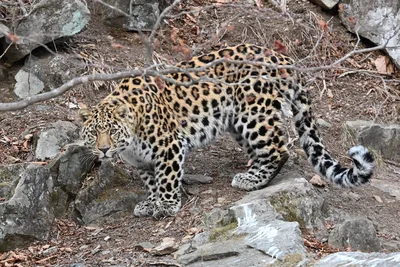 Leopard
- crowned eagle
- african rock python
- chimpanzee
Ecological equivalents
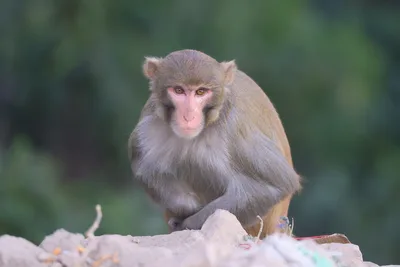
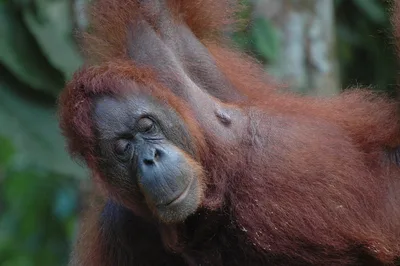
Related species on this site
Crab-Eating Macaque (same family), De Brazza's Monkey (same family), Douc (same family), Japanese macaque (same family), Macaque (same family), Olive Baboon (same family), and more.
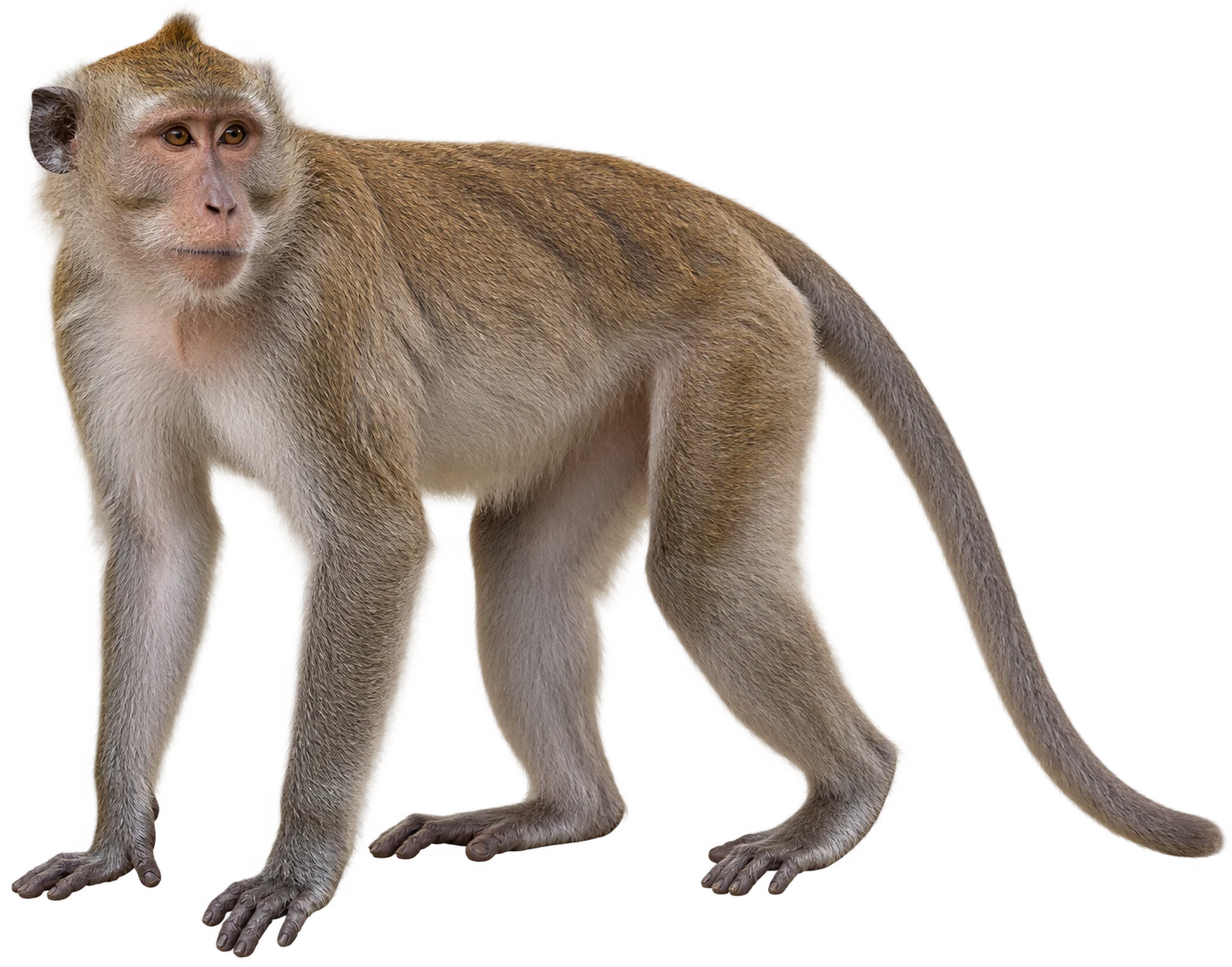
Mammals
Crab-Eating Macaque
Macaca fascicularis
Classification and source reference
LivingAI illustration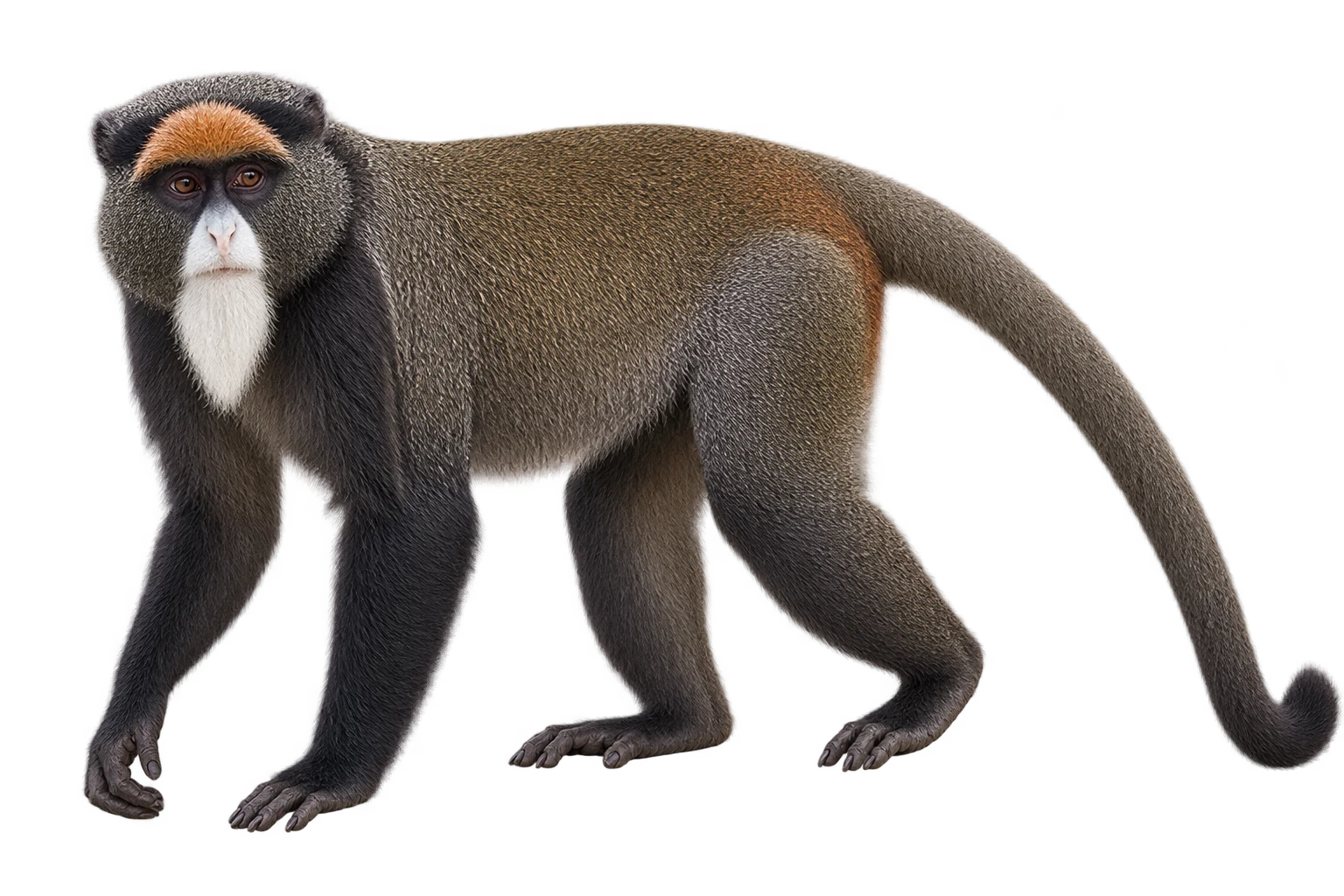
Mammals
De Brazza's Monkey
Cercopithecus neglectus
Classification and source reference
LivingAI illustration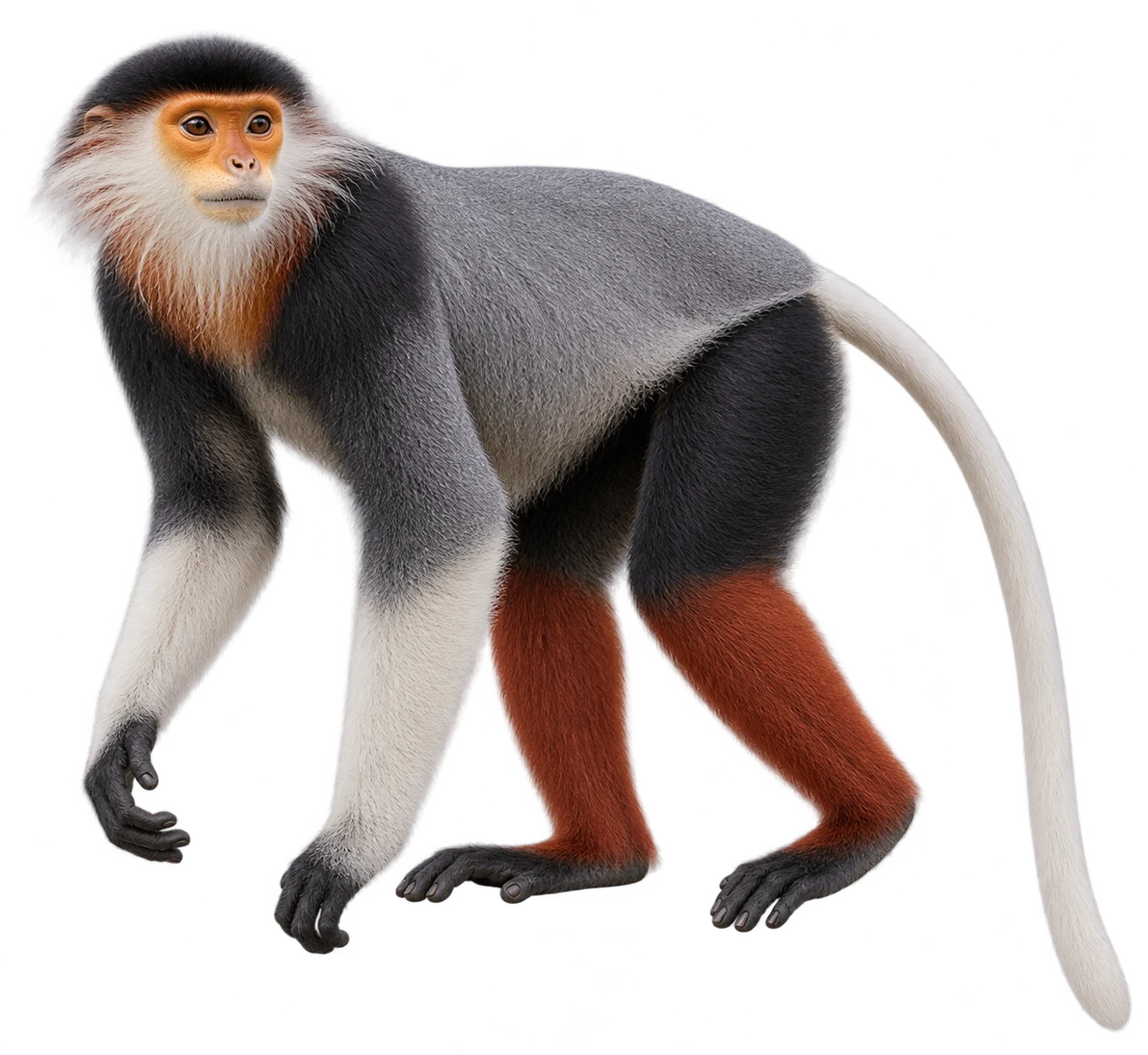
Mammals
Douc
Pygathrix
Classification and source reference
LivingAI illustration LC
Mammals
Japanese macaque
Macaca fuscata
The Japanese macaque, or snow monkey, is the only monkey native to Japan and the most northerly primate apart from people.
Living
Mammals
Macaque
Macaca
Macaques are adaptable monkeys with many different species across Asia and beyond.
Living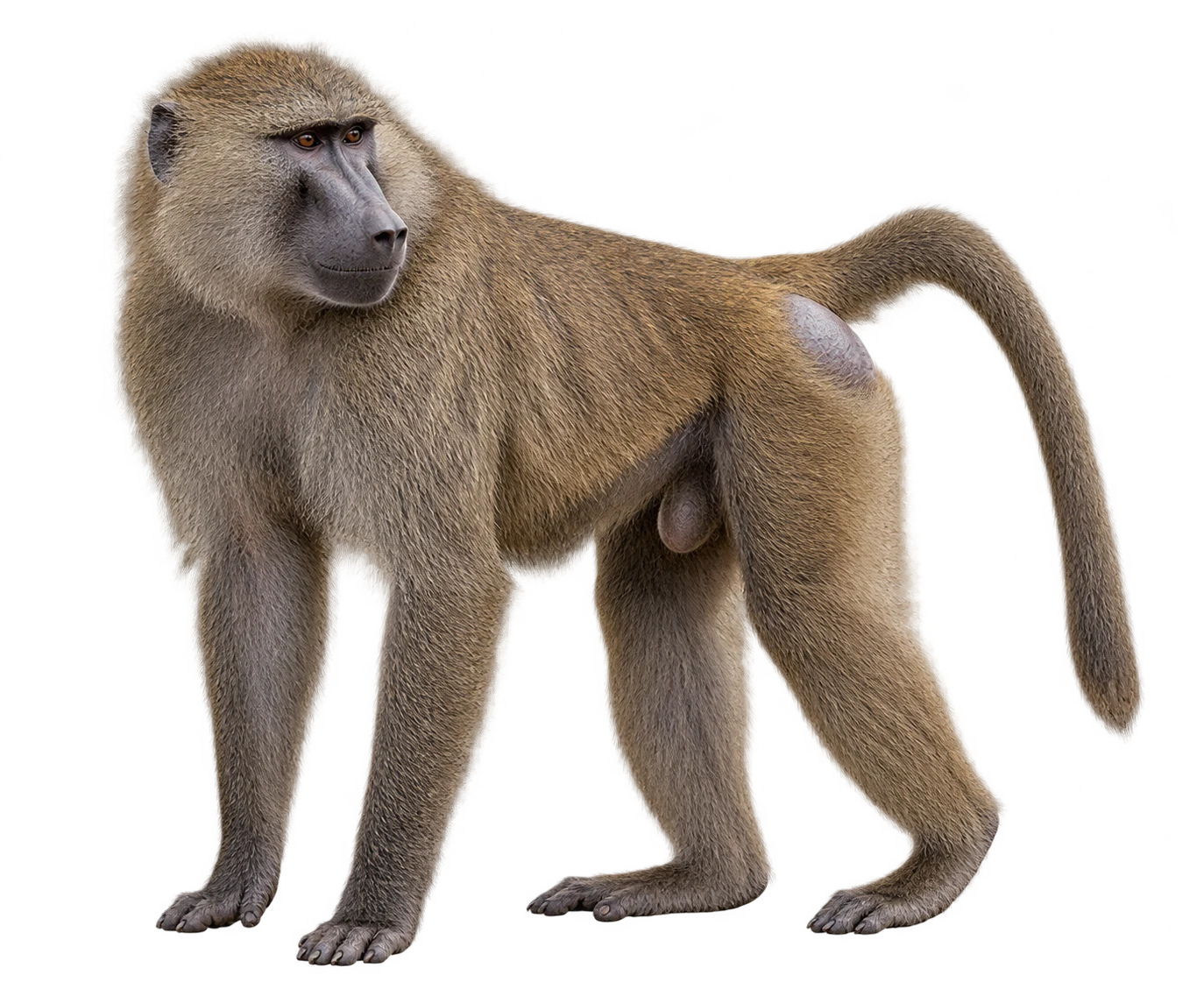
Mammals
Olive Baboon
Papio anubis
Classification and source reference
LivingAI illustration