Red-eyed tree frog
The green frog that opens red eyes to startle a snake
Agalychnis callidryas
Living individuals or members of this group exist today. This does not mean they are safe from extinction.
Meet the red-eyed tree frog
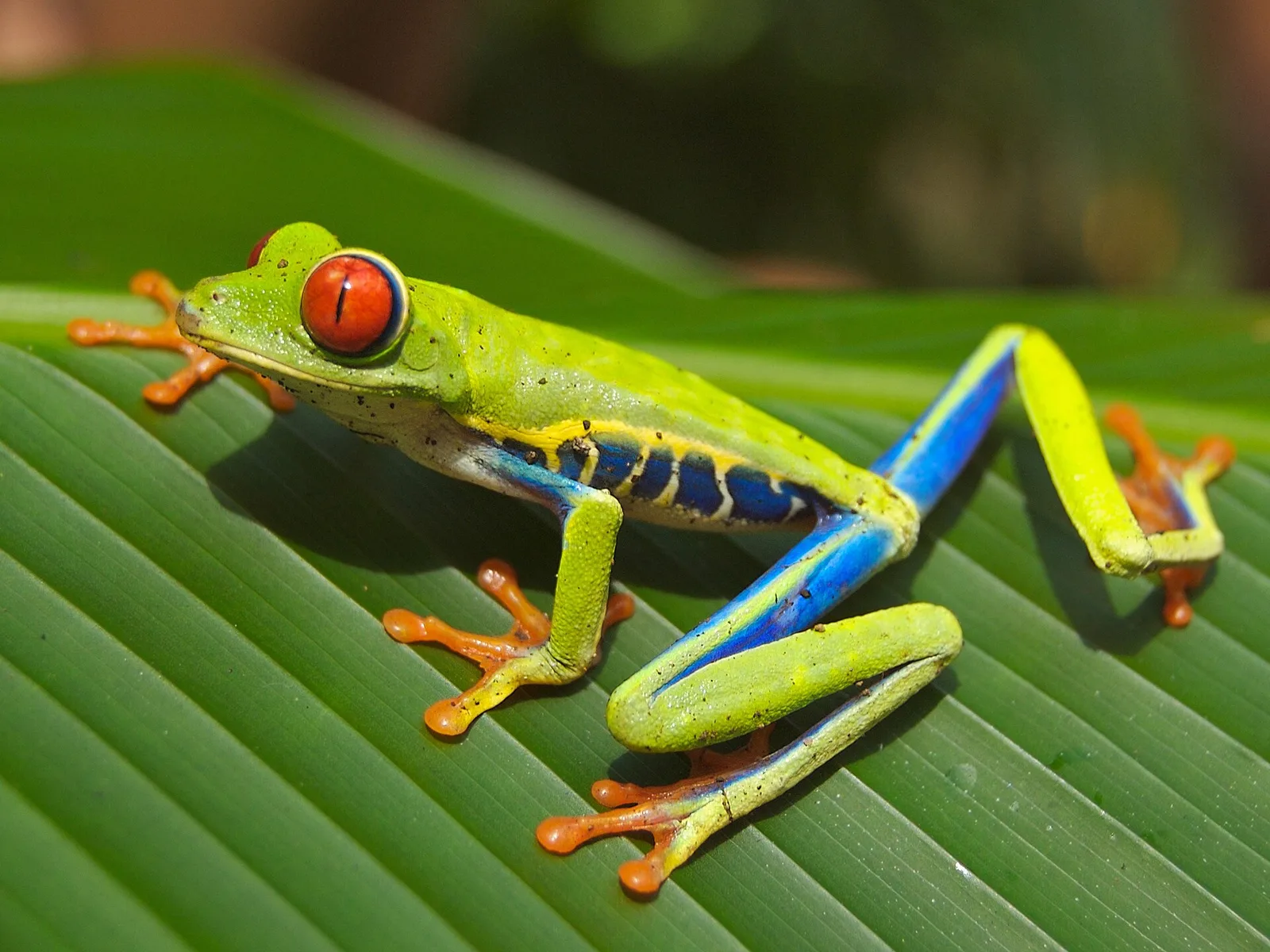
The red-eyed tree frog sleeps by day under a leaf with its colours hidden. When disturbed it flashes its red eyes and blue sides to startle a predator for a moment.
Images of the red-eyed tree frog
Lifespan in the wild
About 5 years
Weight
6 to 15 g
Length
4 to 7 cm
Fact file
Red-eyed tree frog
- Location
- Southern Mexico to Colombia
- Habitat
- Rainforest, Wetlands
- Diet
- Insectivore
- Prey / food
- Crickets, moths, flies, other small insects
- Predators
- Snakes, bats, birds
- Lifestyle
- Nocturnal
- Name of young
- Tadpole
- Incubation
- About 7 days of egg development
- Clutch size
- About 40 eggs
- Biggest threat
- Deforestation and the pet trade
- Distinctive feature
- Bright red eyes with vertical pupils
- Colour
- Green with blue and yellow sides and orange feet
- Skin type
- Smooth, moist skin
Size
Next to a person
Measurements
Size and speed
- Length
- 4 to 7 cm
- Weight
- 6 to 15 g
Typical adult ranges. Source: Animal Diversity Web.
Life cycle
Lifespan
- In the wildAbout 5 years
- In captivityAbout 8 years
- 01 years
Source: Animal Diversity Web.
Appearance
Colour and coat
- Primary colours
- green
- Secondary colours
- blueorangeyellow
- Skin type
- smooth skin
- Male and female
- Females are larger, reaching about 76 millimetres against about 51 for males. Colour is the same in both sexes.
Life cycle
Mating and family
- Mating system
- polygynandrous, with female choice and male wrestling
- Social structure
- solitary, gathering at ponds to breed
- Breeding
- several clutches of about 40 eggs in a night, in the rainy season
Breeding runs through the rains from about October to March. The male clasps the female on a leaf over a pond, and she lays about 40 eggs that he fertilises as they emerge. The eggs hatch in 6 to 8 days, or sooner if a snake attacks, and the tadpoles drop into the water. They metamorphose after weeks or months. The frog matures at about two years and lives about 5 years in the wild.
Classification
Taxonomy
- Kingdom
- Animalia
- Phylum
- Chordata
- Class
- Amphibia
- Order
- Anura
- Family
- Phyllomedusidae
- Genus
- Agalychnis
- Species
- Agalychnis callidryas
Conservation
Red List status
- LC
- NT
- VU
- EN
- CR
- EW
- EX
Least Concern on the IUCN Red List
Range
Recorded in 8 countries
Habitat layer: tropical moist broadleaf forest, flooded grassland and savanna, mangrove.
Countries from 7,122 wild records on GBIF (iNaturalist research grade), filtered and checked by hand. Country shapes: Natural Earth. Habitat: RESOLVE Ecoregions 2017, CC BY 4.0. Basemap: Natural Earth.
Habitats
Three things to know
- 1
Eggs are laid on leaves over water, and the tadpoles drop in when they hatch.
- 2
Embryos can hatch early when a snake shakes the leaf.
- 3
Sticky toe pads let it cling to wet leaves.
Did you know
Seven more facts
- 1
Froglets are born with yellow eyes, which only turn red as they mature.
- 2
A tadpole that misses the water can survive only about 20 hours on land.
- 3
Embryos hatch towards the light.
- 4
One clutch can have several fathers, because the eggs are fertilised outside the body.
- 5
Its skin reflects near-infrared light strongly.
- 6
Carotenoids in the diet make its skin redder and its females more fertile.
- 7
iNaturalist holds 11,343 observations of the species.
Field notes
How it looks and acts
Field notes
Distinguishing features
- Large red eyes with a vertical slit pupil.
- A leaf-green back with blue and yellow bars on the sides.
- Orange webbed feet with round toe pads.
- A pale blue or cream belly.
- A body of 4 to 7 centimetres, the female larger.
Field notes
Unique adaptations
- Toe pads that grip the wet underside of a leaf.
- A flash of red, blue and orange to startle a predator.
- A clear eye membrane that lets a sleeping frog sense a shadow.
- A mucus coat that slows water loss.
- Embryos that read vibration and hatch early under attack.
Field notes
Interesting behaviours
- Sleeps under a leaf by day with its colours folded away.
- Hunts insects in the canopy at night.
- Flashes its eyes and flanks when disturbed.
- Wrestles rival males in the breeding season.
- Lays eggs on a leaf over a pond and folds the leaf over them.
Field notes
Temperament
- Shy and still by day.
- Males fight each other for mates.
- Harmless to people, and tolerant of a keeper's hands, as is typical of pet tree frogs.
Field notes
Communication
- A chack call from the male in heavy rain.
- Branch shaking that sends vibrations to rivals.
- Flank stripes that females read alongside the call.
- A colour flash aimed at predators.
Ecology
Ecological role
The red-eyed tree frog is a mid-level predator of the canopy and a meal for many others.
- Keeps insects and small frogs in check.
- Feeds snakes, birds, bats and spiders as an adult, and wasps and fish as an egg or tadpole.
- Its tadpoles graze algae and plankton in forest ponds.
- Its sensitivity to pollution makes it an indicator of forest health.
Stories
Myths and legends
- In Mesoamerican tradition, frog calls announce the rains and stand for fertility.
- In Maya tradition, the frog carries rain associations, and this species is simply the green frog, yaaxmuch.
- In modern conservation culture, the red-eyed tree frog is the face of the rainforest.
People
Relationship with humans
People
Living alongside us
The red-eyed tree frog is harmless and much loved. It is one of the most popular pet frogs, and captive breeding has improved greatly. Wild capture for the pet trade still threatens some populations in Costa Rica, Nicaragua and Panama. Its image sells rainforest conservation around the world.
- It is not poisonous, unlike many bright tropical frogs.
- Animal Diversity Web records no harmful effect on people.
- Its only defence is to startle and jump.
People
Status, uses and products
- Domestication
- Wild
- As a pet
- Kept by some. A popular vivarium frog that needs high humidity, warmth, climbing plants and live insects. Buy captive-bred stock, because wild capture harms some populations. Feed a diet rich in carotenoids to keep its colour.
- Uses
- vivarium petpollution indicatorconservation symbol
- Products
- None recorded
The full account
About the red-eyed tree frog
The red-eyed tree frog, Agalychnis callidryas, is the best known frog of the Central American rainforest. It has a leaf-green back, blue and yellow bars on its sides, orange feet and large red eyes with slit pupils. Adults measure 4 to 7 centimetres and weigh 6 to 15 grams. The species ranges from southern Mexico through Central America to northern Colombia.
Unlike many bright frogs, it is not poisonous. By day it sleeps under a leaf with its legs folded, so only the green shows. If a predator finds it, the frog opens its red eyes and flashes its blue sides to buy a moment to leap away. It lays its eggs on leaves over water, and a clutch under attack from a snake can hatch early. The IUCN lists it as Least Concern, and it is a common pet.
Name and taxonomy
The species name callidryas joins the Greek kalos, meaning beautiful, with dryas, a nymph of the trees. English speakers also call it the red-eyed leaf frog or the gaudy leaf frog. In Spanish it is the rana de árbol de ojos rojos, and Maya speakers know it as yaaxmuch, the green frog. GBIF lists names in more than a dozen languages, from the German Rotaugenlaubfrosch to the Japanese akame amagaeru.
The genus Agalychnis belongs to the leaf frogs, Phyllomedusinae. Some authorities keep that group as a subfamily of the tree frog family Hylidae, and others raise it to the family Phyllomedusidae. The site fields follow the second view. Every Agalychnis species shares a red tint in the iris and a golden net pattern on the lower eyelid membrane. Like other tree frogs, it has a claw-shaped last bone in each toe. Wikidata records the IUCN status and the Spanish name rana arborícola under the same entry.
Evolution and relatives
Leaf frogs are a New World group of tree frogs that lay their eggs on leaves rather than in water. The red-eyed tree frog shares this habit with the rest of its genus. All Agalychnis species are climbers with long limbs and webbed toes, and all are active at night. Like the whole genus, this frog loses water fast in heat, which is probably why it hunts after dark.
Its colours are not a warning, because the skin carries no strong toxin. They may instead copy the colours of toxic frogs, a case of Batesian mimicry. The side stripes vary across the range: blue, blue and red, orange or purple in Costa Rica and Panama. The orange and purple forms are not genetically distinct groups, so distance and drift may explain them. The skin reflects strongly in the near infrared, unlike that of the European tree frog. That reflectance may help the frog match a leaf to a predator that sees beyond the visible range.
Appearance
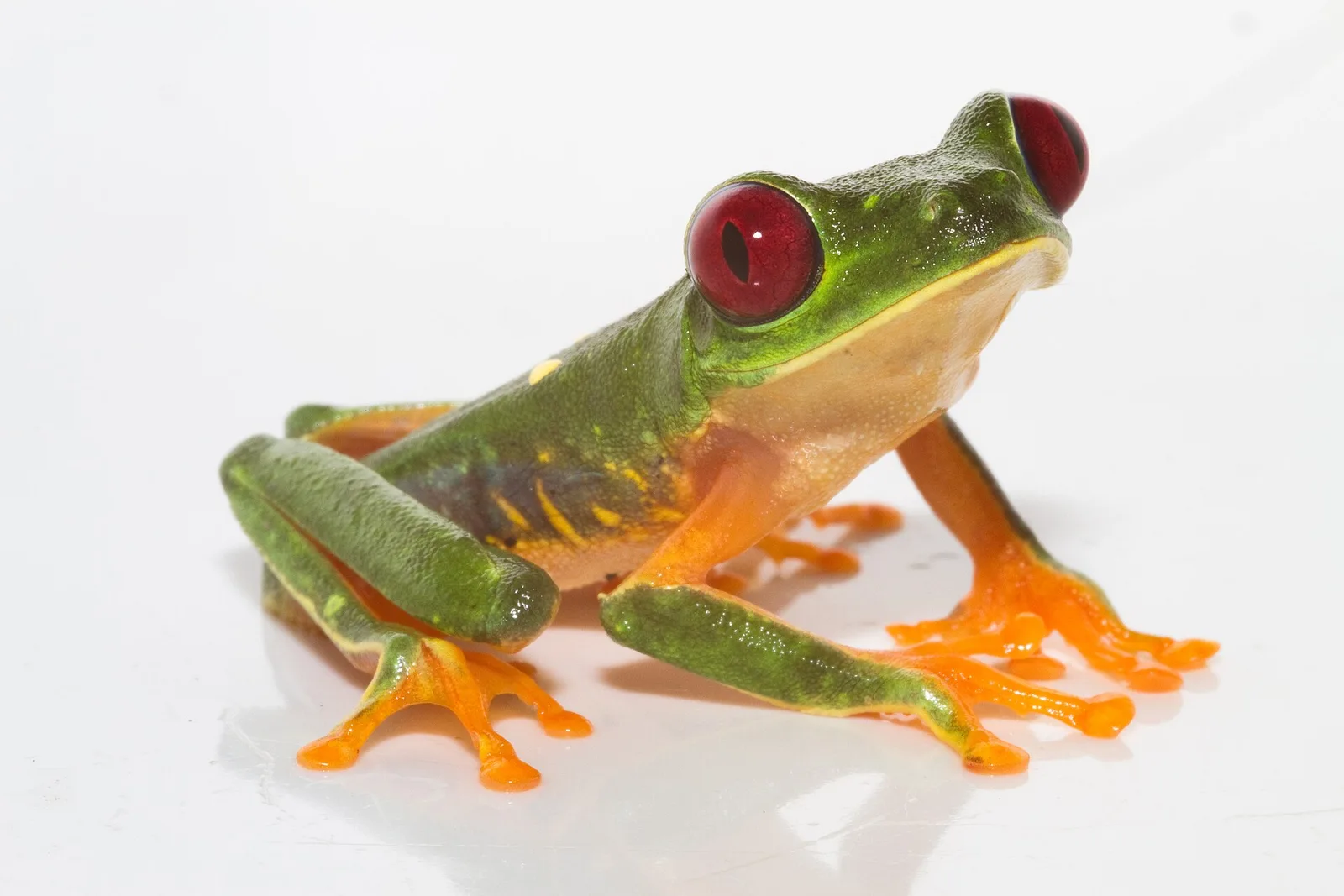
The back is bright leaf green and the belly is pale blue or cream. Blue and yellow bars run along the flanks and the inner legs. The feet are orange, webbed, and tipped with round pads that grip the underside of a leaf. The skin is smooth with few or no bumps, and a mucus gland on the surface slows water loss and resists infection.
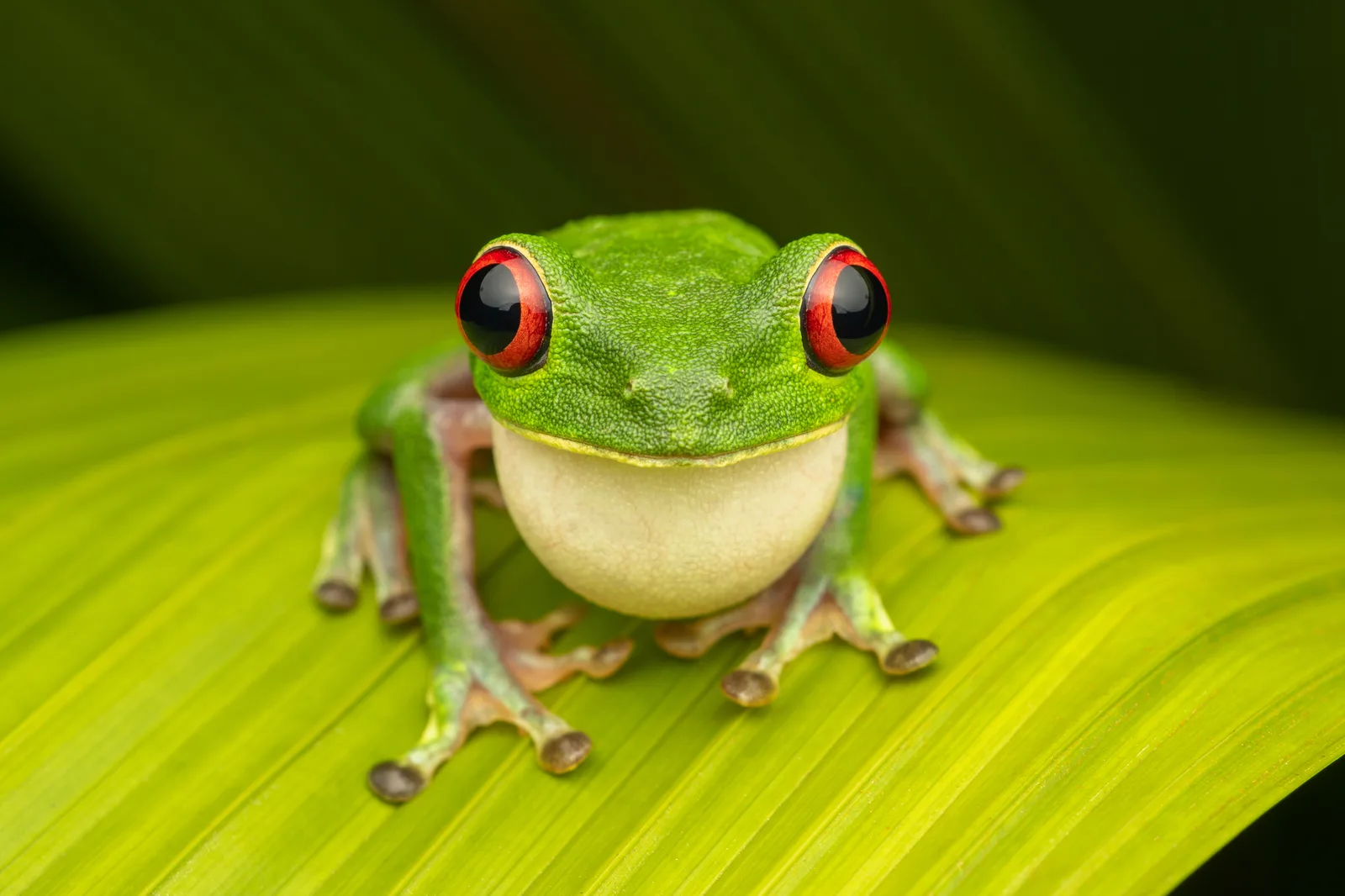
The eyes are large and red with a vertical pupil. There is no true eyelid, only a clear membrane that lets light through when the eye is shut. That is thought to let a sleeping frog wake when a shadow passes over it. Adults measure 4 to 7 centimetres and weigh about 6 to 15 grams. Males reach about 51 millimetres, and females grow to about 76 mm.
A tadpole is fairly large, 4 to 5 centimetres, with a long narrow tail and pale grey skin. A froglet has a green torso and yellow eyes. The torso turns brown, then the eyes turn deep red as the frog matures. Young froglets can shift their skin colour with the time of day. The site fields describe the frog as green with blue and yellow sides and orange feet, which fits every source.
Habitat and range
The frog lives in the humid lowlands from southern Mexico through Central America to northern Colombia. Wikipedia gives a narrower core range, from north-eastern Honduras to Colombia. GBIF holds records from 10 countries, and most come from Costa Rica and Panama. iNaturalist holds 11,343 observations, which shows how often visitors meet it.
It needs rainforest or wet forest with a pond nearby, because the tadpoles must drop into water. It also lives in wetlands and in hill forest where cover and water remain. Humidity of at least 80 percent is usual in its haunts. It spends most of its life in the canopy among leaves. In hot or dry weather it drops lower and shelters under broad leaves near the floor. Records from the United States and Japan on GBIF are probably captive animals, not wild ones. The species has not been shown to travel far, and a frog probably stays near one pond for life.
Diet and hunting
The adult is a night hunter of insects. It takes moths, crickets, katydids, grasshoppers, flies and mosquitoes. Now and then it eats a smaller frog. Like other frogs, it probably waits for prey to move and then lunges with its sticky tongue.
Tadpoles feed in mid water on plants, algae, plankton, bacteria and dead matter. They also eat each other. After metamorphosis a froglet starts on fruit flies and pinhead crickets.
Carotenoids in the food matter a great deal. In the weeks after metamorphosis they speed female growth and raise the number of eggs she will lay. They also make the skin redder in both sexes. Captive frogs on a poor diet lose their colour. Keepers probably dust the insects with a carotenoid supplement for this reason.
Behaviour and social life
The frog is nocturnal. By day it presses itself flat on the underside of a leaf. It tucks its legs in, closes its eyes, and hides every colour but green. At dusk it wakes, climbs, and hunts.
When a predator finds it, the frog opens its eyes wide and stretches, which shows the red eyes, the blue flanks and the orange feet. The sudden colour startles the attacker for a moment, and the frog jumps. Biologists call this a deimatic or flash display. The trick probably works because the attacker has learned that bright colours can mean poison, even though this frog has none.
Frogs have been seen in groups, but nothing is known about any rank order among them. The species does not migrate. In the breeding season males fight each other, and a male shakes his branch to keep rivals away. Outside that season the frog is probably solitary, like most tree frogs.
Communication and senses
The male calls with a short chack, loudest when the rain is heaviest. Females judge a male by his call, his size and the stripe pattern on his flank. They prefer males whose stripes and calls match the local type. Call and colour also serve in territorial displays and against predators.
Males shake branches to send vibrations to rivals. This was the first evidence that a tree-living vertebrate communicates by vibration. The embryos sense vibration too, while still in the egg. They hatch early only when the pulses match the pattern of a snake or wasp attack, not a rainstorm. They also use light: embryos hatch towards the light, and clutches hatch just after nightfall.
The red eyes see well at night, and the closed membrane still lets light in. Animal Diversity Web notes that the flash of the eyes is itself a visual signal aimed at a predator. Like most frogs, it probably finds prey by sight and ignores an insect that does not move.
Reproduction and life cycle
Breeding follows the rains, from about October to March. Males call and wrestle for access to females. Larger males win more often, but pairs also tend to match in size, so that the male can fertilise the eggs. The female grips the underside of a leaf over a pond, and the winning male clasps her waist from behind in amplexus. She carries him for several hours while she lays.
A clutch holds about 40 eggs, and a female can lay several clutches in one night. The male fertilises them outside her body as they reach the leaf. Because there is no sperm priority, one clutch may have several fathers. The parents glue the eggs with sticky jelly and may fold the leaf over them. Then they leave, and neither returns. Animal Diversity Web gives a gestation of around 45 days, which probably covers the egg and early tadpole stages together.
Undisturbed eggs hatch in 6 to 8 days, and the tadpoles drop into the water below. A tadpole can live only about 20 hours on land, so a miss is fatal. The tadpoles stay in the water for weeks or months, depending on conditions, and then metamorphose. Young mature at about two years and breed two years after that. Wild frogs live about 5 years, and captive frogs average about 4.1 years but can pass 8.
Predators and threats
Each life stage has its own enemies. The wasp Polybia rejecta and the cat-eyed snake Leptodeira septentrionalis eat eggs. Shrimp of the genus Macrobrachium and the fish Brachyrhaphis rhabdophora take tadpoles, as do dragonflies and water beetles. Froglets and adults fall to water spiders, snakes, birds and bats.
The eggs fight back by hatching early. When a snake bites into a clutch, the whole clutch can hatch within seconds and scatter into the pond. Early hatching is a gamble, because a young tadpole is easier prey in the water. Drying eggs also hatch sooner than wet ones. A rainstorm or a flood can trigger the same response.
The larger threats are human. Logging and housing remove forest, and chytrid fungus threatens frogs everywhere. Ranavirus has killed wild tadpoles in die-offs. Populations in Costa Rica, Nicaragua and Panama are also caught for the pet trade.
Population and conservation
The IUCN lists the red-eyed tree frog as Least Concern, last assessed in 2016. It has a wide range, tolerates some change to its forest, and has a large captive population. Many local populations are falling all the same. The species sits on CITES Appendix II, which regulates trade.
Deforestation is the main cause of the decline. Parks across the range keep enough forest and ponds to hold the species. Captive husbandry and breeding improved a great deal in the 21st century, which eases pressure on wild frogs. No total population figure exists, and GBIF records are heavily skewed to Costa Rica. The IUCN reasoning rests partly on a captive population that is presumed large but not counted.
Relationship with humans
The frog is harmless to people. Its skin carries some active peptides that put off predators, but Animal Diversity Web records no harm to a person. It is a popular pet, and the trade in wild-caught frogs is a threat in three countries. Captive breeding now supplies much of the demand. Pet keepers seem to value it for its colour and for its calm habit of sleeping in full view on a leaf.
Like other amphibians, it absorbs pollutants through its skin, which makes it a useful early warning of a damaged environment. It is the poster animal of rainforest conservation campaigns. Its face appears on books, posters and tour brochures across Central America. Tourists in Costa Rica probably see this frog more than any other, given the GBIF and iNaturalist records.
In culture and myth
In Mesoamerica, frog calls announce the coming rains. The web notes link frogs to rain and fertility in Maya belief. The Maya name yaaxmuch simply means green frog, and it is still used in Yucatán. No named myth about this frog in particular appears in the sources read here.
In modern culture the frog stands for the rainforest itself. Conservation groups use its red eyes and green skin on campaign material. The species name means beautiful tree nymph, and the popular name gaudy leaf frog says the same in plain words. It is thought to be the most photographed frog in the world, though no source counts the pictures.
A sentence with a dotted underline is inferred: it describes the group the animal belongs to, or is a reading of the sources, rather than a measured or reported fact about this species.
Questions
Red-eyed tree frog questions, answered
Is the red-eyed tree frog poisonous?
No. Its skin has some mild active peptides, but it is not poisonous like a dart frog. Its bright colours are a bluff to startle predators.
Why does the red-eyed tree frog have red eyes?
The red eyes are part of a startle display. The frog sleeps with them shut and its colours hidden. When disturbed it opens them and flashes its blue sides, which can freeze a predator for a moment.
Where do red-eyed tree frogs live?
In humid lowland forest from southern Mexico through Central America to northern Colombia. They stay near ponds, because their tadpoles need water. Most records come from Costa Rica and Panama.
How big is a red-eyed tree frog?
An adult is 4 to 7 centimetres long and weighs 6 to 15 grams. Females are larger, at about 76 millimetres, while males reach about 51 mm.
What do red-eyed tree frogs eat?
Insects such as moths, crickets, katydids, flies and mosquitoes, caught at night. They sometimes eat smaller frogs. Tadpoles eat algae, plankton and each other.
How long do red-eyed tree frogs live?
About 5 years in the wild. Captive frogs average about 4.1 years, though some live past 8.
Are red-eyed tree frogs endangered?
No. The IUCN lists them as Least Concern, but many populations are falling because of deforestation and the pet trade. CITES Appendix II regulates their trade.
How do red-eyed tree frogs reproduce?
In the rainy season the male clasps the female on a leaf above a pond. She lays about 40 eggs, which he fertilises. The eggs hatch in 6 to 8 days and the tadpoles fall into the water.
Can red-eyed tree frog eggs really hatch early?
Yes. When a snake or wasp attacks the clutch, the embryos sense the vibration and hatch within seconds, dropping into the pond. They ignore rain, which has a different vibration pattern.
Are red-eyed tree frogs good pets?
Yes, they are among the most popular pet frogs. They need a humid, warm vivarium with plants to climb and live insects to eat. Choose captive-bred frogs.
Are red-eyed tree frogs nocturnal?
Yes. They sleep under leaves by day and hunt at night, partly because they lose water quickly in heat.
What eats red-eyed tree frogs?
Snakes, birds, bats and large spiders eat adults. Wasps and cat-eyed snakes eat the eggs, and fish, shrimp and dragonfly larvae eat the tadpoles.
How do red-eyed tree frogs climb?
Round pads on their orange toes grip the wet underside of leaves. Their long limbs and webbed feet help them move through the canopy.
What does the name callidryas mean?
It comes from the Greek kalos, beautiful, and dryas, a tree nymph. So the name means beautiful tree nymph.
Do red-eyed tree frogs change colour?
Froglets can, shifting their skin tone through the day. Adults keep a green back, but the flank stripes vary from blue to orange or purple across the range.
Food web
Prey and food
- crickets
- moths
- flies
- insects
Food web
Predators
- snakes
- bats
- birds
Ecological equivalents
Related species on this site
African Bullfrog (same order), African Clawed Frog (same order), African Tree Toad (same order), American Toad (same order), Argentine Horned Frog (same order), Bullfrog (same order), and more.
Amphibians
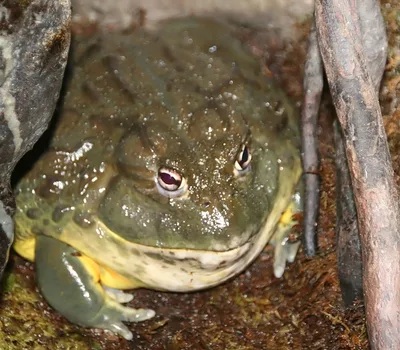
African Bullfrog
Pyxicephalus adspersus
The African bullfrog spends dry periods buried underground and becomes active with rain.
LivingAmphibians
African Clawed Frog
Xenopus laevis
Classification and source reference
LivingAmphibians
African Tree Toad
Nectophryne
Classification and source reference
Living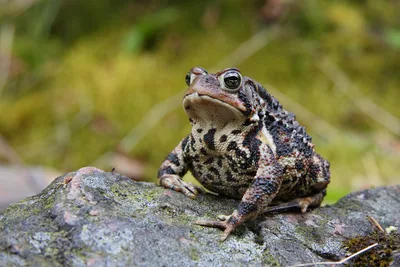
Amphibians
American Toad
Anaxyrus americanus
The American toad is a stout amphibian of North America.
Living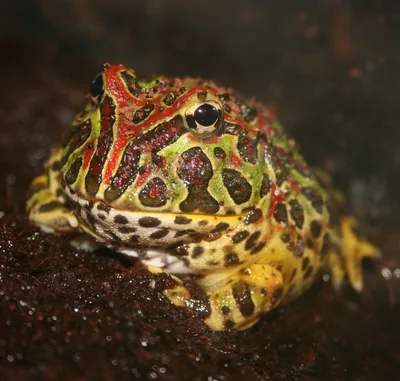
Amphibians
Argentine Horned Frog
Ceratophrys ornata
The Argentine horned frog is a broad-bodied ambush hunter with a very large mouth.
Living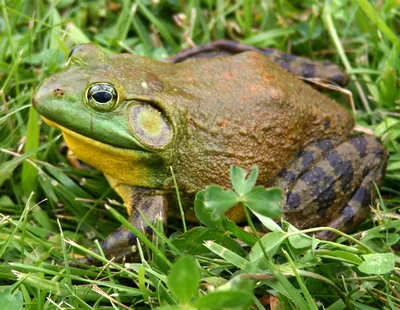
Amphibians
Bullfrog
Lithobates catesbeianus
The American bullfrog is a large frog that waits near water for passing prey.
Living