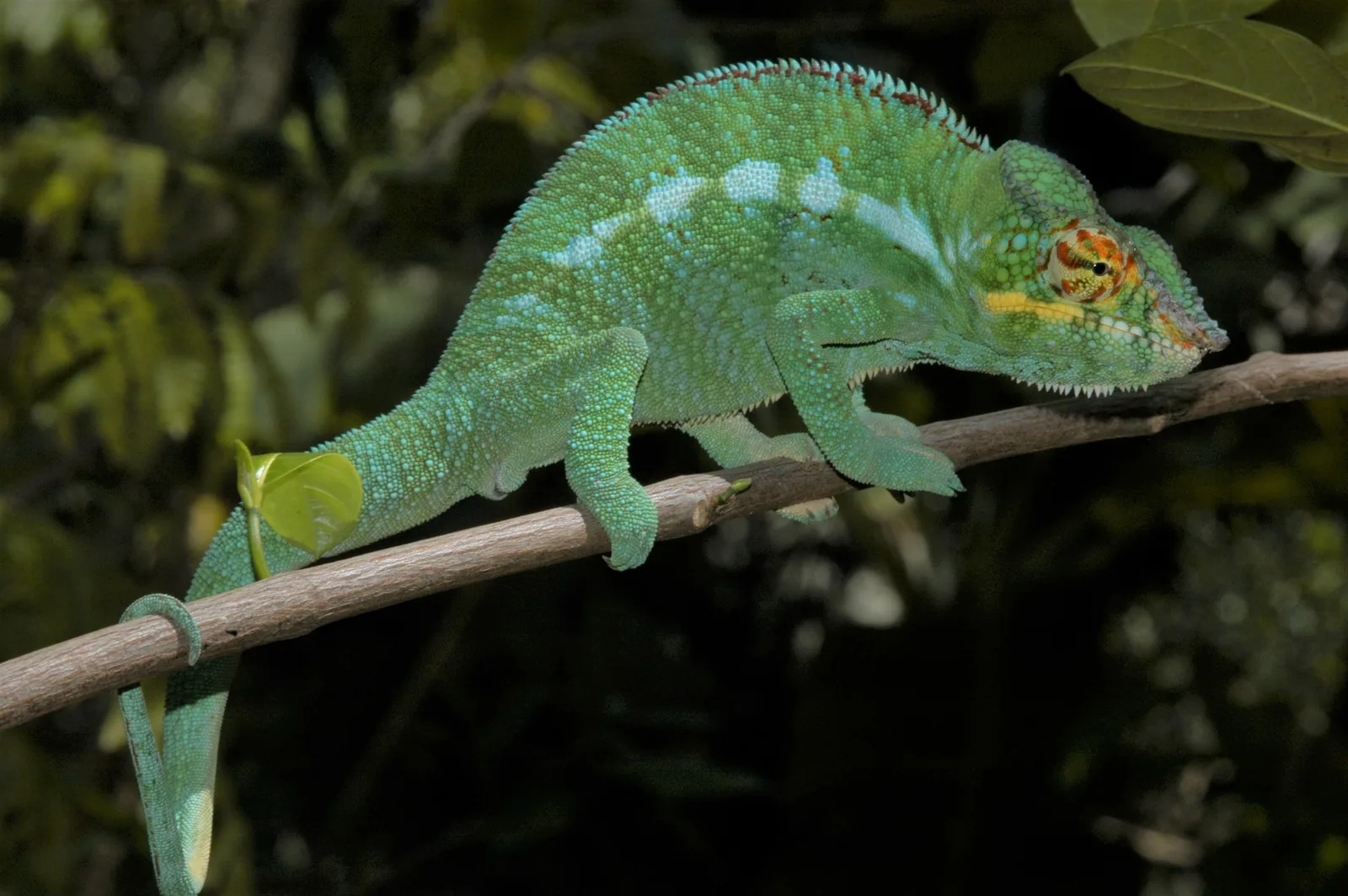
Panther chameleon
Madagascar's colour-changing lizard with a catapult tongue
Furcifer pardalis
Living individuals or members of this group exist today. This does not mean they are safe from extinction.
Meet the panther chameleon
The panther chameleon is one of the most colourful lizards in the world. It lives in the trees of Madagascar and catches insects with a tongue longer than its body.
Images of the panther chameleon
Lifespan in the wild
1 to 3 years
Length
40 to 51 cm
Fact file
Panther chameleon
- Location
- Madagascar; introduced to Réunion and Mauritius
- Habitat
- Rainforest, Temperate forest
- Diet
- Insectivore
- Prey / food
- Crickets, grasshoppers, cockroaches, moths
- Predators
- Snakes, birds
- Lifestyle
- Diurnal
- Name of young
- Hatchling
- Incubation
- 6 to 12 months of incubation
- Clutch size
- 10 to 40 eggs
- Biggest threat
- Habitat loss and collection for the pet trade
- Distinctive feature
- Eyes that move independently and a coiling tail
- Colour
- Varies by region: blue, red, green, orange
- Skin type
- Scales
Size
Next to a person
Measurements
Size and speed
- Length
- 40 to 51 cm including the tail
Typical adult ranges. Source: Wikipedia.
Life cycle
Lifespan
- In the wild1 to 3 years
- In captivityUp to 5.2 years
- 05.2 years
The pale bar is the record. Sources: Animal Diversity Web, AnAge.
Appearance
Colour and coat
- Primary colours
- bluegreenred
- Secondary colours
- orangetanbrown
- Skin type
- scales
- Male and female
- Strong. Males are much larger and heavier, carry a swollen tail base, and show vivid blue, red, green or orange patterns that vary by locale. Females are tan, brown or pale green with hints of pink or orange.
Life cycle
Mating and family
- Mating system
- serial polygyny, with brief pair bonds after mating
- Social structure
- solitary and territorial
- Breeding
- several clutches of 10 to 40 eggs a year
Males roam and court females with bright colours and head bobbing between January and May. A mated female turns dark with orange bars and carries her eggs for 3 to 6 weeks. She buries 10 to 40 eggs in a burrow and leaves them. The eggs hatch after 6 to 12 months, and the young breed at six to seven months. A wild chameleon lives 1 to 3 years.
Classification
Taxonomy
- Kingdom
- Animalia
- Phylum
- Chordata
- Class
- Reptilia
- Order
- Squamata
- Family
- Chamaeleonidae
- Genus
- Furcifer
- Species
- Furcifer pardalis
Conservation
Red List status
- LC
- NT
- VU
- EN
- CR
- EW
- EX
Least Concern on the IUCN Red List
Range
Recorded in 2 countries
Habitat layer: tropical moist broadleaf forest, temperate broadleaf and mixed forest, temperate conifer forest, boreal forest and taiga.
Countries from 1,235 wild records on GBIF (iNaturalist research grade), filtered and checked by hand. Country shapes: Natural Earth. Habitat: RESOLVE Ecoregions 2017, CC BY 4.0. Basemap: Natural Earth.
Habitats
Three things to know
- 1
Colour change is mostly about mood and temperature, not camouflage.
- 2
The tongue shoots out in about 20 milliseconds.
- 3
Each eye can look in a different direction at once.
Did you know
Seven more facts
- 1
The genus name Furcifer means fork-bearer and refers to the split feet.
- 2
A hatchling weighs 0.25 to 0.75 grams.
- 3
The eggs take 6 to 12 months to hatch, sometimes longer than the mother lives afterwards.
- 4
A female can sense her own vitamin D level and seeks sunlight when it is low.
- 5
The species thrives near roads, houses and plantations.
- 6
From 1977 to 2001 it made up almost eight percent of chameleon exports to the United States.
- 7
A released pet turned up in the Singapore Botanic Gardens in 2006.
Field notes
How it looks and acts
Field notes
Distinguishing features
- A total length of 40 to 51 centimetres, large for a chameleon.
- Eyes in domed turrets that move independently.
- Feet with toes fused into bundles of two and three.
- A coiling, prehensile tail.
- Males in vivid blue, red, green or orange by locale; females tan or brown.
- A swollen tail base in males.
Field notes
Unique adaptations
- A projectile tongue with a suction-and-adhesive tip catches insects out of reach.
- Independently moving eyes give an almost complete view without moving the head.
- Zygodactyl feet and a prehensile tail grip thin branches.
- Colour change signals mood and helps the lizard warm up or cool down.
- A slow, swaying walk mimics a leaf in the wind and hides it from predators.
Field notes
Interesting behaviours
- Waits motionless for prey and shoots its tongue when an insect comes close.
- Basks in the sun to warm up and moves into shade to cool.
- Brightens and inflates to face down a rival male.
- Bobs its head and brightens to court a female.
- Digs a burrow, lays its eggs and hides the spot with leaves.
Field notes
Temperament
- Solitary and intolerant of other chameleons.
- Aggressive towards rivals in the breeding season.
- Defensive when gravid, with hissing, gaping and biting.
- Calm and slow with people, though it probably dislikes handling.
Field notes
Communication
- Brightens its colours to court or to challenge.
- Darkens to surrender after losing a contest.
- A gravid female shows black and orange bars to refuse males.
- Bobs and jerks its head during courtship.
- Gapes, hisses and rocks to threaten an unwanted suitor.
Ecology
Ecological role
The panther chameleon is a mid-level insect hunter of Madagascar's lowland forests and forest edges.
- Eats large numbers of crickets, grasshoppers, cockroaches and moths.
- Feeds birds and snakes, which are its main predators.
- Has no significant effect on the wider ecosystem beyond these links.
Stories
Myths and legends
- In Malagasy tradition, one eye of the chameleon looks into the future and the other into the past.
- In some Malagasy regions, a fady, or taboo, forbids people from harming a chameleon.
- In popular Western belief, a chameleon changes colour to match any background, which the science does not support.
People
Relationship with humans
People
Living alongside us
People value the panther chameleon for its colour, and it is one of the most traded chameleons in the pet market. Captive breeding now supplies most pets, and Madagascar limits wild exports. It is harmless, rarely eaten and protected by taboo in parts of its homeland. Escaped pets have founded colonies on Réunion, Mauritius and in Florida.
- The panther chameleon has no known adverse effects on people.
- It has no venom, and its bite is thought to be weak.
- It freezes or moves away rather than attack.
People
Status, uses and products
- Domestication
- Wild
- As a pet
- Kept by some. The panther chameleon is one of the easier chameleons to keep. It still needs a tall planted enclosure, UVB light, live insects and careful humidity. Buy a captive-bred animal. With good care a male lives 5 to 7 years.
- Uses
- pet tradezoo exhibition
- Products
- None recorded
The full account
About the panther chameleon
The panther chameleon, Furcifer pardalis, is one of the most colourful lizards on Earth. It lives in the trees of northern and eastern Madagascar and has been introduced to Réunion, Mauritius and Florida. An adult measures 40 to 51 centimetres including the tail, and males are much larger than females. Males come in blue, green, red or orange, and the pattern depends on where they were born. Females stay tan, brown or pale pink wherever they live.
The chameleon hunts insects with a tongue that can be longer than its body and shoots out in about 20 milliseconds. Each eye moves on its own, so the lizard can watch two things at once. It changes colour to show mood, to court a mate and to warm up, not to match its background. Wild panther chameleons live only 1 to 3 years, and the captive record is 5.2 years. The IUCN lists the species as Least Concern, and it is a favourite of the pet trade.
Name and taxonomy
Georges Cuvier described the species in 1829. The genus name Furcifer comes from the Latin furci, forked, and refers to the split feet. The species name pardalis means leopard in Latin and points to the spotted markings. The word chameleon comes from the Greek khamaileon, ground lion, which itself translates an Akkadian phrase with the same meaning.
The panther chameleon belongs to the family Chamaeleonidae and the order Squamata, which holds all lizards and snakes. It is treated as one species with many colour forms, called locales after the places where they occur. Genetic work and captive breeding suggest that it may in fact be several species. Polish speakers call it kameleon lamparci, the leopard chameleon.
Evolution and relatives
Chameleons belong to the Iguania, the group of lizards that also holds iguanas and agamas. Wikidata places the genus Furcifer within the subfamily Chamaeleoninae, the typical chameleons. Madagascar is the centre of chameleon diversity, and the genus Furcifer is thought to have evolved there. Like all chameleons, the panther chameleon carries the group's shared toolkit: split feet, a prehensile tail, turret eyes and a projectile tongue.
The panther chameleon is one of the largest members of its genus, and it breeds readily in captivity. Its many locales probably represent populations cut off from each other by rivers and by patches of unsuitable forest. If those populations prove to be separate species, the panther chameleon will probably become a species complex like the king cobra.
Appearance
A panther chameleon measures 40 to 51 centimetres from nose to tail tip. Animal Diversity Web gives an adult body length of 23 cm without the tail. Males are far larger and heavier than females, and they show a swollen tail base that houses the paired hemipenes. Females are smaller, with a thin tail base, and eggs can sometimes be seen through the body wall. Juveniles under six months are dull and hard to sex.
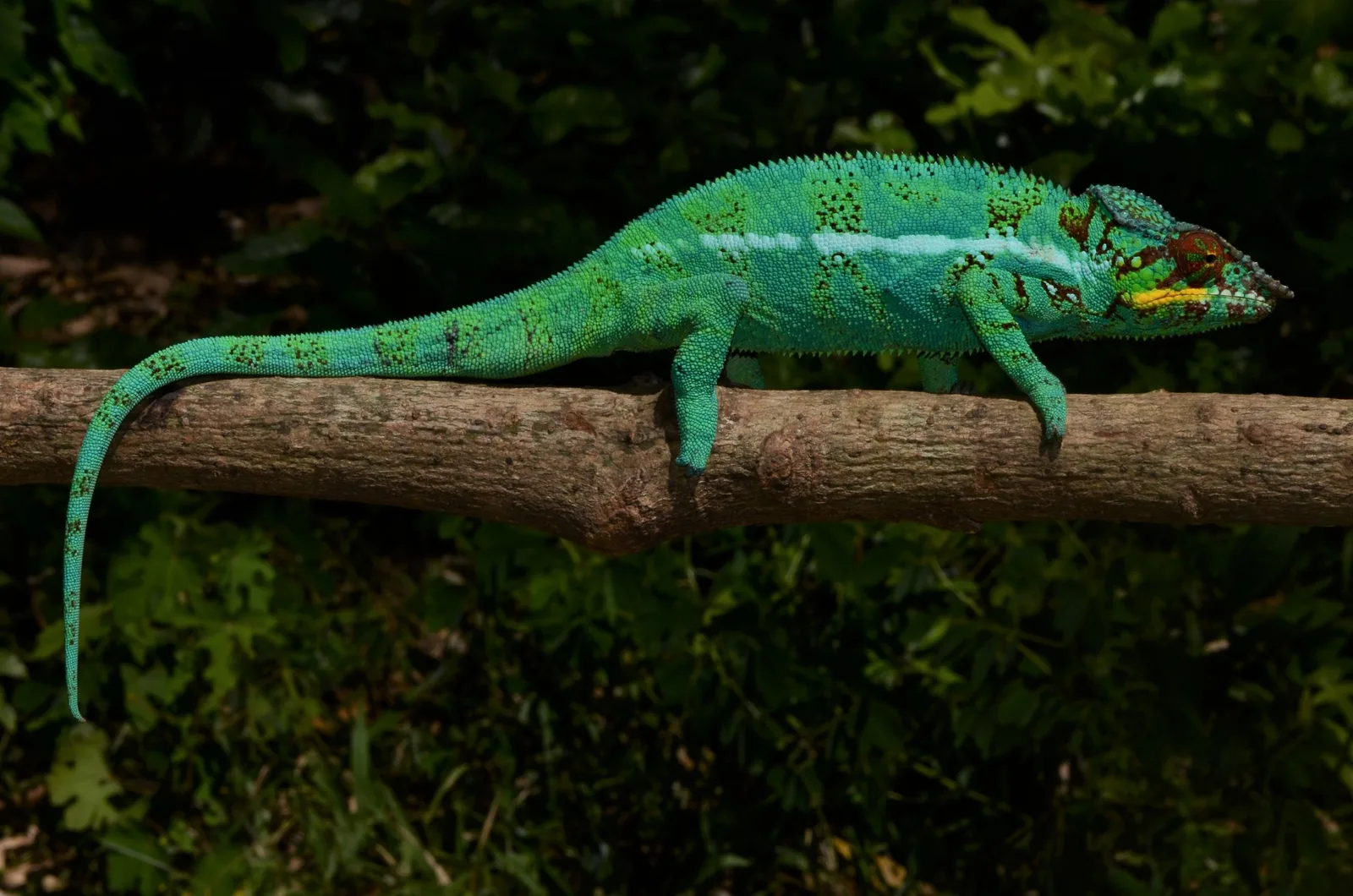
Colour depends on the locale. Males from Nosy Be, Ankify and Ambanja are a vivid blue or blue-green. Males from Ambilobe, Sambava and Antsiranana come in red, green or orange, and those from Maroantsetra and Tamatave are mostly red. Northwest coast males are bright pink, with a pale yellow stripe down each side, and keepers call them pink panthers. Females are tan, brown or pale green with touches of pink, peach or orange, whatever their origin.
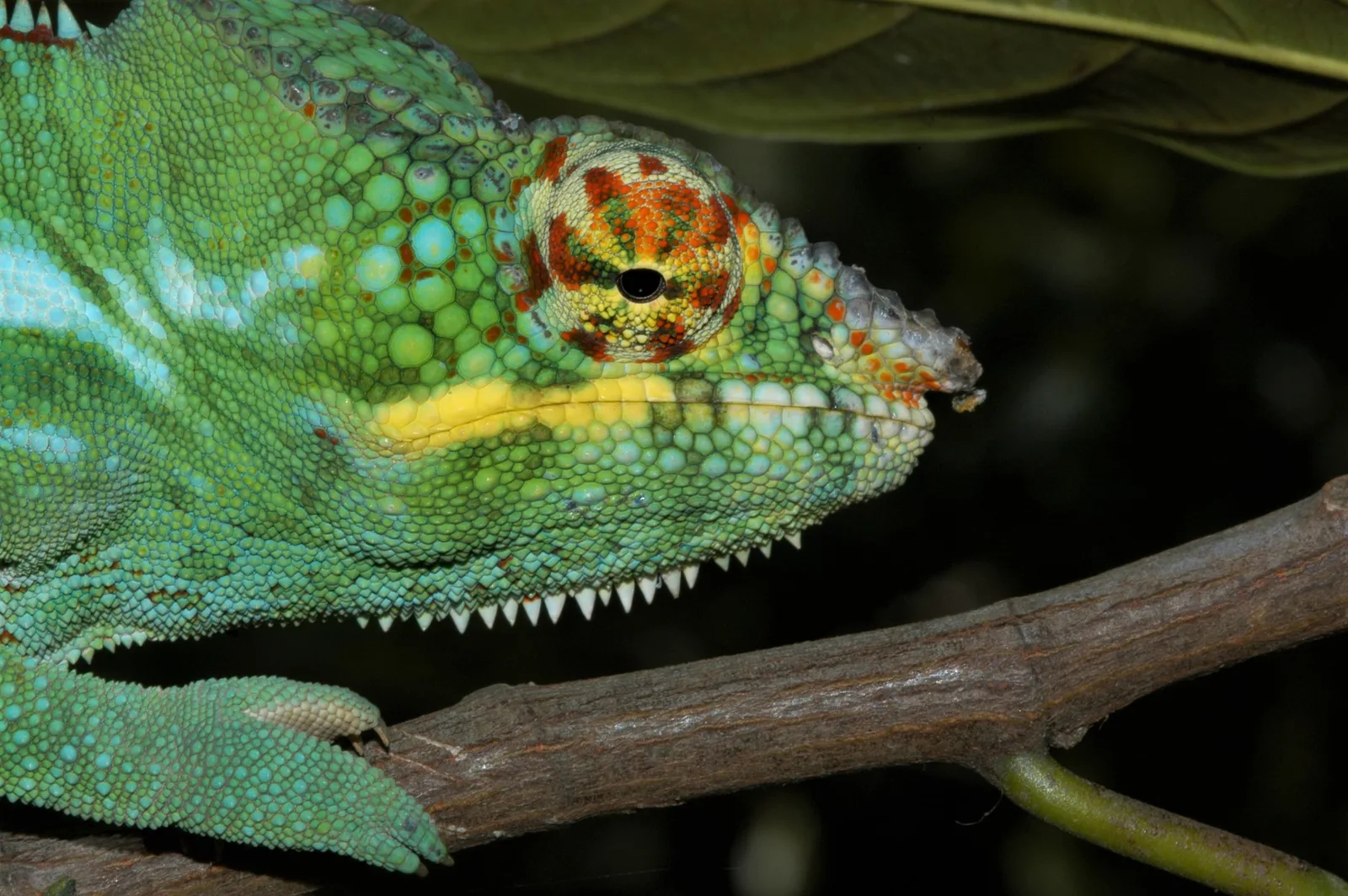
Each foot has five toes fused into two bundles, one of two toes and one of three. On the front feet the group of three sits on the inside, and on the hind feet the arrangement is reversed. This tong-like grip holds narrow branches, and a sharp claw on each toe bites into bark. The eyes sit in domed turrets on either side of the head and swivel independently. The tail coils and grips like a fifth limb.
Habitat and range
The panther chameleon is native to Madagascar and is common in the lowlands of the east, northeast, north and northwest coasts. It lives in rainforest in the east and in drier, broken forest and savanna in the northwest. It favours open, sunlit spots such as thin belts of trees along rivers and roads, where it can bask and males can display. Males use higher perches than females, probably to hold a territory.
The original forest across much of its range has been cut or degraded, but the chameleon does well in disturbed land. It is often found near roads, houses and plantations. A territory is usually a single tree or shrub. Males roam over larger home ranges, and females stay in a small area.
People have introduced the species to Réunion and Mauritius in the Indian Ocean and, more recently, to Florida through the pet trade. A released animal was photographed in the Singapore Botanic Gardens in 2006. GBIF holds records from 16 countries, most of them escaped or released pets. iNaturalist holds 2,675 observations of the species.
Diet and feeding
The panther chameleon eats insects and other invertebrates that live on the ground and in the trees. Crickets, grasshoppers, cockroaches and moths are typical prey. It very rarely takes plant matter. It hunts by sight and waits for prey to come within range of its tongue.
The tongue rests folded on the hyoid bone in the throat. Ring muscles fire it out of the mouth, and it can reach further than the length of the lizard's own body. The whole strike takes about 20 milliseconds. A 2000 study showed that the tongue pad works by suction as well as by sticky adhesion. The prey is pulled back into the mouth and crushed by the strong jaws.
Before the strike, one eye finds the prey and then the head turns so both eyes can fix on it. With both eyes forward the chameleon gains stereoscopic vision and can judge the distance exactly. Captive animals need insects dusted with calcium and exposure to UVB light, or their bones and eggs fail.
Behaviour and social life
The panther chameleon is solitary and territorial at every age and in both sexes. It spends nearly all its life alone and meets others only to mate. It is active by day, because its eyes lack the rods and pigments needed to see at night. It moves slowly and often freezes for long periods, and when it walks it sways like a leaf in the wind.
When two males meet, each brightens its colours and puffs up its body. Most contests end there, and the loser turns drab and dark and retreats. If neither backs down, the males fight, and an intruder can be badly hurt. Hostility rises in the breeding season.
The chameleon controls its body heat by basking or moving into shade. It tolerates a wide range and lets its temperature drift between 24 and 36 degrees Celsius during the day. A female can sense when she is short of vitamin D and moves into sunlight to make more. When she has enough, she avoids strong UV.
Communication and senses
Colour is the chameleon's language. A male turns brighter to court a female and to challenge a rival, and a beaten male turns dark. A female signals whether she will mate by her colour. Once gravid, she turns dark brown or black with orange bars to tell males to stay away. Courtship also involves head bobbing and a jerky, halting walk towards the female.
Each eye turns on its own, which gives the lizard a view all round its body while it stays still. The web notes put the field of view at about 342 degrees. The eyes contain no rods, so the chameleon is blind at night. It has no outer or middle ear, and it may be deaf. It also lacks the vomeronasal organ that most lizards use to smell.
Reproduction and life cycle
Breeding runs from January to May in most places, and some females breed several times a year. Males roam in search of females, and the mating system looks like serial polygyny. A male approaches with bright colours and bobbing head. An unwilling female flees or faces him with an open mouth, hisses, rears up on her hind legs and rocks from side to side. A willing female lets the male grip her flanks and mate, for minutes or for hours.
After mating the male may stay in the female's territory for a while to keep other males off. The female carries the eggs for 3 to 6 weeks. She digs a burrow with her front feet, backs in and lays 10 to 40 eggs, sometimes up to 46. She fills the tunnel, stamps the soil flat and may drag leaves and twigs over the spot. That is her last act as a mother.
The eggs take 6 to 12 months to hatch, typically about 240 days. A hatchling cuts a star-shaped slit in the shell with an egg tooth, which later falls off. It weighs 0.25 to 0.75 grams and is independent from the first minute. Young reach adult colour and breeding age at six to seven months. A female lays five to eight clutches in her life and lives two to three years after her first, worn out by egg laying. Wild animals live 1 to 3 years, and the AnAge captive record is 5.2 years.
Predators and threats
No detailed study of predation on this species exists. Birds and snakes are the main predators of chameleons in general. The chameleon's defences are stillness, a slow swaying walk and colours that blend with leaves and bark. Hatchlings, being tiny, probably fall to a wider range of predators, including large insects and spiders.
The chief threat from people is the loss and degradation of Madagascar's forests. Collection for the pet trade was heavy. From 1977 to 2001 the species made up almost eight percent of all chameleons exported to the United States. Trade quotas are now stricter, and exports have fallen to a level the population can sustain. Because it thrives in disturbed land, the species is in less danger than many other Madagascan reptiles.
Population and conservation
The IUCN Red List rates the panther chameleon as Least Concern. It has a wide range in the lowlands of Madagascar and copes with farmland, roadsides and plantations. No population count exists, but the species is described as locally abundant along the northern and eastern coasts.
Madagascar sets export quotas for the pet trade, and the species breeds so well in captivity that most pets are now captive-bred. The bigger question is taxonomy. If the locales prove to be separate species, some of them may have small ranges and need protection of their own. Introduced populations on Réunion, Mauritius and in Florida are probably too small to harm native wildlife, though no one has measured their effect.
Relationship with humans
The panther chameleon is harmless to people. Local people in Madagascar make little use of it, and it is rarely eaten. Its value lies in the international pet trade, where the United States, Europe and Asia are the main buyers. Colour, size and easy breeding make it one of the most wanted chameleons.
It is easier to keep than most chameleons, but it is still a demanding pet. It needs live insects, a tall planted enclosure, UVB light and careful humidity. With good care a captive female lives up to 3 years and a male 5 to 7 years. A study found that females given more UVB hatch more of their eggs. Escaped or released pets have founded the colonies on Réunion, Mauritius and Florida.
In culture and myth
Malagasy legend says that one eye of the chameleon looks into the future and the other into the past. In some regions of Madagascar a traditional fady, or taboo, forbids harming a chameleon. The slow, careful walk of the chameleon probably made it a symbol of patience and caution in Malagasy proverbs.
Beyond Madagascar the panther chameleon is probably the best-known face of colour change in books, films and advertising. The popular idea that it changes colour to match any background is wrong: colour follows mood, heat and social signals. Keepers have built a culture of their own around the locales. A blue Nosy Be male or a red Ambilobe male is prized like a breed.
A sentence with a dotted underline is inferred: it describes the group the animal belongs to, or is a reading of the sources, rather than a measured or reported fact about this species.
Questions
Panther chameleon questions, answered
Why do panther chameleons change colour?
Colour shows mood, warms or cools the body and sends social signals. A male brightens to court or to fight, a loser turns dark, and a gravid female turns black with orange bars. The lizard does not change colour to match its background.
How big is a panther chameleon?
An adult measures 40 to 51 centimetres including the tail. Males are much larger than females.
How long do panther chameleons live?
Wild animals live 1 to 3 years, and few pass their first year. The AnAge captive record is 5.2 years. With good care a captive male lives 5 to 7 years and a female up to 3.
Where do panther chameleons live?
They are native to the lowland forests of northern and eastern Madagascar. Introduced populations live on Réunion, Mauritius and in Florida.
What do panther chameleons eat?
Insects and other invertebrates, mainly crickets, grasshoppers, cockroaches and moths. They very rarely eat plants.
How fast is a chameleon's tongue?
The tongue shoots out in about 20 milliseconds and can reach further than the length of the body. The tip grips prey by suction and adhesion.
Can a panther chameleon see in two directions at once?
Yes. Each eye moves independently, which gives an almost complete view around the body. When it spots prey, both eyes turn forward for depth perception.
Are panther chameleons good pets?
They are among the easier chameleons to keep, but still demanding. They need a tall planted cage, UVB light, live insects and the right humidity. Choose a captive-bred animal.
What are panther chameleon locales?
Locales are colour forms named after the places in Madagascar where they occur. Nosy Be males are blue, Ambilobe males are red, green or orange, and Tamatave males are red.
How many eggs does a panther chameleon lay?
A female lays 10 to 40 eggs per clutch, and up to 46. She buries them in a burrow and never sees them again.
How long do panther chameleon eggs take to hatch?
Between 6 and 12 months, typically about 240 days. The young are independent as soon as they hatch.
Are panther chameleons endangered?
No. The IUCN lists the species as Least Concern. It thrives in disturbed land, and pet trade exports are now within sustainable limits.
Can panther chameleons hear?
They have no outer or middle ear, so they may be deaf. They rely on sight and communicate by colour and gesture.
Why is a male chameleon more colourful than a female?
Males use bright colour to court females and to challenge rivals. Females stay tan or brown and change colour mainly to signal that they are gravid.
Do chameleons have any meaning in Malagasy culture?
Yes. Legend says one eye looks into the future and the other into the past. In some regions a fady, or taboo, forbids harming one.
Food web
Prey and food
- crickets
- grasshoppers
- cockroaches
- moths
Food web
Predators
- snakes
- birds
Ecological equivalents
Related species on this site
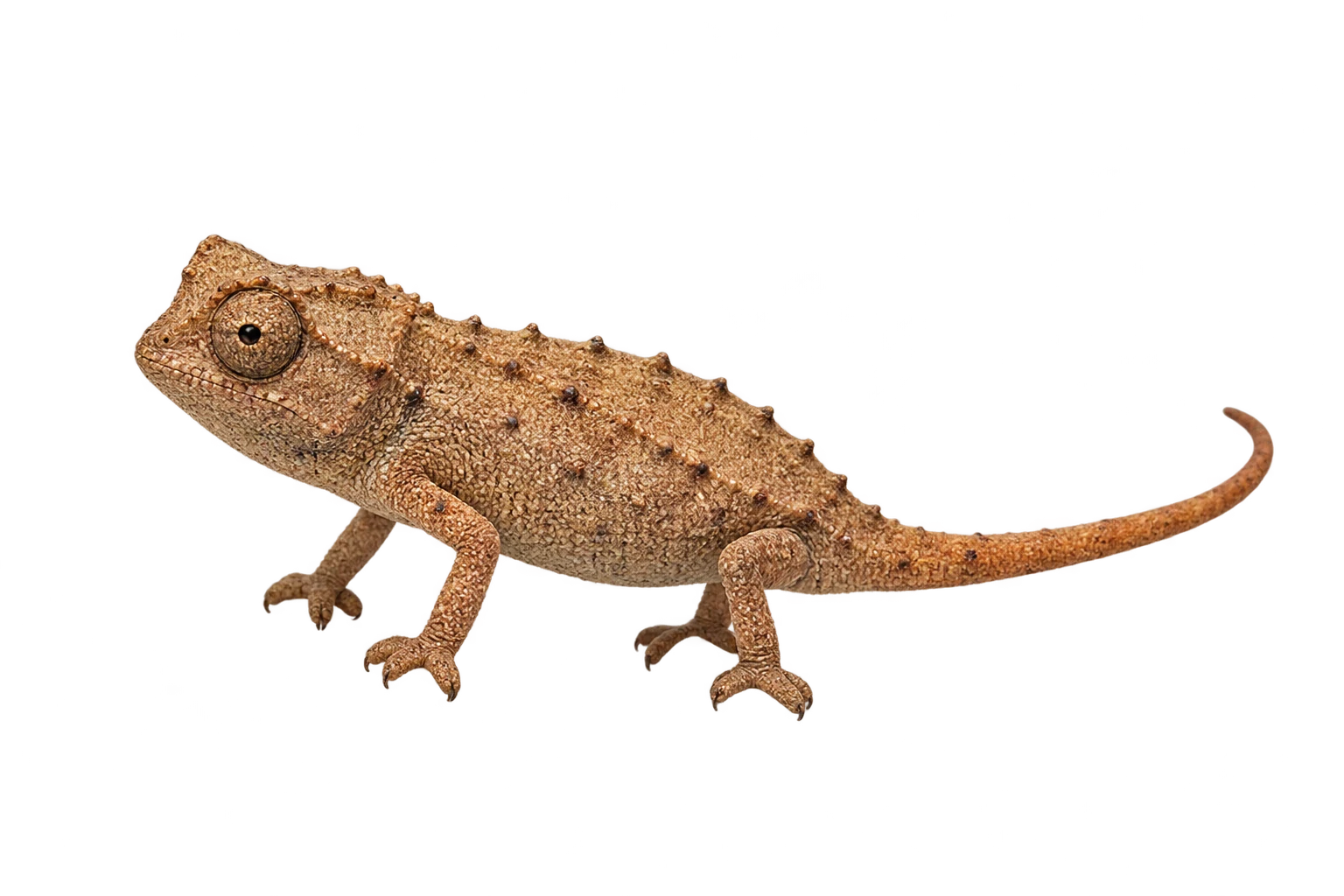
Brookesia Micra (same family), Chameleon (same family), Jackson’s Chameleon (same family), King cobra (same order), Komodo dragon (same order).
Reptiles
Brookesia Micra
Brookesia micra
Classification and source reference
LivingAI illustration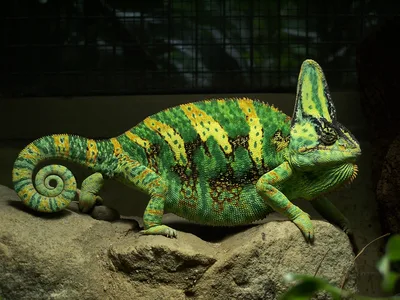
Reptiles
Chameleon
Chamaeleonidae
Chameleons are climbing lizards with specialized prey-catching tongues.
Living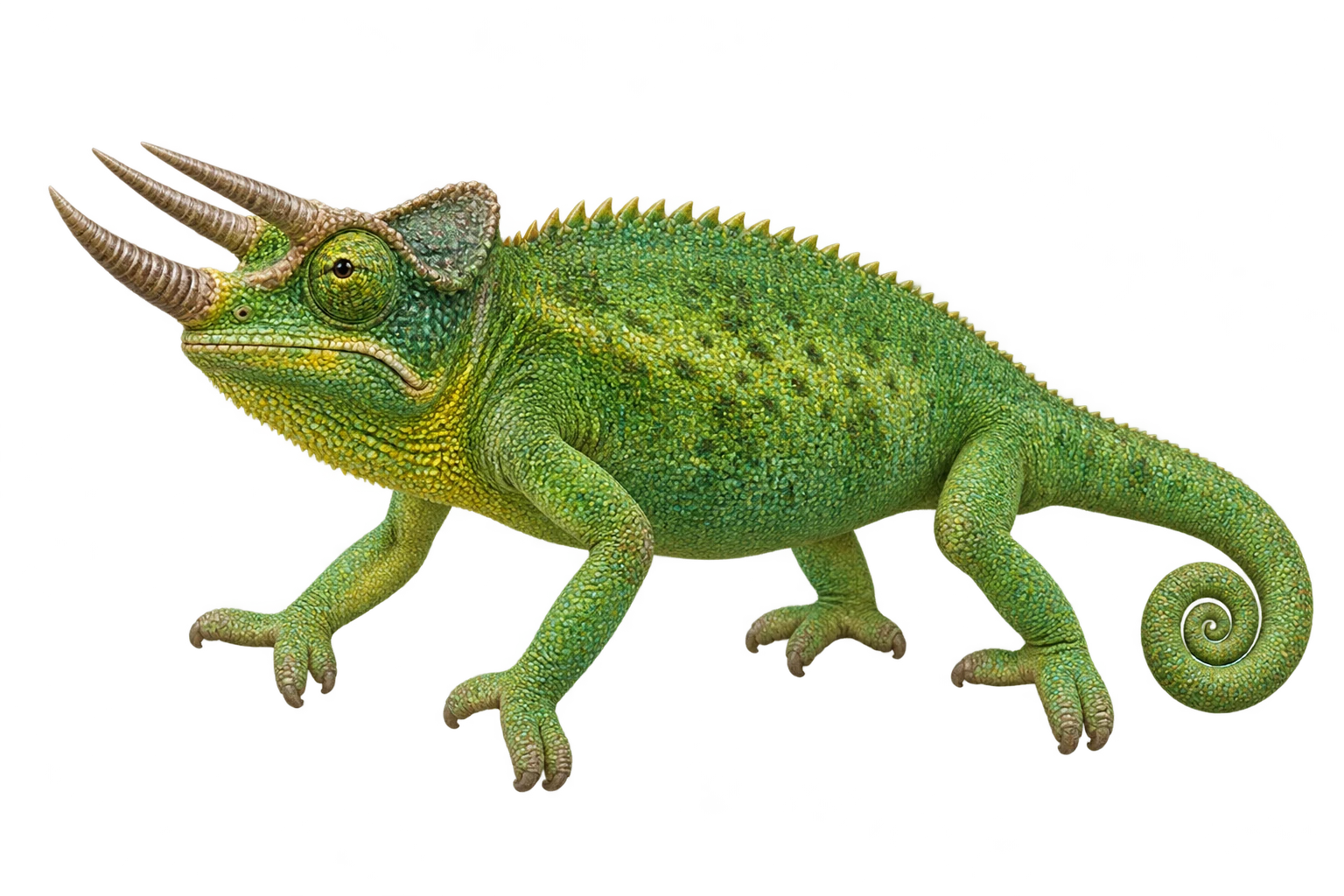
Reptiles
Jackson’s Chameleon
Trioceros jacksonii
Classification and source reference
LivingAI illustration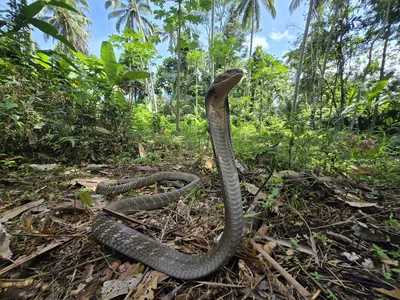 VU
Reptiles
King cobra
Ophiophagus hannah
The king cobra is the longest venomous snake.
Living EN
Reptiles
Komodo dragon
Varanus komodoensis
The Komodo dragon is the largest living lizard.
Living