Living individuals or members of this group exist today. This does not mean they are safe from extinction.
Meet the komodo dragon
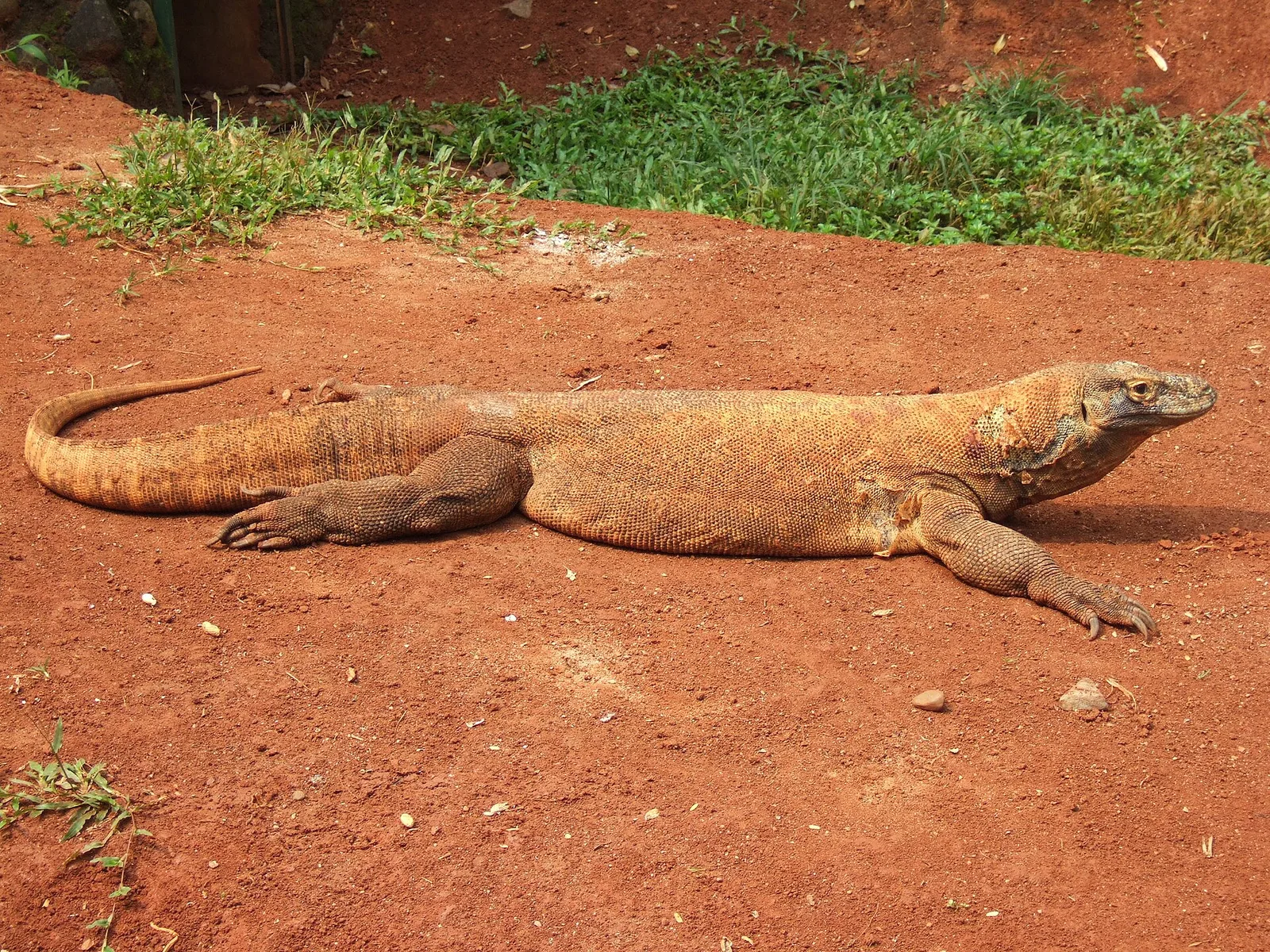
The Komodo dragon is the largest living lizard. It lives on a few Indonesian islands and brings down deer and buffalo with a venomous bite and patience.
Images of the komodo dragon
Lifespan in the wild
Up to 30 years
Weight
68 to 91 kg
Length
2.29 to 2.59 m
Top speed
Up to 20 km/h
Fact file
Komodo dragon
- Location
- Komodo, Rinca, Flores and nearby islands, Indonesia
- Habitat
- Savanna, Temperate forest, Coast
- Diet
- Carnivore
- Prey / food
- Deer, wild boar, water buffalo, carrion
- Predators
- None as adults; adults eat young dragons
- Lifestyle
- Diurnal
- Name of young
- Hatchling
- Incubation
- About 8 months of incubation
- Clutch size
- 15 to 30 eggs
- Population
- About 3,400
- Biggest threat
- Habitat loss and rising sea levels
- Distinctive feature
- A forked yellow tongue and armoured skin
- Colour
- Grey-brown
- Skin type
- Scales
Size
Next to a person
Measurements
Size and speed
- Length
- 2.29 to 2.59 m, up to 3.13 m
- Length, male
- About 2.59 m
- Length, female
- About 2.29 m
- Weight
- 68 to 91 kg
- Weight, male
- 79 to 91 kg
- Weight, female
- 68 to 73 kg
- Top speed
- Up to 20 km/h in a brief sprint
Typical adult ranges. Source: Wikipedia.
Life cycle
Lifespan
- In the wildUp to 30 years
- 030 years
The pale bar is the record. Source: Wikipedia.
Appearance
Colour and coat
- Primary colours
- grey-brown
- Secondary colours
- reddish greyyellow
- Skin type
- scales
- Male and female
- Slight. Males grow larger, at about 259 centimetres against 229 for females, but the sexes look alike otherwise.
Life cycle
Mating and family
- Mating system
- males fight for females, and some pairs may bond briefly
- Social structure
- solitary, with a size-based order at carcasses
- Breeding
- one clutch of about 20 eggs a year
Dragons mate from May to August after males wrestle for access to females. The female lays about 20 eggs in September, often in a scrubfowl mound, and guards the nest for 7 to 8 months. Hatchlings climb into trees at once and stay there for years to avoid adults. They mature at 8 to 11 years and live for up to 30 years in the wild.
Classification
Taxonomy
- Kingdom
- Animalia
- Phylum
- Chordata
- Class
- Reptilia
- Order
- Squamata
- Family
- Varanidae
- Genus
- Varanus
- Species
- Varanus komodoensis
Conservation
Red List status
- LC
- NT
- VU
- EN
- CR
- EW
- EX
Endangered on the IUCN Red List
Range
Recorded in 1 country
Habitat layer: temperate broadleaf and mixed forest, temperate conifer forest, boreal forest and taiga, tropical grassland, savanna and shrubland, mangrove.
Countries from 1,046 wild records on GBIF (iNaturalist research grade), filtered and checked by hand. Country shapes: Natural Earth. Habitat: RESOLVE Ecoregions 2017, CC BY 4.0. Basemap: Natural Earth.
Habitats
Three things to know
- 1
Young dragons live in trees to avoid being eaten by adults.
- 2
A dragon can smell carrion from about 10 km away with its tongue.
- 3
Females can reproduce without a male by parthenogenesis.
Did you know
Seven more facts
- 1
The species once lived in Australia, where fossils go back 3.8 million years.
- 2
Each tooth is replaced about every 40 days.
- 3
A dragon's skin holds small bones that make it useless for leather.
- 4
It hears only between about 400 and 2,000 hertz and was once thought deaf.
- 5
A dragon can swallow a whole goat, but it takes 15 to 20 minutes.
- 6
The first live dragons in Europe arrived at London Zoo in 1927.
- 7
The oldest known Komodo dragon lived to 62 years.
Field notes
How it looks and acts
Field notes
Distinguishing features
- A total length of 229 to 259 centimetres, the largest of any living lizard.
- A long, yellow, deeply forked tongue.
- Rough grey-brown skin armoured with bony osteoderms.
- About 60 curved, serrated teeth with blood-tinged saliva.
- A thick muscular tail as long as the body.
- Green hatchlings banded with yellow and black.
Field notes
Unique adaptations
- Venom glands in the lower jaw stop blood clotting and lower blood pressure in prey.
- A flexible skull and stretchy stomach let it swallow prey whole.
- A slow metabolism lets it live on about 12 meals a year.
- A burrow holds body heat overnight and shortens the morning bask.
- Parthenogenesis lets one female start a population on an empty island.
Field notes
Interesting behaviours
- Waits in ambush on a cleared ridge and charges passing deer.
- Basks in the morning, rests in shade at midday and hunts in the afternoon.
- Wrestles upright on its hind legs to settle rank.
- Rams a carcass against a tree to push the meat down its throat.
- Swims between islands and climbs trees when young.
Field notes
Temperament
- Solitary and wary of people, and quick to retreat.
- Aggressive at a carcass, where the biggest animal rules.
- Unpredictable in captivity even when it seems tame.
- Females are often shyer than males.
Field notes
Communication
- Hisses and holds a low posture to submit.
- Rears upright to challenge a rival.
- A female scents her droppings when ready to mate.
- A male rubs his chin on a female and licks her during courtship.
Ecology
Ecological role
The Komodo dragon is the apex predator and chief scavenger of its islands.
- Controls deer, pig and buffalo numbers as the only large predator.
- Removes carrion from the landscape quickly.
- Eats its own young, which probably keeps adult numbers in check.
- Once preyed on dwarf Stegodon before modern hoofed animals arrived.
Stories
Myths and legends
- In Komodo tradition, dragons and people descend from the twins Ora and Gerong, so the dragons are kin.
- In Komodo tradition, a dragon that swims out to sea fights the crocodiles and, if it wins, becomes one.
- In local island belief, the dragon is an ancestor spirit that links the living world and the spirit world.
- In Dutch colonial rumour of 1910, the island held fire-breathing lizards 7 metres long.
People
Relationship with humans
People
Living alongside us
Western science met the dragon in 1910, and zoos have shown it since 1927. The islanders of Komodo treat it as kin and leave it alone. It usually avoids people, but the national park recorded 24 attacks between 1974 and 2012, five of them fatal. Tourists come to see it, and poachers and smugglers still target it. Its blood has given medicine a new antibacterial peptide.
- A dragon can kill a person, and five of 24 park attacks between 1974 and 2012 were fatal.
- Most dragons flee from people, and a juvenile runs when someone comes within about 100 metres.
- A cornered dragon warns with an open mouth, a hiss and a swinging tail before it bites.
People
Status, uses and products
- Domestication
- Wild
- As a pet
- Not suitable. The species is protected under Indonesian law and CITES Appendix I, so private ownership is illegal. It grows to over two metres, needs whole large prey and carries a venomous bite.
- Uses
- ecotourismzoo exhibitionmedical research
- Products
- None recorded
The full account
About the komodo dragon
The Komodo dragon, Varanus komodoensis, is the largest lizard alive today. It belongs to the monitor lizard family and lives only on a handful of islands in eastern Indonesia. A typical adult measures 229 to 259 centimetres from nose to tail and weighs 68 to 91 kilograms. The longest verified animal reached 313 cm. With that size it sits at the top of its food chain and takes deer, pigs and water buffalo.
The dragon hunts from ambush, and its bite combines slashing teeth with venom that stops blood from clotting. Young dragons live in trees for their first years, because adults eat them. Females can lay fertile eggs without a male, a trick that zoos discovered in 2006. The IUCN lists the species as Endangered, with about 3,400 animals left in the wild. Rising seas and drier weather threaten the low valleys that the dragons depend on.
Name and taxonomy
Western science first heard of the animal in 1910, when a Dutch officer, van Steyn van Hensbroek, followed up rumours of a land crocodile. Peter Ouwens of the Bogor zoological museum published the first description in 1912, from a skin, a photograph and two collected specimens. The American explorer W. Douglas Burden coined the name Komodo dragon after his 1926 expedition. Scientific papers sometimes call it the Komodo monitor.
The species belongs to the genus Varanus, the monitor lizards, in the family Varanidae and the order Squamata. On Komodo itself the people call it ora, buaya darat, meaning land crocodile, or biawak raksasa, meaning giant monitor. The Komodo people also call the dragons sebae, twins, because tradition says people and dragons share one spiritual mother. The Baar people of Flores call it mbau.
Evolution and relatives
Mitochondrial DNA shows that the closest living relative is the lace monitor of Australia, Varanus varius. Their shared ancestor split from the line that led to the crocodile monitor of New Guinea. A 2021 study found that early Komodo dragons interbred with the ancestor of the Australian sand monitors in the late Miocene. So the dragon's story begins in Australia, not Indonesia.
Fossils from Queensland show the species living in Australia from about 3.8 million years ago until at least 330,000 years ago. There it shared the land with megalania, Varanus priscus, the largest land lizard that ever lived. The oldest Komodo dragon fossils on Flores are about 1.4 million years old. Pleistocene monitor fossils from Java and Timor may belong to the same species. During the Pleistocene the dragons probably preyed on dwarf Stegodon, small relatives of elephants, before deer and pigs reached the islands.
Appearance
An average male measures about 259 centimetres and weighs 79 to 91 kilograms. An average female is smaller, at about 229 cm and 68 to 73 kg. Wild adults usually weigh around 70 kg, and captive animals often weigh more. The largest captive animal on record measured 313 cm and weighed 166 kg with a full stomach. The tail is as long as the body.
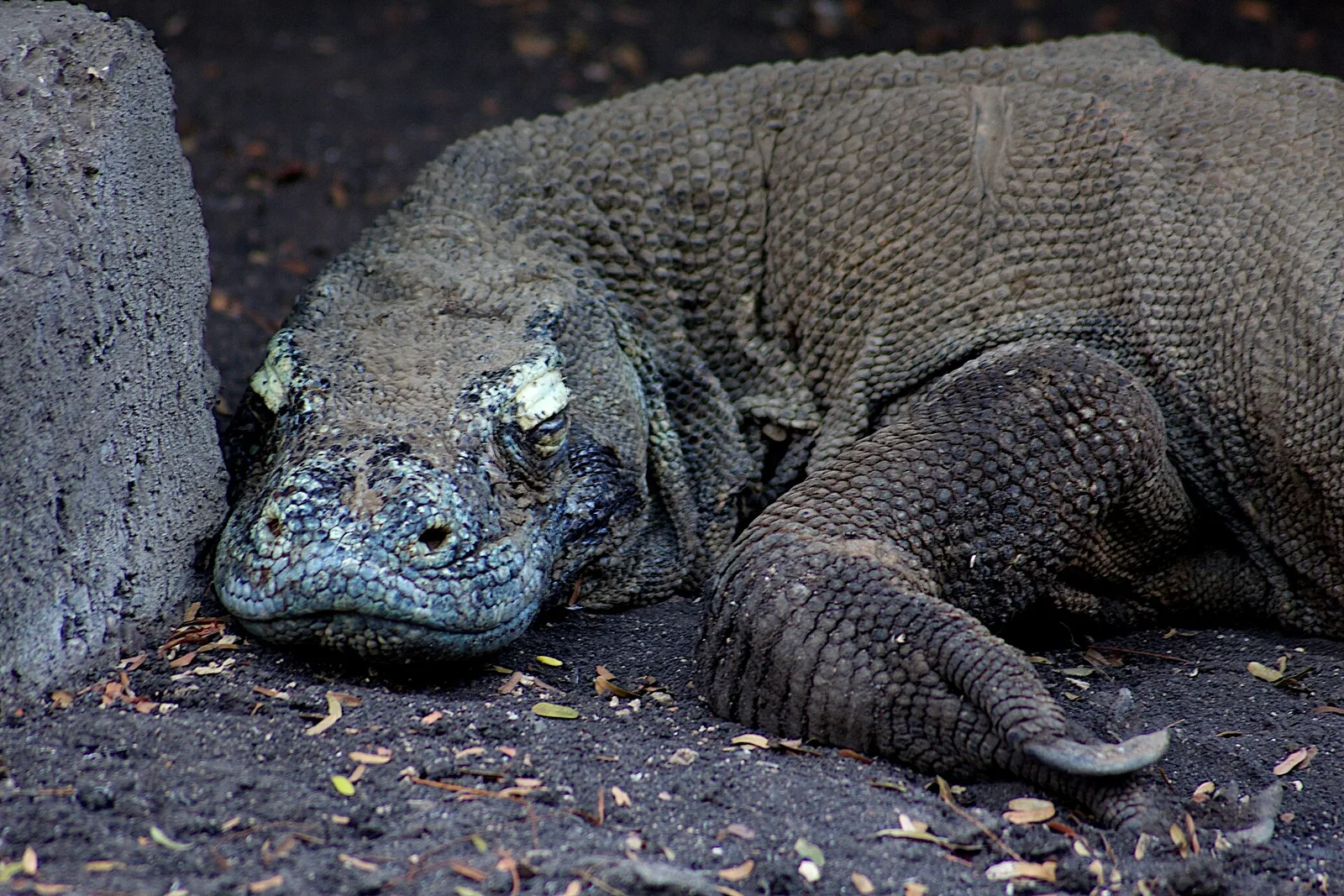
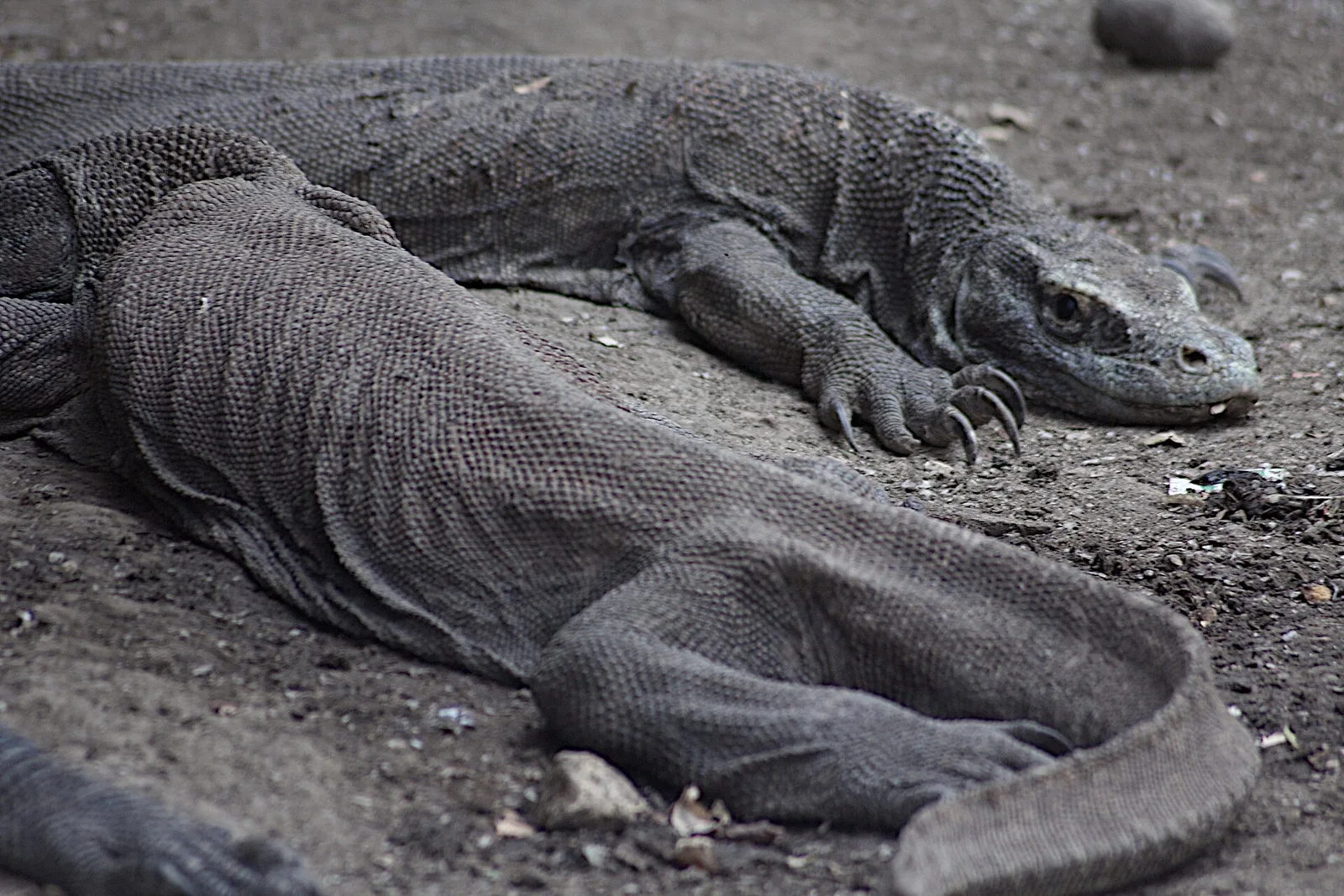
Adults are a dull grey-brown to reddish grey, while hatchlings are green with yellow and black bands. The skin is rough and studded with small bones called osteoderms, which act like chain mail. These bones grow with age, so a hatchling has none and an old adult is heavily armoured. The armour makes the hide useless for leather. A light-sensing parietal eye sits on top of the head, one of the few spots without bone.
The mouth holds about 60 curved, serrated teeth up to 2.5 cm long, of the kind seen in meat-eating dinosaurs. Each tooth is replaced about every 40 days, with up to 5 spares waiting behind it. A 2024 study found an orange, iron-rich coating on the tips and edges that keeps them sharp. The tongue is long, yellow and deeply forked. Gum tissue covers most of each tooth and tears during feeding, so the saliva is often tinged with blood.
Habitat and range
The Komodo dragon lives only in the Lesser Sunda islands of Indonesia: Komodo, Rinca, Flores, Gili Motang and Gili Dasami. The largest population lives inside Komodo National Park. The population on Padar died out, and the last dragons there were seen in 1975. GBIF holds records from 6 countries, but these include zoo animals and a mistaken Singapore newspaper report.
The dragon prefers hot, dry country: open grassland, savanna with tall grass and scrub, and tropical forest at low altitude. It also uses beaches, ridge tops and dry river beds. It does not climb into the higher parts of the islands, which is why sea level rise matters so much. Young dragons keep to forested areas, where they can climb, until they are about eight months old.
An adult roams a home range of up to 1.9 square kilometres. Dragons do not defend these ranges, so they overlap, and the biggest animal eats first at a shared kill. Each dragon digs a burrow 1 to 3 metres wide with its forelimbs and claws. It sleeps there at night and hides there in the worst heat of the day. The burrow holds warmth overnight, so the dragon needs less basking time in the morning.
Diet and hunting
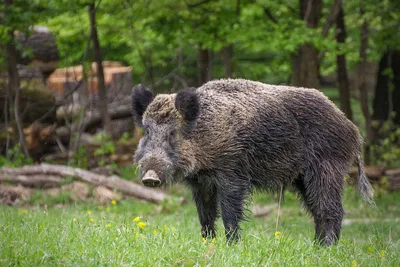
The Komodo dragon is a carnivore and the apex predator of its islands. Adults eat mainly Javan rusa deer and feral pigs, and they also kill water buffalo and goats. They take a great deal of carrion as well. Juveniles eat insects, geckos, birds and eggs, and switch to large prey once they pass about 20 kilograms. Young dragons make up about 10% of an adult's diet.
Older accounts said the dragon lived on carrion, but newer research shows it often ambushes live prey. It waits on a cleared resting spot, often a ridge with a sea breeze, and charges when a deer comes close. It goes for the throat or the belly and tries to kill on the spot through torn flesh and blood loss. Wild pigs have died within seconds, and most kills take a few minutes. The old story that a dragon bites once and then follows a dying animal for days is probably a misreading of failed attacks.
The dragon tears off big chunks of flesh and swallows them whole while it pins the carcass with its front legs. Loose jaw joints, a flexible skull and a stretchy stomach let it swallow a goat whole, though this takes 15 to 20 minutes. A tube under the tongue lets it breathe while it swallows. One meal can equal 80% of its body weight, and a big dragon can get by on only 12 meals in a year. After digestion it brings up a pellet of horns, hair and teeth, then rubs its face in the dirt to clean off the mucus.
Behaviour and social life
The Komodo dragon lives alone and meets others only to breed or to share a carcass. As a cold-blooded animal it is active mostly by day, with some movement at night. It rests in shade through the hottest hours and hunts in the afternoon. Individuals differ in temperament, and females in particular can be shy.
At a carcass the largest male eats first, then smaller males, then females, and last the juveniles once the adults leave. Smaller animals show submission with body posture and low hisses. Two dragons of equal size may wrestle upright on their hind legs, and the loser is sometimes killed and eaten. Juveniles roll in dung and hide inside the gut of a gutted carcass so hungry adults leave them alone.
The dragon can sprint at up to 20 kilometres per hour for a short distance. It swims between islands and can dive to 4.5 metres. Young dragons climb well with their strong claws, but an adult is too heavy for trees. To reach food above its head, a dragon can stand on its hind legs and prop itself with its tail.
Communication and senses
Smell is the dragon's main sense, and it smells with its tongue. The forked tongue flicks out, collects scent particles and passes them to the Jacobson's organ in the roof of the mouth. A dragon swings its head as it walks and, with a helpful wind, can find carrion 4 to 9.5 kilometres away. It has only a few taste buds, at the back of the throat.
The eyes work well by day and can pick out an object 300 metres away. The retina holds only cones, so night vision is thought to be poor. The dragon sees colour but is bad at spotting something that stays still. With a single ear bone, it hears only sounds between about 400 and 2,000 hertz. People once thought it deaf, until the keeper Joan Procter trained a London Zoo dragon to come to her voice.
Dragons signal with their bodies more than with sound. A rival hisses and holds itself low to submit, or rears up to fight. A female ready to mate leaves a scent in her droppings, and a male answers with chin rubs and licks. Sensory plaques in the scales, thickest around the lips, chin and feet, give the dragon a sense of touch.
Reproduction and life cycle
Mating runs from May to August, and females lay in September. Males fight for females by grappling upright on their hind legs until one is pinned to the ground. The winner flicks his tongue at the female to test whether she is ready. Females resist at first with claws and teeth, so the male must hold her firmly to avoid injury. Some pairs stay together for a few days afterwards, and the species may form pair bonds, which is rare in lizards.
A clutch holds about 20 eggs on average, and up to 30. In one study, 60% of females laid in the mound nests of orange-footed scrubfowl, and the rest on flat ground or hillsides. The female digs several decoy nests so other dragons cannot find the eggs. She lies on the nest during incubation, which lasts 7 to 8 months, and hatching falls in April when insects are plentiful. There is no parental care once the eggs hatch.
A hatchling cuts its way out with an egg tooth and may rest in the shell for hours before it digs upwards. One nest of 16 hatchlings averaged 46.5 cm in length and 105.1 grams in weight. The young climb into trees at once and stay there for their first years. A dragon matures at 8 to 11 years and lives for up to 30 years in the wild. The oldest known individual reached 62 years.
In 2006 a female called Flora at Chester Zoo laid 11 eggs without ever meeting a male, and seven hatched. All were male, because the dragon's ZW sex chromosomes produce only males by parthenogenesis. This may let a single female colonise a new island and then breed with her sons.
Predators and threats
An adult Komodo dragon has no natural predator. Hatchlings and juveniles are eaten by adult dragons, by larger mammals and by birds. Cannibalism probably helps adults stay large on islands where medium-sized prey is scarce. Fights over food and mates can also kill a full-grown dragon.
The species faces volcanic eruptions, earthquakes, fire and habitat loss on its small islands. Poachers take the deer the dragons need, and some poach the dragons themselves. In 2019 police in Surabaya broke up a ring that tried to smuggle 41 young dragons out of Indonesia. Climate change is the biggest future threat, through drier weather and rising seas in the lowland valleys. One projection puts the loss of suitable habitat by 2050 at 8.4%, 30.2% or 71%, depending on the emissions scenario.
Population and conservation
The IUCN Red List classes the Komodo dragon as Endangered. Surveys counted 3,222 wild dragons in 2013, 3,092 in 2014 and 3,014 in 2015. Numbers held steady on Komodo and Rinca but fell on the small islands of Nusa Kode and Gili Motang, probably because prey ran short. The population on Padar vanished after poaching removed its large prey.
Indonesian law protects the species, and Komodo National Park opened in 1980 to guard Komodo, Rinca and Padar. The Wae Wuul and Wolo Tado reserves on Flores followed. CITES Appendix I bans all commercial trade in skins or live animals. Some scientists dispute the more extreme climate projections, but all agree that the low-lying habitat is the weak point. iNaturalist holds 2,707 observations of the species.
Relationship with humans
Komodo dragons usually avoid people. A juvenile flees if a person comes within about 100 metres, and adults also retreat. A cornered dragon gapes, hisses and swings its tail, and it bites only if pushed further. Komodo National Park recorded 24 attacks between 1974 and 2012, five of them fatal, mostly on local villagers. Dragons have dug up bodies from shallow graves, so villagers now bury their dead in clay and pile rocks on top.
The first live dragons reached Europe in 1927, when London Zoo opened its Reptile House. Early zoo animals died within a few years, until Walter Auffenberg's 1969 field study on Komodo showed how to keep them. Surabaya Zoo has bred them since 1990 and held 134 in 2022, the largest group outside the wild. Captive dragons become tame, recognise their keepers and play with shovels, cans and shoes. Even so, a Los Angeles Zoo dragon bit the journalist Phil Bronstein on the foot in 2001 and severed tendons.
The dragons are a major draw for tourists, which brings money to the park and some disturbance to the animals. They also kill livestock in villages near their range. Scientists have taken a peptide from dragon blood and built a drug candidate, DRGN-1, that kills drug-resistant bacteria.
In culture and myth
On Komodo, an origin story tells of twins, the girl Ora and the boy Gerong, born to the same mother. Ora was a dragon and grew up in the wild, so islanders regard the dragons as relatives and leave them unharmed. This is why the Komodo language calls the animals sebae, twins. Local belief treats the dragon as a protector and an ancestor spirit that joins the physical and spirit worlds.
Another Komodo tale says a dragon that enters the sea must fight the crocodiles, and a winner remains in the sea as a crocodile. Dutch reports in 1910 spoke of fire-breathing lizards 7 metres long, which gave the animal its dragon name. Burden's 1926 expedition inspired the 1933 film King Kong. Three of his stuffed specimens still stand in the American Museum of Natural History.
A sentence with a dotted underline is inferred: it describes the group the animal belongs to, or is a reading of the sources, rather than a measured or reported fact about this species.
Questions
Komodo dragon questions, answered
How big is a Komodo dragon?
An adult measures 229 to 259 centimetres and weighs 68 to 91 kilograms. The record length is 313 cm. It is the largest lizard alive.
Is a Komodo dragon venomous?
Yes. Researchers found venom glands in the lower jaw in 2009. The venom stops blood clotting and lowers blood pressure, though some scientists argue that the bite wound itself does most of the damage.
Where do Komodo dragons live?
Only on a few Indonesian islands: Komodo, Rinca, Flores, Gili Motang and Gili Dasami. Most live inside Komodo National Park.
What do Komodo dragons eat?
Adults eat deer, wild pigs, water buffalo and goats, plus a lot of carrion. Young dragons eat insects, geckos, birds and eggs. Adults also eat smaller dragons.
Are Komodo dragons endangered?
Yes. The IUCN lists them as Endangered, with about 3,400 left in the wild. Habitat loss, poaching of prey and rising sea levels are the main threats.
How fast can a Komodo dragon run?
It can sprint at up to 20 kilometres per hour, but only for a short burst. It relies on ambush rather than a chase.
Can a Komodo dragon kill a human?
Yes, though attacks are rare. Komodo National Park recorded 24 attacks between 1974 and 2012, and five people died. Most dragons avoid people.
How long do Komodo dragons live?
A wild dragon can reach 30 years of age. The oldest known individual reached 62.
How many eggs does a Komodo dragon lay?
A clutch averages about 20 eggs and can hold up to 30. The eggs incubate for 7 to 8 months and hatch in April.
Can Komodo dragons reproduce without a male?
Yes. A female can lay fertile eggs by parthenogenesis, as Flora did at Chester Zoo in 2006. All such hatchlings are male because of the dragon's ZW sex chromosomes.
Why do young Komodo dragons live in trees?
Adults eat them. Juveniles make up about 10% of an adult's diet, so hatchlings climb at once and stay in the trees for their first years.
Can Komodo dragons swim?
Yes. They swim between islands and can dive to 4.5 metres.
Do Komodo dragons have bacteria in their saliva?
Older accounts said their saliva was full of deadly bacteria. A 2013 study found ordinary mouth bacteria like those of other carnivores, and dragons clean their mouths after feeding. Venom and the slashing bite do the real work.
How far can a Komodo dragon smell?
With a good wind it can detect carrion 4 to 9.5 kilometres away. It smells with its forked tongue and the Jacobson's organ in its mouth.
Why is it called a dragon?
Early Dutch reports in 1910 described fire-breathing lizards 7 metres long. W. Douglas Burden, an American explorer, gave the animal its English name in 1926.
Can you keep a Komodo dragon as a pet?
No. The species is protected by Indonesian law and CITES, so trade is illegal. It also grows too large and too dangerous for any private home.
Food web
Prey and food
- deer
 Wild boar
- water buffalo
- carrion
Food web
Predators
- adults
Ecological equivalents
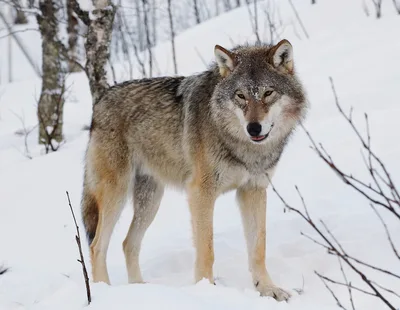
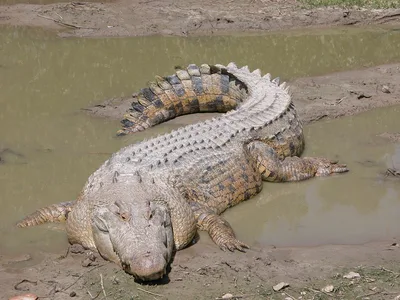
Related species on this site
Ackie Monitor (same genus), Asian Water Monitor (same genus), Black Throat Monitor (same genus), Crocodile Monitor (same genus), Emerald Tree Monitor (same genus), Lace Monitor (same genus), and more.
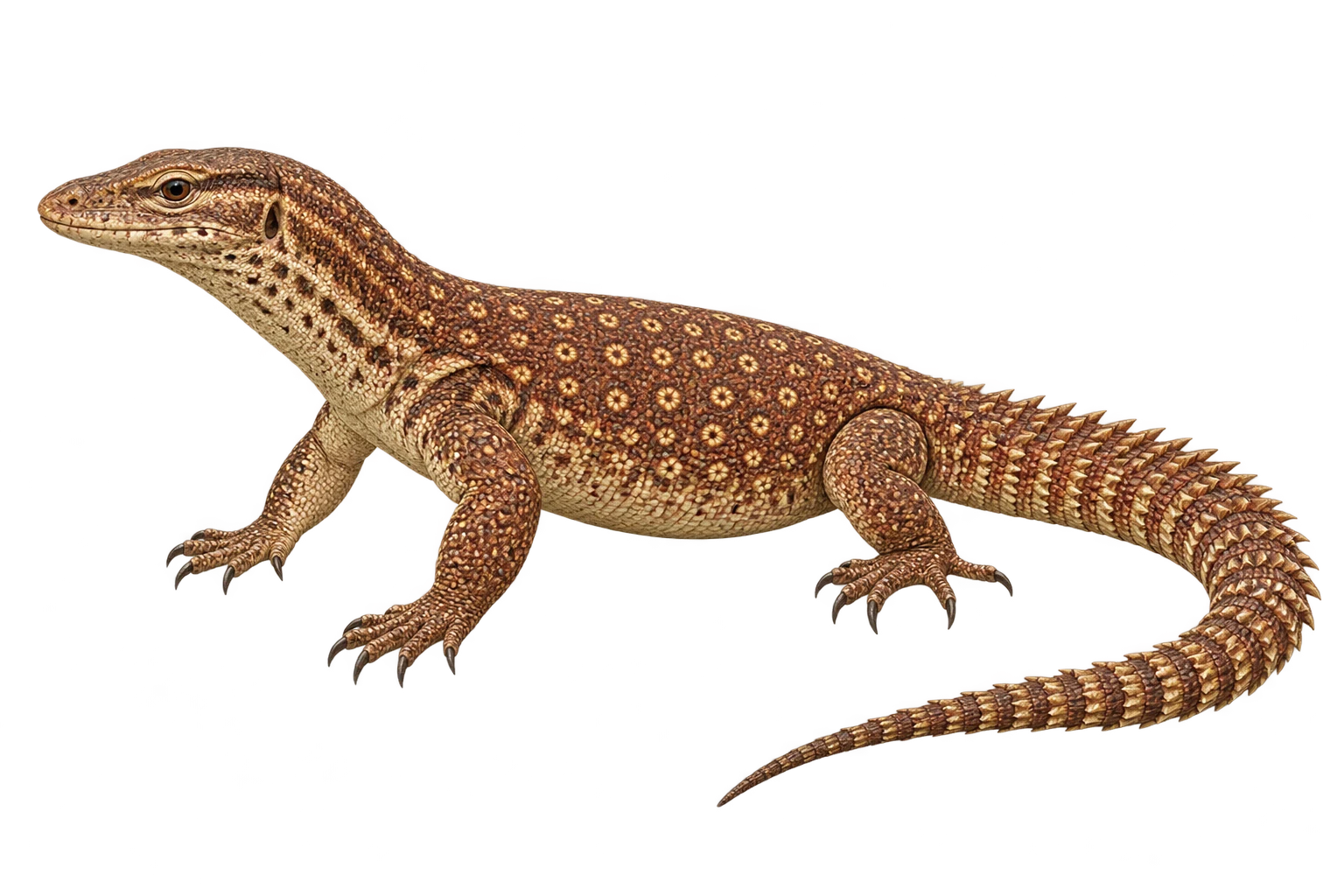
Reptiles
Ackie Monitor
Varanus acanthurus
Classification and source reference
LivingAI illustration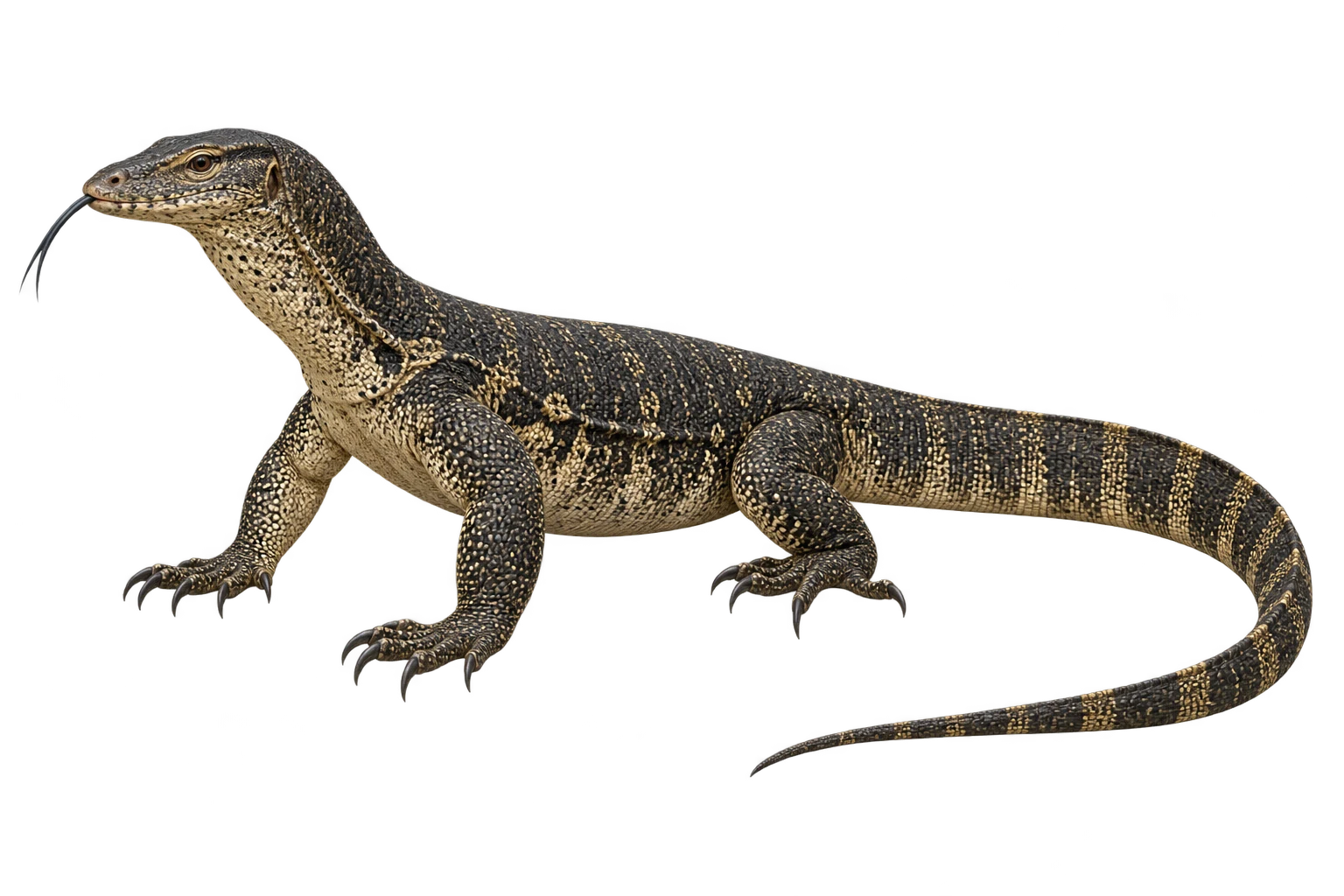
Reptiles
Asian Water Monitor
Varanus salvator
Classification and source reference
LivingAI illustration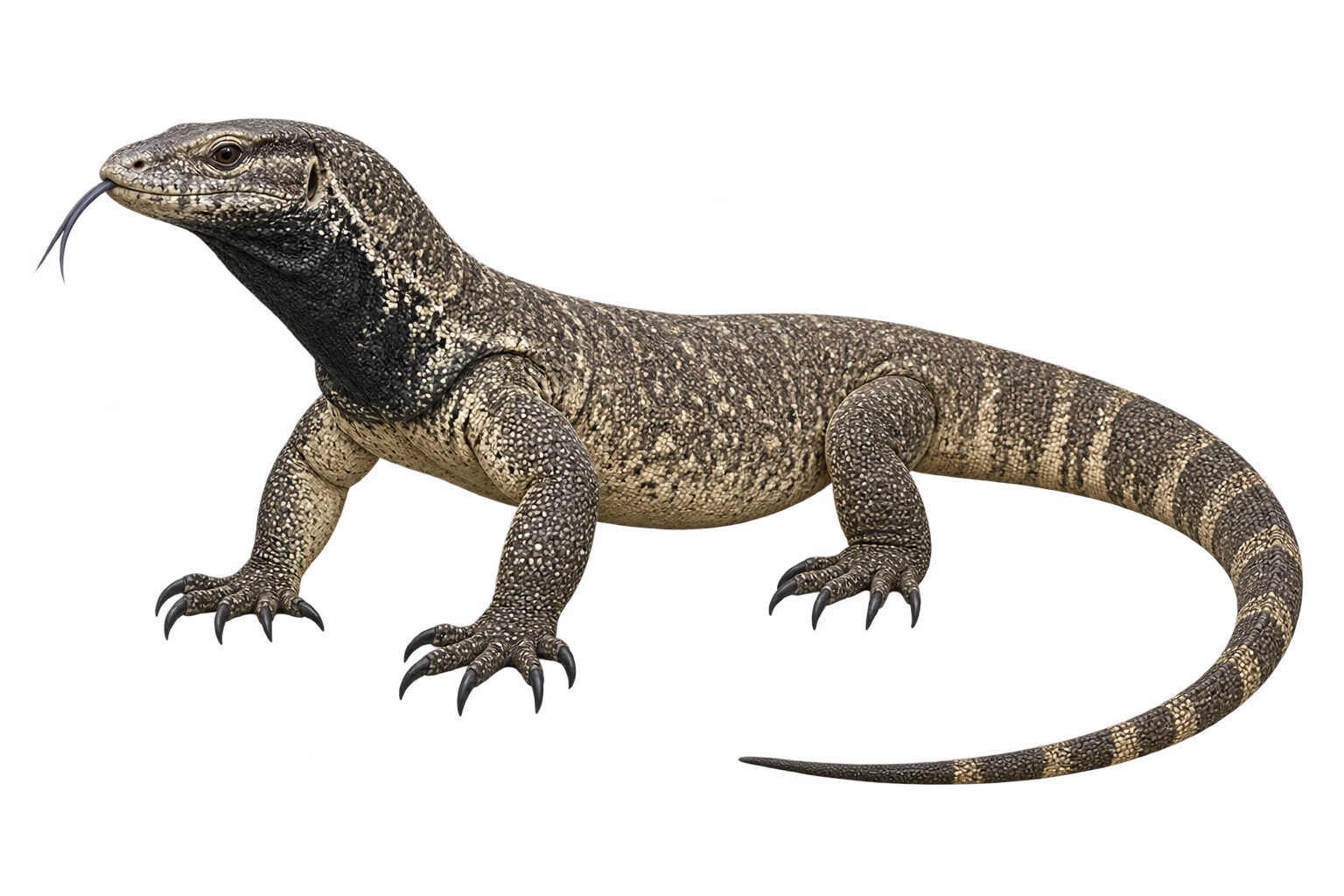
Reptiles
Black Throat Monitor
Varanus albigularis ionidesi
Classification and source reference
LivingAI illustration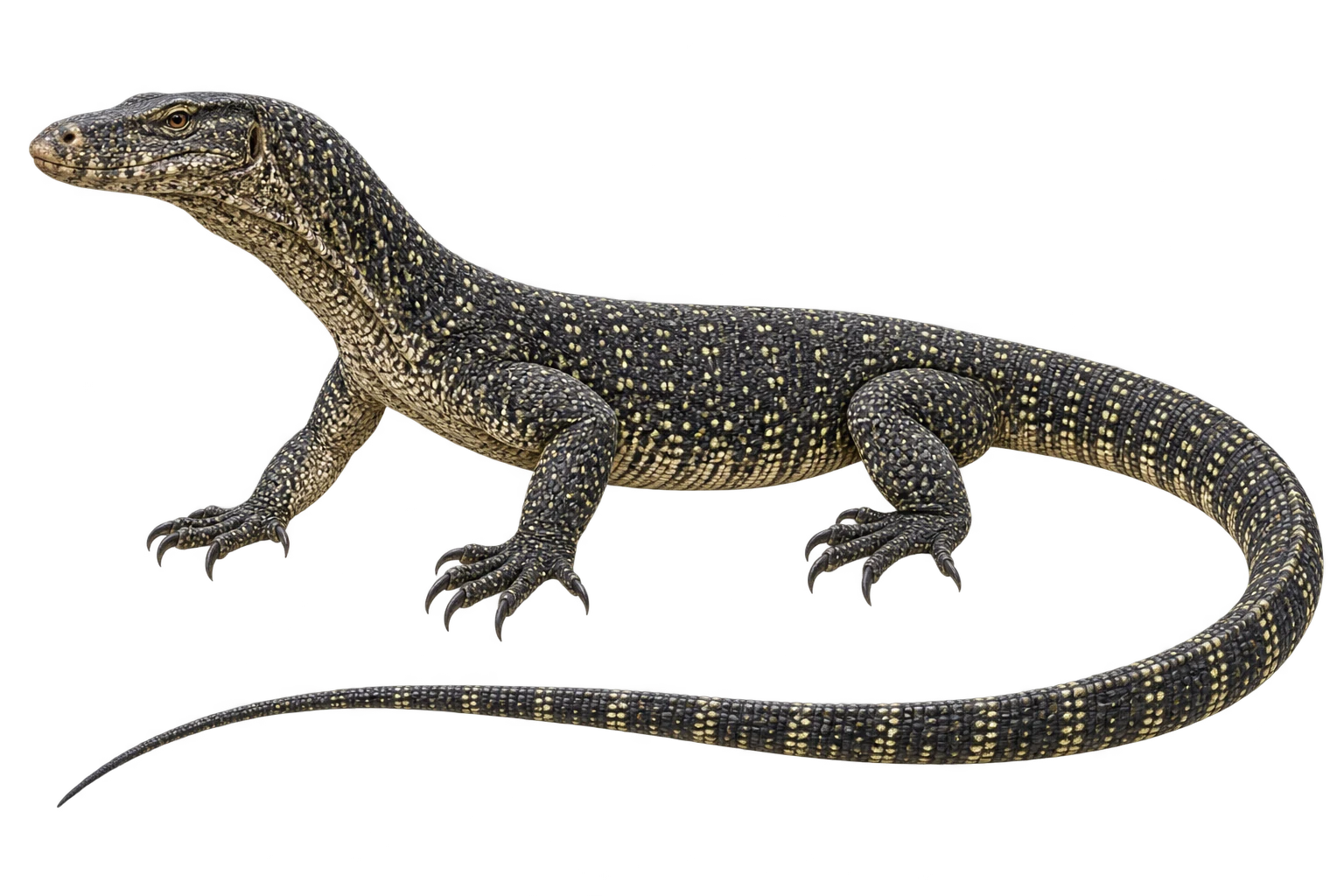
Reptiles
Crocodile Monitor
Varanus salvadorii
Classification and source reference
LivingAI illustration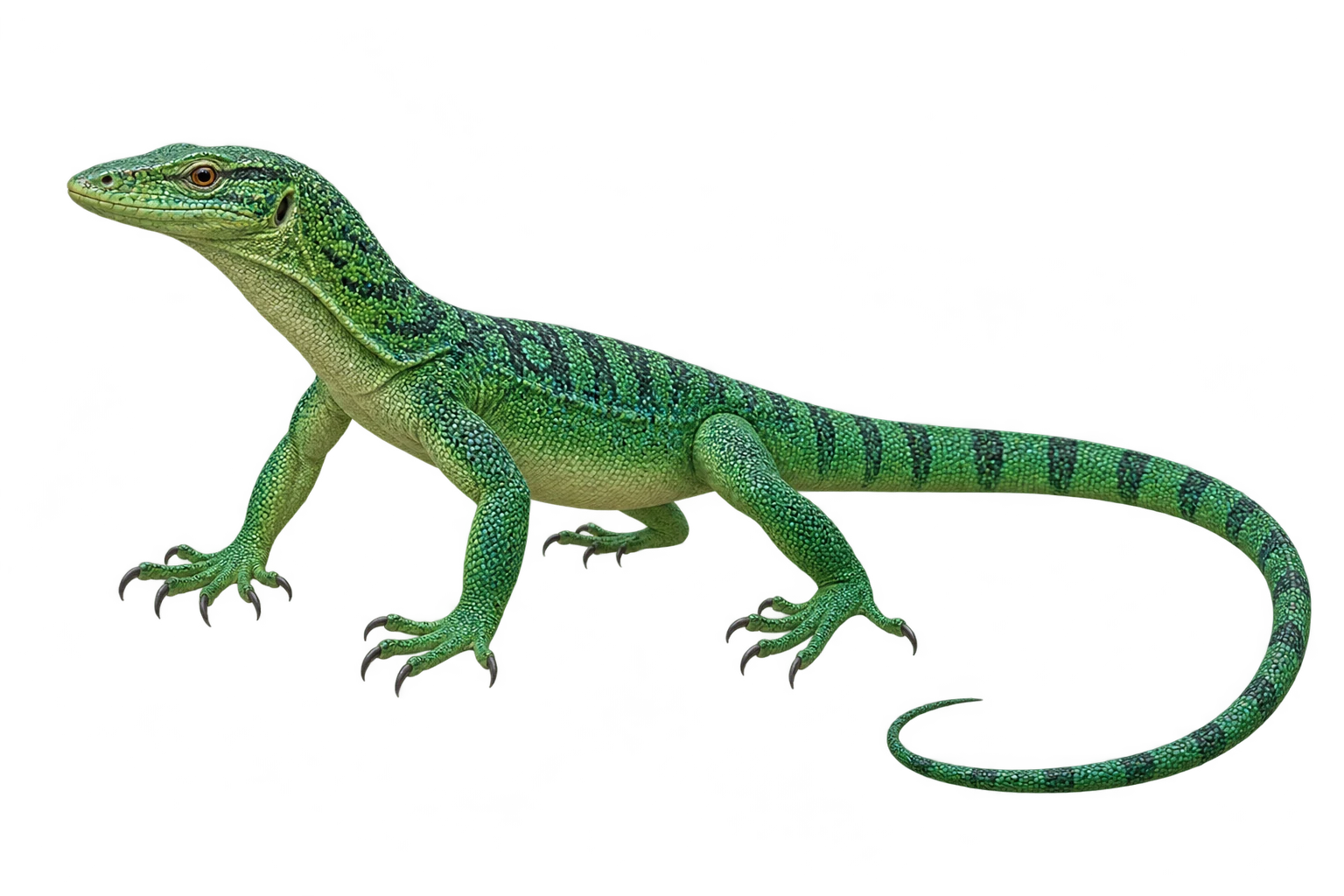
Reptiles
Emerald Tree Monitor
Varanus prasinus
Classification and source reference
LivingAI illustration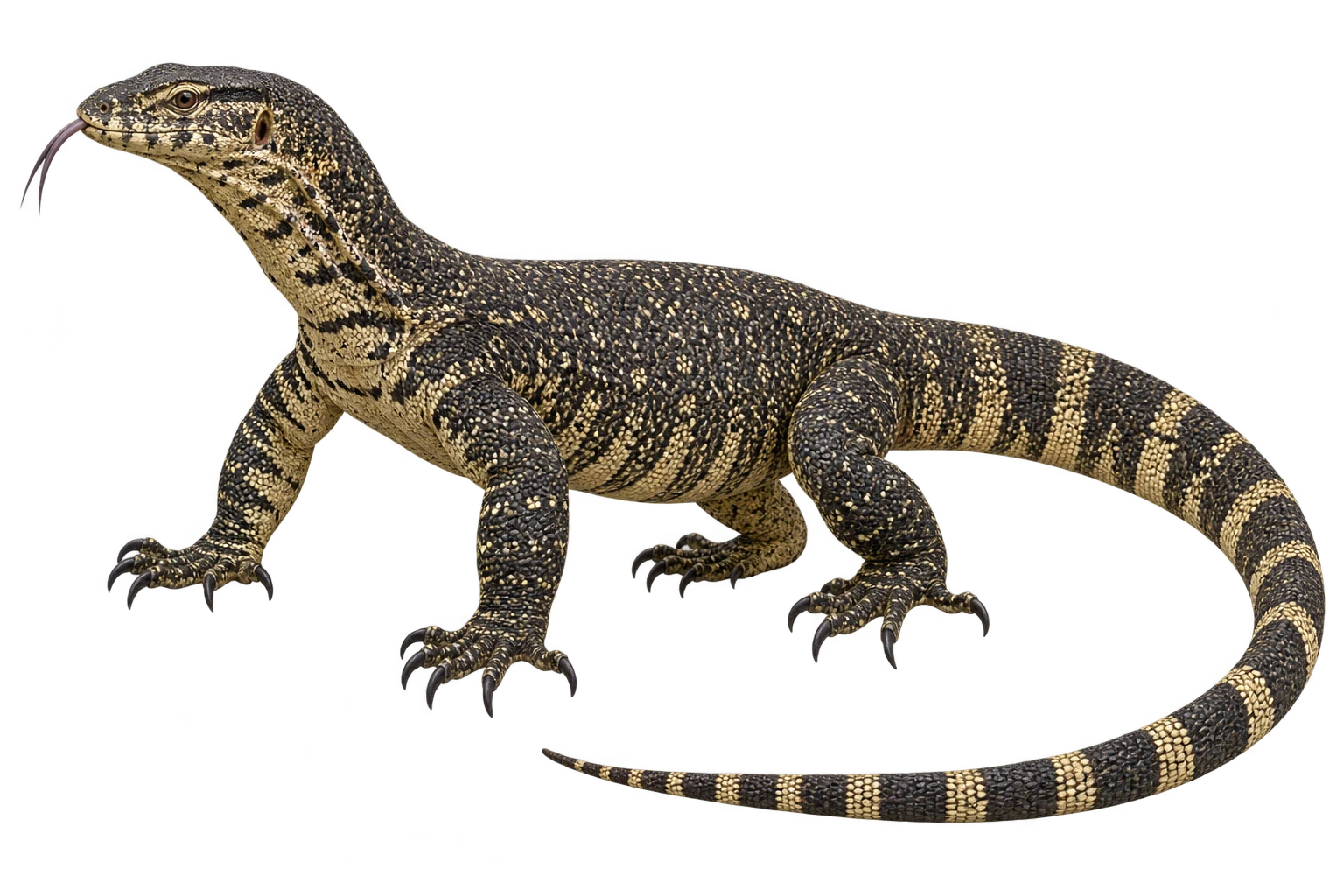
Reptiles
Lace Monitor
Varanus varius
Classification and source reference
LivingAI illustration