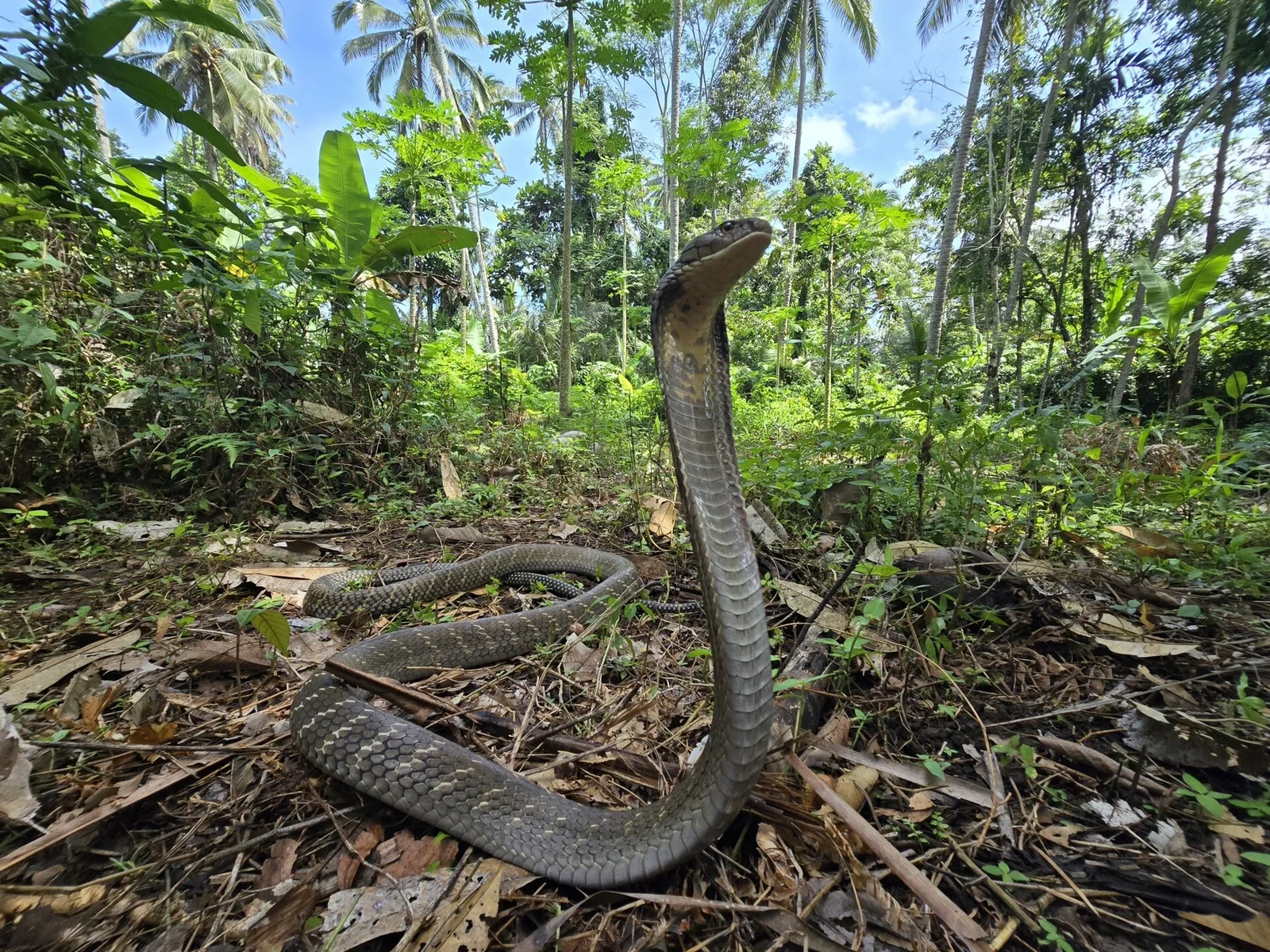
King cobra
The longest venomous snake, and the only one that nests
Ophiophagus hannah
Living individuals or members of this group exist today. This does not mean they are safe from extinction.
Meet the king cobra
The king cobra is the longest venomous snake. It hunts other snakes in the forests of South and Southeast Asia and is the only snake that builds a nest.
Images of the king cobra
Lifespan in the wild
About 20 years
Weight
Up to 10 kg
Length
3.18 to 4 m
Fact file
King cobra
- Location
- India, southern China, Southeast Asia, Indonesia
- Habitat
- Rainforest, Temperate forest, Wetlands
- Diet
- Carnivore
- Prey / food
- Other snakes, lizards
- Predators
- Mongooses, birds of prey take young
- Lifestyle
- Diurnal
- Name of young
- Hatchling
- Incubation
- 60 to 80 days of incubation
- Clutch size
- 20 to 40 eggs
- Biggest threat
- Deforestation and harvesting for skin and medicine
- Distinctive feature
- A hood it spreads when threatened
- Colour
- Olive, brown or black with pale bands
- Skin type
- Scales
Size
Next to a person
Measurements
Size and speed
- Length
- 3.18 to 4 m, up to 5.85 m
- Length, male
- Up to 3.75 m in one Kerala sample
- Length, female
- Up to 2.75 m in one Kerala sample
- Weight
- Up to 10 kg
- Weight, male
- Up to 10 kg
- Weight, female
- Up to 5 kg
Typical adult ranges. Source: Wikipedia.
Life cycle
Lifespan
- In the wildAbout 20 years
- In captivityUp to 22.5 years
- 022.5 years
Appearance
Colour and coat
- Primary colours
- olivebrownblack
- Secondary colours
- yellowcream
- Skin type
- scales
- Male and female
- Moderate. Males grow longer and heavier, reaching 375 centimetres and 10 kilograms in a Kerala sample against 275 cm and 5 kg for females. Males are also paler in the breeding season.
Life cycle
Mating and family
- Mating system
- males fight in ritual combat for a female
- Social structure
- solitary, with pairs together only at the nest
- Breeding
- one clutch of 20 to 40 eggs a year
Males wrestle for females between January and April. The female carries the eggs for 50 to 59 days, then builds a mound of dead leaves and lays 20 to 40 eggs inside. She guards the nest, and the rotting leaves keep the eggs warm for 66 to 105 days. Hatchlings are venomous at once and fend for themselves. A wild snake lives about 20 years.
Classification
Taxonomy
- Kingdom
- Animalia
- Phylum
- Chordata
- Class
- Reptilia
- Order
- Squamata
- Family
- Elapidae
- Genus
- Ophiophagus
- Species
- Ophiophagus hannah
Conservation
Red List status
- LC
- NT
- VU
- EN
- CR
- EW
- EX
Vulnerable on the IUCN Red List
Range
Recorded in 16 countries
- Bangladesh
- Brunei
- Bhutan
- People's Republic of China
- Hong Kong
- Indonesia
- India
- Cambodia
- Laos
- Sri Lanka
- Myanmar
- Malaysia
- Nepal
- Philippines
- Thailand
- Vietnam
Habitat layer: tropical moist broadleaf forest, temperate broadleaf and mixed forest, temperate conifer forest, boreal forest and taiga, flooded grassland and savanna, mangrove.
Countries from 287 wild records on GBIF (iNaturalist research grade), filtered and checked by hand. Country shapes: Natural Earth. Habitat: RESOLVE Ecoregions 2017, CC BY 4.0. Basemap: Natural Earth.
Habitats
Three things to know
- 1
It can raise a third of its body off the ground and look a person in the eye.
- 2
One bite carries enough venom to kill an elephant.
- 3
The genus name means 'snake eater'.
Did you know
Seven more facts
- 1
The king cobra is not a true cobra, and its closest relatives are the mambas of Africa.
- 2
The genus name Ophiophagus means snake eater.
- 3
A 2024 revision split the species into four, with the northern king cobra keeping the old name.
- 4
The species name hannah may honour a young woman named Hannah Wallich, not a queen.
- 5
After a large meal the snake may go for months without eating.
- 6
Females can lay fertile eggs without a male.
- 7
A pair of large scales behind the head, the occipitals, sets it apart from every true cobra.
Field notes
How it looks and acts
Field notes
Distinguishing features
- A length of 318 to 400 centimetres, the longest of any venomous snake.
- A narrow, oval hood with two black spots on the neck.
- A pair of large occipital scales behind the head.
- Olive, brown or black skin with pale cross-bands that converge towards the head.
- Golden eyes with round pupils.
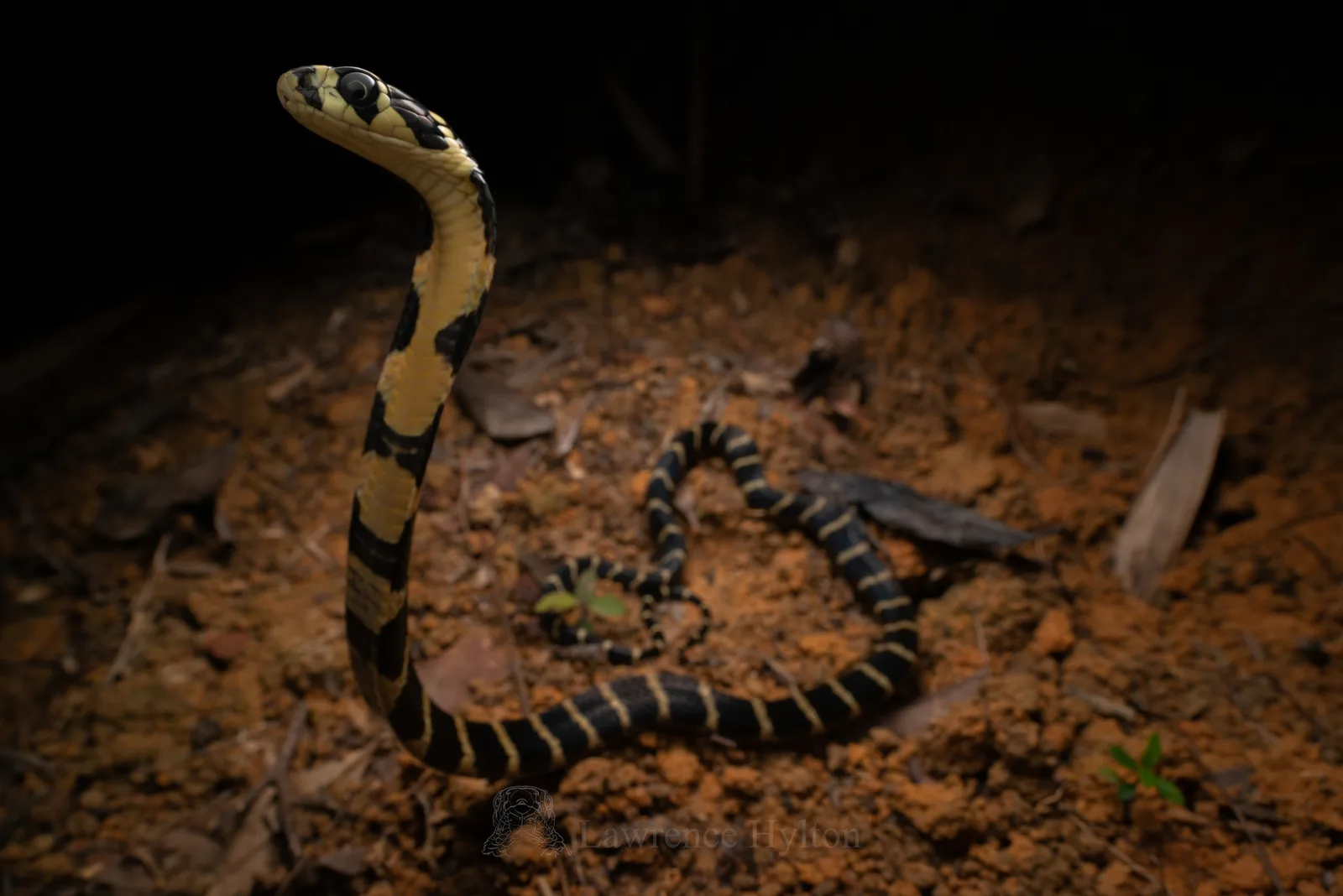
- Black juveniles with forward-pointing white or yellow chevrons.
Field notes
Unique adaptations
- Venom rich in nerve toxins that stops the breathing of large prey.
- Loose jaws that let it swallow snakes wider than its head.
- A slow metabolism that carries it for months between meals.
- Resonating pouches on the windpipe that produce a deep warning growl.
- Resistance to the venom of the snakes it eats, which is thought to let it prey on cobras and kraits.
Field notes
Interesting behaviours
- Hunts other snakes by day, following their scent trails.
- Rears up, spreads its hood and growls when threatened.
- Builds a mound of leaves for its eggs and lies on top to guard them.
- Males wrestle without biting to win a female.
- Slips away from people when it can.
Field notes
Temperament
- Shy and cautious, and quick to retreat.
- Fierce in defence of its nest.
- Easily startled by sudden movement or a close object.
- Nervous and defensive as a hatchling.
Field notes
Communication
- A low growling hiss that peaks near 600 hertz.
- A spread hood and raised body as a visual warning.
- Bared fangs and a forward charge when the warning fails.
- Scent, read with the tongue and the Jacobson's organ, to track prey and mates.
Ecology
Ecological role
The king cobra is the top predator among the snakes of Asian forests.
- Eats rat snakes, cobras, kraits and pythons, and so controls other snake populations.
- Takes monitor lizards, birds and rodents when snakes are scarce.
- Feeds mongooses and birds of prey as a hatchling.
- Probably keeps venomous snake numbers down around villages at the forest edge.
Stories
Myths and legends
- In Indian tradition, the image of a cobra's killer stays in its eyes for its mate to see and avenge.
- In Hindu and Buddhist tradition, the king cobra stands for the Nagas, serpent guardians of water and treasure.
- In Pakokku tradition in Myanmar, a weekly tattoo with venom-laced ink protects the wearer from the snake.
- In Thai tradition, a shrine in Bangkok houses the spirit of a female king cobra whose nest was destroyed by a road.
People
Relationship with humans
People
Living alongside us
The king cobra is India's national reptile and a figure in the myths of South and Southeast Asia. Its bite can kill a person within an hour, yet it avoids people and kills fewer than five a year across its range. Antivenom from India and Thailand treats bites well when given fast. Poachers take the snake for meat, skin and medicine, and forest loss is the bigger threat. Zoos show it as a star exhibit.
- A single bite can kill an adult in as little as 30 minutes without antivenom.
- The snake is shy and bites only when cornered, surprised or guarding its nest.
- It can strike from a long distance and bite several times in one attack.
People
Status, uses and products
- Domestication
- Wild
- As a pet
- Not suitable. The king cobra is a protected species with a bite that can kill within the hour. It grows to over three metres and needs a diet of live snakes. It belongs in a zoo with antivenom on hand, not a home.
- Uses
- zoo exhibitionvenom researchsnake charming
- Products
- skinmeattraditional medicine
The full account
About the king cobra
The king cobra, Ophiophagus hannah, is the longest venomous snake in the world. An adult measures 318 to 400 centimetres, and the record is 585 cm. It lives in the forests of South and Southeast Asia, from India and Nepal through Myanmar and Thailand to southern China, Indonesia and the Philippines. Despite its name, it is not a true cobra of the genus Naja, and its closest relatives are the mambas of Africa. The genus name means snake eater, and other snakes are its main food.
No other snake builds a nest, but the king cobra does. The female heaps up dry leaves, lays her eggs inside and guards the mound until they hatch. When alarmed, the snake lifts the front third of its body, spreads its hood and gives a low hiss that sounds like a growl. It usually avoids people, and fewer than five people a year die from its bite across its whole range. The IUCN has listed the species as Vulnerable since 2010, because of the loss of its forests.
Name and taxonomy
The Danish naturalist Theodore Cantor described the species in 1836 as Hamadryas hannah, from three snakes taken in the Sundarbans and one near Kolkata. He never explained the name hannah, and it may honour Hannah Sarah Wallich, the daughter of his uncle and host, the botanist Nathaniel Wallich. Albert Günther proposed the genus Ophiophagus in 1864, because Hamadryas was already the name of a butterfly. Charles Bogert confirmed Ophiophagus hannah as the valid name in 1945 after showing how much the snake differs from the Naja cobras. Older books call it the hamadryad.
The oldest name of all, Naja bungaroides, was given by Friedrich Boie in 1828 for a young snake from Java. By a mix-up in 1837 that name ended up on an Australian snake, and the error was found only in 2024. Taxonomists chose to keep the familiar names rather than upend two centuries of literature. A 2021 genetic study and a 2024 revision split the king cobra into four species. O. hannah, the northern king cobra, keeps the old name. The Sunda, Western Ghats and Luzon king cobras became O. bungarus, O. kaalinga and O. salvatana.
Evolution and relatives
The king cobra belongs to the family Elapidae, which also holds the true cobras, kraits, mambas, coral snakes and sea snakes. Genetic studies using cytochrome b and several other genes place it as an early branch of the line that led to the mambas. So its hood and its name are a case of resemblance, not close kinship, with the Naja cobras. Cantor noted in 1838 that its teeth sit between those of Naja and the kraits, Bungarus.
Mitochondrial DNA shows that snakes from southern Thailand form a deeply separate group from those of northern Thailand, Myanmar and Guangdong. That split underlies the modern division into four species. The northern species differs from the others in its dark-edged yellow bands. It also has more teeth on the pterygoid bone, 18 to 21 against 11 or 12. Its juveniles carry 27 to 48 body bands, far fewer than the 57 to 87 of the Sunda king cobra.
Appearance
An adult king cobra is 318 to 400 centimetres long. The longest known specimen measured 585 cm, and one from Thailand reached 5.59 m. Males grow larger than females: in one Kerala sample, males reached 375 cm and 10 kilograms, females 275 cm and 5 kg. Males are also paler, especially in the breeding season. The snake is heavier in the body than most elapids and ranks among the heaviest venomous snakes.
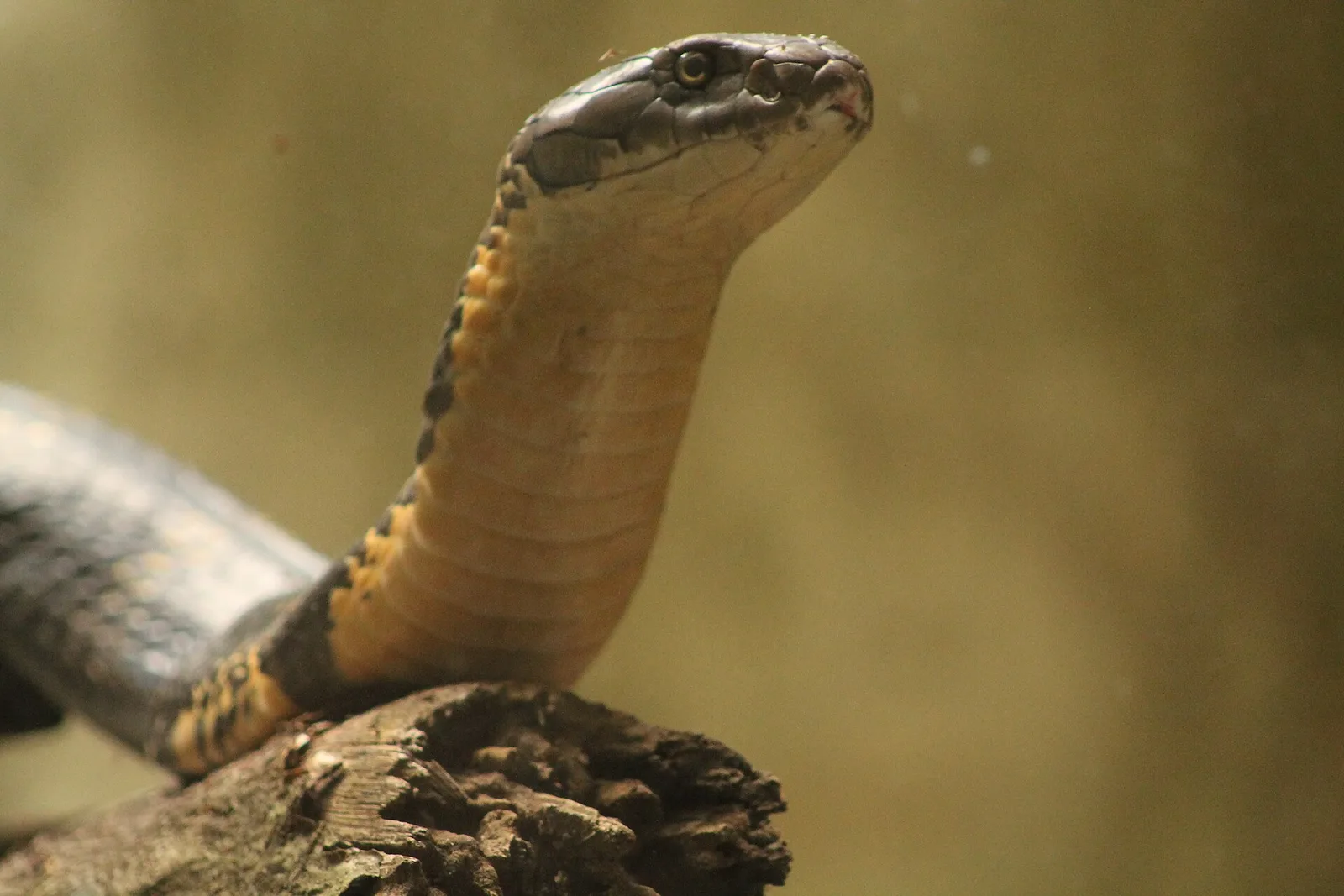
The skin is olive green, yellow, brown or black, with pale cross-bands that run together towards the head. Colour varies across the range, from black with white stripes to a plain brownish grey. The throat is light yellow or cream. Juveniles are jet black with white, yellow or buff chevrons that point forward, and the bright marks fade with age. The tail is yellowish green above, marked with black.
The head is covered by 15 large shields, and a pair of large occipital scales sits behind them, which no true cobra has. The muzzle is rounded, the tongue black, and the big eyes show a golden iris around a round pupil. There are 17 to 19 rows of smooth scales on the neck and 15 on the body. The upper jaw holds two fangs and 3 to 5 other teeth. The hood is oval and narrower and longer than a Naja cobra's, with two black spots on the neck.
Habitat and range
The king cobra lives in dense and open forest, bamboo thickets, mangrove swamps and farmland next to forest, usually near streams. It occurs from sea level up to 2,000 metres. It probably prefers rainforest and moist forest but tolerates drier woodland and rice fields at the forest edge.
The range runs from the Terai of India and Nepal along the Himalayan foothills to Bhutan and northeast India. From there it reaches Bangladesh, Myanmar, southern China including Hong Kong and Hainan, Cambodia, Laos, Thailand and Vietnam. In the south it covers Malaysia, Singapore, Indonesia and the Philippines. In India it lives in the Eastern Ghats, the Western Ghats, the Sundarbans, the Andaman Islands and the hills of the northeast. Old records from Lahore and Palanpur in the far west were once blamed on snake charmers but are now thought to be natural.
The species is widespread but seldom seen. Singapore has 39 records between 1929 and 2010, and recent sightings include a 3 m snake in the lobby of a housing block. GBIF holds records from 23 countries, and iNaturalist has only 624 observations, which shows how rarely people meet it.
Diet and hunting
The king cobra eats mainly other snakes, including its own kind. Recorded prey includes the Indian cobra, the banded krait, rat snakes, reticulated pythons, whip snakes, keelbacks and wolf snakes. It tracks Malabar and hump-nosed pit vipers by following their scent trails. Some individuals fix on a single species of snake and refuse anything else. It also takes monitor lizards, and in Singapore one was seen swallowing a clouded monitor.
When snakes are scarce, it eats birds, other lizards and rodents. It is an apex predator and dominates every other snake except the large pythons. It hunts by day, tasting the air with its forked tongue and passing scent to the Jacobson's organ in the roof of its mouth. It bites, injects venom and swallows the prey whole, head first.
Its loose jaws let it swallow prey far wider than its own head, including rat snakes and pythons up to about 3 metres long. Now and then it wraps its body around a victim to hold it, though it is not a true constrictor. After a big meal it may not eat again for months, because its metabolism is slow.
Behaviour and social life
The king cobra is active by day, unlike most other cobras, though it has been seen at night on rare occasions. It lives alone except in the breeding season. It is a shy snake that slips away when disturbed. Wild snakes met in Singapore seemed placid until cornered, when they reared up and struck in defence.
The threat display is the most famous thing about the species. The snake raises the front third of its body, about a metre off the ground, spreads its hood, shows its fangs and hisses. It can move forward in this pose and follow an enemy for some distance, so people misjudge the safe zone. It can strike from a long way off and bite several times in one attack. Sudden movements or an object brought close set it off.
Rival males wrestle in a ritual combat, pushing each other with the front of the body and trying to press the rival down. They do not bite during these bouts. A nesting female is the exception to the snake's shyness and may attack anyone who comes near the mound. Hatchlings are alert, nervous and quick to defend themselves.
Communication and senses
Like other snakes, the king cobra reads the world mostly through scent, gathered by its flicking tongue. Its large eyes with round pupils suit a hunter that works by day. Like other snakes, it probably has no outer ear and feels vibration through its jaw and body rather than hearing airborne sound.
The king cobra's hiss is far deeper than that of other snakes. Most snakes hiss across a wide band from about 3,000 to 13,000 hertz, with a peak near 7,500 Hz. The king cobra's sound stays below 2,500 Hz, with a peak near 600 Hz, close to a human voice, so people call it a growl. Pouches on the windpipe act as resonating chambers and make the low note possible. Its prey, the rat snake, has the same pouches and makes a similar growl.
The spread hood, the raised body and the bared fangs are visual warnings meant to end an encounter without a bite. In the breeding season a male probably finds a female by following her scent trail, as other snakes do.
Reproduction and life cycle
Breeding runs from January to April, and males fight each other for females at this time. The female carries the eggs for 50 to 59 days. Between late March and late May she builds the nest, the only snake to do so. She pushes dry leaves and branches into a mound, usually at the base of a tree, up to 55 cm high and 140 cm across. The mound has several layers and usually one chamber, and the heat of the rotting leaves incubates the eggs.
A clutch holds 7 to 43 eggs, and typically 20 to 40. The eggs hatch after 66 to 105 days, and 6 to 38 young emerge from a nest. Nest temperature swings with altitude, from 13.5 to 37.4 degrees Celsius. The female lies on top of the nest for anything from two days to 77 days, and the male often stays close by. During this time she is very aggressive towards anyone who approaches.
Hatchlings measure 37.5 to 58.5 cm and weigh 9 to 38 grams. Their venom is as strong as an adult's from the first day. Females can also produce young without a male by facultative parthenogenesis. A wild king cobra lives about 20 years, and the AnAge record in captivity is 22.5 years.
Predators and threats
An adult king cobra has few natural enemies apart from large pythons. Mongooses and birds of prey take hatchlings and young snakes. Adult king cobras eat their own kind, so a small snake must fear the large ones.
The main threat is the loss of forest to logging and farmland across Southeast Asia. Poachers kill the snake for bushmeat, for its skin and for use in traditional Chinese medicine. Wildlife smugglers trade in live animals. Many people kill any king cobra they meet out of fear.
Population and conservation
The IUCN Red List has rated the king cobra as Vulnerable since 2010. Singapore also lists it as Vulnerable, and the Philippines counts it among its threatened species. No global population estimate seems to exist, because the snake is so hard to survey.
The species sits on CITES Appendix II, which controls its international trade. China and Vietnam protect it by law. In India it falls under Schedule II of the Wildlife Protection Act of 1972, and killing one can bring up to six years in prison. The Philippines bans the killing, trade and eating of the snake under its Wildlife Act. The penalty there is a fine of 20,000 pesos and up to two years in jail. The split into four species means each one now has a smaller range and probably needs its own assessment.
Relationship with humans
A bite from a king cobra is a medical emergency, and death can follow in as little as 30 minutes without treatment. One bite can deliver up to 420 milligrams of dried venom, mostly nerve toxins that stop the breathing muscles. The victim feels pain and swelling, then blurred vision, dizziness and drowsiness, and finally paralysis and collapse. In severe cases the flesh around the bite dies and a limb may need amputation. Antivenom from the Haffkine Institute and the King Institute in India and from the Thai Red Cross neutralises the venom.
Even so, the snake bites people rarely. Most bites happen when a snake is surprised, cornered or guarding a nest. The web notes put human deaths at fewer than five a year across the entire range. In India and Thailand some people treat bites with turmeric and herbs, but there is no evidence that this works.
Zoos prize the king cobra as a star of the reptile house. Female snake charmers in Myanmar perform a ritual that ends with a kiss on the top of the snake's head. Its venom is studied for drug leads, and up to 1 gram has been milked from one snake for research. India has made it the national reptile.
In culture and myth
The king cobra holds a high place in the folklore of Myanmar, Sri Lanka, Bangladesh and India. In Hindu and Buddhist tradition the great serpents, the Nagas, are guardians of treasure and water, and the king cobra is their living image. In India people believe the snake has a perfect memory. One myth says the face of a king cobra's killer stays in its eyes, and its mate reads the image and hunts the killer down. For that reason a dead cobra's head is often crushed or burned to destroy the eyes.
In Myanmar the priestess who kisses the cobra is usually tattooed with three pictograms. Members of the Pakokku clan there tattoo their upper bodies every week with ink mixed with cobra venom, which they believe protects them. No science supports the belief. In Bangkok a shrine on Rama II Road honours a female king cobra whose nest was destroyed when the road was built. A second shrine nearby honours her mate, and locals believe large king cobras still live in the scrub behind them.
A sentence with a dotted underline is inferred: it describes the group the animal belongs to, or is a reading of the sources, rather than a measured or reported fact about this species.
Questions
King cobra questions, answered
How long is a king cobra?
An adult measures 318 to 400 centimetres. The longest known specimen was 585 cm. It is the longest venomous snake in the world.
Is the king cobra a real cobra?
No. It sits in its own genus, Ophiophagus, and genetic studies place it closer to the mambas than to the true cobras of the genus Naja. It shares the hood by resemblance, not close kinship.
How dangerous is a king cobra bite?
Very. One bite can deliver up to 420 milligrams of dried venom, and death from respiratory failure can come in as little as 30 minutes. Antivenom from India or Thailand saves most patients if given promptly.
What does a king cobra eat?
Mainly other snakes, including rat snakes, cobras, kraits and pythons up to about 3 metres long. It also eats monitor lizards and, when snakes are scarce, birds and rodents.
Where do king cobras live?
In forests, bamboo thickets and mangroves from India and Nepal through Myanmar, Thailand and southern China to Malaysia, Indonesia and the Philippines. They occur up to 2,000 metres.
Do king cobras build nests?
Yes, and they are the only snakes that do. The female heaps dry leaves into a mound up to 55 cm high and 140 cm across. She lays her eggs inside and guards the nest until they hatch.
How many eggs does a king cobra lay?
A clutch usually holds 20 to 40 eggs, and the recorded range is 7 to 43. The eggs hatch after 66 to 105 days.
Are king cobras endangered?
The IUCN lists the king cobra as Vulnerable, one step below Endangered. Forest loss, poaching and killing out of fear are the main threats.
How long do king cobras live?
A wild king cobra lives about 20 years. The AnAge record in captivity is 22.5 years.
Why is it called Ophiophagus hannah?
Ophiophagus means snake eater in Greek. The species name hannah was never explained by Cantor, who described the snake in 1836, but it may honour Hannah Sarah Wallich, his cousin.
How many people do king cobras kill each year?
Fewer than five a year across the whole range, according to the web notes. The snake avoids people and bites mainly when cornered or guarding a nest.
Why does a king cobra growl?
Its hiss stays below 2,500 hertz and peaks near 600 Hz, far lower than other snakes, so it sounds like a growl. Pouches on the windpipe act as resonating chambers.
How high can a king cobra raise its body?
It can lift the front third of its body, about a metre off the ground, and move forward in that pose. This lets it strike from farther away than people expect.
Is the king cobra the most venomous snake?
No. Its venom is less potent drop for drop than that of many smaller elapids, but it injects a very large dose. Size and volume make it deadly.
Are there different species of king cobra?
Yes. A 2024 revision split the group into four species: the northern king cobra, O. hannah, plus the Sunda, Western Ghats and Luzon king cobras.
Can a king cobra kill an elephant?
The fact file says one bite carries enough venom to kill an elephant. A bite can deliver up to 420 milligrams of dried venom, many times the dose needed to kill a person.
Food web
Prey and food
- snakes
- lizards
Food web
Predators
- mongooses
- birds of prey
Ecological equivalents
Related species on this site
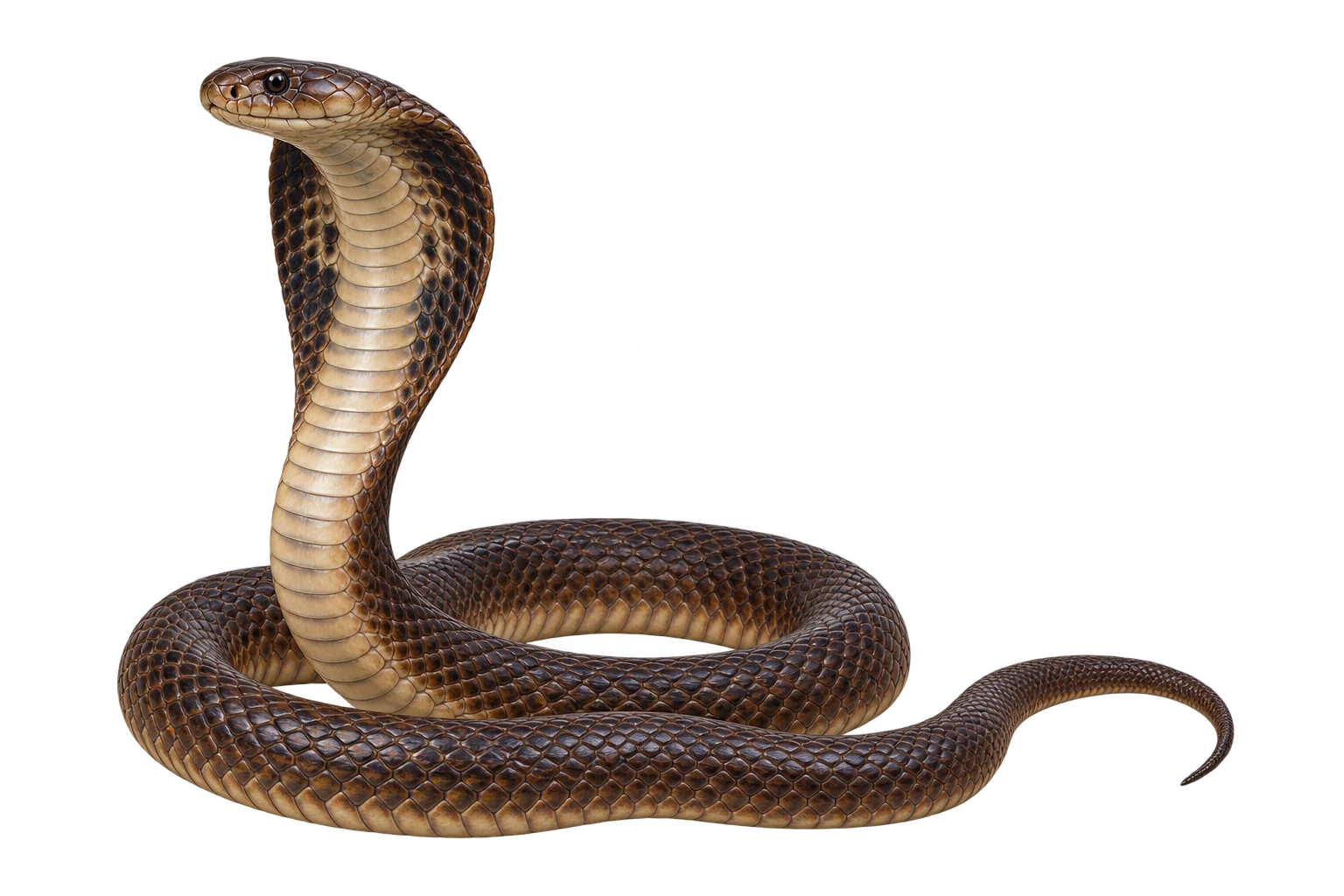
Arabian Cobra (same family), Arizona Coral Snake (same family), Asp (same family), Banded Krait (same family), Black Mamba (same family), Brown Snake (same family), and more.
Reptiles
Arabian Cobra
Naja arabica
Classification and source reference
LivingAI illustration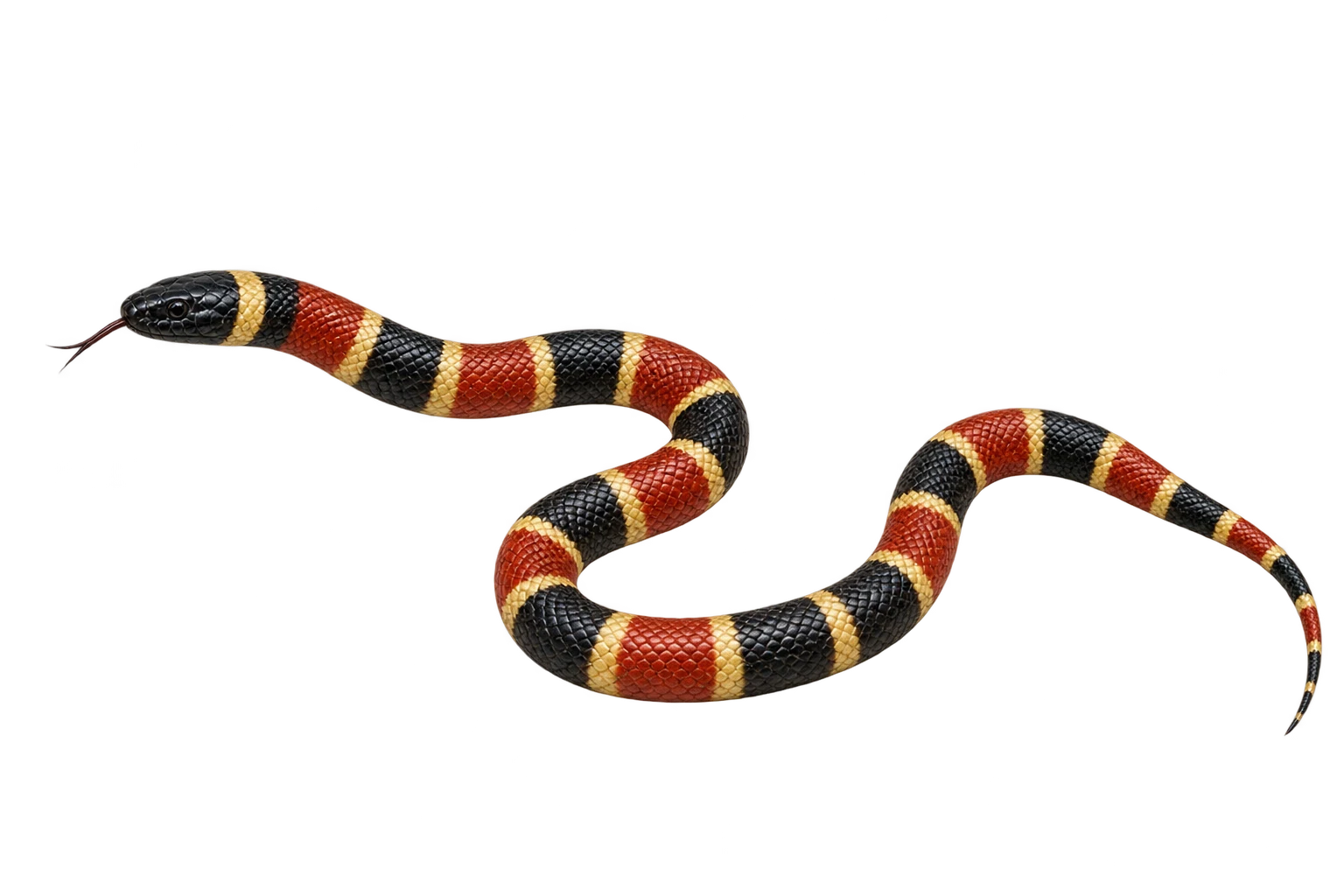
Reptiles
Arizona Coral Snake
Micruroides euryxanthus
Classification and source reference
LivingAI illustration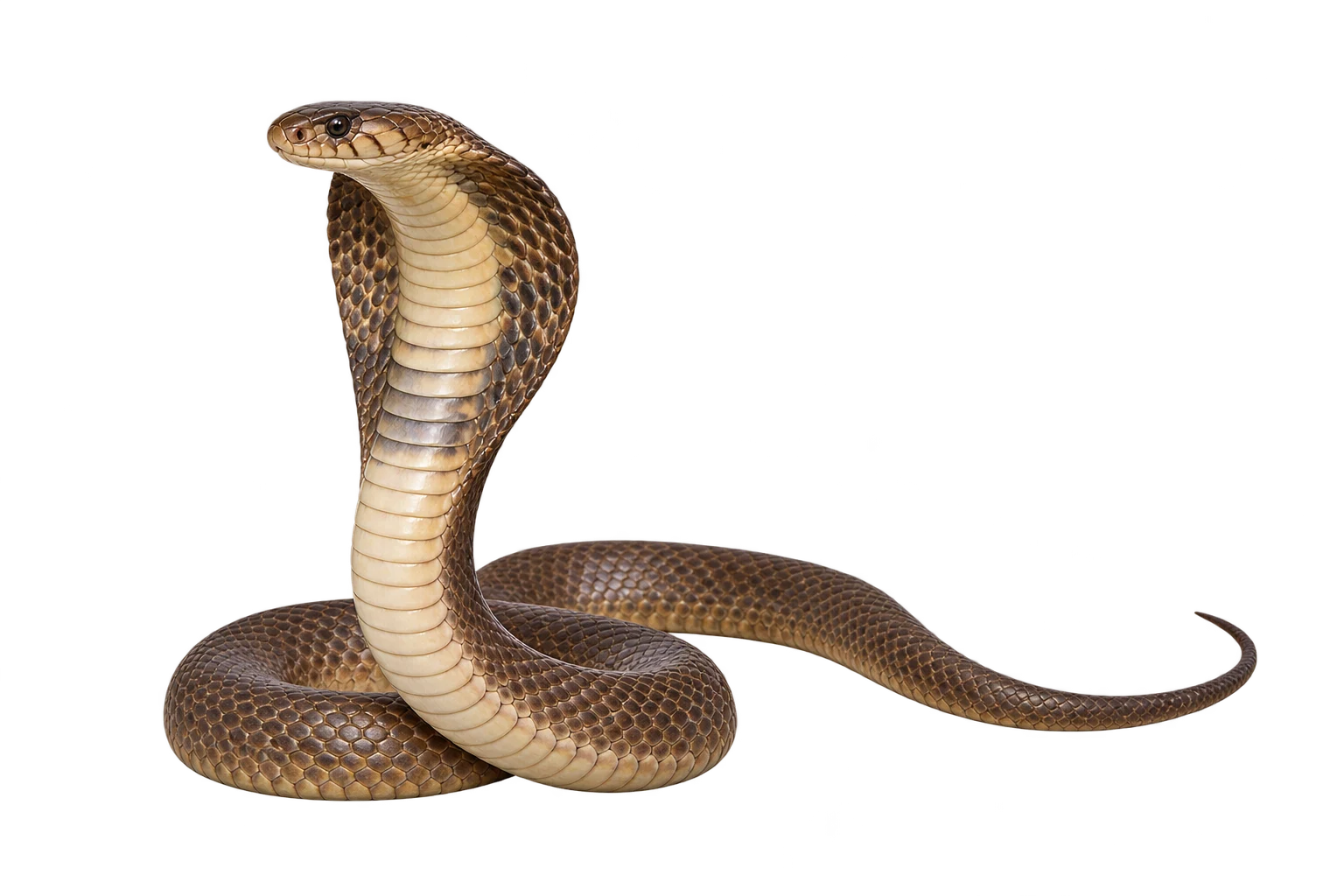
Reptiles
Asp
Naja haje
Classification and source reference
LivingAI illustration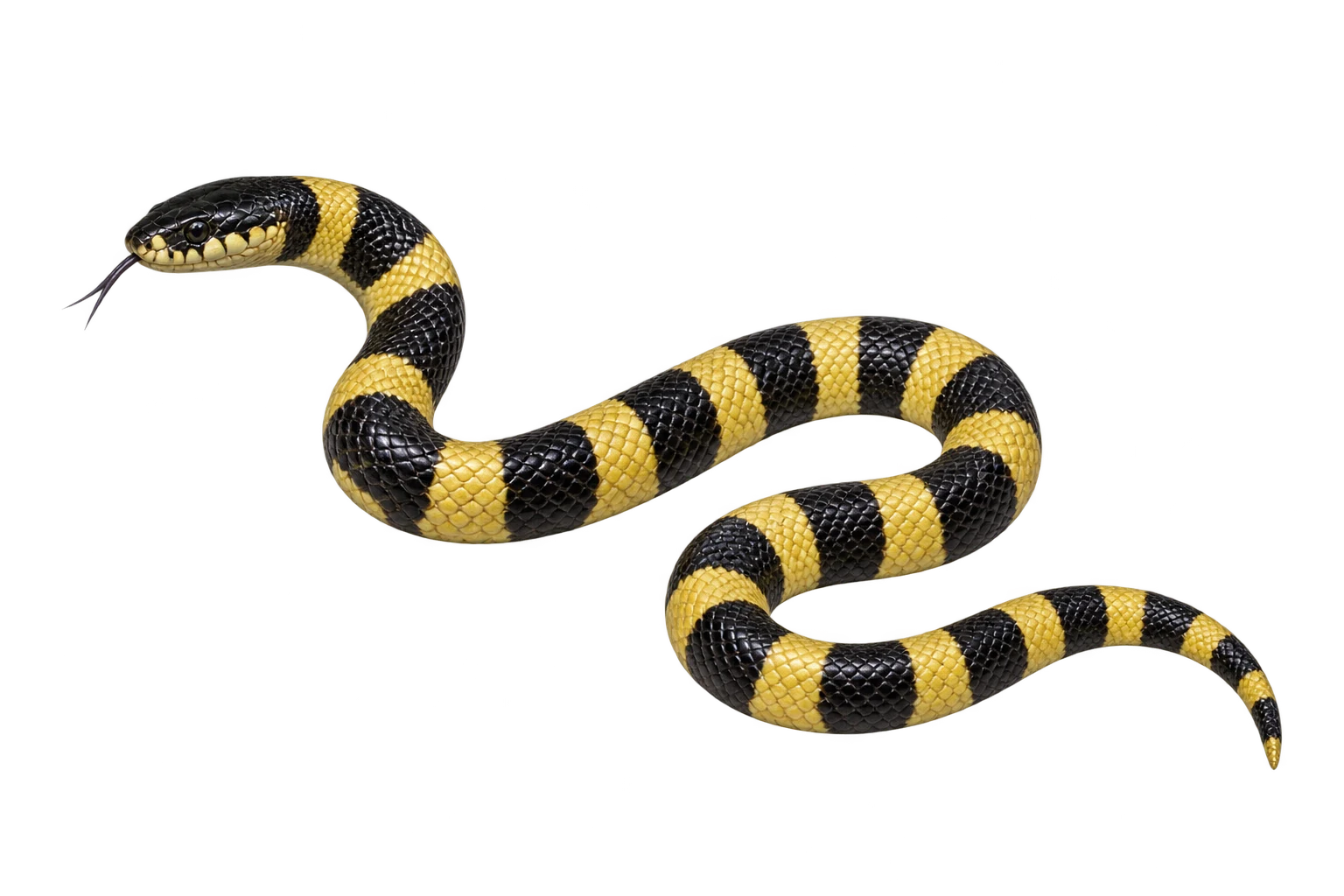
Reptiles
Banded Krait
Bungarus fasciatus
Classification and source reference
LivingAI illustration
Reptiles
Black Mamba
Dendroaspis polylepis
The black mamba is a venomous African snake named for the dark lining of its mouth.
Living
Reptiles
Brown Snake
Pseudonaja
Classification and source reference
LivingAI illustration