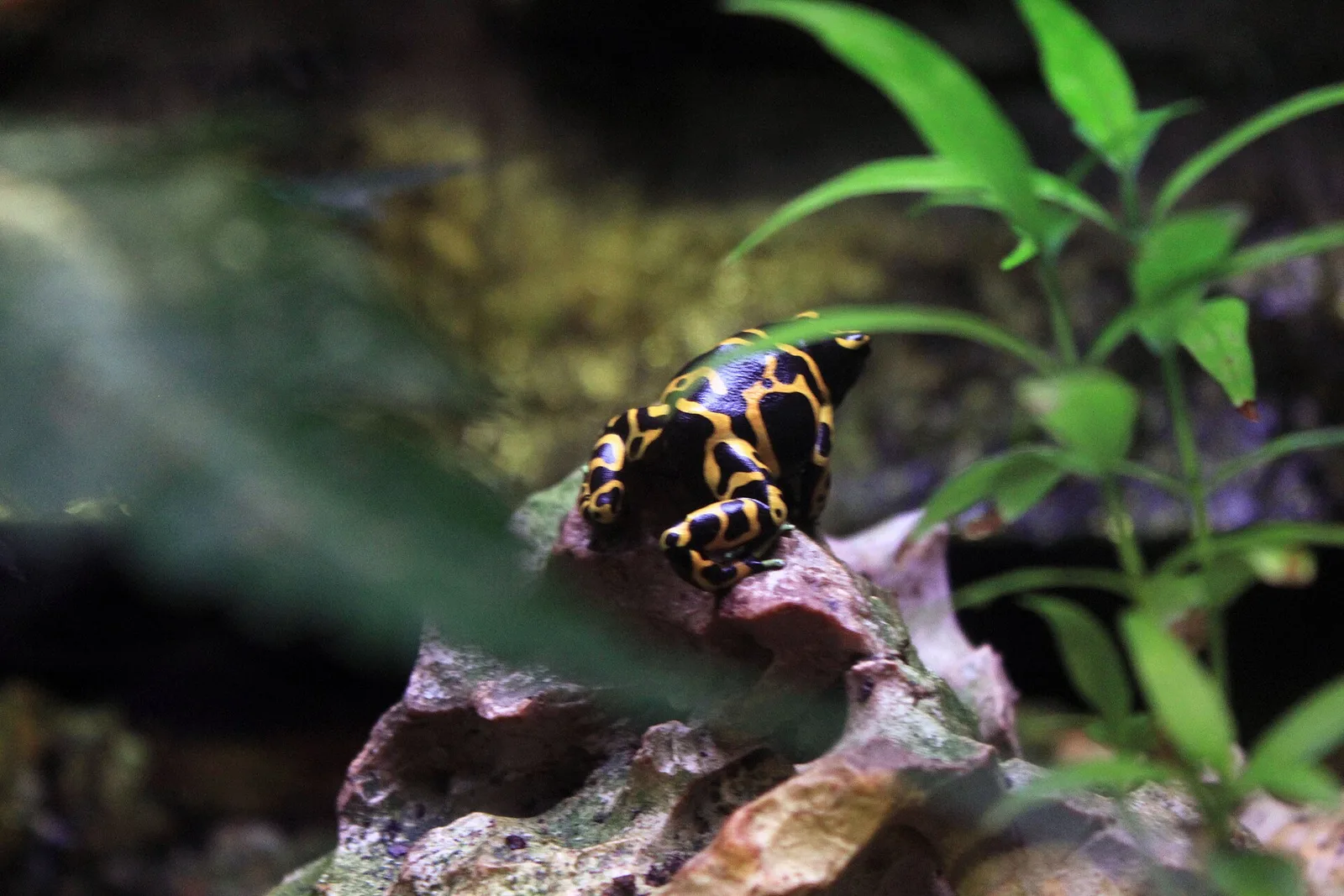
Golden poison frog
The most poisonous animal known, and it fits in a teaspoon
Phyllobates terribilis
Also called Golden dart frog
Living individuals or members of this group exist today. This does not mean they are safe from extinction.
Meet the golden poison frog
The golden poison frog is the most poisonous animal known. A single frog carries enough toxin in its skin to kill several people, and its bright colour warns predators away.
Images of the golden poison frog
Lifespan
Up to 5 years
Weight
Up to 30 g
Length
4.7 to 5.5 cm
Fact file
Golden poison frog
- Location
- The Pacific coast of Colombia
- Habitat
- Rainforest
- Diet
- Insectivore
- Prey / food
- Ants, mites, beetles, termites
- Predators
- One snake species tolerates the poison
- Lifestyle
- Diurnal
- Name of young
- Tadpole
- Incubation
- About 2 weeks of egg development
- Clutch size
- Up to 20 eggs
- Biggest threat
- Deforestation
- Distinctive feature
- Uniform bright yellow, orange or pale green skin
- Colour
- Golden yellow
- Skin type
- Smooth, moist skin
Size
Next to a person
Measurements
Size and speed
- Length
- 4.7 to 5.5 cm
- Weight
- Up to 30 g
Typical adult ranges. Sources: Wikipedia, Animal Diversity Web.
Life cycle
Lifespan
- In captivityUp to 5 years
- 05 years
The pale bar is the record. Source: Animal Diversity Web.
Appearance
Colour and coat
- Primary colours
- golden yellow
- Secondary colours
- orangemint greenblack
- Skin type
- smooth skin
- Male and female
- Slight. Females are usually larger than males, reaching 50 to 55 millimetres against an average of about 47.
Life cycle
Mating and family
- Mating system
- polygynandrous, both sexes with several mates
- Social structure
- solitary, spaced out across the forest floor
- Breeding
- clutches of fewer than 20 eggs, probably all year
Males trill to attract females, and the pair stroke each other before laying. The eggs go under leaf litter and hatch in about 11 to 12 days. A parent carries the tadpoles on its back to a small pool, where they grow and metamorphose. Froglets take their adult colour at about 18 weeks. Captive frogs have lived up to 5 years.
Classification
Taxonomy
- Kingdom
- Animalia
- Phylum
- Chordata
- Class
- Amphibia
- Order
- Anura
- Family
- Dendrobatidae
- Genus
- Phyllobates
- Species
- Phyllobates terribilis
Conservation
Red List status
- LC
- NT
- VU
- EN
- CR
- EW
- EX
Endangered on the IUCN Red List
Range
Recorded in 1 country
Habitat layer: tropical moist broadleaf forest.
Countries from 42 wild records on GBIF (iNaturalist research grade), filtered and checked by hand. Country shapes: Natural Earth. Habitat: RESOLVE Ecoregions 2017, CC BY 4.0. Basemap: Natural Earth.
Habitats
Three things to know
- 1
The Emberá people once tipped blowgun darts with its poison.
- 2
Captive-bred frogs are harmless: the poison comes from wild prey.
- 3
Males carry tadpoles on their backs to pools of water.
Did you know
Seven more facts
- 1
Young frogs are black with two gold stripes and only turn solid gold at about 18 weeks.
- 2
The jaw has a bony plate that looks like teeth, though the frog has none.
- 3
The same toxin occurs in a few birds and beetles in Papua New Guinea.
- 4
No egg of this frog has ever been found in the wild.
- 5
Its home gets 5 metres of rain a year or more.
- 6
The mint green form is the largest and can be almost white.
- 7
A captive frog learns that an opening lid means food and rushes forward.
Field notes
How it looks and acts
Field notes
Distinguishing features
- A single bright colour over the whole body: yellow, orange, green or white.
- A body of 4.7 to 5.5 centimetres, large for a dart frog.
- A tooth-like bone plate at the edge of the jaw.
- A middle toe longer than the outer toes.
- Black feet, throat and rump in the orange blackfoot line.
- Stripes on a black body in the young.
Field notes
Unique adaptations
- Skin glands loaded with batrachotoxin, gathered from prey.
- Warning colours that predators learn to avoid.
- A toxin-binding protein probably protects it from its own poison, as in other poison frogs.
- A long sticky tongue and a strike too fast to see.
- Mucus on the back that holds tadpoles during the carry to water.
Field notes
Interesting behaviours
- Hunts ants by day on the open forest floor.
- Walks away from a threat instead of hiding.
- Wrestles with rivals of the same sex.
- Carries tadpoles on its back to a tree hole or bromeliad pool.
- Taps its middle toe when excited.
Field notes
Temperament
- Bold and unafraid, because little can eat it.
- Tolerant of crowding in captivity.
- Aggressive mainly towards frogs of the same sex.
Field notes
Communication
- A 6 to 7 second trill from the male to attract a female.
- Push-ups for dominance and a lowered head for submission.
- Stroking of the head, back and sides before egg laying.
- Bright skin as a standing warning to predators.
Ecology
Ecological role
The golden poison frog is a small ground predator that few animals dare to eat.
- Eats large numbers of ants, termites and beetles on the forest floor.
- Feeds one resistant snake, which takes the young.
- Its tadpoles graze algae and mosquito larvae in tree holes and bromeliads.
Stories
Myths and legends
- In Emberá tradition, a hunter warms the frog over a fire and wipes his darts on its back.
- In Cofán tradition, the frog is also the source of dart poison for the hunt.
- In popular belief, one frog can kill ten adults, a figure repeated more often than measured.
People
Relationship with humans
People
Living alongside us
The Emberá and Cofán peoples have long used the frog's skin to poison hunting darts. Scientists described it only in 1978, and its toxin is now studied for medicine. Poaching for pets was once a threat, but captive breeding has made wild frogs less worth catching. A captive frog is harmless, while a wild one can kill with a touch.
- The skin of a wild frog carries enough toxin to kill 10 to 20 people if it enters the body.
- The frog never attacks, and captive-bred frogs carry no poison.
- Toxin on the face has caused burning for hours, and the lethal dose for a person is only 2.0 to 7.5 micrograms.
People
Status, uses and products
- Domestication
- Wild
- As a pet
- Kept by some. Captive-bred frogs are non-toxic, legal and widely sold. They need a warm, very humid vivarium at about 26 °C and 80 to 90% humidity and a steady supply of small live insects.
- Uses
- dart poisonmedical researchvivarium pet
- Products
- batrachotoxin
The full account
About the golden poison frog
The golden poison frog, Phyllobates terribilis, is a small bright frog from the rainforest of Colombia's Pacific coast. It is the most poisonous animal known. Its skin holds batrachotoxin, an alkaloid that jams the sodium channels of nerves and stops the muscles. An average wild frog carries about one milligram, enough to kill 10 to 20 people. Adults measure 4.7 to 5.5 centimetres and weigh up to 30 grams.
The frog lives on the forest floor, hunts ants by day, and makes no attempt to hide. Its yellow, orange or green skin warns predators that it is deadly. The Emberá people of the Chocó wipe blowgun darts on its back to hunt. Captive-bred frogs are harmless, because the poison comes from wild prey. The IUCN lists the species as Endangered, mainly because its small range is being cleared.
Name and taxonomy
Charles Myers, John Daly and Borys Malkin described the species in 1978. The name terribilis refers to the deadly toxin in the skin. Myers worked from hundreds of specimens taken at Quebrada Guanguí and La Brea. He also kept a colony of 18 frogs at the American Museum of Natural History. That colony gave the first observations of the frog's breeding. The paratypes were collected in February 1973 near the junction of the Guanguí stream and the Patía river.
The species belongs to the genus Phyllobates in the poison dart frog family, Dendrobatidae. English names include golden dart frog, golden poison arrow frog and golden poison dart frog. In Spanish it is the rana dorada venenosa, and German names call it the terrible leaf climber. Some of these names are misleading, because the frog is used on darts, not arrows, and it does not climb.
Evolution and relatives
Dendrobatidae holds about 175 species, and most are tiny, some no bigger than a fingernail. The golden poison frog is the largest of them. Its closest relatives are the other Phyllobates species, such as P. aurotaenia, P. lugubris and P. vittatus. Those species carry dark spots or stripes, while the golden poison frog is one solid colour as an adult. Only three frogs in the world carry batrachotoxin, and all three are Colombian Phyllobates.
The same toxin turns up in a few birds of Papua New Guinea and in four Papuan beetles of the genus Choresine. That pattern suggests the frog does not make the poison itself but gathers it from its food. Its poison is about twenty times stronger than that of any other dart frog. Some Dendrobates frogs modify a toxin from their food, and this frog may do the same, but that is not proven. Like other poison frogs, it probably carries a protein that binds the toxin and keeps it from poisoning itself.
Appearance
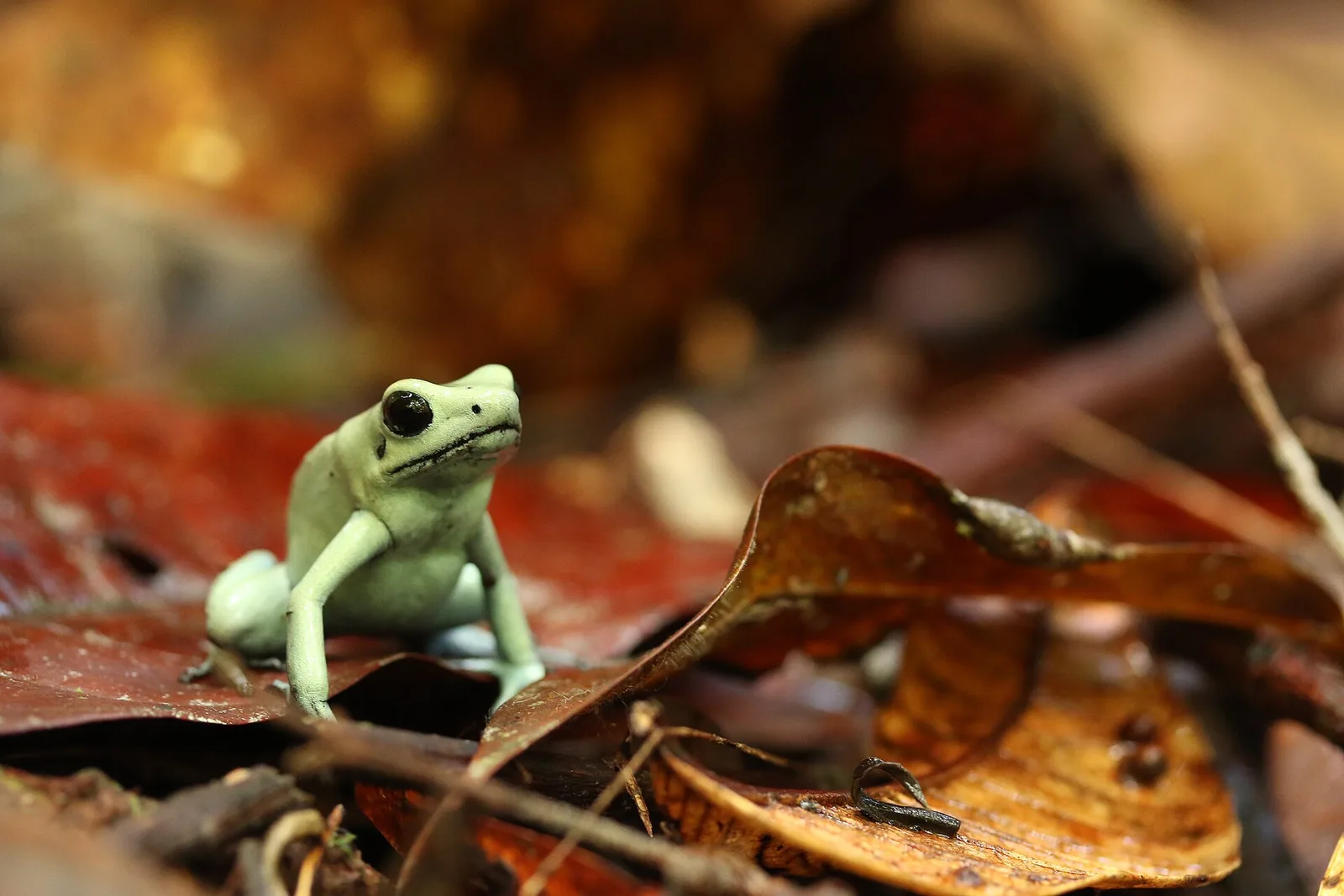
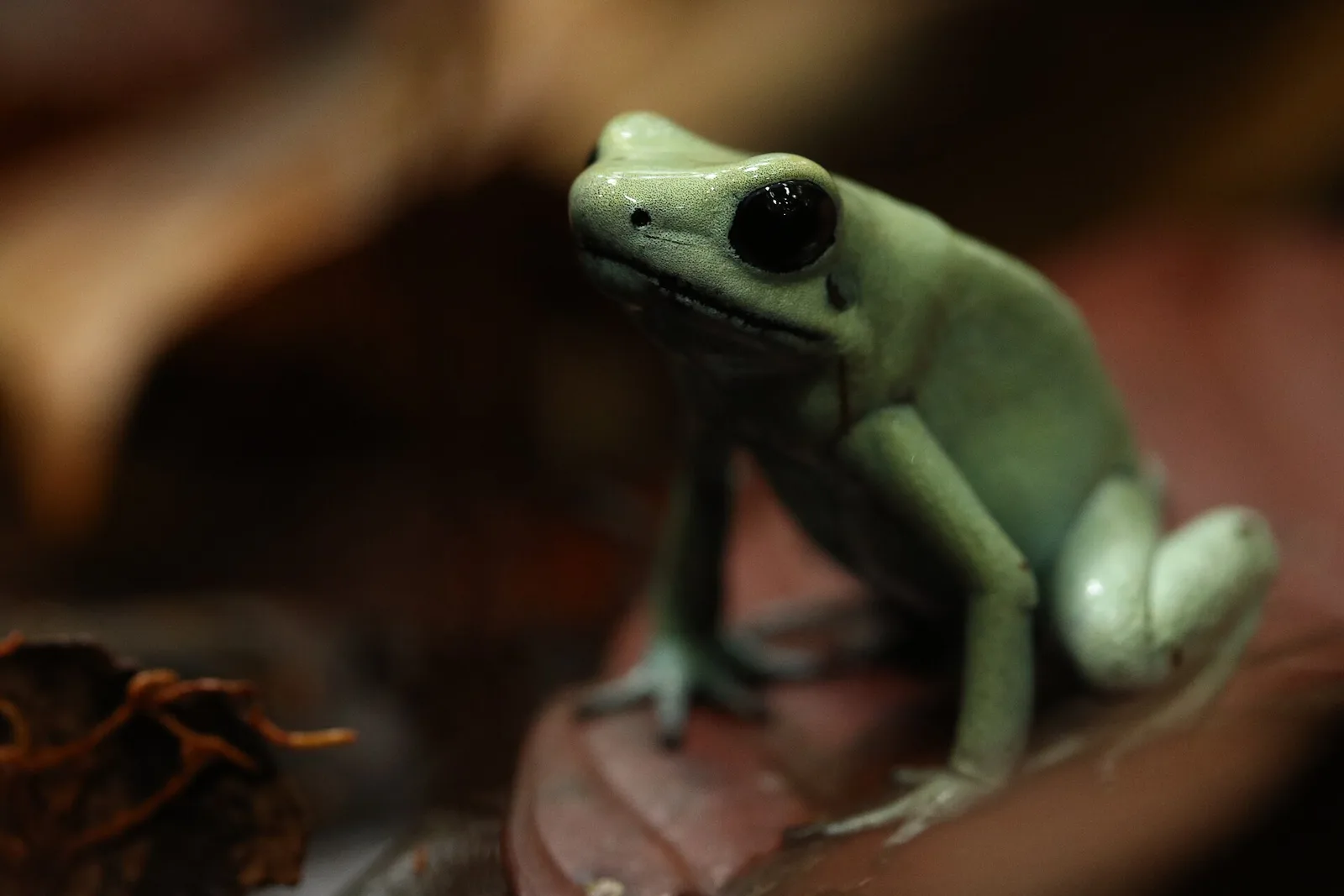
An adult is one bright colour from nose to toe. Yellow is the most common, from pale to deep gold, and it gives the frog its name. Frogs at La Brea and La Sirpa are mint green, metallic green or even white, and they are the largest form. Orange frogs live near the yellow ones at Quebrada Guanguí. A captive line called orange blackfoot has dark marks on the feet, throat and rump.
Young frogs look quite different: mostly black with two golden stripes down the back. The black fades, and the frog has its adult colour at about 18 weeks. Body length runs from 4.7 to 5.5 centimetres, and the larger figures are usually females. Wikipedia gives a maximum of about 6 centimetres and nearly 30 grams. Females are usually larger than males.
A bone plate juts from the upper jaw and looks like a row of teeth, but the frog has none. The middle toe is longer than the outer two. The skin is smooth and moist, as in other frogs, and its colour is a warning to predators.
Habitat and range
The frog lives only in the Chocó rainforest on the Pacific coast of Colombia, in the departments of Cauca and Valle del Cauca. The whole range covers less than 5,000 square kilometres. Most frogs live along the upper Río Saija drainage, near Quebrada Guanguí and at La Brea. The river splits the population, with separate groups on its east and west banks. Within that small area the frog is common.
The land is hilly lowland forest between about 100 and 200 metres above the sea. It is one of the wettest places on Earth, with 5 metres of rain a year or more, and at least 1.25 metres. The frog does best at 26 °C or warmer and at 80 to 90% humidity. The ground there is wet gravel with small saplings and little leaf litter. The frog stays on the floor, but it needs standing water nearby for its tadpoles. It is known only from primary forest, so a cleared or regrown patch probably does not hold it.
GBIF holds records from 4 countries, but nearly all come from Colombia. The records from Brazil, the United States and Japan are probably captive animals.
Diet and hunting
The frog eats insects and other small invertebrates. Its main prey are ants of the genera Brachymyrmex and Paratrechina. It also takes termites, beetles, mites and flies. It hunts by ambush and takes larger prey for its size than most dart frogs. It will not usually attack an insect bigger than an adult cricket.
The strike is a single fast movement that is hard to follow with the naked eye. A long sticky tongue pulls the prey into the mouth. Captive frogs learn fast, and they rush to the front of the tank when the lid opens. Tadpoles eat algae, mosquito larvae and whatever else they find in their pool.
The diet is also the source of the poison. Frogs fed on shop-bought insects lose their toxin over time. Scientists suspect a small beetle of the family Melyridae, because a related beetle makes the same toxin.
Behaviour and social life
The frog is active by day and lives entirely on the ground. No one has seen it climb, in the wild or in captivity. It sits on the soil or a few centimetres up on a root. Most dart frogs are shy and quick to hide, but this one sits in the open. When something approaches, it moves away rather than hiding. Its poison probably explains this boldness.
Wild frogs live spaced out, not in dense groups. Captive frogs tolerate crowding with little aggression, unlike many relatives. Most disputes are between frogs of the same sex. Females wrestle over males, and males wrestle over territory. Fights involve calling, chasing and wrestling. The size of a wild frog's home range is unknown. Relatives such as P. aurotaenia are far more territorial, so the golden poison frog seems the calm one in its genus.
Communication and senses
The male sings a long trill to court a female. The call lasts 6 to 7 seconds, then repeats in a short 2 to 3 second version. It is an even run of notes at about 13 beats per second and a pitch near 1,800 hertz. That pitch is lower than the calls of most related frogs.
The frog also uses body language. A push-up shows dominance, and a lowered head shows submission. An excited frog taps its long middle toe, both when it hunts and when it courts. Before laying, the pair stroke each other's head, back, sides and vent.
Like other frogs, it hunts by sight and reacts to the smallest movement. The skin itself is a signal, a bright warning that predators learn to read.
Reproduction and life cycle
The frog is thought to breed all year. Both sexes take several mates. In captivity each breeding involved one female and two or more males. Egg laying is a fast scramble under cover of plants, and it has never been seen in the wild. The eggs are fertilised outside the body and laid on the ground under leaf litter.
A clutch holds fewer than 20 eggs. In captivity the eggs hatch after 11 to 12 days, and a whole clutch takes 2 to 4 days to finish. The tadpoles wriggle onto the mucus on a parent's back. The adult carries them to a water-filled tree hole or the pool inside a bromeliad. Only three wild males have ever been caught with a clutch on their backs. Once the tadpoles are in the water, parental care ends.
The tadpoles graze algae and eat mosquito larvae, then go through full metamorphosis into froglets. Captive froglets start eating fruit flies less than 10 days after they leave the water. A young frog keeps its black and gold stripes until about 18 weeks. Captive frogs have lived up to 5 years, and wild frogs probably live 5 years or more. No wild eggs have ever been found. Whether the frogs press vent to vent during mating is still unconfirmed. The tadpole stage probably takes several weeks, as in other dart frogs, but no source gives a figure.
Predators and threats
An adult has few enemies, if any. One small snake, Leimadophis epinephelus, resists several frog toxins including batrachotoxin. It eats young frogs without harm, but it is too small to take an adult. A predator that mouths an adult frog is likely to die. Animal Diversity Web credits this safety with the frog's long life for its size.
The real threat is the chainsaw. Forest inside the tiny range is being cleared for farming. The frog is now known from fewer than five areas. Poaching for the pet trade was once a serious threat. Captive breeding has cut the demand for wild frogs, and the IUCN now rates that threat as small. The chytrid fungus that has hit many tropical frogs is not named as a threat in any source read here.
Population and conservation
The IUCN Red List rates the golden poison frog as Endangered. No population count exists, and the species is abundant where its forest still stands. Its whole range is under 5,000 square kilometres, so a few clearings can remove a large share of it. The population is split into groups on either bank of the Saija, which may limit gene flow.
Tesoros de Colombia, a Colombian breeder, floods the pet trade with cheap captive frogs. The aim is to make a poached wild frog worth too little to catch. Captive frogs are legal, non-toxic, healthier and cheaper, so demand for wild ones has dropped. The IUCN estimates that most frogs sold as pets now come from captive lines. iNaturalist holds 458 observations of the species.
Relationship with humans
The Emberá and Cofán peoples use the frog to poison hunting darts. A hunter holds a live frog near a fire, and the heat makes its back sweat poison. Darts wiped across the skin stay deadly for two years or more. The web notes say one frog can coat 30 to 50 darts. The darts bring down small game, and they may once have been used in war.
Touching a wild frog is dangerous. Toxin rubbed onto the face has caused a burning feeling that lasted for hours. Myers estimated the lethal dose for a person at 2.0 to 7.5 micrograms. In mice the subcutaneous LD50 is 0.2 micrograms per kilogram. Researchers are testing the toxins as muscle relaxants, anaesthetics and heart stimulants. The frog is a popular vivarium animal because of its colour and its bold manner. Captive frogs show no aggression towards people, and the only risk is the skin of a wild-caught animal.
In culture and myth
In Emberá tradition, the frog is called kokoi, and French speakers still know it as the kokoï de Colombie. In the Chocó, the frog is part of hunting life rather than of story, and its poison is the point. The Emberá and Noanamá are the peoples most often named as users of frog darts.
Outside Colombia the frog is famous for one number: the count of people a single frog could kill. Wikipedia gives 10 to 20 people, or up to two bull elephants. Popular articles often say about ten adults, but that is a common claim rather than a measurement. The name terribilis, the terrible one, has stuck in German as the schrecklicher Pfeilgiftfrosch. The story of its discovery in 1978, when Myers and Daly first handled it, is retold by the American Museum of Natural History.
A sentence with a dotted underline is inferred: it describes the group the animal belongs to, or is a reading of the sources, rather than a measured or reported fact about this species.
Questions
Golden poison frog questions, answered
How poisonous is the golden poison frog?
No animal known is more poisonous. An average wild frog holds about one milligram of batrachotoxin, enough to kill 10 to 20 people. The lethal dose for a person is estimated at 2.0 to 7.5 micrograms.
Can a golden poison frog kill you by touch?
A wild frog can. Its skin secretion enters through cuts or the mouth and stops the nerves and muscles. Captive-bred frogs carry no toxin and are safe to keep.
Where does the golden poison frog live?
Only in the Chocó rainforest on the Pacific coast of Colombia, in Cauca and Valle del Cauca. Its range is under 5,000 square kilometres, mostly along the upper Río Saija.
Why is the golden poison frog so toxic?
It gathers the toxin from its prey, probably from small beetles of the family Melyridae. Frogs fed on shop-bought insects lose the poison. How the frog avoids poisoning itself is not yet known.
Is the golden poison frog endangered?
Yes. The IUCN lists it as Endangered because forest in its tiny range is being cleared for farms. Poaching was once a threat, but captive breeding has reduced it.
How big is a golden poison frog?
An adult is 4.7 to 5.5 centimetres long and weighs up to 30 grams. That makes it the largest poison dart frog.
What does the golden poison frog eat?
Mostly ants of the genera Brachymyrmex and Paratrechina, plus termites, beetles and mites. It ambushes prey and flicks out a sticky tongue.
Are golden poison frogs always yellow?
No. They come in yellow, orange, mint green and even white, depending on the locality. Young frogs are black with two gold stripes.
What eats the golden poison frog?
Almost nothing. One small snake, Leimadophis epinephelus, resists the toxin and eats young frogs. Adults have few predators, if any.
How do people use the golden poison frog for darts?
The Emberá hold a live frog near a fire so that its back sweats poison. They wipe blowgun darts across the skin. The darts stay deadly for two years or more.
Can you keep a golden poison frog as a pet?
Yes, captive-bred frogs are legal, non-toxic and widely available. They need a warm, very humid vivarium and small live insects. Never handle a wild-caught frog.
How does the golden poison frog reproduce?
The male trills, the pair stroke each other, and the female lays fewer than 20 eggs under leaf litter. A parent then carries the tadpoles on its back to a small pool. The tadpoles metamorphose there.
How long does a golden poison frog live?
In captivity the record is 5 years. Wild frogs probably live 5 years or more, because so little can eat them.
What does batrachotoxin do?
It locks open the sodium channels of nerve cells. The muscles stay contracted, and the heart can go into fibrillation and stop.
Does the golden poison frog climb trees?
No. It has never been seen climbing, in the wild or in captivity. It stays on the forest floor or a few centimetres up on a root.
Food web
Prey and food
- ants
- mites
- beetles
- termites
Food web
Predators
- one snake species
Ecological equivalents
Related species on this site
Poison Dart Frog (same family), African Bullfrog (same order), African Clawed Frog (same order), African Tree Toad (same order), American Toad (same order), Argentine Horned Frog (same order), and more.
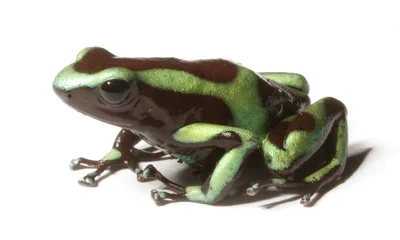
Amphibians
Poison Dart Frog
Dendrobatidae
Poison dart frogs are colourful tropical amphibians.
Living
Amphibians
African Bullfrog
Pyxicephalus adspersus
The African bullfrog spends dry periods buried underground and becomes active with rain.
LivingAmphibians
African Clawed Frog
Xenopus laevis
Classification and source reference
LivingAmphibians
African Tree Toad
Nectophryne
Classification and source reference
Living
Amphibians
American Toad
Anaxyrus americanus
The American toad is a stout amphibian of North America.
Living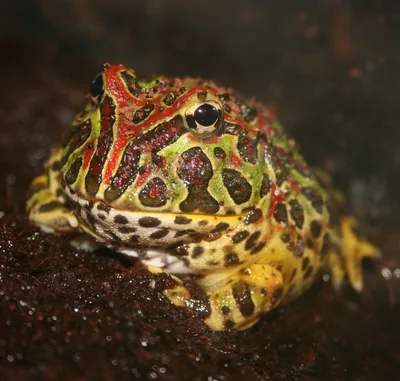
Amphibians
Argentine Horned Frog
Ceratophrys ornata
The Argentine horned frog is a broad-bodied ambush hunter with a very large mouth.
Living