Living individuals or members of this group exist today. This does not mean they are safe from extinction.
Meet the monarch butterfly
The monarch butterfly makes the longest migration of any insect. Each autumn, millions fly up to 4,800 km from Canada and the USA to a few mountain forests in Mexico.
Images of the monarch butterfly
Lifespan in the wild
2 to 5 weeks for a breeding-season adult
Wingspan
8.9 to 10.2 cm
Top speed
About 9 km/h
Fact file
Monarch butterfly
- Location
- North America; also Australia, New Zealand and Pacific islands
- Habitat
- Grassland, Temperate forest, Towns and cities
- Diet
- Nectarivore
- Prey / food
- Nectar; caterpillars eat only milkweed
- Predators
- Birds, wasps, spiders; most avoid its bitter toxins
- Lifestyle
- Diurnal
- Group name
- Roost
- Name of young
- Caterpillar or larva
- Incubation
- 3 to 5 days of egg development
- Clutch size
- 300 to 500 eggs over a lifetime
- Biggest threat
- Loss of milkweed and of the Mexican winter forests
- Distinctive feature
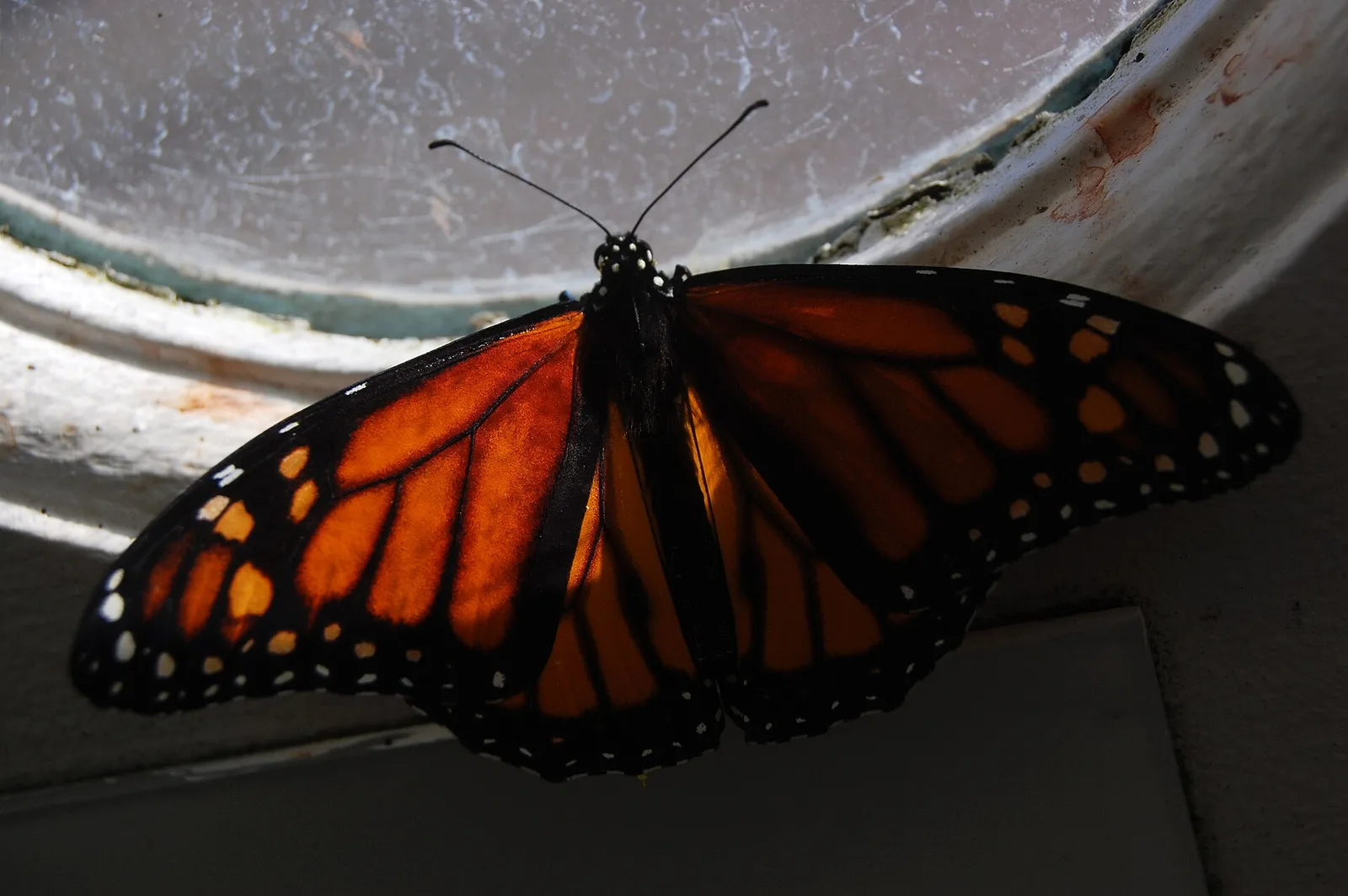
- Orange wings with black veins and white spots
- Colour
- Orange, black and white
- Skin type
- Scaled wings
Size
Next to a person
Measurements
Size and speed
- Wingspan
- 8.9 to 10.2 cm
- Top speed
- About 9 km/h in flight
Typical adult ranges. Source: Wikipedia.
Life cycle
Lifespan
- In the wild2 to 5 weeks for a breeding-season adult
- 01 years
The generation that migrates lives through the winter, several times longer than a summer adult.
Source: Wikipedia.
Appearance
Colour and coat
- Primary colours
- orangeblack
- Secondary colours
- white
- Skin type
- scaled wings
- Male and female
- Males are slightly larger and carry a black scent spot on each hindwing. Females are darker, with thicker black veins and no spots.
Life cycle
Mating and family
- Mating system
- promiscuous, both sexes mate more than once
- Social structure
- solitary in summer, roosts of millions in winter
- Breeding
- 300 to 500 eggs over two to five weeks
A female glues 300 to 500 eggs one by one under milkweed leaves. Each hatches in three to eight days into a caterpillar that grows through five instars in about two weeks. The chrysalis stage lasts 8 to 15 days. A summer adult breeds within 4 to 5 days and lives 2 to 5 weeks. The autumn generation delays breeding, flies to Mexico and lives up to 8 months.
Classification
Taxonomy
- Kingdom
- Animalia
- Phylum
- Arthropoda
- Class
- Insecta
- Order
- Lepidoptera
- Family
- Nymphalidae
- Genus
- Danaus
- Species
- Danaus plexippus
Conservation
Red List status
- LC
- NT
- VU
- EN
- CR
- EW
- EX
Vulnerable on the IUCN Red List
Range
Recorded in 5 countries
Habitat layer: temperate broadleaf and mixed forest, temperate conifer forest, boreal forest and taiga, tropical grassland, savanna and shrubland, temperate grassland, savanna and shrubland.
Countries from 367,829 wild records on GBIF (iNaturalist research grade), filtered and checked by hand. Country shapes: Natural Earth. Habitat: RESOLVE Ecoregions 2017, CC BY 4.0. Basemap: Natural Earth.
Habitats
Three things to know
- 1
The toxins from milkweed stay in the adult and make it taste bad to birds.
- 2
No monarch that flies south has ever seen Mexico before.
- 3
The migrating generation lives about eight times longer than its parents.
Did you know
Seven more facts
- 1
The monarch's genome was read before that of any other butterfly.
- 2
A monarch cannot fly until its body warms to 30 degrees Celsius.
- 3
Monarchs have been reared in space, on the International Space Station in 2009.
- 4
A black-eared mouse can eat 40 wintering monarchs in one night.
- 5
A wasp can turn one chrysalis into up to 400 new wasps.
- 6
iNaturalist holds 530,700 observations of the species.
- 7
A mating pair can stay joined for up to 16 hours.
Field notes
How it looks and acts
Field notes
Distinguishing features
- Orange wings with black veins and black margins.
- Two rows of white spots along the wing edges.
- A wingspan of 8.9 to 10.2 centimetres.
- A black scent spot on each hindwing of the male.
- A caterpillar banded in white, yellow and black with two pairs of black tentacles.
- A pale green chrysalis with gold dots.
Field notes
Unique adaptations
- Stores milkweed poisons that make it foul to birds.
- A mutated sodium pump lets it eat poisons that would stop another insect's heart.
- Bright orange warns predators before they bite.
- Eyes that read polarised ultraviolet light keep it on course by the sun.
- The migrant generation delays breeding, which lets it live through the winter.
Field notes
Interesting behaviours
- Flies up to about 4,000 kilometres south each autumn.
- Clusters by the million on fir trees through the winter.
- Basks or shivers its wings to warm up before flight.
- Drinks from damp soil to take in minerals.
- Hangs in a J shape for 12 to 16 hours before it pupates.
Field notes
Temperament
- Placid as an adult, and it will uncurl its tongue to a person's fingertip.
- Caterpillars turn aggressive when milkweed runs short.
- Females refuse most mating attempts.
Field notes
Communication
- Males carry courtship pheromones in black spots on the hindwings.
- Sees ultraviolet, blue, green and a fourth long-wavelength channel.
- Uses colour to find flowers and leaf shape to find milkweed.
- Reads polarised skylight to hold a heading.
Ecology
Ecological role
The monarch is a milkweed specialist that feeds predators, parasites and pollinates flowers along a continent-wide route.
- Its caterpillars thin out milkweed, including species that poison cattle.
- Adults carry pollen between late-summer flowers such as goldenrod and asters.
- It feeds orioles, grosbeaks, mice, wasps and parasitic flies at every stage.
- It probably moves nutrients across thousands of kilometres as millions of bodies die in the winter groves.
Stories
Myths and legends
- In Purépecha tradition, the monarchs that arrive for the Day of the Dead are the returning souls of the dead.
- In Mexican tradition, some say the butterflies carry the souls of children.
- In Aztec tradition, some writers tie the butterfly to Mictecacihuatl, goddess of the underworld.
- In Greek tradition, Danaus was a king of Egypt and Plexippus a son of his twin brother Aegyptus.
People
Relationship with humans
People
Living alongside us
People plant milkweed, tag butterflies and visit the winter colonies. Schools and families rear monarchs, though scientists warn that mass rearing spreads disease. Farm herbicides, logging and cars have cut the migrating population by 80% or more. The United States, Canada and Mexico now protect habitat, and the US has proposed to list the species as threatened. The monarch is harmless to people.
- The monarch cannot bite or sting.
- Its poisons only matter to an animal that eats it.
- A monarch will sit on a fingertip and uncurl its tongue.
People
Status, uses and products
- Domestication
- Wild
- As a pet
- Not suitable. Rearing a few caterpillars on milkweed is common in schools. Rearing many spreads the OE parasite, and butterflies raised indoors navigate badly. California requires a permit even for education.
- Uses
- ecotourismeducationbutterfly releases
- Products
- None recorded
The full account
About the monarch butterfly
The monarch, Danaus plexippus, is a milkweed butterfly in the family Nymphalidae. It is probably the best known butterfly in North America. Its orange wings carry black veins and a border of white spots, and they span 8.9 to 10.2 centimetres. The caterpillar eats only milkweed, and the poisons in that plant stay in the adult and make it taste foul to birds.
Each autumn the monarchs east of the Rocky Mountains fly south to a few fir forests in central Mexico. The trip can cover about 4,000 kilometres, and no butterfly that makes it has seen Mexico before. The return north in spring takes three or four generations. A summer adult lives 2 to 5 weeks, but the migrating generation survives the whole winter. The IUCN lists the species as Vulnerable, because the winter colonies in Mexico and California have shrunk sharply.
Name and taxonomy
Carl Linnaeus described the species in 1758 and placed it in the genus Papilio, which then held every butterfly. In 1780 Jan Krzysztof Kluk made it the type species of a new genus, Danaus. Danaus was a mythical king of Egypt or Libya, and Plexippus was a son of his twin brother Aegyptus, who had 50 sons. The entomologist Samuel Hubbard Scudder proposed the name The Monarch in 1874, because the butterfly is large and rules a vast domain. He preferred it to Storm Fritillary and to Archippus, which rivals had suggested.
Depending on the region, people also call it the milkweed butterfly, the common tiger, the wanderer or the black-veined brown. The monarch sits in the subfamily Danainae, the milkweed butterflies, which was once treated as a family of its own. Six subspecies are recognised. D. p. plexippus is the migratory form of North America, and D. p. megalippe is a non-migratory form from Florida south to the Amazon. A white morph called nivosus makes up nearly 10% of the monarchs on Oahu, Hawaii.
Evolution and relatives
The genus holds two other monarchs. The southern monarch, D. erippus, lives in South America from Brazil to Chile. Some researchers think the two separated about two million years ago, as the Pliocene ended. The Jamaican monarch, D. cleophile, ranges from Jamaica to Hispaniola.
No butterfly had its genome sequenced before the monarch. The draft holds 273 million base pairs and 16,866 protein-coding genes. Migrating and non-migrating monarchs carry the same migration gene, but only the migrants switch it on. Three mutations in one enzyme, the sodium pump, let the insect tolerate milkweed poisons. When scientists edited those mutations into fruit flies, the flies became resistant too.
Appearance
The wings span 8.9 to 10.2 centimetres. The upper side is tawny orange with black veins and black margins. Two rows of small white spots run along the margins, and a few orange spots sit near the forewing tips. The underside is similar, but the wing tips are yellow-brown and the white spots are larger. Like all Nymphalidae, the monarch holds its small forelegs against the body and walks on four legs.
A male has a black scent spot on a vein of each hindwing and slightly thinner veins. A female lacks the spots, looks darker and has thicker black veins. Males are a little larger and heavier, but females have thicker wings, which probably resist damage on migration. The viceroy butterfly copies the pattern, but it is smaller, with an added black band across each hindwing.
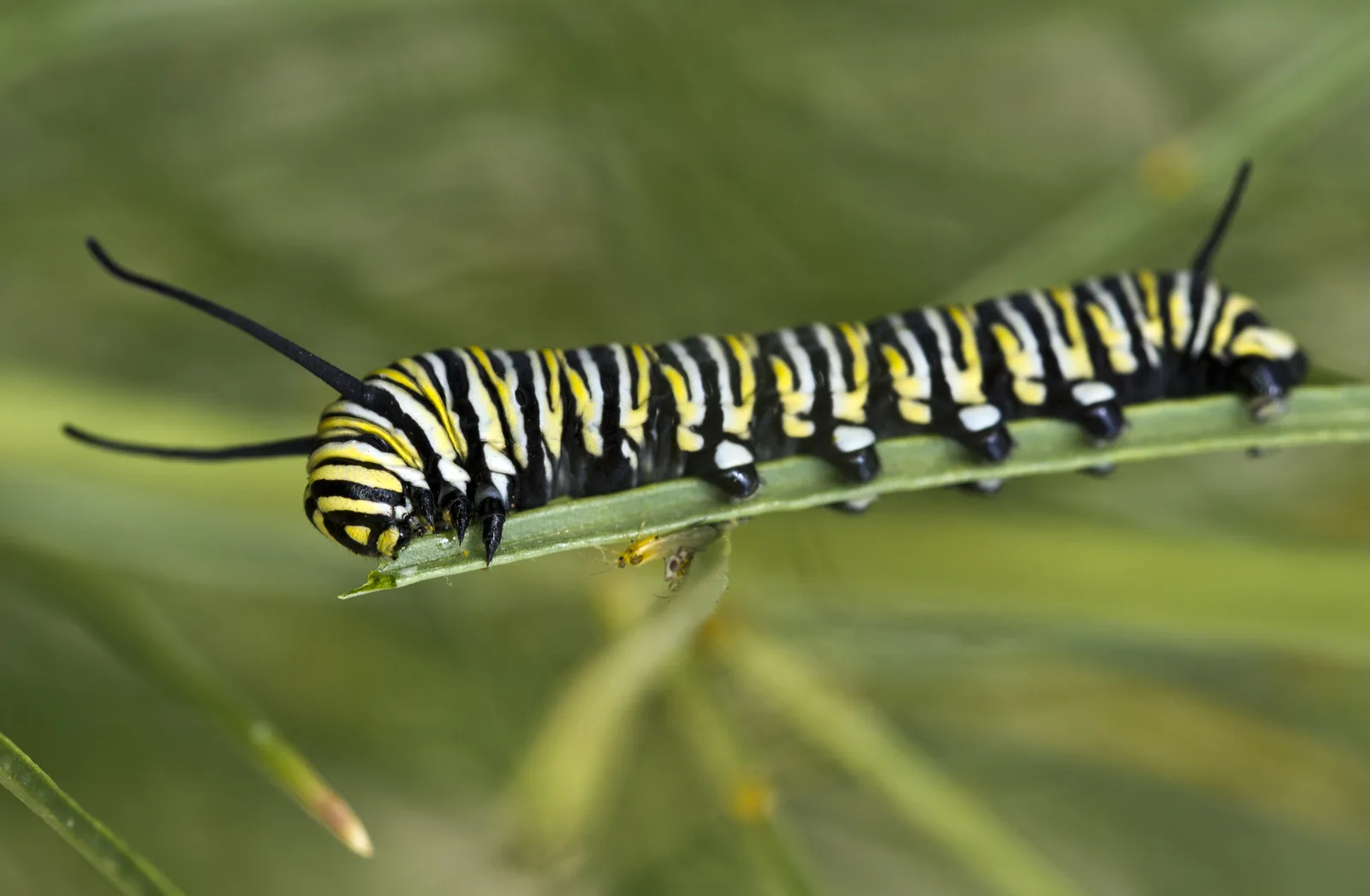
The caterpillar is banded in white, yellow and black, with a pair of black tentacles at each end. A full-grown one is 4.5 centimetres long and weighs about 1.5 grams. The chrysalis is pale green with a rim of gold and black dots near the top.
Habitat and range
In the New World the monarch lives from southern Canada to northern South America. Since the 1800s it has spread across the world. Non-migratory populations live in Hawaii, Australia, New Zealand, the Pacific islands, the Canaries, Madeira, Portugal and Morocco. In some years it reaches Britain as a stray. GBIF holds records from 116 countries.
The monarch breeds wherever milkweed grows: fields, pasture, prairie, roadsides, gardens and suburbs. It cannot stand frost, so the northern breeders must leave each autumn. The eastern population winters in oyamel fir forest in the mountains of Michoacán and the State of México. The western population winters in groves along the California coast, many of them blue gum eucalyptus planted from Australia. Smaller winter roosts occur in Florida, along the Gulf Coast, in Arizona and as far north as Virginia Beach.
A winter site needs streams, plenty of sun and dense trees for roosting. A monarch cannot fly until its body reaches 30 degrees Celsius, so it basks or shivers its wings to warm up. Above 35 degrees the caterpillars die, and eggs dry out in hot, arid weather.
Diet and feeding
The caterpillar eats milkweed and nothing else. The eastern migration depends mainly on three species: common milkweed, green antelopehorn and antelope horns. Chemical fingerprints show that 85 to 92% of the monarchs wintering in Mexico ate common milkweed as caterpillars. Milkweed sap is rich in cardenolides, heart poisons like digitalis, and the caterpillar stores them in its body. Too much poison stunts the larva, so females prefer plants with a moderate dose.
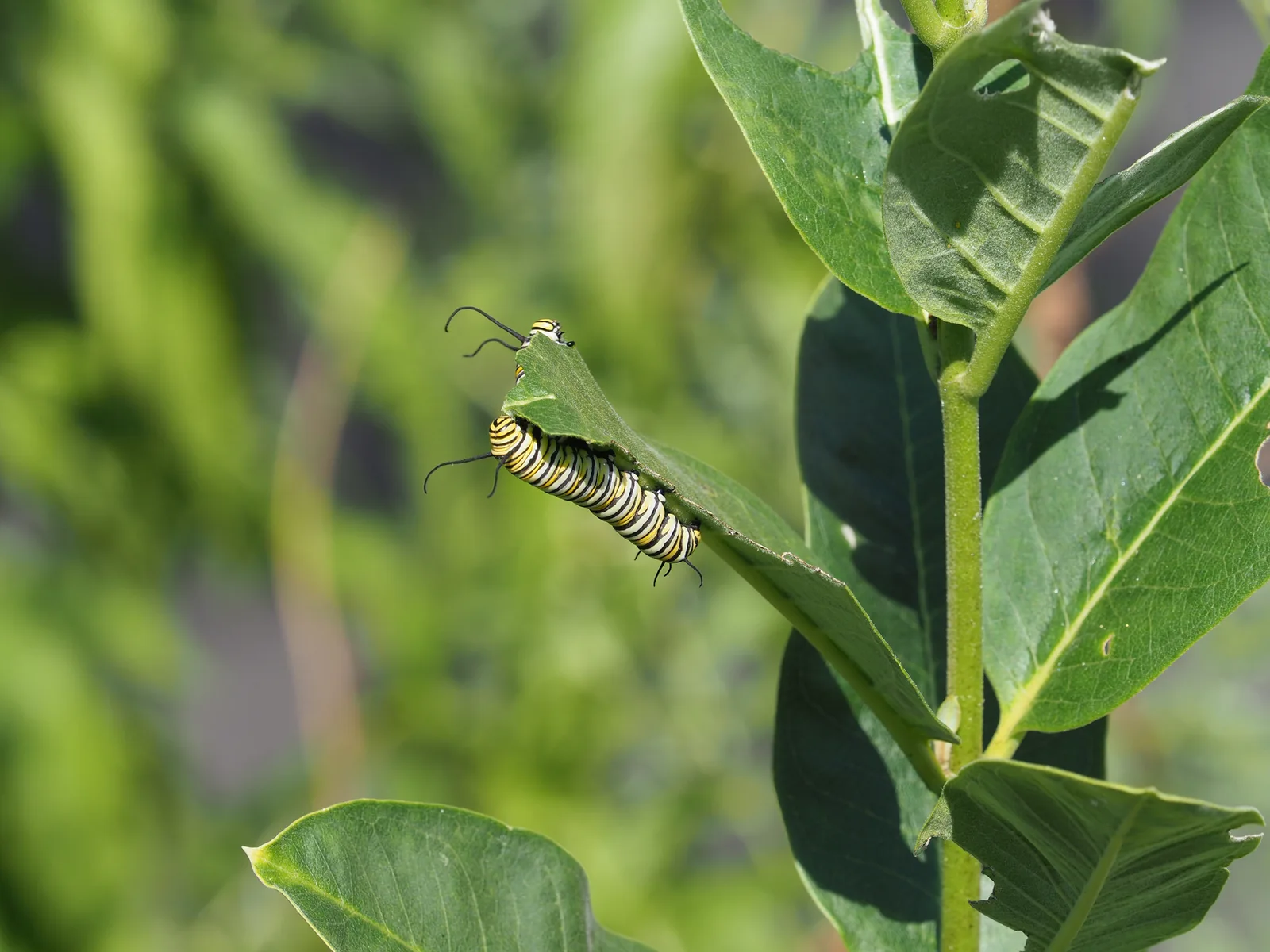
A caterpillar first bites through a latex vein to release the pressure, then feeds above the cut. A large larva chews a notch in the leaf stalk so the leaf hangs down and bleeds less. When milkweed is scarce, older caterpillars fight over it. Females sometimes lay on swallow-wort, a European relative of milkweed, and the hatchlings are poisoned.
The adult drinks nectar from many plants and favours flat flower heads such as sunflowers and asters. Goldenrods, coneflowers, gayfeathers and Mexican sunflower fuel the autumn flight south. It also sucks water and minerals from damp soil, a habit called mud-puddling. Despite its fame as a pollinator, it is not very good at pollinating milkweed.
Behaviour and social life
The monarch is the only butterfly known to make a two-way migration, as birds do. In late summer the monarchs of the northern United States and southern Canada head south. They fly at about 9 kilometres per hour and may cover 160 kilometres in a day. By early November they reach the fir forests of central Mexico and hang in clusters until mid March. The trip south is made by one generation, but the return takes the second, third and fourth.
The wintering butterflies do not breed until spring. In March they mate, fly north to Texas and Oklahoma, lay eggs and die. Their children and grandchildren carry the population back to Canada by summer. In 2025 researchers fitted over 400 tiny solar-powered transmitters to migrating monarchs to map their routes.
Winter roosts hold millions of butterflies on a few hectares of forest. The largest roost on record covered 18 hectares in the winter of 1996 to 1997. Butterflies reared indoors migrate less successfully, and a 2019 study found their sense of direction impaired. Monarchs also learn: they can link a colour with a sugar reward and remember it.
Communication and senses
The monarch sees four kinds of light: ultraviolet, blue, green and a filtered long-wavelength channel. That fourth channel lets it tell yellow from orange. It judges colour by wavelength alone, not by brightness, which is called true colour vision. Colour draws it to a flower first, and shape comes second. For egg laying the order flips, and leaf shape matters more than colour.
Cells at the top rim of the eye detect polarised ultraviolet skylight. The butterfly uses that light to keep its bearing from the sun on the long flight south. A male carries pheromone scales in the black spots on his hindwings. Even so, monarch courtship relies less on scent than that of other Danaus species. Like other insects, it senses smell and taste through its antennae and feet.
Reproduction and life cycle
Courtship starts in the air, where the male chases the female and forces her to the ground. The pair then couple and may stay joined for up to 16 hours. Only 30% of attempts end in mating, so females can refuse. The male passes a spermatophore that carries sperm and food, and a bigger one means more eggs. Both sexes mate more than once.
The female glues each egg singly under a young milkweed leaf. She lays 300 to 500 eggs over two to five weeks, and the record is 1,180. An egg is about 1.2 by 0.9 millimetres and hatches in three to eight days. The caterpillar eats its eggshell, then the leaf, and passes through five instars of about 3 to 5 days each. Fewer than 10% of eggs and caterpillars survive weather, predators and disease.
The full-grown caterpillar walks up to 10 metres from its plant and spins a silk pad. It hangs from the pad in a J shape for 12 to 16 hours. Its skin splits to reveal a green chrysalis about 2.5 centimetres long. The adult forms inside in 8 to 15 days, and the case turns clear a day before it emerges. From egg to adult takes as little as 25 days in summer and up to seven weeks in a cool spring. A breeding adult matures in 4 to 5 days and lives 2 to 5 weeks, but the migrant generation lives up to 8 months.
Predators and threats
The monarch's orange warns predators that it is poisonous, and most birds learn to leave it alone. The wings hold three times the poison of the body, so a bird that pecks a wing gets the message first. Two Mexican birds have beaten the defence. The black-backed oriole tastes the poison and discards the toxic parts, and the black-headed grosbeak can swallow it without vomiting. Together with the black-eared mouse, they eat about 14% of the wintering monarchs, and one mouse can take 40 a night.
Wasps, spiders, assassin bugs, stink bugs, ants and the introduced Asian lady beetle take eggs and caterpillars. Tachinid flies and braconid wasps grow inside a caterpillar and kill it. One tiny wasp lays in a fresh chrysalis, and up to 400 adults emerge from it 14 to 20 days later. The protozoan parasite Ophryocystis elektroscirrha, or OE, passes from mother to caterpillar and cripples heavily infected adults. In Hawaii two bulbul species introduced in 1965 to 1966 eat monarchs, which may explain why the white morph thrives there.
The real threats are human. Herbicide-tolerant corn and soybean, now 89% and 94% of those crops, let farmers spray glyphosate over fields that once held milkweed. Illegal logging eats into the oyamel fir forests in Mexico. Cars kill millions of butterflies a year, and two road hotspots in northern Mexico kill about 200,000 migrants each autumn.
Population and conservation
The IUCN Red List rates the monarch as Vulnerable. In July 2022 it had listed the migratory subspecies as Endangered, but a petition in 2023 moved it to Vulnerable. Canada listed the monarch as endangered under its Species at Risk Act in December 2023. In December 2024 the US Fish and Wildlife Service proposed to list it as threatened. The service put the chance of extinction within 60 years at 56 to 74% for the eastern migrants and 99% for the western.
The eastern population has fallen by about 80% since the 1980s, and the western by 95%. Nearly a billion monarchs vanished from the winter sites between 1990 and 2015. The Mexican colonies covered 18 hectares in 1996 to 1997, about 6 hectares on average, and only 0.67 hectares in 2013 to 2014. They rose to 1.79 hectares in 2024 to 2025 and 2.93 hectares the winter after. The California count fell to 1,901 butterflies in 2020, recovered to 335,479 in 2022, then dropped to 9,119 in 2024.
Counts of breeding adults in summer have not fallen over the last two decades, so the loss seems to happen on migration. Mexico and California protect the winter groves as sanctuaries. A US national strategy in 2015 set a goal of 225 million eastern monarchs on 6.1 hectares by 2020. Monarch Watch and the Xerces Society urge people to plant native milkweed as waystations.
Relationship with humans
Seven states have made the monarch their state insect, among them Texas, Illinois, Minnesota, Vermont, Idaho, West Virginia and Alabama. Congress twice failed to adopt it as the national insect, in 1989 and 1991. Schools rear monarchs, and captive-bred butterflies are released at weddings, hospices and memorials. Scientists warn against rearing more than 100 at once, because OE spreads fast in crowded containers. California requires a permit to handle wild monarchs, and Pacific Grove fines anyone who disturbs them 1,000 dollars.
Tourists visit the winter colonies in Mexico and California, and the sanctuaries earn from them. Butterflies in quieter groves show better immune responses than those near crowds. Volunteers tag monarchs each autumn to track the migration. Some milkweeds poison cattle, so farmers gain when the caterpillars thin them out. Monarchs even went to orbit: in 2009 caterpillars pupated and emerged on the International Space Station.
Gardeners plant milkweed for the caterpillars, but tropical milkweed grown year round in the southern US is controversial. It lets monarchs breed all winter and builds up the OE parasite. At least 14 US states had passed laws by 2025 to restore pollinator habitat. A 2015 highway law asks states to mow less and plant milkweed along roads, though roads also kill butterflies.
In culture and myth
The monarchs reach central Mexico in late October and early November, just as families celebrate the Day of the Dead. In Purépecha tradition and in other Mexican communities, the butterflies are the souls of the dead coming home. Some say they are the souls of children. Monarch images sit on home altars among marigolds and sugar skulls. Some writers link the butterfly to Mictecacihuatl, the Aztec goddess of the underworld.
The scientific name comes from Greek myth: Danaus the king and Plexippus, whose name means one who urges on horses. Linnaeus took the names of his colourful butterflies from the sons of Aegyptus and of his white ones from the daughters of Danaus. The 2012 IMAX film Flight of the Butterflies tells how the Urquharts and their helpers found the Mexican winter sites. Barbara Kingsolver's 2012 novel Flight Behavior imagines a colony settling in the Appalachians. Across North America the monarch has probably become the best-known symbol of pollinators and of long journeys.
A sentence with a dotted underline is inferred: it describes the group the animal belongs to, or is a reading of the sources, rather than a measured or reported fact about this species.
Questions
Monarch butterfly questions, answered
How far do monarch butterflies migrate?
The eastern population flies up to about 4,000 kilometres from Canada and the northern United States to central Mexico. The trip south is made by one generation, and the return takes three or four.
How long do monarch butterflies live?
A summer adult lives 2 to 5 weeks. The generation born in late summer delays breeding, migrates and lives up to 8 months.
What do monarch caterpillars eat?
Only milkweed. The eastern migration depends mainly on common milkweed, and the poisons in the plant stay in the butterfly.
What do adult monarchs eat?
Nectar from many flowers, especially flat heads such as sunflowers, asters and goldenrod. They also take minerals from damp soil.
Are monarch butterflies poisonous?
Yes, to animals that eat them. The caterpillar stores heart poisons from milkweed, and they stay in the adult. They are harmless to touch.
Are monarch butterflies endangered?
The IUCN lists the species as Vulnerable. The eastern migrants have fallen by about 80% since the 1980s and the western by 95%. Canada lists it as endangered, and the US has proposed a threatened listing.
Where do monarchs spend the winter?
Eastern monarchs cluster in oyamel fir forests in Michoacán and the State of México. Western monarchs roost in groves along the California coast.
How big is a monarch butterfly?
The wingspan is 8.9 to 10.2 centimetres. Males are slightly larger than females.
How fast does a monarch fly?
About 9 kilometres per hour in normal flight, and up to 160 kilometres in a day on migration with a following wind.
How many eggs does a monarch lay?
Usually 300 to 500 over two to five weeks, one at a time under milkweed leaves. The record is 1,180.
How long does a monarch take to become a butterfly?
As little as 25 days in summer and up to seven weeks in cool weather. The egg hatches in three to eight days, and the chrysalis lasts 8 to 15 days.
How do I tell a male from a female monarch?
A male has a black spot on a vein of each hindwing. A female has no spots, darker colour and thicker black veins.
What is the difference between a monarch and a viceroy?
The viceroy is smaller, and a black band crosses each of its hindwings. Both taste bad, so each protects the other.
Why are monarchs linked to the Day of the Dead?
They arrive in central Mexico in late October and early November, when families honour their dead. Purépecha communities and others see the butterflies as the returning souls.
Should I raise monarchs at home?
A few caterpillars on fresh milkweed are fine for learning. Scientists advise against rearing more than 100, because the OE parasite spreads in containers and indoor-reared adults navigate poorly.
What eats monarch butterflies?
Black-backed orioles and black-headed grosbeaks in Mexico, black-eared mice, wasps, spiders, assassin bugs and parasitic flies. Most birds avoid them because of the poison.
Food web
Prey and food
- nectar
Food web
Predators
- birds
- wasps
- spiders
Ecological equivalents
Related species on this site
Admiral Butterfly (same family), Fritillary Butterfly (same family), Kamehameha Butterfly (same family), Owl Butterfly (same family), Peacock Butterfly (same family), Purple Emperor Butterfly (same family), and more.
Insects
Admiral Butterfly
Vanessa atalanta
Classification and source reference
LivingInsects
Fritillary Butterfly
Nymphalidae
Classification and source reference
LivingInsects
Kamehameha Butterfly
Vanessa tameamea
Classification and source reference
LivingInsects
Owl Butterfly
Caligo
Classification and source reference
LivingInsects
Peacock Butterfly
Aglais io
Classification and source reference
LivingInsects
Purple Emperor Butterfly
Apatura iris
Classification and source reference
Living