Philippine eagle
The king of birds of the Philippine forest
Pithecophaga jefferyi
Also called Monkey-eating eagle, Great Philippine eagle, Haribon, Banoy, Manaul
Living individuals or members of this group exist today. This does not mean they are safe from extinction.
Meet the philippine eagle
The Philippine eagle is the longest eagle in the world, a crested forest hunter found on only four Philippine islands. Logging has left it Critically Endangered, with a few hundred birds and one egg every two years.
Images of the philippine eagle
Lifespan in the wild
30 to 60 years
Weight
4.04 to 8 kg
Length
0.86 to 1.02 m
Wingspan
1.84 to 2.2 m
Fact file
Philippine eagle
- Location
- Luzon, Samar, Leyte and Mindanao
- Habitat
- Rainforest, Temperate forest, Mountains
- Diet
- Carnivore
- Prey / food
- Flying lemurs, macaques, cloud rats, civets, snakes, monitor lizards, hornbills
- Predators
- None except people
- Lifestyle
- Solitary by day, paired for life, non-migratory
- Group name
- Pair
- Name of young
- Eaglet
- Incubation
- Incubation 58 to 68 days
- Clutch size
- 1 egg every two years
- Population
- About 400 pairs, with estimates of 180 to 600 birds
- Biggest threat
- Loss of old-growth forest, then shooting and trapping
- Distinctive feature
- A shaggy brown crest and a deep bluish-grey bill
- Colour
- Dark brown above, white below, with a creamy nape
Size
Next to a person
Measurements
Size and speed
- Length
- 0.86 to 1.02 m, up to 1.12 m males average 95 cm and females 105 cm, and a captive bird measured 112
- Length, male
- About 95 cm
- Length, female
- About 1.05 m
- Wingspan
- 1.84 to 2.2 m
- Tail
- 42 to 45.3 cm, up to 50 cm
- Weight
- 4.04 to 8 kg males average about 4.5 kg and females about 6 kg
- Weight, male
- About 4.5 kg
- Weight, female
- About 6 kg
Typical adult ranges. Source: Wikipedia.
Life cycle
Lifespan
- In the wild30 to 60 years
- In captivityUp to 46 years a bird at the Philippine Eagle Center reached 46, and AnAge records 41 years in Rome
- 060 years
The pale bar is the record. Sources: Animal Diversity Web, Wikipedia.
Appearance
Colour and coat
- Primary colours
- brownwhite
- Secondary colours
- creamgreyyellow
- Skin type
- feathers
- Male and female
- Moderate. The male is thought to be about 10 percent smaller than the female. Males average about 4.5 kilograms and 95 centimetres, and females about 6 kg and 105 cm.
Life cycle
Mating and family
- Mating system
- monogamous pairs for life
- Social structure
- solitary birds and territorial pairs
- Breeding
- one egg every two years
The whole breeding cycle takes two years. Females start to breed at about five years of age, and males at about seven. The pair builds a stick platform high in a tall forest tree, and the female lays one egg. Both parents incubate it for 58 to 68 days, and the female sits through the night. The young bird feeds itself from about five months old.
Classification
Taxonomy
- Kingdom
- Animalia
- Phylum
- Chordata
- Class
- Aves
- Order
- Accipitriformes
- Family
- Accipitridae
- Genus
- Pithecophaga
- Species
- Pithecophaga jefferyi
Conservation
Red List status
- LC
- NT
- VU
- EN
- CR
- EW
- EX
Critically Endangered on the IUCN Red List
Range
Recorded in 1 country
Habitat layer: tropical moist broadleaf forest, temperate broadleaf and mixed forest, temperate conifer forest, boreal forest and taiga, montane grassland and shrubland.
Countries from 31 wild records on GBIF (iNaturalist research grade), filtered and checked by hand. Country shapes: Natural Earth. Habitat: RESOLVE Ecoregions 2017, CC BY 4.0. Basemap: Natural Earth.
Habitats
Three things to know
- 1
It is the longest living eagle, and females average 105 centimetres from bill to tail.
- 2
A pair raises one chick every two years, which makes every loss hard to replace.
- 3
Killing one carries up to 12 years in prison under Philippine law.
Did you know
Seven more facts
- 1
The bird was first called the monkey-eating eagle, and the name was dropped in 1978.
- 2
Its lower leg ties for the longest of any eagle, at 12.2 to 14.5 centimetres.
- 3
DNA moved the species from the harpy eagles to the snake eagles in 2005.
- 4
Only about 9,220 square kilometres of old-growth forest survive in its range.
- 5
Two eagles flew to Singapore in 2019 with printed passports of their own.
- 6
One captive bird lived to 46 at the Philippine Eagle Center in Davao City.
- 7
A nest platform can be 1.5 metres across and sits 30 metres up.
Field notes
How it looks and acts
Field notes
Distinguishing features
- Long nape feathers lift into a shaggy crest.
- The face is dark and the crown and nape are creamy brown.
- The underside and the underwings are white against a dark brown back.
- The bill is tall, arched and bluish grey.
- The eyes are a pale blue-grey, which is unusual in a large eagle.
- The yellow legs are heavy, and the lower leg is the longest of any eagle.
Field notes
Unique adaptations
- Broad, fairly short wings suit fast flight inside forest rather than open soaring.
- Very long legs probably give the bird reach into a tree hole or a tangle of branches.
- The deep bill tears prey as large as a small deer.
- Still-hunting from a perch probably saves energy in dense forest.
- A wide prey list lets the bird switch between islands with different animals.
Field notes
Interesting behaviours
- The eagle sits motionless near the canopy and watches for movement.
- It glides from perch to perch, working its way down a tree.
- A pair hunts monkeys together, one distracting and one striking.
- Young birds grip knotholes and hang upside down in play.
- A pair returns to the same nest for chick after chick.
Field notes
Temperament
- The eagle is solitary and keeps away from other eagles outside its pair.
- It bonds for life and stays with one mate.
- It takes on dangerous prey, including macaques as heavy as itself.
- It seems shy of people and hunts deep inside forest where it can.
Field notes
Communication
- Mates call to each other, most often in the breeding season.
- Parents and fledglings keep in contact by voice.
- Loud calls go with the display flights over a nesting territory.
- The male shows his talons to the female, and she rolls over to answer.
Ecology
Ecological role
The Philippine eagle is the top predator of its forest, and protecting its territory protects everything else living there.
- It probably holds down the numbers of flying lemurs, cloud rats and macaques.
- It hunts across a home range of 60 to 130 square kilometres.
- Conservation workers treat it as an umbrella species for the whole forest.
- Its decline appears to track the loss of old-growth forest almost exactly.
Stories
Myths and legends
- In Visayan tradition the bird Manaul started the war of sky and sea that made dry land.
- In Visayan tradition Manaul dropped boulders that became the islands of the country.
- In Bisaya tradition Manaul pecked the first man and woman free from a bamboo stem.
- In Tagalog tradition the same deeds belong to Amihan, the bird of the northeast wind.
- In modern Filipino usage the eagle is the haribon, the king of birds.
People
Relationship with humans
People
Living alongside us
People decide whether this eagle survives. Logging has stripped most of the old forest it hunts in, and shooting and trapping kill birds every year. The Philippine Eagle Foundation runs rescue, nest monitoring, captive breeding and community work from Davao City. The bird is the national symbol, and it appears on banknotes, coins, stamps and a basketball crest. Killing one carries up to 12 years in prison.
- The eagle does not hunt people and keeps to deep forest where it can.
- It takes chickens, cats, piglets and small dogs near villages.
- A bird handled without care may injure a person with its claws.
People
Status, uses and products
- Domestication
- Wild
- As a pet
- Not suitable. This is a Critically Endangered national symbol, and holding one is a crime. It needs many square kilometres of forest and several kilograms of live prey a week. Only the Philippine Eagle Center and licensed zoos may keep one.
- Uses
- ecotourismbirdwatchingnational symbolconservation research
- Products
- None recorded
The full account
About the philippine eagle
The Philippine eagle, Pithecophaga jefferyi, hunts in the forests of four Philippine islands. It measures 86 to 102 centimetres from bill to tail. Males average 95 cm and females average 105 cm, which makes it the longest eagle alive. The wings span 184 to 220 cm, and adults weigh 4.04 to 8 kilograms. A shaggy crest of long brown feathers stands up on the nape.
The bird eats flying lemurs, monkeys, cloud rats, civets, snakes and large birds. It needs old forest, and logging has taken most of that away. The IUCN has listed the species as Critically Endangered since 1994. Estimates run from 180 to 600 birds, and one count puts it at about 400 pairs. A pair raises one chick every two years. The Philippines made it the national bird in 1995.
Name and taxonomy
The English explorer John Whitehead watched the bird in 1896. A servant named Juan shot the first specimen for him a few weeks later. William Robert Ogilvie-Grant received the skin in London and named the species that year. He first showed it off in a restaurant near his home. The genus name joins the Greek words for ape and eater. The species name honours Jeffery Whitehead, the father of John.
People on Samar told the collectors that the bird ate only monkeys. That report gave the species its first English name. Later work showed a far wider diet, so the name was dropped. A proclamation of 1978 made Philippine eagle the official name. Filipino languages call it banoy, agila, manaul, tipule and mam-boogook. Modern Filipino uses haribon, which packs two words meaning bird king.
Evolution and relatives
The species is the only member of its genus, and it has no subspecies. A study of its skeleton in 1919 put the harpy eagle closest to it. Books then filed it with the harpy eagles in the subfamily Harpiinae. DNA work in 2005 broke that link. The nearest relatives turned out to be the snake eagles, a group that includes the bateleur. The species now sits in the subfamily Circaetinae.
The eagle appears to stand almost alone on the tree of living birds. The Zoological Society of London ranks it in the top 15 of its EDGE list. That list scores a species on how distinct it is and how close to extinction. It is the most distinct and most endangered animal in the Philippines by that measure. Island life without rival predators probably shaped the bird into the top hunter of the forest.
Appearance
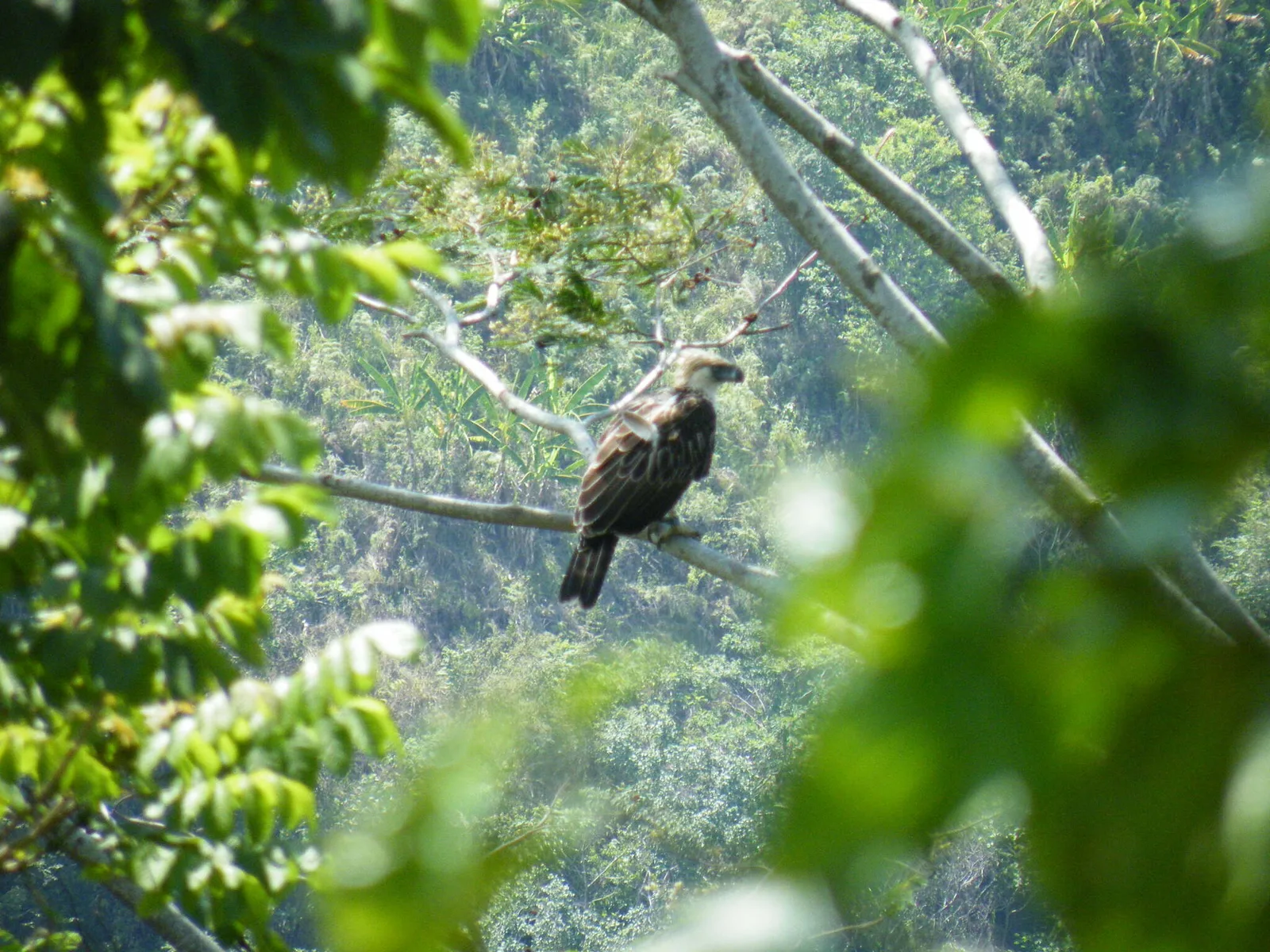
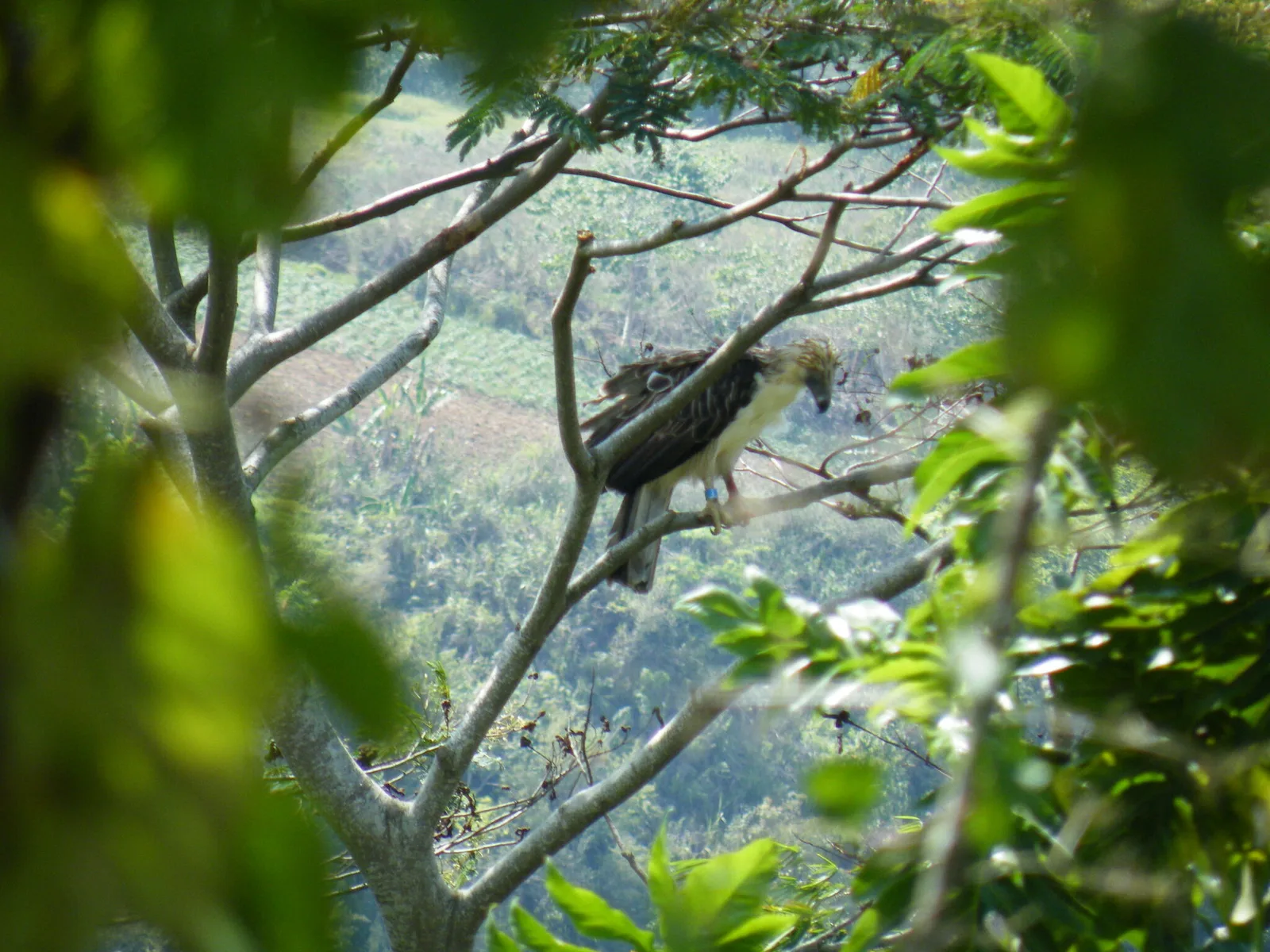
The face is dark, and the crown and nape are a creamy brown. Long feathers on the nape lift into a mane-like crest. The back is dark brown, and the underside and underwings are white. The legs are heavy and yellow, and the claws are dark and thick. The tall arched bill is bluish grey, and the eyes are blue-grey. A juvenile looks the same but for pale edges on the upper feathers.
The reported length runs from 86 to 102 centimetres. The longest bird on record measured 112 cm, though it had lived in captivity. The wings are broad but shorter than those of eagles that hunt open country. The lower leg is 12.2 to 14.5 cm long, which ties the longest of any eagle. The bill averages 7.22 cm from the gape. The tail is long as well, at 42 to 45.3 cm.
Habitat and range
The species lives only in the Philippines. It survives on eastern Luzon, Samar, Leyte and Mindanao. Mindanao holds the bulk of the birds, with 82 to 233 breeding pairs. Samar holds about six pairs, Leyte two, and Luzon a few more. National parks on Mount Apo, Mount Kitanglad and Mount Malindang protect some of them. The Northern Sierra Madre National Park holds the Luzon birds.
The eagle wants dipterocarp forest and mid-montane forest, often on steep ground. It ranges from the lowlands up past 1,800 metres. Its total range covers about 146,000 square kilometres. Only about 9,220 square kilometres of old-growth forest are left inside that range. The gap between those two figures is probably the whole conservation problem.
Diet and hunting
This eagle takes whatever the forest offers in numbers. Flying lemurs form up to 90 percent of the food at some Mindanao sites. Luzon has no flying lemurs, so birds there hunt macaques, reptiles and giant cloud rats. A northern Luzon cloud rat weighs 2 to 2.5 kilograms. Civets, flying squirrels, flying foxes, rats and mouse deer fill in the rest. Prey at nests has ranged from a 10 gram bat to a 14 kg Philippine deer.
The eagle also takes hornbills, owls, hawks, snakes and monitor lizards. One pair even carried a Philippine cobra to the nest. Near villages the birds catch chickens, cats, piglets and small dogs. One hunting method is to sit still near the canopy and watch. The other is to glide from perch to perch, working down the branches and back up. A pair may hunt monkeys together, with one bird distracting the troop.
Behaviour and social life
The bird flaps far more than it soars, and its flight is fast and agile. It seems to behave more like a large forest hawk than like an open-country eagle. It is active by day, does not migrate and lives alone or with its mate. A pair needs a very large area to raise one chick. Home ranges of 60 to 130 square kilometres have been reported.
On Mindanao the nearest breeding pairs sat about 13 kilometres apart. That spacing gives each pair a circle of roughly 133 square kilometres. Young birds play, and the play appears to be practice for hunting. They grip knotholes, push their heads into tree cavities and balance with tail and wings. They also attack objects and hang upside down while the parents are away.
Communication and senses
Calls appear to carry most of the message in this species. A bird calls to its mate, and it calls most in the breeding season. A fledgling and its parents keep contact by voice. Loud advertisement calls go with the display flights of courtship. The calls seem to tell neighbours that a territory is taken.
Display seems to carry the rest of the message. A pair soars together over the nesting ground. The male chases the female in a slanting dive. He shows his talons at her back, and she rolls over to show her own. Like other eagles, it hunts by sight and can spot a small animal in the canopy.
Reproduction and life cycle
The full breeding cycle takes two years. A female is ready to breed at five years old and a male at seven. Pairs stay together for life, and a widowed bird usually finds a new mate. Courtship starts when a bird begins to build and stays near the nest. The earliest courtship on record fell in July.
The nest goes in a tall dipterocarp or another tree with an open crown. It is a platform of sticks about 1.5 metres across, lined with green leaves. It usually sits 30 metres or more above the ground. A pair uses the same nest for one chick after another. Eight to 10 days before laying, the female stops eating and drinks a great deal. Keepers call that state egg lethargy.
She lays a single egg, usually in the late afternoon or at dusk. Both parents incubate, and the female sits through every night. The egg hatches after 58 to 68 days, and 62 days is typical. The chick becomes independent at about five months. Wild birds are thought to live 30 to 60 years. One captive bird at the Philippine Eagle Center reached 46 years.
Predators and threats
No wild animal hunts a grown Philippine eagle. People are, in general, the whole of the problem. Five eagles were shot on Mindanao between 1999 and 2000. Three were trapped in the Sierra Madre of Luzon between 2002 and 2003. Of four tagged young birds followed from 1998 to 2002, three were lost to hunting and trapping.
More than 20 eagles have been rescued since 2019, most of them with gunshot wounds. Birds also die in snares that villagers set for deer. A released bird named Kabayan was electrocuted in January 2005. Another named Kagsabua was released in 2008, and a farmer shot and ate it. Logging, mining, pesticides and floods after clearance add to the pressure. Typhoon Haiyan wrecked the forest of Leyte in 2013, and nobody saw an eagle there afterwards. Two rescued birds were flown to Leyte in June 2024 to start the island again. The male drowned at sea, and the female was still hunting well in October 2024.
Population and conservation
The IUCN and BirdLife International listed the species as Critically Endangered in 1994. The IUCN then put the survivors at 180 to 500 birds. A 2015 estimate raised the figure to about 600. The Philippine Eagle Foundation counts about 400 pairs in the wild. Loss of old-growth forest remains the first cause of the decline.
Dioscoro Rabor and Jesus Alvarez raised the alarm abroad in 1965. Charles Lindbergh visited the country several times between 1969 and 1972 for the World Wildlife Fund. His visits helped move the government towards protection. A conservation programme began in 1969. The first captive hatching came in 1992 and the first natural one in 1999. The foundation in Davao City has bred the eagle 31 times as of 2025.
Relationship with humans
President Fidel Ramos declared the bird the national bird on 4 July 1995. Killing one carries up to 12 years in prison and heavy fines. The eagle appears on the 1,000-peso banknote, which caused an argument when the design changed. It has been on at least 12 stamps and on the 50-sentimo coin. It served as the mascot Gilas at the 2005 Southeast Asian Games.
The country now lends eagles abroad as a form of diplomacy. A male named Geothermica and a female named Sambisig went to Singapore in 2019. Each bird travelled with a printed passport of its own. Geothermica died of a fungal infection in 2022, and Sambisig stayed on. Birdwatchers travel to Mindanao to see the species, which probably brings work to local guides.
In culture and myth
Visayan tradition knows a great bird called Manaul. The name belongs to this eagle and to the white-bellied sea eagle. In the creation story only the sea, the sky and Manaul existed at first. The bird grew tired of flying and could find nowhere to rest. So it set the sky god Kaptan against the sea goddess Magwayen.
Kaptan sent storms down and Magwayen sent waves up. The long fight between them raised dry land out of the water. Manaul then dropped boulders to part the wind from the waves. Those boulders became the islands of the Philippines. Another story has Manaul peck a bamboo stem open to free the first man and woman.
Tagalog tradition gives both stories to Amihan, the spirit of the northeast wind. Amihan also takes the shape of a bird. The modern name haribon appears to carry the same idea of a royal bird. The national basketball team wears the eagle on its crest.
A sentence with a dotted underline is inferred: it describes the group the animal belongs to, or is a reading of the sources, rather than a measured or reported fact about this species.
Questions
Philippine eagle questions, answered
How big is a Philippine eagle?
It measures 86 to 102 centimetres long, with wings spanning 184 to 220 cm. Adults weigh 4.04 to 8 kilograms. Females average 105 cm and males 95 cm.
Is the Philippine eagle the largest eagle in the world?
It is the longest living eagle, and it has the greatest wing area. The harpy eagle and Steller's sea eagle are heavier and bulkier.
Why is it called the monkey-eating eagle?
The first specimen came from Samar, where people said the bird ate only monkeys, and its stomach held monkey remains. Later work showed a much wider diet, so the name changed in 1978.
What do Philippine eagles eat?
Flying lemurs, macaques, giant cloud rats, civets, flying foxes, snakes, monitor lizards and large birds such as hornbills. Prey at nests has ranged from a 10 gram bat to a 14 kilogram deer.
How many Philippine eagles are left?
Estimates run from 180 to 600 birds. The Philippine Eagle Foundation puts the figure at roughly 400 pairs.
Why is the Philippine eagle endangered?
Logging and farming have taken most of the old-growth forest it needs. Shooting, trapping, mining and pesticides add to the loss. A pair raises only one chick every two years.
Where do Philippine eagles live?
Only in the Philippines, on eastern Luzon, Samar, Leyte and Mindanao. They use dipterocarp and mid-montane forest from the lowlands up past 1,800 metres.
How long do Philippine eagles live?
The usual estimate for a wild bird is 30 to 60 years. One captive eagle reached 46 years in Davao City, and another lived 41 years in Rome.
How many eggs does a Philippine eagle lay?
One, and only once every two years. Both parents incubate it for 58 to 68 days. If the egg fails, the pair usually tries again the next year.
Is it illegal to kill a Philippine eagle?
Yes. Philippine law sets a penalty of up to 12 years in prison and heavy fines. Birds are still shot, and more than 20 have been rescued with wounds since 2019.
What is the national bird of the Philippines?
The Philippine eagle. President Fidel Ramos declared it the national bird on 4 July 1995. It also appears on the 1,000-peso note.
What is a haribon?
Haribon is the modern Filipino name for the eagle. It joins two words meaning king and bird. Older names include banoy, agila and manaul.
What is the closest relative of the Philippine eagle?
The snake eagles, a group that includes the bateleur. A DNA study in 2005 moved the species there from the harpy eagle group.
How big is a Philippine eagle's territory?
A pair uses 60 to 130 square kilometres. On Mindanao, neighbouring pairs nested about 13 kilometres apart.
Can you see a Philippine eagle in the wild?
It is possible but hard, and Mindanao gives the best chance. Most visitors see the birds at the Philippine Eagle Center in Davao City instead.
Food web
Prey and food
- flying lemurs
- macaques
- cloud rats
- civets
- snakes
- monitor lizards
- hornbills
Food web
Predators
- none except people
Ecological equivalents
Related species on this site
African Fish Eagle (same family), Australian Firehawk (same family), Bald eagle (same family), Bearded vulture (same family), Black kite (same family), Cinereous Vulture (same family), and more.
Birds
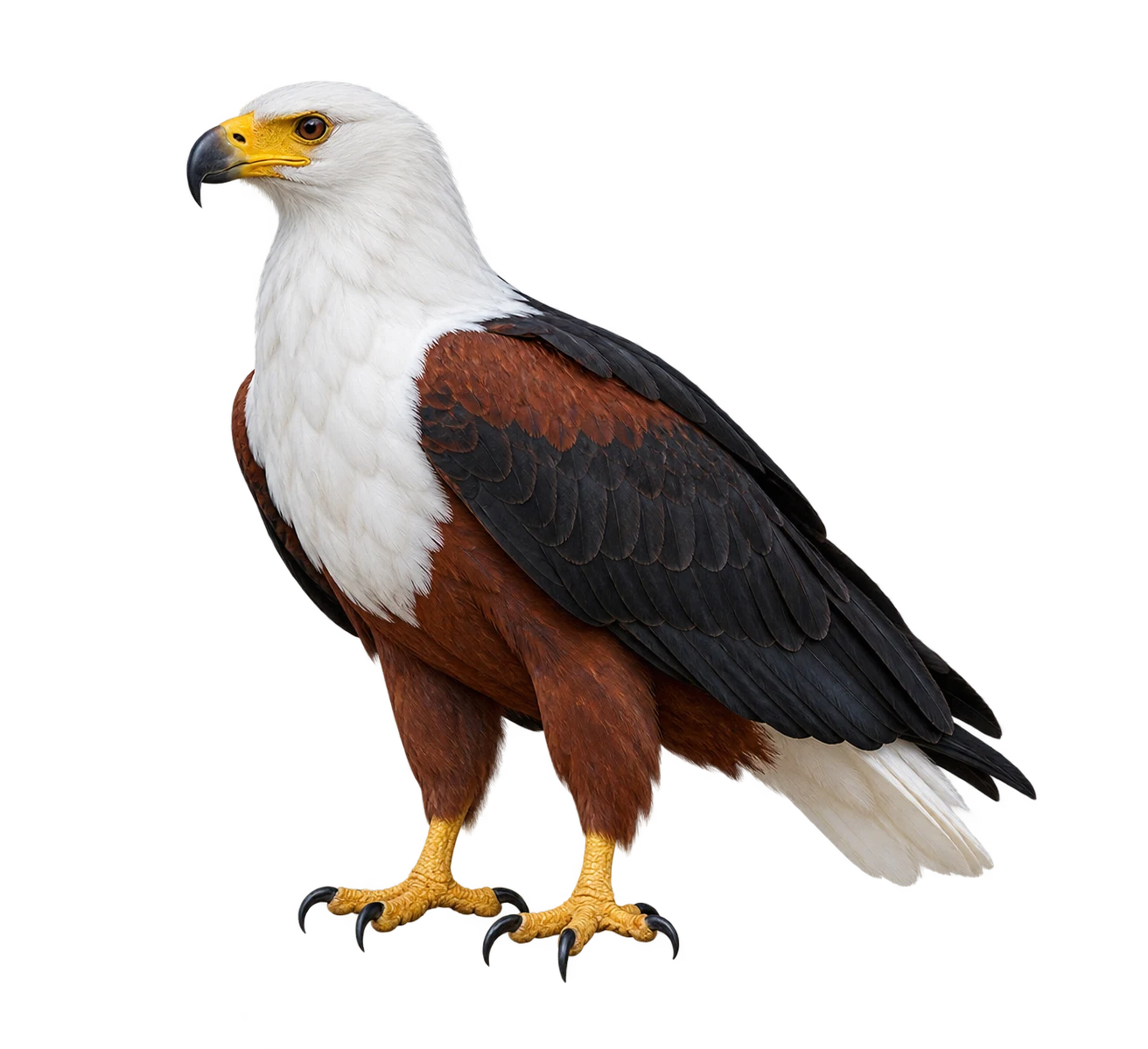
African Fish Eagle
Haliaeetus vocifer
Classification and source reference
LivingAI illustration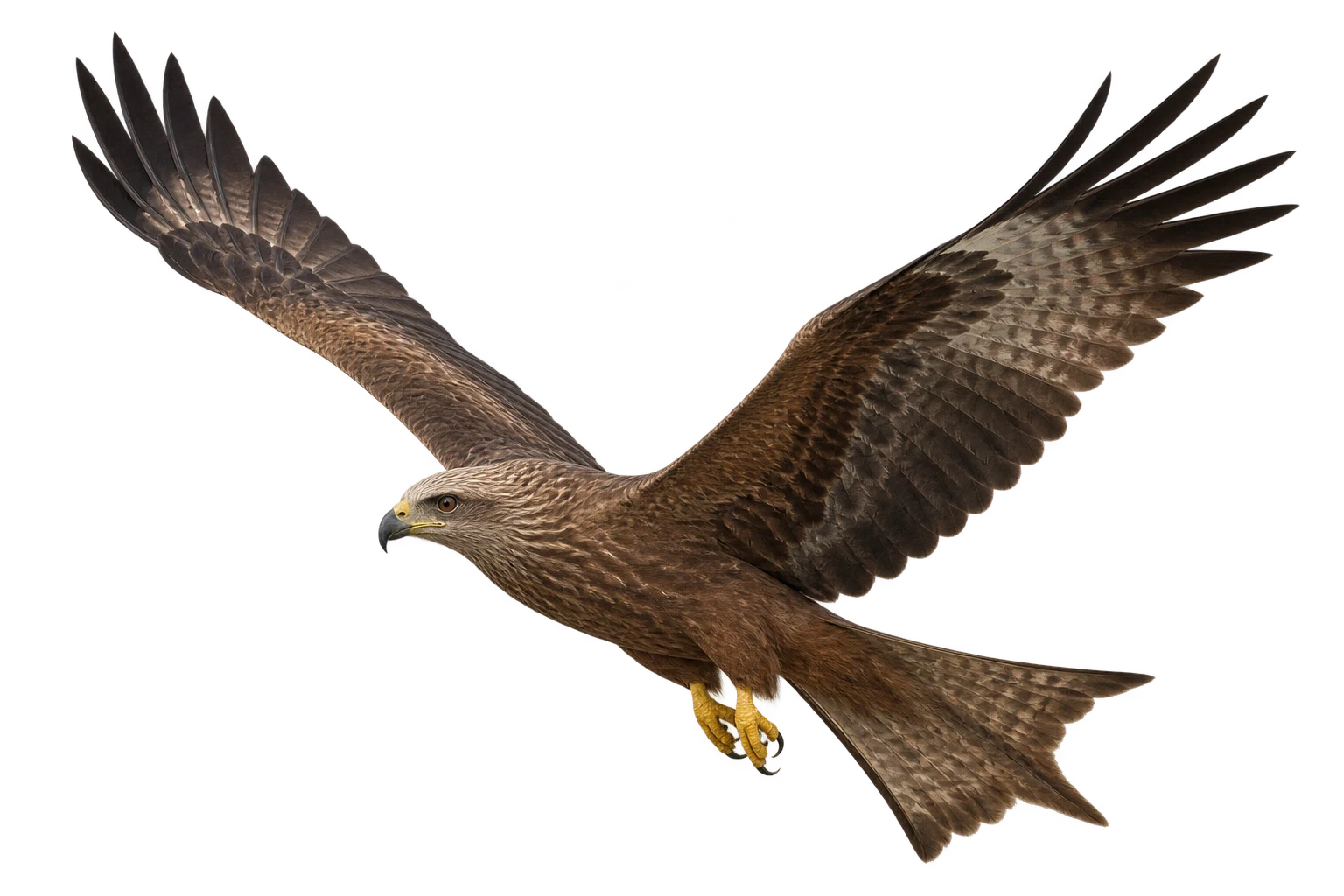
Birds
Australian Firehawk
Milvus migrans
Classification and source reference
LivingAI illustration LC
Birds
Bald eagle
Haliaeetus leucocephalus
The bald eagle is the national bird of the United States.
Living NT
Birds
Bearded vulture
Gypaetus barbatus
The bearded vulture is a huge mountain raptor that lives almost entirely on bone.
Living LC
Birds
Black kite
Milvus migrans
The black kite is a medium-sized raptor with angled wings and a forked tail.
Living
Birds
Cinereous Vulture
Aegypius monachus
Classification and source reference
LivingAI illustration