Hoatzin
The leaf-eating bird whose chicks climb on claws
Opisthocomus hoazin
Also called Stinkbird, Canje pheasant, Hoazin, Cigana
Living individuals or members of this group exist today. This does not mean they are safe from extinction.
Meet the hoatzin
The hoatzin is a crested bird of Amazon swamp forest that lives on leaves and ferments them in a huge crop. Its chicks hatch with claws on their wings and swim to escape predators.
Images of the hoatzin
Weight
0.7 to 1 kg
Length
61 to 66 cm
Fact file
Hoatzin
- Location
- Amazon and Orinoco basins and the Guianas, South America
- Habitat
- Wetlands, Rainforest, Rivers and lakes
- Diet
- Herbivore
- Predators
- Great black hawks, monkeys and snakes, mostly at the nest
- Lifestyle
- Social and active by day, in small colonies over water
- Group name
- Flock
- Name of young
- Chick
- Incubation
- About 32 days of incubation
- Clutch size
- 2 or 3 eggs
- Population
- Widespread and common, but thought to be decreasing
- Biggest threat
- Clearing of riverside and flooded forest
- Distinctive feature
- Spiky rufous crest over a bare blue face
- Colour
- Sooty brown above, buff below, chestnut under the wings
- Skin type
- Feathers
Size
Next to a person
Measurements
Size and speed
- Length
- 61 to 66 cm total length including the long tail, from ADW's 24 to 26 inches
- Weight
- 0.7 to 1 kg Wikipedia gives 700 grams as the low figure for an adult; the upper figure comes from a general bird reference
Typical adult ranges. Sources: Animal Diversity Web, Wikipedia.
Appearance
Colour and coat
- Primary colours
- brownbuff
- Secondary colours
- chestnutbluebronze-green
- Skin type
- feathers
- Male and female
- None known. Males and females appear alike in colour and size, and the crest is the same on both.
Life cycle
Mating and family
- Mating system
- monogamous pairs with helpers
- Social structure
- small colonies of territorial pairs
- Breeding
- one clutch a year in the rains
Hoatzins pair and hold a waterside territory, and grown young from earlier years help at the nest. The female lays two or three eggs on a stick platform over water. Both parents incubate for about 32 days. Chicks stay in the nest for 14 to 21 days, then climb about the branches on their wing claws. Birds first breed after their first year and live about 14 to 15 years in the wild.
Classification
Taxonomy
- Kingdom
- Animalia
- Phylum
- Chordata
- Class
- Aves
- Order
- Opisthocomiformes
- Family
- Opisthocomidae
- Genus
- Opisthocomus
- Species
- Opisthocomus hoazin
Conservation
Red List status
- LC
- NT
- VU
- EN
- CR
- EW
- EX
Least Concern on the IUCN Red List
Range
Recorded in 7 countries
Habitat layer: tropical moist broadleaf forest, flooded grassland and savanna, mangrove.
Countries from 3,034 wild records on GBIF (iNaturalist research grade), filtered and checked by hand. Country shapes: Natural Earth. Habitat: RESOLVE Ecoregions 2017, CC BY 4.0. Basemap: Natural Earth.
Habitats
Three things to know
- 1
It is the only bird known to ferment its food in a crop, as cattle do.
- 2
Chicks climb with two claws on each wing and lose them as adults.
- 3
The smell of its digestion earned it the name stinkbird.
Did you know
Seven more facts
- 1
A hoatzin meal can take 45 hours to move through the bird.
- 2
The crop is so big that it squeezes the flight muscles and the keel of the breastbone.
- 3
Fermentation makes methane, and the bird burps it out.
- 4
A frightened chick dives into the river and swims underwater to escape.
- 5
Young birds may need up to 70 days before they can fly.
- 6
One Venezuelan study found a diet of 82 percent leaves.
- 7
The hoatzin line split from other birds about 64 million years ago.
Field notes
How it looks and acts
Field notes
Distinguishing features
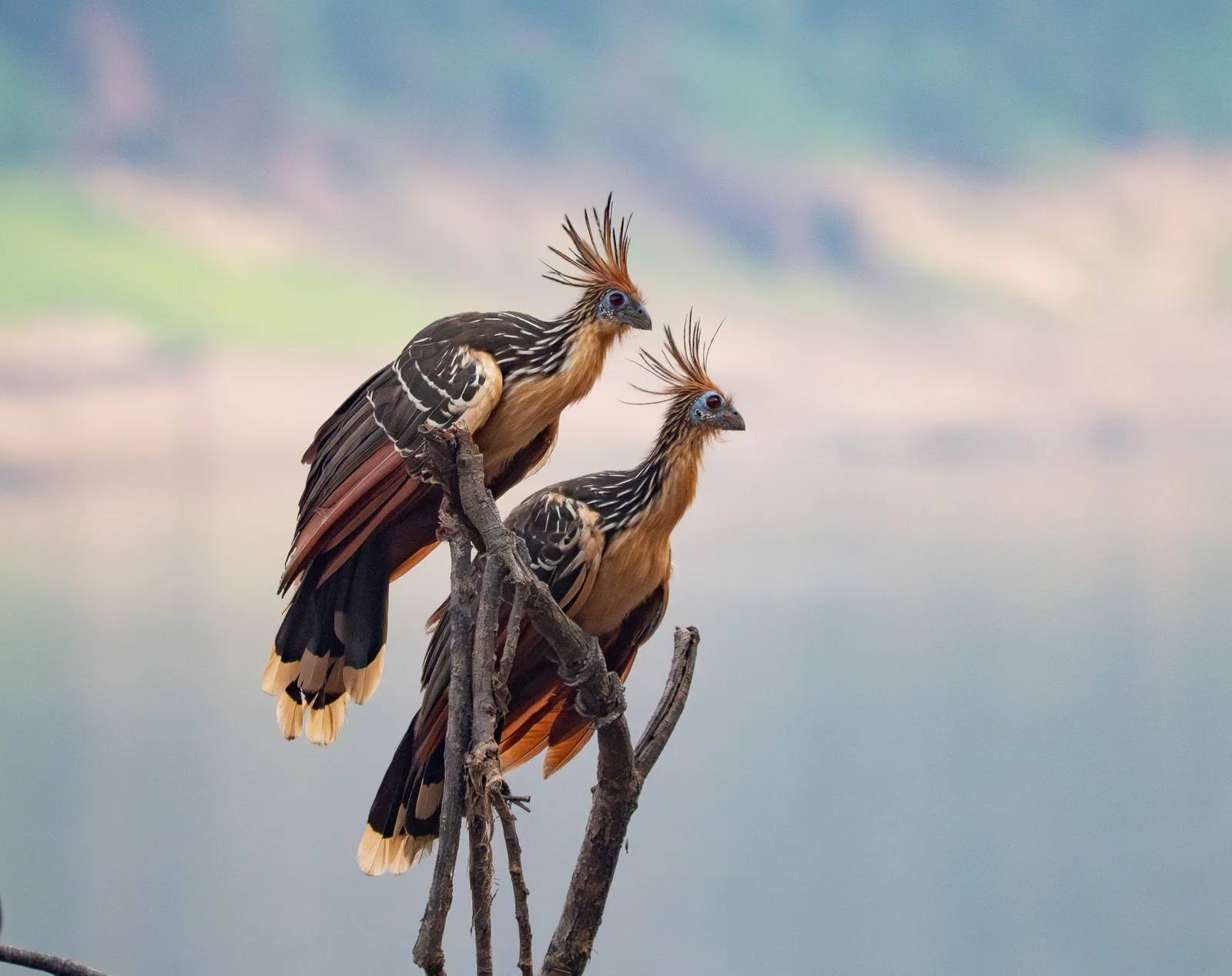
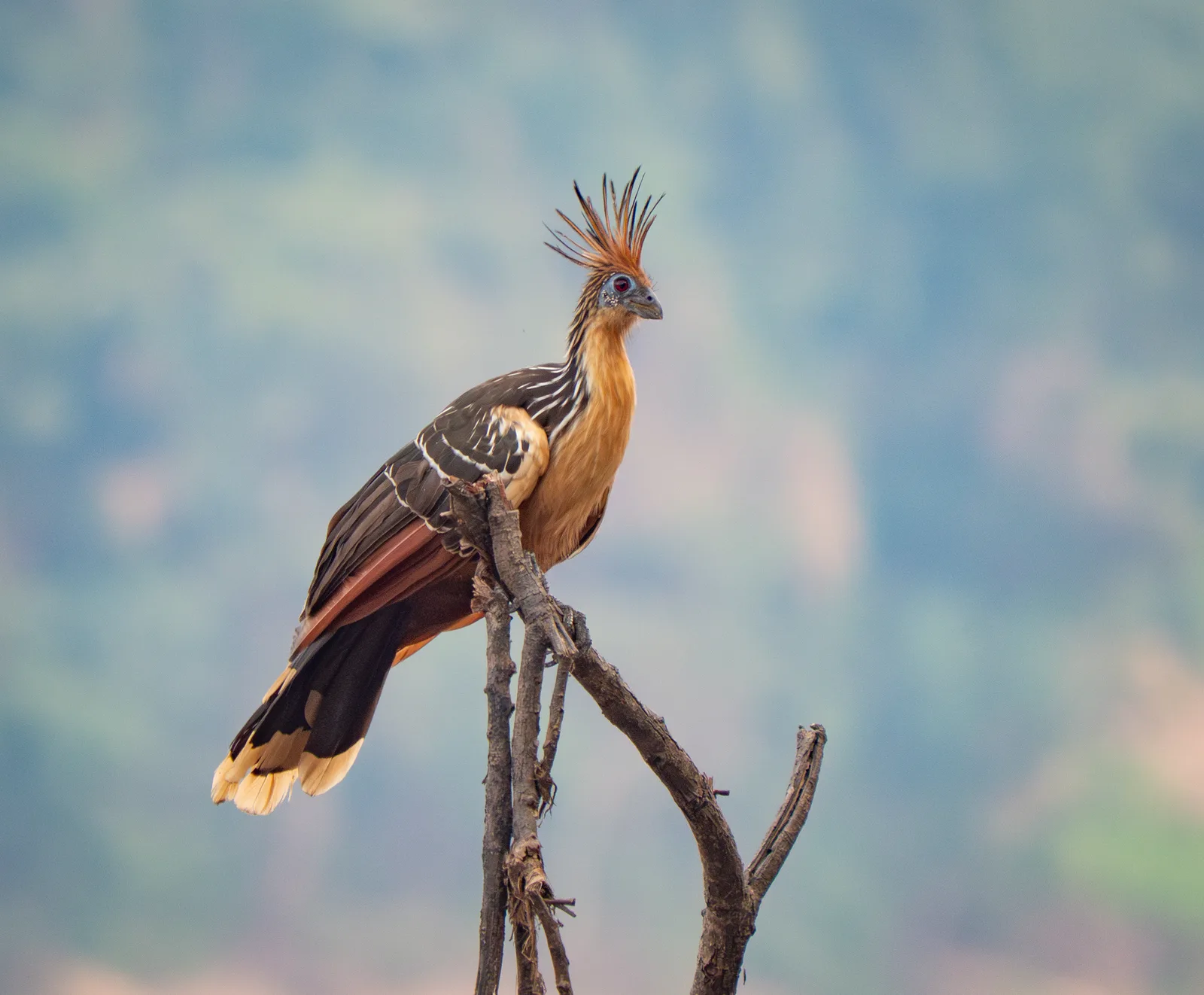
- A spiky rufous crest stands up from the crown.
- The face carries bare blue skin around a maroon eye.
- The long tail ends in a broad whitish or buff band.
- Chestnut flashes on the flanks and under the wings when the bird opens them.
- Adults measure 61 to 66 centimetres, with a small head on a long neck.
- A leathery pad under the crop shows on the breast of a perched bird.
Field notes
Unique adaptations
- The two-chambered crop holds bacteria that break down leaf fibre.
- Serrations on the bill cut leaves before the bird swallows them.
- A hardened crop lining grinds the pieces, in place of chewing.
- Chicks carry wing claws that let them climb back to the nest.
- The breast pad lets a heavy bird rest its crop on a branch.
Field notes
Interesting behaviours
- Hoatzins nest in small colonies over standing water.
- Pairs defend a stretch of waterside all through the breeding season.
- Grown young stay on as helpers and feed the next brood.
- Adults mob a great black hawk to draw it away from chicks.
- Birds clamber through branches rather than fly between them.
Field notes
Temperament
- The hoatzin is noisy and quarrelsome with its neighbours.
- It is territorial in the breeding season and calm outside it.
- The bird appears untroubled by boats and often lets people come close.
Field notes
Communication
- Calls are hoarse and include groans, croaks, hisses and grunts.
- A call usually comes with a body movement, such as a wing spread.
- Pairs advertise a boundary with ritual matings and aggressive postures.
- Chicks beg loudly and take food from the parent's bill.
Ecology
Ecological role
The hoatzin is a leaf specialist that turns riverside foliage into bird, and it feeds the hunters of the flooded forest.
- It converts tough leaves into flesh, which few birds can do.
- Its chicks feed hawks, snakes and monkeys along the river edge.
- Its droppings probably return nutrients from the canopy to the water below the nests.
- Its colonies mark healthy flooded forest, so it may work as an indicator species.
Stories
Myths and legends
- In Guyanese national symbolism the hoatzin stands for the country's wildlife.
- In Colombian country speech the bird is the pava hedionda, the stinking turkey.
- In Brazilian Portuguese the name cigana probably likens the crest to a gypsy headdress.
- In Spanish popular writing the hoatzin is often called a living fossil.
People
Relationship with humans
People
Living alongside us
People mostly leave the hoatzin alone. Its meat has a bad reputation, so hunters take adults only in hard times, though some groups collect the eggs. Guyana made the bird a national symbol and put it on the coat of arms. Boat tours on Amazon rivers now show it to visitors. The threat that matters is the clearing of the flooded forest it nests in.
- The hoatzin has no weapon that is likely to hurt a person.
- It defends a nest with noise and display, not with attacks.
- Its only unpleasant trait for people is the smell of its digestion.
People
Status, uses and products
- Domestication
- Wild
- As a pet
- Not suitable. No. The bird lives on fresh tropical leaves and on gut bacteria that a keeper cannot supply. Even zoos have failed to hold it for long, and it is protected across its range.
- Uses
- ecotourismnational symbol
- Products
- eggs
The full account
About the hoatzin
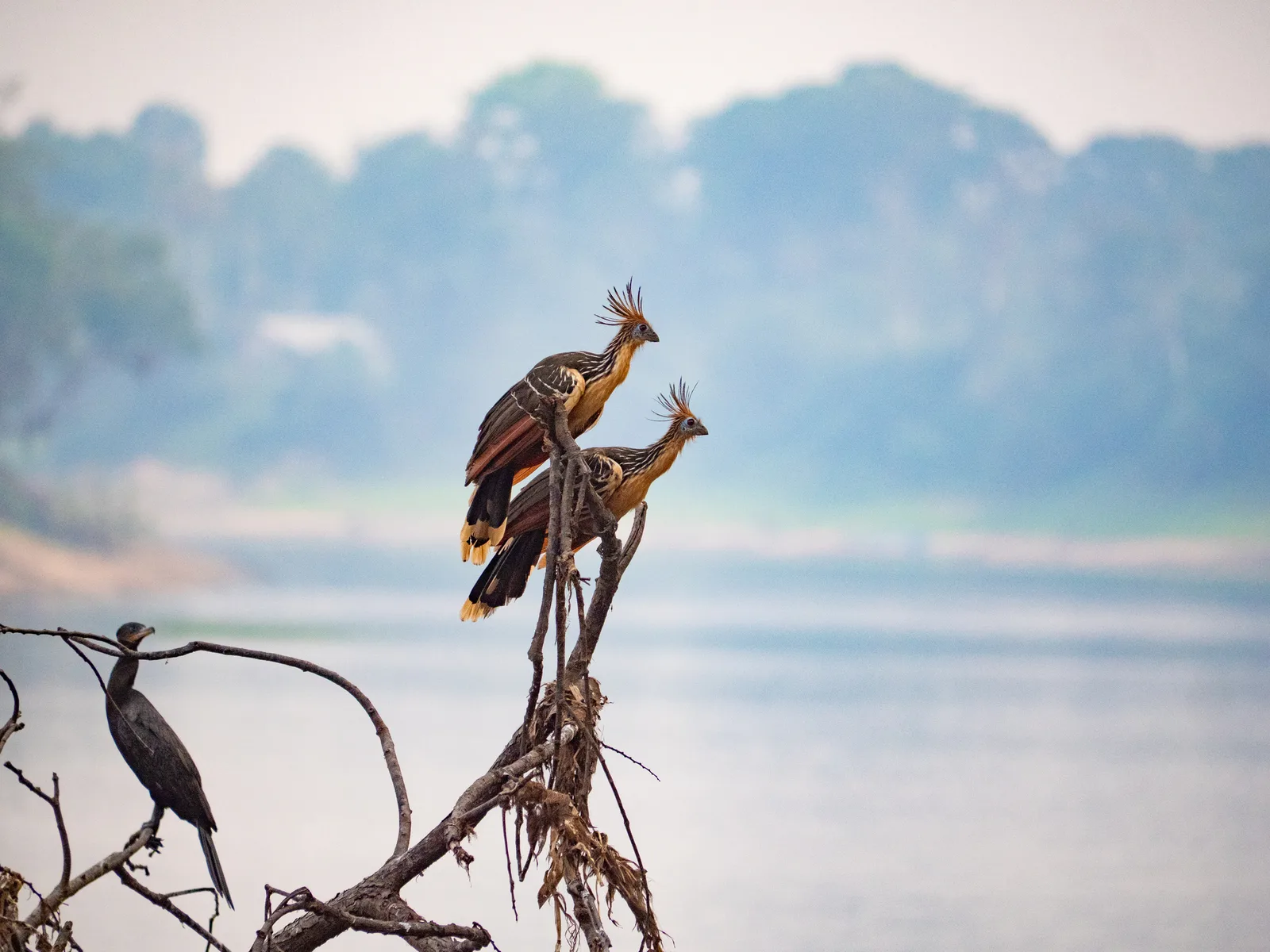
The hoatzin is a leaf-eating bird of the swamp forests of northern South America. It is the only living species in its genus, its family and its order. Adults are 61 to 66 centimetres long, with a small head, a long neck and a spiky rufous crest. The face is bare and blue, and the eye is deep maroon. No other bird digests leaves the way this one does.
A hoatzin ferments its food in an enormous crop, using bacteria, in the way cattle do. The fermentation gives the bird a sour, manure-like smell, and local people call it the stinkbird. Its chicks are stranger again, because each one hatches with two working claws on every wing. A threatened chick drops into the river below the nest and swims to cover. Guyana chose the hoatzin as its national bird, under the name Canje pheasant.
Name and taxonomy
The genus name Opisthocomus is built from two Ancient Greek words, one for behind and one for hair. Together they point at the long crest that stands up on the back of the bird's head. The German zoologist Statius Müller gave the species its first formal description in 1776. Since then it has kept a family of its own, the Opisthocomidae, and an order of its own.
English speakers also call the bird the stinkbird, and Guyanese speakers call it the Canje pheasant. Spanish names vary across the range: chenchena in the Llanos, shansho in Peru, pava hedionda in Colombia. Venezuelans say guacharaca de agua, and Bolivians say pava serere. In Brazil the usual Portuguese name is cigana.
Evolution and relatives
Where the hoatzin belongs in the bird family tree has been argued over for two centuries. Writers have tied it in turn to tinamous, gamebirds, rails, bustards, seriemas, sandgrouse, doves, turacos, cuckoos and mousebirds. A whole-genome study in 2014 made it the sister group of the cranes and the plovers together. A second genomic study in 2024 moved it beside a large group of water birds instead. That combined group came out as the sister of the flamingos and the grebes.
Genetic work published in 2015 dated the split of the hoatzin line to 64 million years ago. That is just after the extinction that removed the non-avian dinosaurs. The 2024 study pushed the origin back to about 70 million years ago, in the Late Cretaceous. It also found that many other bird orders split at the same time, so the hoatzin is no more ancient than they are. The oldest known member of the order is Protoazin from France, about 34 million years old. Relatives also lived in Brazil about 24 to 22 million years ago and in Namibia about 16 million years ago.
Appearance
The hoatzin is about the size of a pheasant, at 61 to 66 centimetres from bill to tail tip. Wikipedia gives a total length of 65 centimetres for the species. Adults weigh from about 0.7 kilograms, and heavier birds reach about 1 kg. The head is small and the neck is long, which makes the body look bulky by comparison. A crest of stiff reddish-brown feathers rises from the crown.
The bare skin of the face is blue, and it sets off a maroon eye. Upperparts are dark sooty brown, with buff edging on the coverts and buff streaks down the nape. The long tail shows bronze-green, and a broad whitish or buff band closes it. Rich chestnut sits on the flanks and under the wings, and it shows only when a bird opens up. Newly hatched chicks are naked, then grow a coat of black down.
Habitat and range
The hoatzin lives in the lowlands of the Amazon and Orinoco basins and in the Guianas. It keeps to swamp, freshwater marsh, gallery forest, mangrove and the wooded banks of rivers, lakes and streams. Seasonally flooded forest suits it best, because it nests over standing water. Birds appear to stay within a short flight of water for their whole lives.
Colombian checklists treat the species as a resident that does not migrate. GBIF holds records from 16 countries, though most of those records come from Colombia, Ecuador and Peru. The bird also reaches Brazil, Bolivia, Venezuela, Guyana, French Guiana and Suriname. iNaturalist carries 4306 observations, which shows how often river tours find it.
Diet and feeding
The hoatzin is a folivore, which means it lives on leaves. One study in Venezuela measured a diet of 82 percent leaves, 10 percent flowers and 8 percent fruit. The species was once thought to take only arum and mangrove leaves. It is now known to eat leaves from more than 50 kinds of plant. Any insect it swallows arrives by accident with the greenery.
Serrations along the bill cut a leaf into pieces before the bird swallows it. The pieces go into a crop that is folded into two chambers and packed with bacteria. Those bacteria break down plant fibre, and up to 70 percent of it is digested. Muscle pressure and a hardened crop lining grind the leaves, in place of the chewing a cow does. A single meal can take 45 hours to pass through the bird. The process releases methane, which the hoatzin burps out.
At a body weight of about 700 grams, this is the smallest animal known to ferment food in its foregut. The lower limit among mammals is roughly 3 kilograms. The crop is so large that it crowds out the flight muscles and the keel of the breastbone. Many of the leaves the bird takes, including aroids, hold crystals of calcium oxalate that would hurt a person.
Behaviour and social life
Hoatzins are sociable and live in flocks, and they nest in small colonies. A breeding pair holds a stretch of waterside and both birds defend it. Good sites over water are scarce, so neighbours press hard on one another. Young birds often remain on their parents' ground for two years or so after hatching. They act as helpers, feeding the next brood and joining in the defence.
The bird clambers along branches on its way to food, and it uses its wings for balance. A leathery pad under the crop rests on a branch and takes some of the weight. Flight is short, heavy and clumsy, because the crop leaves little room for flight muscle. A hoatzin probably spends much of the day sitting still while its crop works. When a great black hawk comes at a colony, the adults fly about noisily to pull it away.
Communication and senses
The hoatzin is a loud bird with a rough voice. Its calls include groans, croaks, hisses and grunts. Birds often pair a call with a movement of the body, such as spreading the wings. A pair marks the edge of a territory with loud noise, aggressive postures and ritual matings.
The large maroon eye and the daytime habits suggest that sight leads the bird to its food. Leaves do not run away, so a hoatzin probably needs less sharp senses than a hunter. The smell of the bird is probably a by-product of fermentation rather than a signal. Chicks beg from the adults and take fermented food straight from the bill.
Reproduction and life cycle
Hoatzins breed once a year, in the rainy season, and the timing shifts across the range. Pairs build a loose platform of sticks on a branch that hangs over water. The female lays two or three eggs. Both parents sit on the clutch, and incubation runs about 32 days. Chicks stay in the nest for 14 to 21 days after they hatch.
Adults feed the chicks on regurgitated leaf pulp that is already fermenting. That meal also passes on the gut bacteria the young bird will need for life. Each chick has two claws on each wing and oversized feet. With them it scrambles about the branches around the nest without falling in. A chick that is found by a predator drops into the water and swims below the surface. It then hauls itself back up the stems with the wing claws.
Young hoatzins can take up to 70 days to fly at all, because the crop is heavy. The claws are lost as the bird matures, and no adult keeps them. Birds do not breed until after their first year. A general bird reference gives about 14 to 15 years in the wild and up to 30 in captivity. None of the four research sources this site uses publishes a hoatzin lifespan, so the page states no measured figure.
Predators and threats
Chicks are the vulnerable stage, and monkeys, snakes and hawks take them from the nest. The great black hawk is the raider named most often in accounts of colonies. Adults answer a raid with noise and movement, which draws the hunter away from the young. A chick that escapes into the water has a real chance of getting back to the nest.
People appear to be a smaller threat here than they are to most large tropical birds. Hoatzin meat has a bad name for its taste, so adults are only taken in hard times. In Brazil some indigenous groups collect the eggs, and the Cuiba of Colombia hunt the bird. The real pressure comes from clearance of Amazonian forest and drainage of inland wetland.
Population and conservation
The IUCN Red List puts the hoatzin in the Least Concern category. The bird is still common over a large part of a very large range. Its numbers are likely falling, because the riverside forest it needs is being cleared. No global count appears to have been published for the species.
Regional lists tell a sharper story in places. The French committee of the IUCN lists the hoatzin as Endangered in French Guiana. Colombian sources treat it as a resident that the national red book has not assessed. Protected wetlands along the Amazon and Orinoco probably hold the strongest colonies.
Relationship with humans
The hoatzin and people appear to have kept a distance from one another for a long time. The smell that follows the bird has kept it off most tables. Egg collecting is local and small, and hunting of adults is rare. River lodges and boat trips now show the bird to visitors, which probably gives it a value alive.
Guyana made the hoatzin its national bird and put it on the coat of arms. The country calls it the Canje pheasant, after the Canje River. No one keeps hoatzins as pets, and the diet of fresh leaves is probably the reason. Zoos appear to have failed with the species for the same reason.
In culture and myth
The bird carries its reputation in its names. In Colombia it is the pava hedionda, the stinking turkey. In Brazil the Portuguese name cigana probably likens the crest and manner to a gypsy. Quechua speakers in Peru know it as shanshu, and Venezuelans as guacharaca de agua.
Guyanese heraldry sets the Canje pheasant at the foot of the national shield. The heraldic text calls it a rare bird found mainly in that part of the world. Spanish writing often calls the hoatzin a living fossil, though the label is not accurate. Early naturalists compared the clawed chicks with Archaeopteryx and guessed at a direct line of descent. Researchers reject that guess, but the picture of a small dinosaur in the reeds seems to have stuck.
A sentence with a dotted underline is inferred: it describes the group the animal belongs to, or is a reading of the sources, rather than a measured or reported fact about this species.
Questions
Hoatzin questions, answered
What is a hoatzin?
The hoatzin is a leaf-eating bird of South American swamp forest. It is the only living member of its family and its order.
Why does the hoatzin smell bad?
It ferments leaves in its crop with bacteria, in the way a cow ferments grass. The process gives the bird a sour, manure-like odour.
Do hoatzin chicks really have claws on their wings?
Yes. Each chick hatches with two working claws on each wing. It uses them to climb branches and to get back to the nest after a fall.
Can a hoatzin fly?
It can, but badly. The huge crop crowds the flight muscles, so flights are short and heavy.
What do hoatzins eat?
Almost only leaves, with some flowers and fruit. One Venezuelan study measured 82 percent leaves, 10 percent flowers and 8 percent fruit.
How big is a hoatzin?
Adults are 61 to 66 centimetres long, about the size of a pheasant. They weigh from about 0.7 kilograms.
Where do hoatzins live?
In the lowland Amazon and Orinoco basins and the Guianas. They keep to swamp, marsh and the wooded banks of rivers and lakes.
Are hoatzins endangered?
No. The IUCN Red List rates the species Least Concern, though the population is likely falling with habitat loss.
How long do hoatzins live?
About 14 to 15 years in the wild. Captive birds have reached 30.
How many eggs does a hoatzin lay?
Two or three, once a year in the rainy season. Both parents incubate them for about 32 days.
Is the hoatzin a living fossil?
No, although popular writing often says so. Its line split about 64 million years ago, but so did the lines of many other bird orders.
Is the hoatzin related to Archaeopteryx?
No. Early naturalists guessed at a link because of the wing claws. Researchers now treat the claws as a recent adaptation for climbing.
Why is the hoatzin the national bird of Guyana?
It stands for the country's wildlife on the coat of arms. Guyanese people call it the Canje pheasant, after the Canje River.
Do people eat hoatzins?
Rarely. The meat is reputed to taste bad, so it is taken in hard times, although some groups collect the eggs.
Can you keep a hoatzin as a pet?
No. It needs a constant supply of fresh tropical leaves and its own gut bacteria. Even zoos have not managed to keep it.
Food web
Prey and food
Not recorded.
Food web
Predators
- great black hawks
- monkeys
- snakes
- mostly at the nest