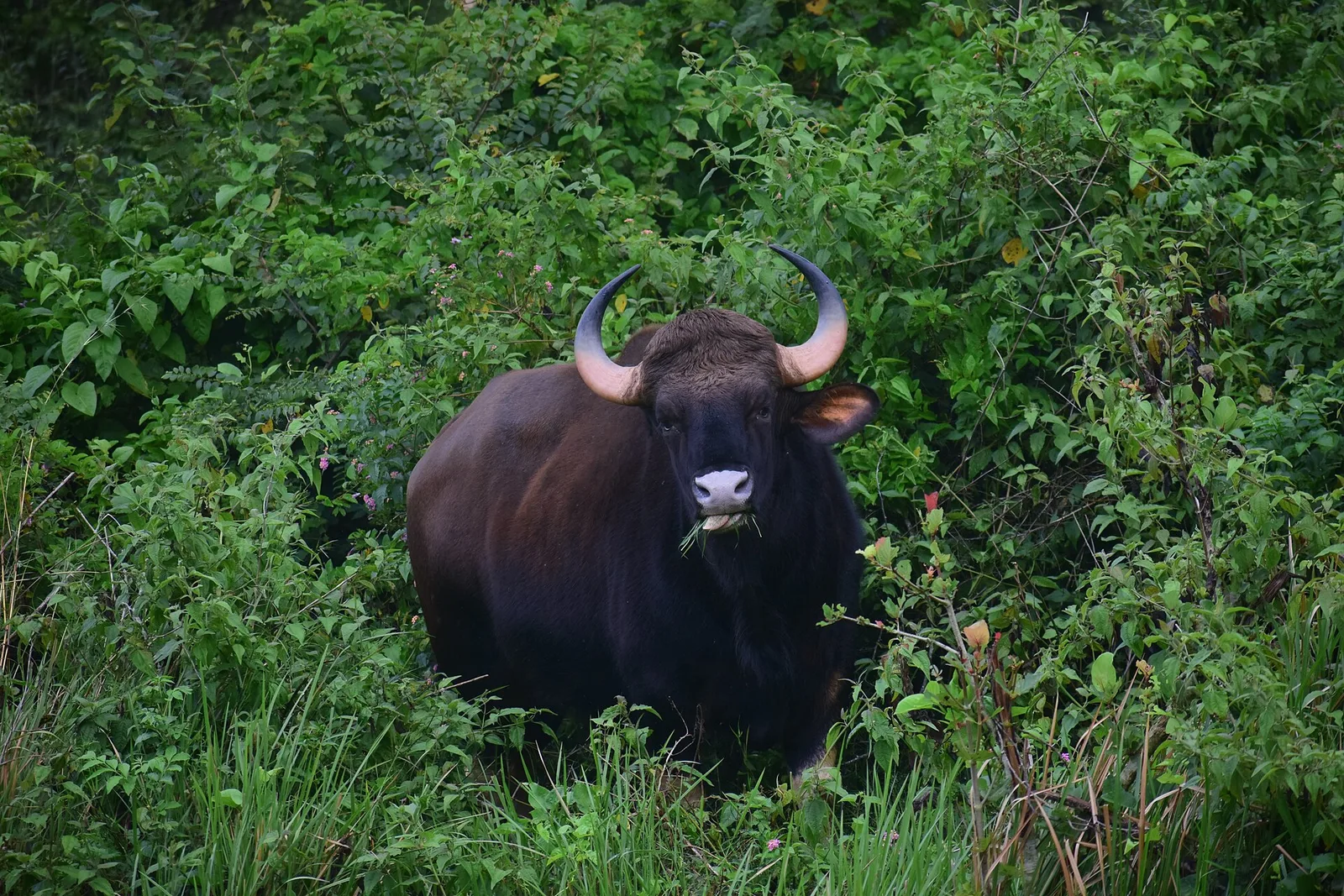
Gaur
The largest wild cattle on Earth, and a match for a tiger
Bos gaurus
Also called Indian bison, Seladang, Pyaung
Living individuals or members of this group exist today. This does not mean they are safe from extinction.
Meet the gaur
The gaur, or Indian bison, is the largest of all wild cattle, a forest bovine of India and Southeast Asia. Bulls can pass 1,500 kilograms, and a herd will form a ring to hold off a tiger.
Images of the gaur
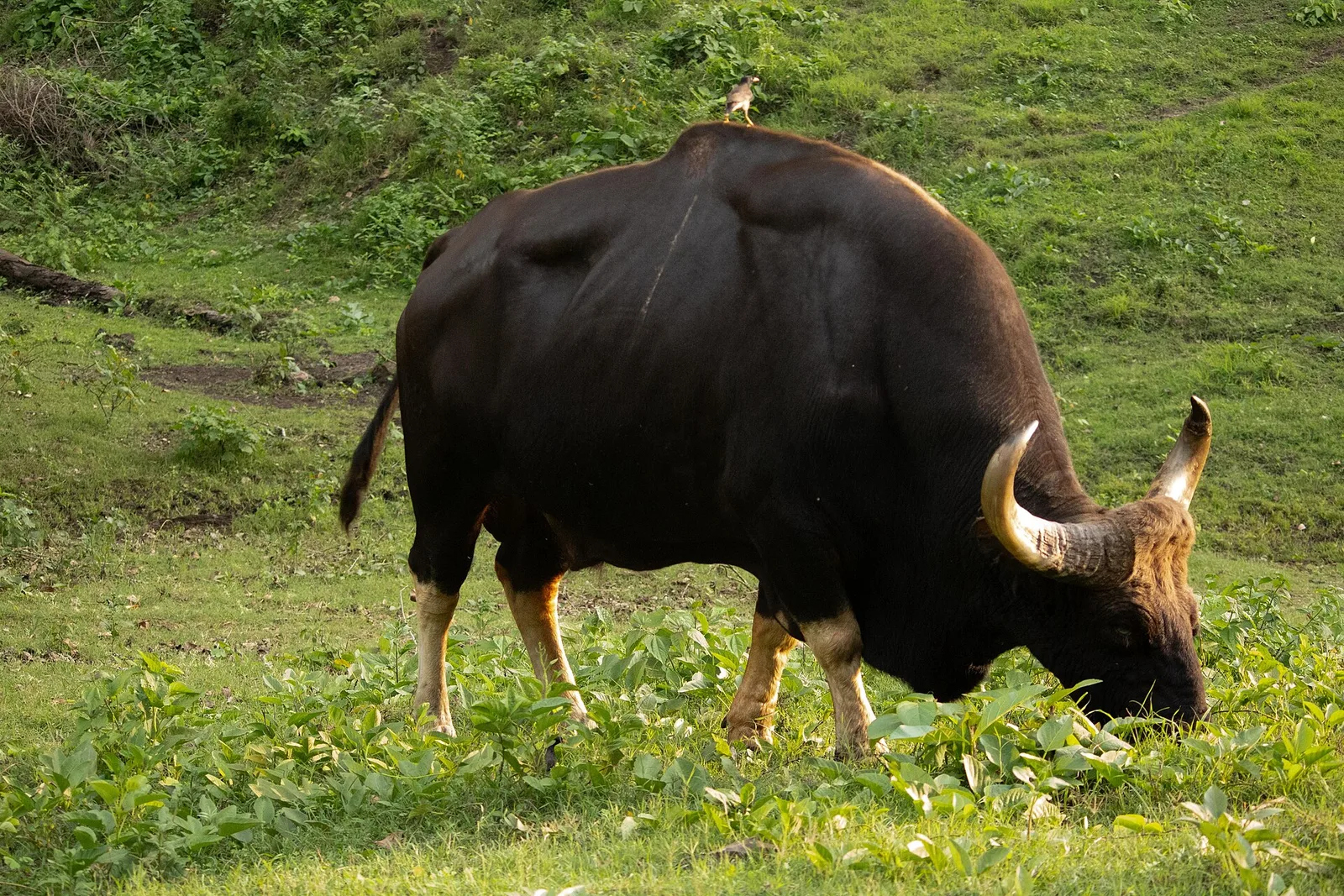
Lifespan
Up to 30 years the wild lifespan is not recorded
Weight
0.44 to 1.5 t
Length
2.5 to 3.3 m
Height
1.42 to 2.2 m
Fact file
Gaur
- Location
- India, Nepal, Bhutan, Bangladesh, Myanmar, Thailand, Laos, Cambodia, Vietnam, southern China
- Habitat
- Temperate forest, Rainforest, Mountains
- Diet
- Herbivore
- Prey / food
- Grasses, bamboo, herbs, leaves, fruit, teak bark
- Predators
- Tiger; leopards, dholes and crocodiles take calves
- Lifestyle
- Diurnal where undisturbed, nocturnal near people; lives in herds
- Group name
- Herd
- Name of young
- Calf
- Gestation
- About 275 days
- Litter size
- 1 calf, rarely 2
- Population
- At most 21,000 mature animals in 2016, most of them in India
- Biggest threat
- Poaching for meat and trophies, and the loss of forest
- Distinctive feature
- A high ridge on the back and white stockings on all four legs
- Colour
- Dark brown to black with white lower legs
- Skin type
- Fur
Size
Next to a person
Measurements
Size and speed
- Height
- 1.42 to 2.2 m at the shoulder; about 168 in females and 188 in males
- Height, male
- About 1.88 m
- Height, female
- About 1.68 m
- Length
- 2.5 to 3.3 m head and body, without the tail
- Tail
- 0.7 to 1.05 m
- Weight
- 0.44 to 1.5 t females 440 to 1,000, males 588 to 1,500
- Weight, male
- 0.59 to 1.5 t
- Weight, female
- 0.44 to 1 t
Typical adult ranges. Source: Wikipedia.
Life cycle
Lifespan
- In captivityUp to 30 years the wild lifespan is not recorded
- 030 years
The pale bar is the record. Source: Wikipedia.
Appearance
Colour and coat
- Primary colours
- dark brownblack
- Secondary colours
- whiteash grey
- Skin type
- fur
- Male and female
- Strong. Bulls are about a quarter larger than cows, at 588 to 1,500 kilograms against 440 to 1,000 kg. Bulls are also darker, with a taller hump and thicker horns.
Life cycle
Mating and family
- Mating system
- polygynous; bulls move between herds and mate with many cows
- Social structure
- herds of eight to 11 led by an old cow, with bulls alone or in bull groups outside the rut
- Breeding
- one calf a year at most, after a gestation of about 275 days
Gaur breed all year, with a peak from December to June. A cow carries a single calf for about 275 days and rarely bears twins. The calf is weaned at seven to 12 months and grows up inside the herd, ringed by adults whenever a tiger is near. Both sexes mature in their second or third year. A captive gaur can live to 30.
Classification
Taxonomy
- Kingdom
- Animalia
- Phylum
- Chordata
- Class
- Mammalia
- Order
- Artiodactyla
- Family
- Bovidae
- Genus
- Bos
- Species
- Bos gaurus
Conservation
Red List status
- LC
- NT
- VU
- EN
- CR
- EW
- EX
Vulnerable on the IUCN Red List
Range
Recorded in 4 countries
Habitat layer: tropical moist broadleaf forest, temperate broadleaf and mixed forest, temperate conifer forest, boreal forest and taiga, montane grassland and shrubland.
Countries from 1,738 wild records on GBIF (iNaturalist research grade), filtered and checked by hand. Country shapes: Natural Earth. Habitat: RESOLVE Ecoregions 2017, CC BY 4.0. Basemap: Natural Earth.
Habitats
Three things to know
- 1
A gaur bull can weigh 1,500 kilograms, which makes the species the largest of all wild cattle and the heaviest bovid alive.
- 2
A gaur herd surrounds its calves in a ring when a tiger appears, and the tiger usually gives up the hunt.
- 3
A bull's mating call carries more than 1.6 kilometres through the forest.
Did you know
Seven more facts
- 1
The Indian bison is not a bison at all but an ox of the genus Bos.
- 2
The shoulders of a gaur can stand 12 centimetres higher than its rump because of a bony ridge.
- 3
The first cloned gaur was born in Iowa on 8 January 2001 but lived less than two days.
- 4
A gaur's horns are pale green or yellow with black tips.
- 5
In central India gaur are seldom seen in the open after 8 in the morning.
- 6
The domestic mithun of north-east India carries gaur ancestry.
- 7
Gaur drink every day but never seem to wallow in mud.
Field notes
How it looks and acts
Field notes
Distinguishing features
- A shoulder height of 142 to 220 centimetres, the tallest of any wild cattle.
- A high ridge along the back, from shoulder to mid-spine.
- White or tan stockings on all four lower legs.
- Upcurved horns of 60 to 115 centimetres with black tips.
- An ash-grey forehead with a bony ridge between the horns.
- A large dewlap on the throat and chest.
Field notes
Unique adaptations
- Massive size that puts an adult beyond the reach of every predator but the tiger.
- A herd defence that rings the calves and faces down an ambush hunter.
- A diet that shifts from grass to bark when the dry season kills the grass.
- A daily schedule that swaps to night where people disturb the forest.
- Narrow, pointed hooves that probably help carry a heavy body over hill forest.
Field notes
Interesting behaviours
- Feeds hardest in the early morning and the late evening.
- Rests in deep shade through the heat of the day.
- Walks 2 to 5 kilometres a day as a herd.
- Gathers in the dry season and scatters into the hills with the monsoon.
- Bulls leave the herd after mating to live alone or with other bulls.
Field notes
Temperament
- Shy where undisturbed, and quick to flee.
- Bold near people in South India and Southeast Asia.
- Short-tempered in summer, when a bull may charge unprovoked.
- Peaceable among bulls, which settle rank by size.
Field notes
Communication
- A ringing mating call from bulls that carries over 1.6 kilometres.
- A whistling snort as an alarm.
- A high whistle that calls the herd to danger.
- A low moo like that of a domestic cow.
Ecology
Ecological role
The gaur is the largest herbivore of the Asian forest after the elephant, and the main large prey of the tiger.
- Grazes and browses across 32 or more plant species, which shapes the forest floor.
- Feeds tigers, and its calves feed leopards, dholes and crocodiles.
- Strips teak bark in summer, which may open the trunk to insects and fungi.
- Probably spreads seeds through the fruit it eats, such as elephant apple and cashew.
Stories
Myths and legends
- In Goan tradition, the gaur is the state animal and a symbol of the forest's strength.
- In the tribal folklore of central India, the gaur is said to be a guardian of the forest.
- In some Hindu communities the gaur is said to be sacred, though no text names it.
- In Sanskrit tradition, the word gaura named both a pale colour and a kind of buffalo.
People
Relationship with humans
People
Living alongside us
The gaur is wild, but its half-domestic descendant, the mithun, is kept in the hills of north-east India and Myanmar. Wild herds raid crops and graze beside village cattle, and a bull may charge and kill a person. Poachers hunt the gaur for meat and trophies across Southeast Asia. It is protected in every country it lives in and listed on CITES Appendix I.
- A bull may charge without provocation, above all in the heat of summer.
- A pursued gaur has on occasion turned and killed the person following it.
- Most gaur flee from people, and attacks are rare.
People
Status, uses and products
- Domestication
- Wild
- As a pet
- Not suitable. A gaur is a wild ox of up to 1,500 kilograms that needs forest, water and a herd. It is protected in every range state and cannot be kept privately.
- Uses
- ecotourismtrophy huntingbushmeat
- Products
- hornsmeat
The full account
About the gaur
The gaur, Bos gaurus, is the largest wild cattle species and the largest living bovid. Many people in India call it the Indian bison, though it is an ox, not a bison. It lives in the forests of the Indian subcontinent and Southeast Asia. A bull is dark brown to black, with white stockings on all four legs and a high ridge along the back.
An adult stands 142 to 220 centimetres at the shoulder, about 168 cm in a cow and 188 cm in a bull. Head and body run 250 to 330 cm, and the tail adds 70 to 105 cm. Cows weigh 440 to 1,000 kilograms and bulls 588 to 1,500 kg. Gaur live in small herds led by an old cow, and they eat grass, herbs, leaves and even bark.
The IUCN has listed the gaur as Vulnerable since 1986. In 2016 the world population was put at no more than 21,000 mature animals, most of them in India. Poaching and forest loss have driven it out of Sri Lanka and Peninsular Malaysia. Numbers in Indochina fell by more than 70% in three generations.
Name and taxonomy
The name gaur comes from Sanskrit, where gaura means white, yellowish or reddish. The same word in Hindi means fair or pale. In Malaysia the animal is the seladang, and in Myanmar the pyaung. Charles Hamilton Smith proposed the name Bison gaurus in 1827, and later authors moved it into Bos or Bibos. The domestic form, the gayal or mithun, had been named earlier. In 2003 the International Commission on Zoological Nomenclature ruled that Bos gaurus stands for the wild animal.
Three subspecies were once recognised. B. g. gaurus lives in India, Nepal and Bhutan. Richard Lydekker described B. g. readei from Myanmar in 1903 and B. g. hubbacki from Pahang, Malaysia, in 1907. That split rested on colour and size and is no longer widely accepted. Today two forms are provisionally used, Bos gaurus gaurus in India and Bos gaurus laosiensis in Southeast Asia, until genetic work settles the question.
Evolution and relatives
The gaur belongs to the genus Bos, the true cattle, in the family Bovidae. Its closest relatives are the banteng, Bos javanicus, and the kouprey, Bos sauveli, which is probably extinct. Both also come from Southeast Asia. A 2021 study of nuclear genomes by Sinding and colleagues set out the family tree of the genus. Like other cattle, the gaur is a ruminant with a four-chambered stomach that ferments plant fibre.
The domestic gayal, or mithun, descends in part from the wild gaur. It is kept in the border hills of Assam, Manipur and Nagaland in north-east India, in Bangladesh, in Myanmar and in Yunnan. About 5,200 years ago the wild gaur still ranged as far north as the 34th parallel in China. A domestic cow in Iowa carried the first gaur clone, which arrived on 8 January 2001. The calf looked healthy at birth, but dysentery killed it in under two days.
Appearance
The gaur is a massive, heavily muscled ox. It stands 142 to 220 centimetres at the shoulder, with cows averaging about 168 cm and bulls about 188 cm. Head and body measure 250 to 330 cm, and the tail is 70 to 105 cm long, reaching only to the hocks. Cows weigh 440 to 1,000 kilograms, bulls 588 to 1,500 kg. In a sample of 13 Indian animals, bulls averaged about 1,500 kg and cows had a median near 700 kg. Bulls are about a quarter larger than cows.
A ridge runs along the back from the shoulders to mid-spine, so the shoulders can stand 12 cm above the rump. Long spines on the vertebrae of the forequarters make the ridge. At the top of the hump an average bull is just under 200 cm tall, and his girth behind the shoulders is about 277 cm. A fold of skin, the dewlap, hangs from the throat and chest. The ears are very large, the hooves narrow and pointed.
An adult bull is dark brown and turns almost black with age. The forehead and crown are ash grey or dirty white, the muzzle is pale, and the lower legs are white or tan. Cows and young bulls are paler, sometimes with a reddish tinge, most of all in dry, open country. The hair is short, fine and glossy, and old bulls grow thin on the back. Both sexes have horns that grow out from the sides of the head and curve upward, 60 to 115 cm long. The horns are pale green or yellow with black tips, and a high ridge of bone stands between them on the forehead.
Habitat and range
The gaur once ranged across mainland South and Southeast Asia: Nepal, India, Bhutan, Bangladesh, Myanmar, Thailand, Laos, Cambodia, Vietnam and China. Today the range is broken into pieces, and the species is gone from Sri Lanka and Peninsular Malaysia. GBIF holds records from 17 countries, but that count includes zoos and does not show the native range.
The gaur keeps mostly to evergreen, semi-evergreen and moist deciduous forest, with drier deciduous forest at the edges. Good habitat means large, quiet forest, hills below 1,500 to 1,800 metres, water, and plenty of grass, bamboo, shrubs and trees. It is recorded from sea level up to at least 2,800 m. Lowland forest is probably the best habitat, and the taste for hills may only reflect the loss of the plains to farms.
India holds most of the world's gaur, with an estimate of 12,000 to 22,000 in the mid 1990s. The Western Ghats are the stronghold, above all the Wayanad, Nagarhole, Mudumalai and Bandipur complex. Nagarahole and Bandipur each hold about 2,000 animals, Tadoba Andhari over 1,000, and Bhadra over 800. In Nepal the Chitwan herd grew from 188 to 368 animals between 1997 and 2016, and Parsa held 112. Thailand had fewer than 1,000 in the 1990s, Laos up to 200, and Yunnan in China perhaps 600 to 800. In Cambodia's Keo Seima sanctuary, surveys found about 500 gaur in 2010 but only 33 in 2020.
Diet and feeding
The gaur both grazes and browses, and it prefers the upper parts of plants: leaf blades, stems, seeds and flowers. In one survey in Goa's Bhagwan Mahaveer Sanctuary and Mollem National Park, gaur ate 32 plant species. They took herbs, young shoots, flowers and the fruit of the elephant apple, and they liked leaves best. In winter and the monsoon they choose fresh, fine grasses and legumes such as tick clover. They also browse shrubs, including karvy, Indian boxwood and the chaste tree.
In summer, when grass dries out, gaur strip and eat the bark of teak and the bark and fruit of cashew. Teak bark is rich in calcium, at 22,400 parts per million, and in phosphorus, at 400 ppm. Bark may therefore fill a gap in minerals as well as in bulk. Feeding fills most of the day, with peaks between 6:30 and 8:30 in the morning and 17:30 and 18:45 in the evening. In the heat of midday the herd rests in the shade of big trees. Gaur drink every day but do not seem to wallow.
Behaviour and social life
Where people leave them alone, gaur are active by day. Where the forest is disturbed they have turned largely nocturnal. In central India few are seen on open ground after 8 o'clock in the morning. In the dry season herds gather in small areas, and they scatter into the hills when the monsoon arrives.
In January and February a herd holds eight to 11 animals, one of them a bull. In April or May more bulls join for the mating season, and a bull may move from herd to herd. By May or June the bulls leave again, to live alone or in bull groups. A herd walks 2 to 5 kilometres a day inside a home range that it does not defend. Herds sometimes merge into gatherings of 50 or more.
An old cow, the matriarch, leads the herd. Bulls settle rank by size, and no serious fight between bulls has been recorded. In quiet parts of India the gaur is timid, and an alarmed herd crashes off through the forest at speed. In Southeast Asia and South India, where gaur are used to people, locals call them bold. They graze beside domestic cattle and sometimes kill them in fights. A bull may charge without warning, most often in summer, when heat and biting insects shorten its temper.
Communication and senses
A bull in the rut gives a clear, ringing mating call that carries more than 1.6 kilometres. The alarm call is a whistling snort, and a gaur also gives a low moo like a domestic cow. A high whistle warns the rest of the herd that danger is near.
Like other cattle, the gaur relies on smell and hearing more than on sight, and its very large ears suit a life in dense forest. The size and colour of a bull probably signal his rank to other bulls, since fights are rare.
Reproduction and life cycle
Gaur mature in their second or third year. They can breed in any month, but most mating falls between December and June. Bulls wander widely in the peak season in search of receptive cows, and each bull mates with many cows. A cow carries her calf for about 275 days, slightly shorter than a domestic cow's pregnancy.
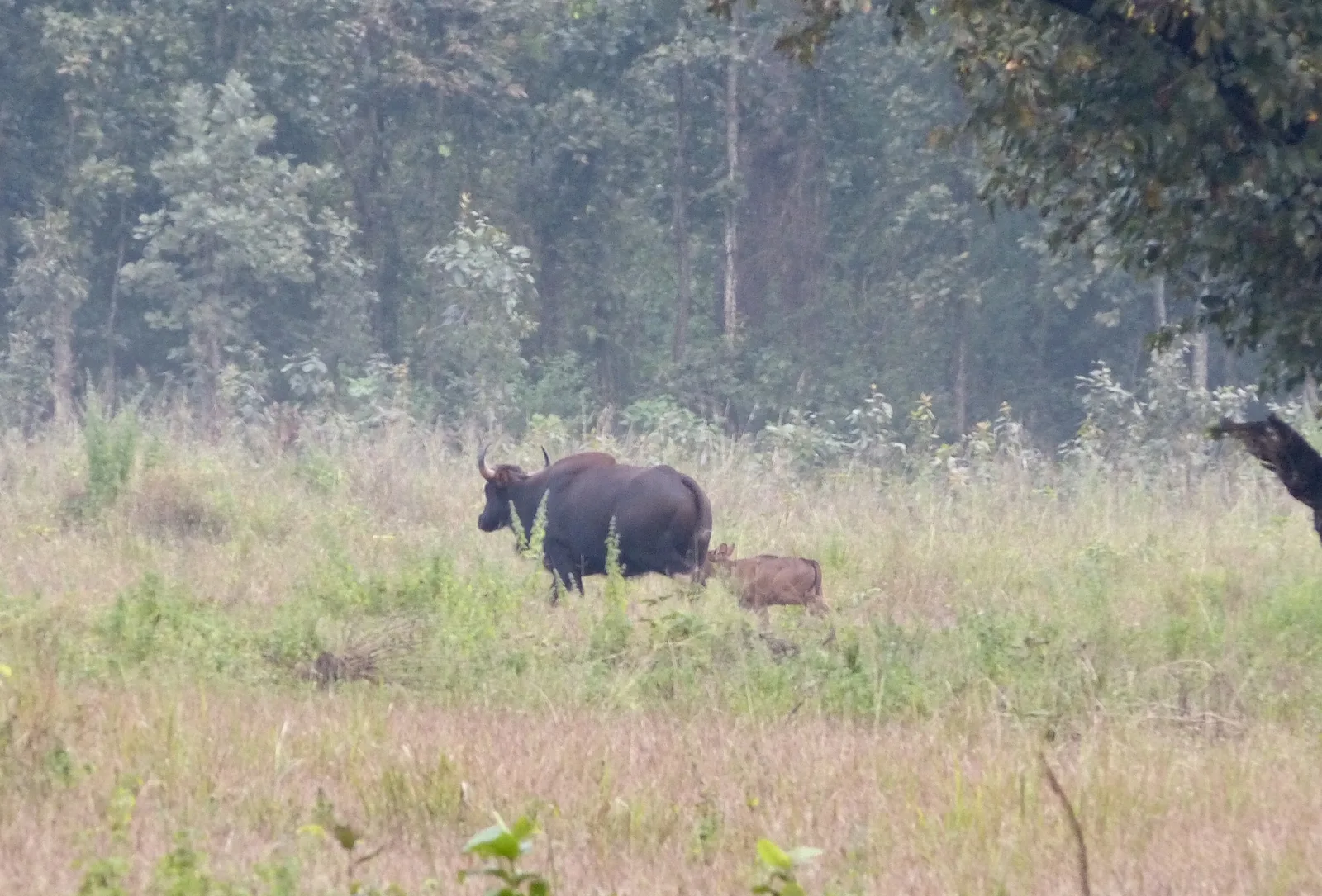
She gives birth to one calf, rarely two. The calf is weaned at seven to 12 months. Adults ring the calves when a tiger appears, and that defence is the young animal's best protection. A captive gaur can live up to 30 years. The generation length used by the IUCN is 24 to 30 years for three generations, or about 8 to 10 years each.
Predators and threats
Size and power leave the gaur with few natural enemies apart from people. Leopards, packs of dholes and large mugger crocodiles sometimes take an unguarded calf or a sick animal. Only the tiger and the saltwater crocodile are known to kill an adult, and the crocodile now rarely shares its range. A crocodile would probably need to be a male over 3.7 metres and 300 kilograms to kill a healthy adult gaur.
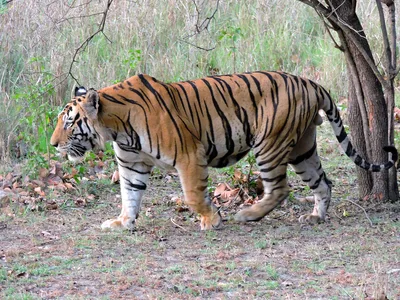
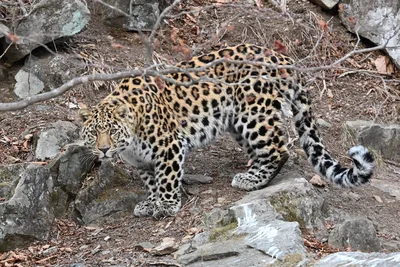
Tigers mostly hunt young or weak gaur, but they have killed healthy bulls of at least 1,000 kg. When a tiger shows itself, the adults form a circle around the calves. A tiger depends on ambush, so it almost always gives up once it is seen and faced. In Malaysia a herd ringed a calf that a tiger had killed and kept the cat from its meal. A gaur can kill a tiger in self-defence.
The real threat is the poacher. In Laos gaur are shot for trade and for the pot. Vietnamese poachers sought them in the 1990s for their commercial value. In Thailand poaching for meat and trophies is severe. Forest clearance shrinks and splits the range, and the loss of the plains has pushed the animal into the hills.
Population and conservation
The IUCN Red List has rated the gaur Vulnerable since 1986. The 2016 assessment put the world population at a maximum of 21,000 mature animals. It found a decline of more than 70% in Indochina and Malaysia over the last three generations, a span of 24 to 30 years. Populations in well-protected reserves appear stable. India, Bhutan and Bangladesh together hold an estimated 23,000 to 34,000 animals of all ages.
The picture is worst in Indochina. Laos held up to 200 gaur in protected areas in the mid 1990s, and a decade of camera traps later found none. In Cambodia's Mondulkiri Province, up to 1,000 may have survived to 2010 across more than 15,000 square kilometres of forest. By 2020 transects in the Sre Pok and Phnom Prich sanctuaries met 0 to 5 animals per 10 km. Vietnam's population is poorly known and may be in serious decline.
The gaur sits on CITES Appendix I, which bans commercial trade across borders. Every range state protects it by law. Its future depends on keeping the forest plants it prefers, so protecting its historic habitat matters more than any single measure.
Relationship with humans
People have lived beside the gaur for thousands of years, and they part-domesticated it as the gayal or mithun. The mithun is still kept in the hills of north-east India, Bangladesh, Myanmar and Yunnan. Wild gaur walk into fields to graze beside village cattle and sometimes kill them. Farmers lose crops to a herd, and a charging bull can kill a person.
Hunters once prized the gaur as a trophy, and poachers still sell its meat and horns. Today the animal is likely a draw for wildlife tourists in the tiger reserves of southern and central India. Zoos keep small numbers, and the cloning attempt of 2001 showed how much effort science will spend on the species.
In culture and myth
Two Indian states, Goa and Bihar, list the gaur as their state animal. In Goa it stands for the wild forest of the Western Ghats and for strength. The Sanskrit root of its name, gaura, describes a pale or reddish colour and was also used for a kind of water buffalo.
Wildlife blogs suggest that tribal communities in the forest belts of India treat the gaur as a sign of strength, prosperity and pride. Some of those stories are said to cast the animal as a guardian of the forest. The same sources suggest that a few Hindu communities hold the gaur sacred, but they name no scripture. Old Indian art may show the gaur, though most cattle in temple carving are domestic zebu.
Among the peoples of north-east India the mithun, its half-domestic descendant, is said to be a measure of wealth and a wedding gift. The wild gaur is less a creature of myth than a fact of the forest: a beast that even the tiger treats with caution.
A sentence with a dotted underline is inferred: it describes the group the animal belongs to, or is a reading of the sources, rather than a measured or reported fact about this species.
Questions
Gaur questions, answered
How big is a gaur?
A gaur stands 142 to 220 centimetres at the shoulder and measures 250 to 330 cm from head to rump. Cows weigh 440 to 1,000 kilograms and bulls 588 to 1,500 kg, which makes it the largest wild cattle species.
Is a gaur a bison?
No. The name Indian bison is a misnomer. The gaur is a true ox of the genus Bos, and its closest relatives are the banteng and the kouprey of Southeast Asia.
What do gaur eat?
Grass, herbs, bamboo, young shoots, leaves and fruit. In summer, when the grass dries, they also strip and eat the bark of teak and cashew, which is rich in calcium.
Where do gaur live?
In the forests of India, Nepal, Bhutan, Bangladesh, Myanmar, Thailand, Laos, Cambodia, Vietnam and southern China. India holds most of them, above all in the Western Ghats.
Are gaur endangered?
The IUCN lists the gaur as Vulnerable. At most 21,000 mature animals remained in 2016, and numbers in Indochina fell by more than 70% in three generations. Herds in well-protected Indian reserves are stable.
Can a gaur kill a tiger?
Yes. A gaur can kill a tiger in self-defence, and a herd will ring its calves to face one down. Tigers still take young, sick and even healthy adult gaur, but they usually give up an attack once they are seen.
Are gaur dangerous to humans?
They can be. Bulls sometimes charge without provocation, most often in summer, and a pursued gaur has killed the person following it. Most gaur flee from people.
What eats a gaur?
The tiger is the only regular predator of adults. Leopards, dhole packs and mugger crocodiles take calves and sick animals, and a very large saltwater crocodile could kill an adult.
How long do gaur live?
In a zoo a gaur lives up to 30 years. The wild lifespan is not recorded.
Do gaur live in herds?
Yes. A herd of eight to 11 animals follows an old cow. Bulls join in the mating season and leave again, and herds sometimes gather in groups of 50 or more.
How fast can a gaur run?
No measured speed is recorded in our sources. An alarmed herd crashes off through the forest at a surprising pace for such a heavy animal.
How many calves does a gaur have?
One calf, rarely two, after a gestation of about 275 days. Weaning comes at seven to 12 months.
What is the difference between a gaur and a mithun?
The mithun, or gayal, is the half-domestic form of the gaur, kept in north-east India, Bangladesh, Myanmar and Yunnan. It descends in part from the wild gaur.
Why is the gaur the state animal of Goa?
Goa chose the gaur as a symbol of the Western Ghats forest and its strength. Bihar also lists it as its state animal.
Are gaur active at night?
Where the forest is quiet they feed by day, with peaks in the early morning and evening. Where people disturb them they have become largely nocturnal.
Food web
Prey and food
- grasses
- bamboo
- herbs
- leaves
- fruit
- teak bark
Food web
Predators
 Tiger
 Leopard
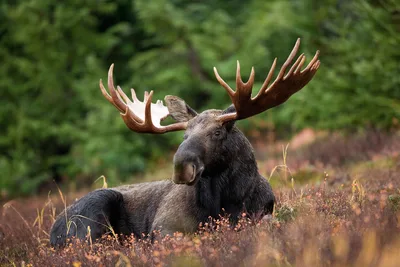
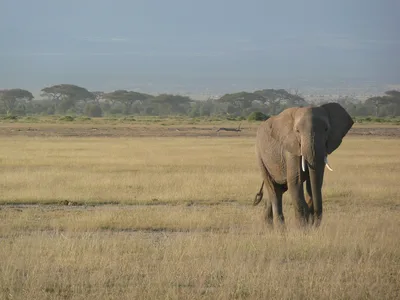
Ecological equivalents
Related species on this site
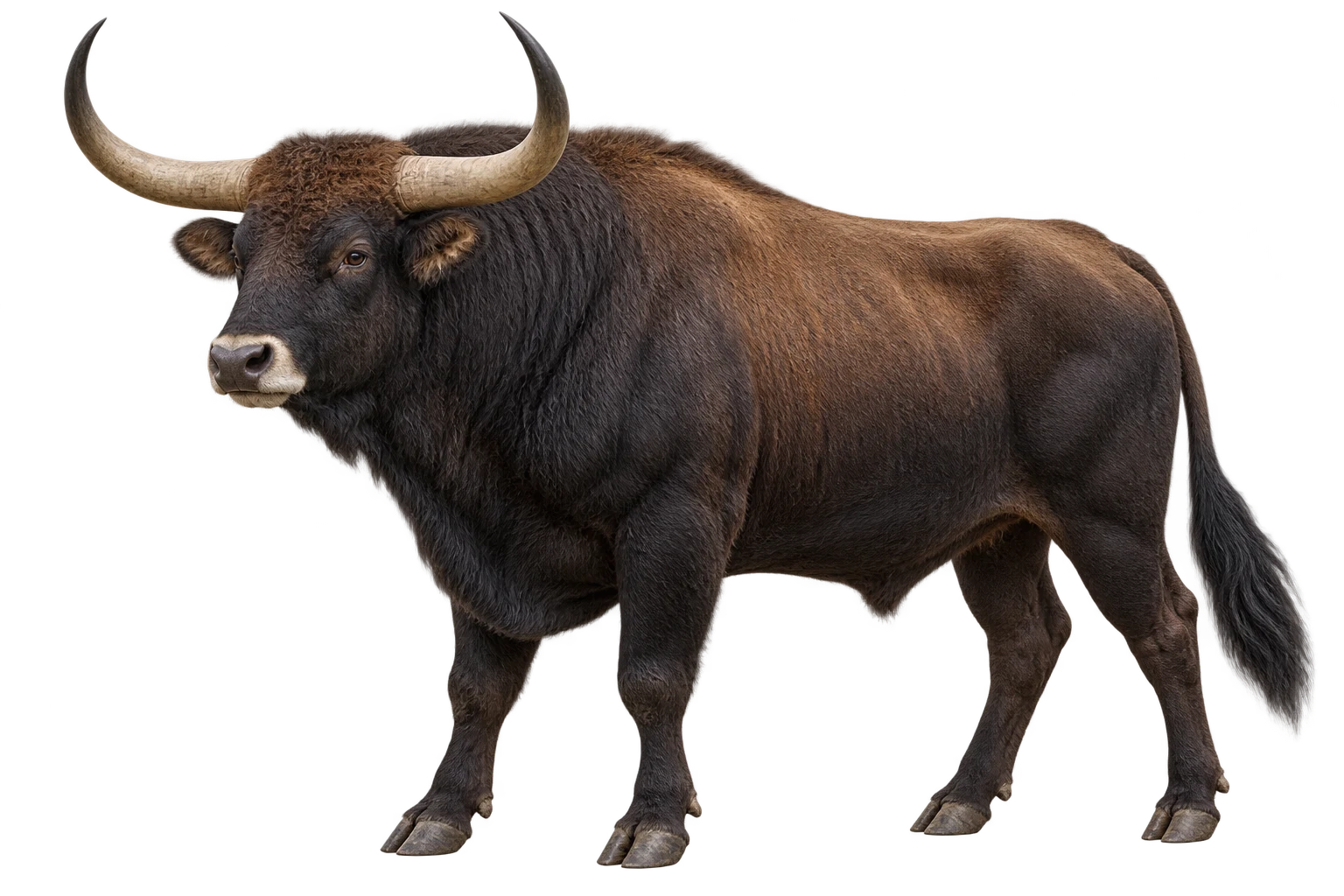
Aurochs (same genus), Cow (same genus), English Longhorn Cattle (same genus), Fleckvieh Cattle (same genus), Highland Cattle (same genus), Kouprey (same genus), and more.
 EX
Mammals
Aurochs
Bos primigenius
The aurochs was the wild ox of Europe, North Africa and much of Asia, and the ancestor of domestic cattle.
ExtinctAI reconstructionMammals
Cow
Bos taurus
Domestic cattle are large social herbivores kept in many parts of the world.
Living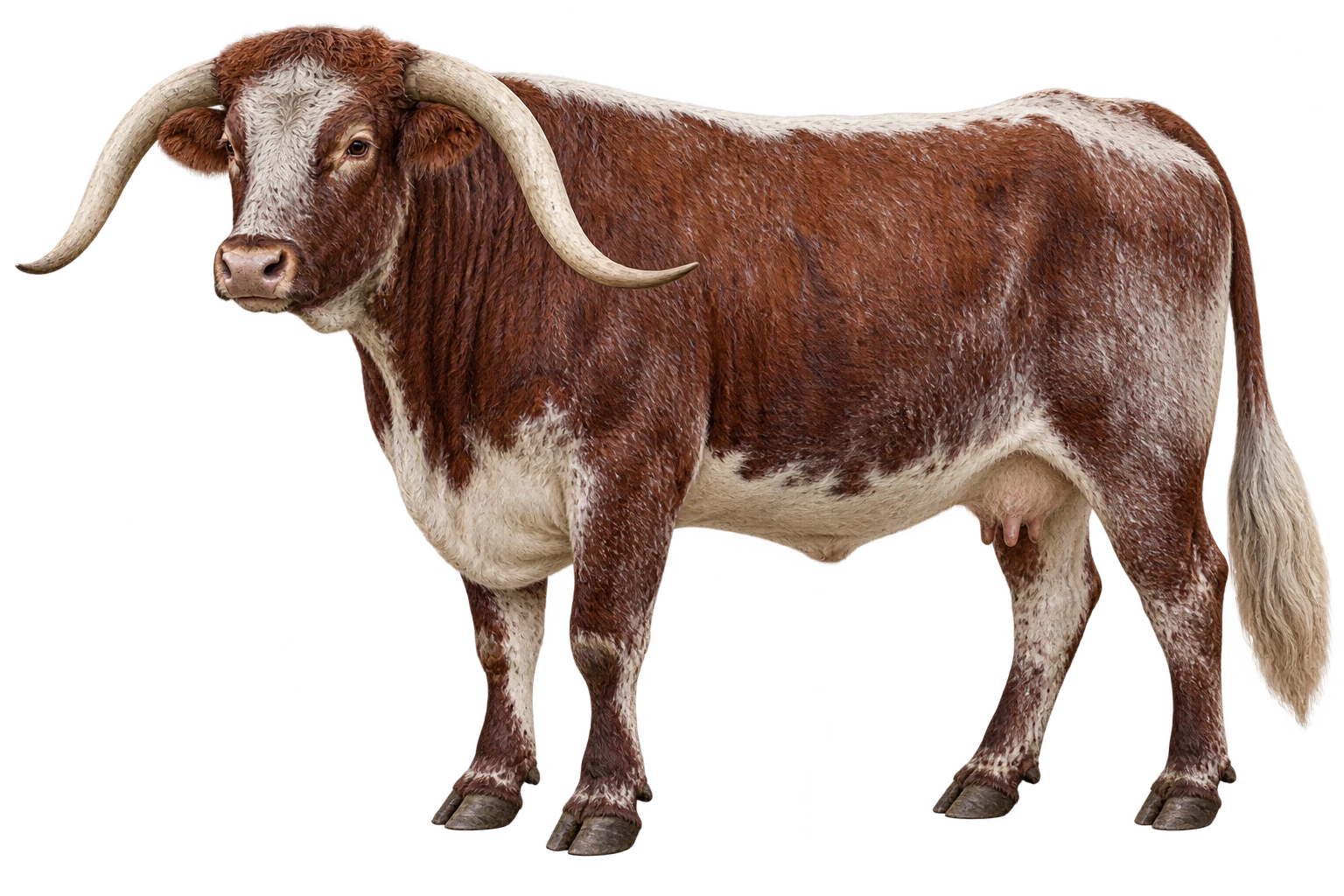
Mammals
English Longhorn Cattle
Bos taurus
Classification and source reference
LivingAI illustration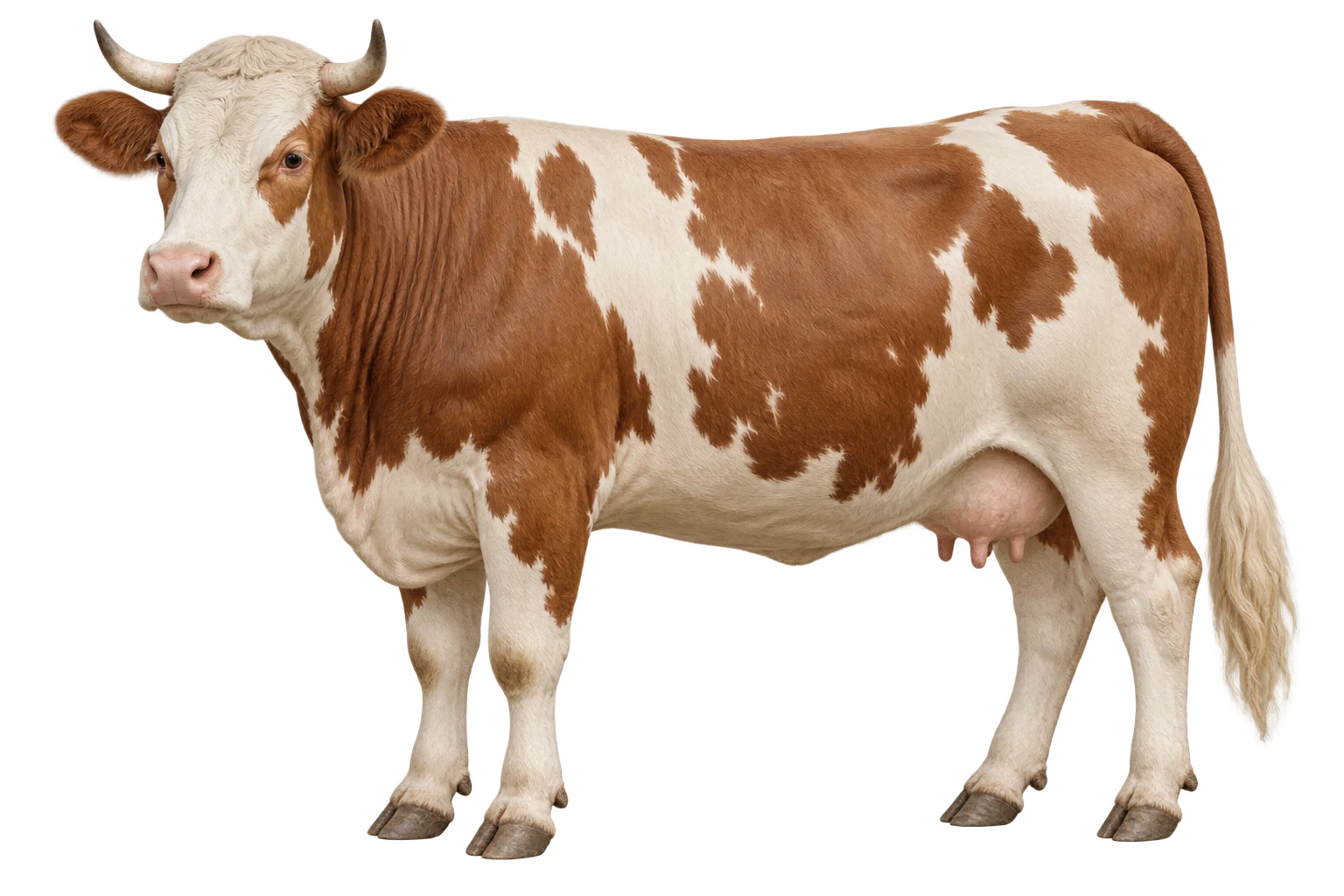
Mammals
Fleckvieh Cattle
Bos taurus
Classification and source reference
LivingAI illustration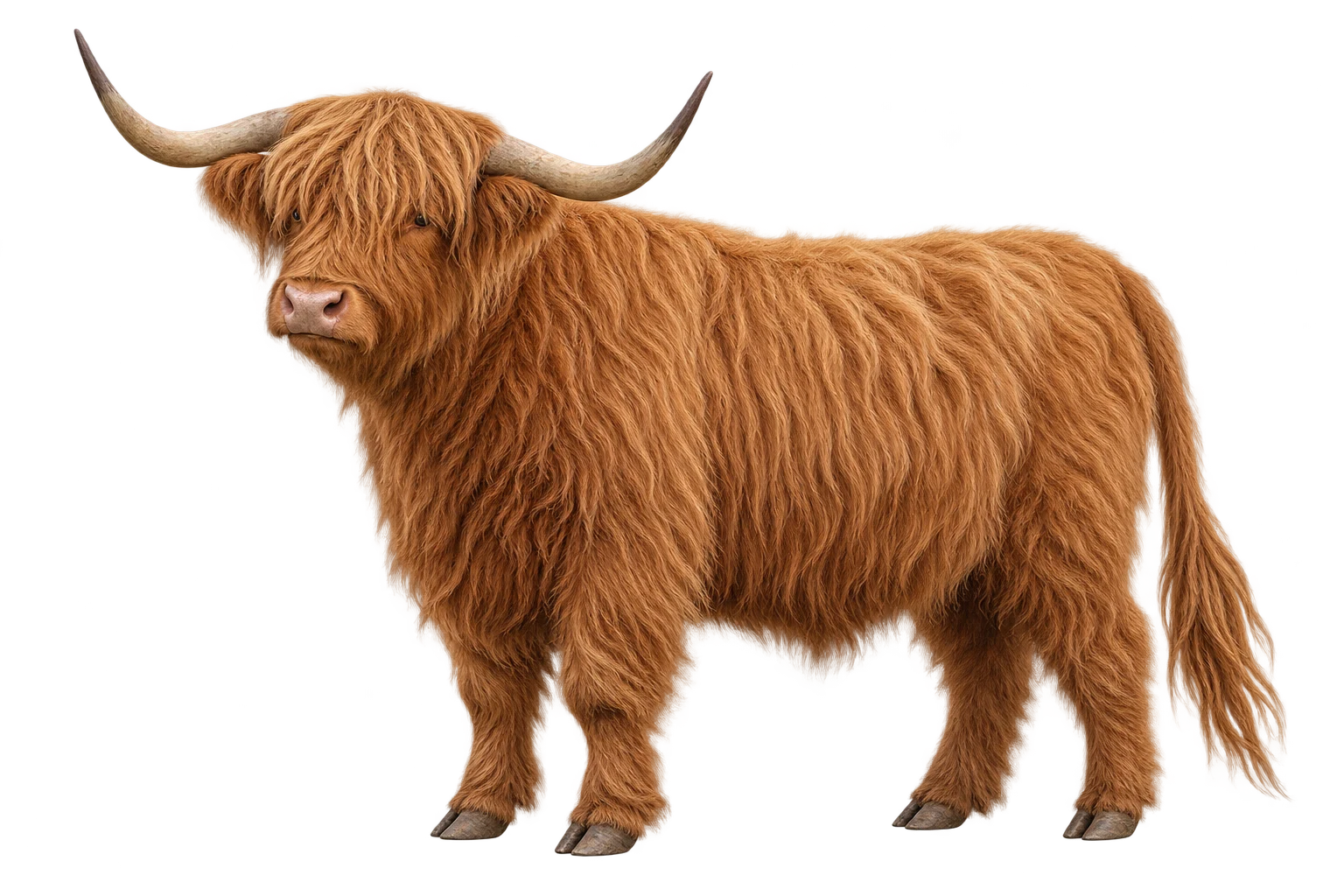
Mammals
Highland Cattle
Bos taurus
Classification and source reference
LivingAI illustration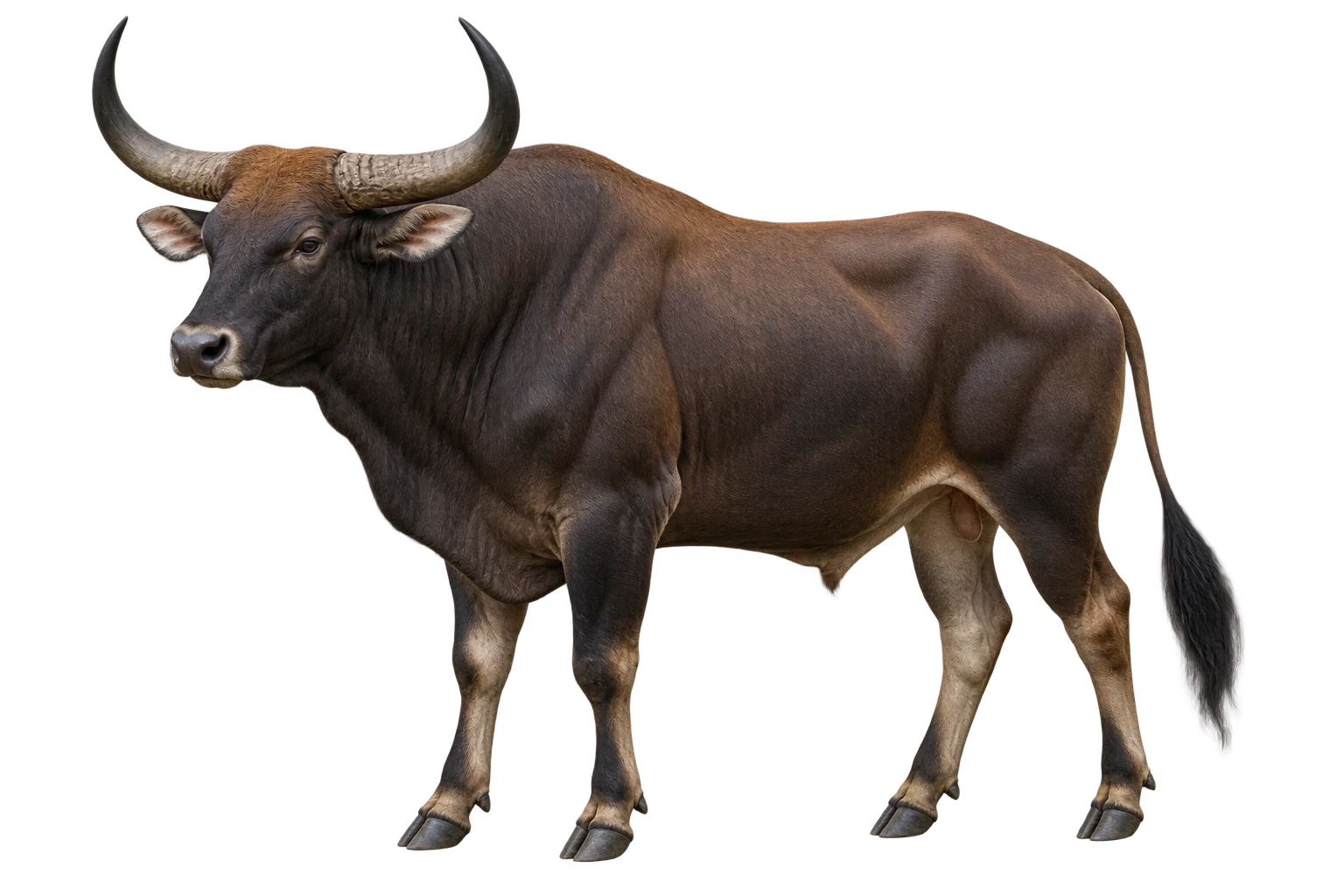
Mammals
Kouprey
Bos sauveli
Classification and source reference
Possibly extinctAI illustration
