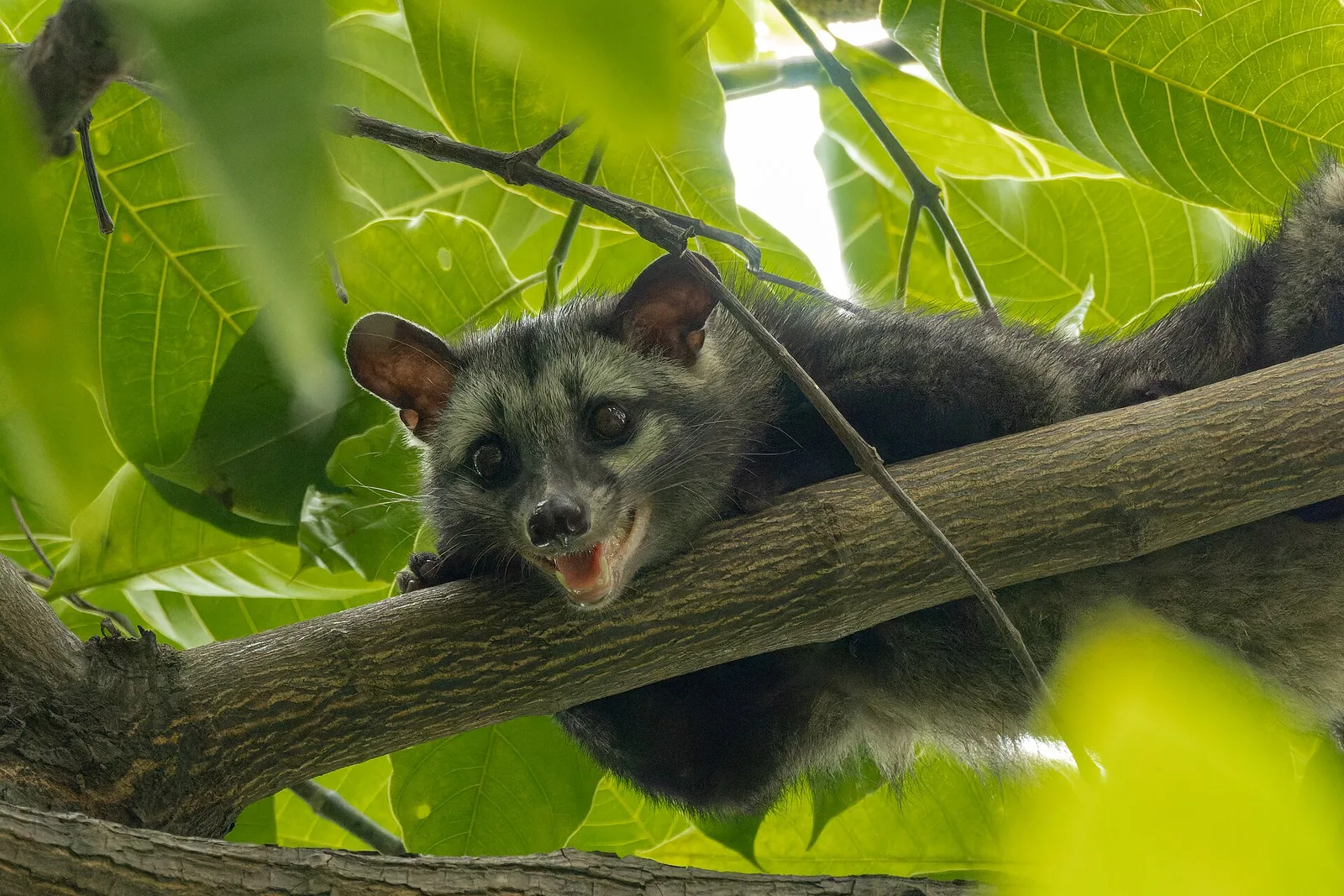
Asian palm civet
The night-time fruit thief behind the world's dearest coffee
Paradoxurus hermaphroditus
Also called Common palm civet, Toddy cat, Musang
Living individuals or members of this group exist today. This does not mean they are safe from extinction.
Meet the asian palm civet
The Asian palm civet is a small, cat-like viverrid of South and Southeast Asia that climbs trees at night to eat fruit. It is common, adaptable and best known as the animal behind kopi luwak coffee.
Images of the asian palm civet


Lifespan in the wild
15 to 20 years
Weight
2 to 5 kg
Length
43 to 71 cm
Fact file
Asian palm civet
- Location
- India and Sri Lanka to southern China, Indochina, Malaysia, Indonesia and the Philippines
- Habitat
- Rainforest, Temperate forest, Towns and cities
- Diet
- Omnivore
- Prey / food
- Fruit, berries, figs, palm sap, rats, mice, birds, insects, snails, eggs
- Predators
- Tigers, leopards, large snakes, crocodiles
- Lifestyle
- Nocturnal and arboreal
- Group name
- None; solitary
- Name of young
- Kitten
- Gestation
- About 60 days
- Litter size
- 2 to 5 kittens
- Population
- Large and thought stable; not counted
- Biggest threat
- Trapping for the pet trade and kopi luwak farms
- Distinctive feature
- White face mask and a long tail without rings
- Colour
- Grey to greyish brown with black spots and stripes
- Skin type
- Fur
Size
Next to a person
Measurements
Size and speed
- Length
- 43 to 71 cm head and body, without the tail
- Tail
- About 48 cm
- Weight
- 2 to 5 kg
Typical adult ranges. Sources: Wikipedia, Animal Diversity Web.
Life cycle
Lifespan
- In the wild15 to 20 years
- In captivityUp to 24.5 years
- 024.5 years
The pale bar is the record. Sources: Animal Diversity Web, AnAge.
Appearance
Colour and coat
- Primary colours
- greygreyish brown
- Secondary colours
- blackwhite
- Skin type
- fur
- Male and female
- None known. Males and females look alike, and both carry the perineal scent gland under the tail.
Life cycle
Mating and family
- Mating system
- unknown; pairs share a resting tree for one to fifteen days while they mate
- Social structure
- solitary
- Breeding
- all year, up to two litters of 2 to 5 kittens, most born between October and December
Asian palm civets breed all year, and a pair meets only for the days they mate. After about 60 days the female bears 2 to 5 kittens in a hollow tree. The kittens open their eyes at 11 days and are weaned at two months. They are full grown at three months and breed at about one year. Wild civets live 15 to 20 years.
Classification
Taxonomy
- Kingdom
- Animalia
- Phylum
- Chordata
- Class
- Mammalia
- Order
- Carnivora
- Family
- Viverridae
- Genus
- Paradoxurus
- Species
- Paradoxurus hermaphroditus
Conservation
Red List status
- LC
- NT
- VU
- EN
- CR
- EW
- EX
Least Concern on the IUCN Red List
Range
Recorded in 11 countries
- Bangladesh
- People's Republic of China
- Indonesia
- India
- Sri Lanka
- Malaysia
- Philippines
- Pakistan
- Singapore
- Thailand
- Vietnam
Habitat layer: tropical moist broadleaf forest, temperate broadleaf and mixed forest, temperate conifer forest, boreal forest and taiga.
Countries from 1,567 wild records on GBIF (iNaturalist research grade), filtered and checked by hand. Country shapes: Natural Earth. Habitat: RESOLVE Ecoregions 2017, CC BY 4.0. Basemap: Natural Earth.
Habitats
Three things to know
- 1
The civet passes coffee cherries through its gut, and people sell the beans as kopi luwak.
- 2
In Nepal, 85% of civet droppings held fruit, so the animal spreads seeds across the forest.
- 3
Its perineal scent gland gave the species the name hermaphroditus, because both sexes carry it.
Did you know
Seven more facts
- 1
A newborn kitten weighs only about 80 grams and opens its eyes at 11 days.
- 2
The civet drinks fermented palm sap, which earned it the name toddy cat.
- 3
On Java it is said to feed from more than 35 kinds of plant.
- 4
Its neck hair grows backwards, the opposite of other civets.
- 5
Civet droppings drop seeds several hundred metres from the parent tree.
- 6
The civet reached Japan through introduction in the late 1800s.
- 7
GBIF holds records from 26 countries, including zoos and escaped animals.
Field notes
How it looks and acts
Field notes
Distinguishing features
- A white mask across the forehead and white patches under the eyes.
- A tail almost as long as the head and body, black at the tip and without rings.
- Three rows of black spots along each flank.
- A pointed nose on a small, cat-like face with large dark eyes.
- A head and body of 43 to 71 centimetres on short legs.
- A scent gland under the tail in both sexes.
Field notes
Unique adaptations
- Semi-retractile claws and gripping hind feet for climbing.
- Pointed teeth suited to fruit rather than to slicing meat.
- A perineal gland that leaves a long-lasting scent message.
- A foul anal secretion that drives off an attacker.
- Night activity that probably keeps it away from tigers and leopards.
Field notes
Interesting behaviours
- Feeds from dusk until dawn and rests all day in a tree.
- Returns to the same rest tree each day while food lasts.
- Drags its scent gland along branches to mark its range.
- Stalks and pounces on small prey like a cat.
- Walks from tree to tree rather than jumping, because its tail cannot grip.
Field notes
Temperament
- Shy and secretive, seldom seen by day.
- Solitary except when mating.
- Hisses, spits and sprays scent when cornered.
- Bold enough to live in roofs, gardens and orchards.
Field notes
Communication
- Marks branches and ground with the perineal gland.
- Reads sex, species and familiarity from another civet's scent.
- Gives a meow-like call, and snarls when alarmed.
- Rubs its ears, neck and heels on objects to leave scent.
Ecology
Ecological role
The Asian palm civet is a seed disperser that helps tropical forest regrow, and it fills a niche like the raccoon's in North America.
- Carries the seeds of Pinanga palms and many fruit trees away from the parent plant in its droppings.
- Passage through the gut encourages seeds to germinate.
- Eats rats, mice, insects and snails, so it probably holds down small pests near villages.
- Feeds tigers, leopards, pythons and crocodiles.
Stories
Myths and legends
- In Bagobo tradition of the Philippines, the talking civet Lakivot slew monsters and became a man.
- In Chinese tradition, a civet cat is swapped for a prince in a famous opera, though the tale means the masked palm civet.
- In Delhi tradition, the civet is the kabar bijju, or gravedigger.
- In Maharashtra tradition, it is the kandechor, or onion thief.
People
Relationship with humans
People
Living alongside us
People have taken civet musk for perfume and medicine for centuries. Today the animal is trapped for the pet trade and caged on farms that produce kopi luwak coffee. Growers kill civets that raid orchards, while villagers value them as rat catchers. Most countries protect the species, but the laws are weakly enforced.
- Bites and scratches only when cornered or handled.
- Sprays a foul scent when threatened.
- Raids fruit crops and makes noise in roofs, but does not attack people.
People
Status, uses and products
- Domestication
- Wild
- As a pet
- Not suitable. Civets are popular pets in Indonesia, but nearly all come from the wild, and the trade drives poaching. A civet is nocturnal, needs trees to climb and sprays a foul scent when upset.
- Uses
- kopi luwak coffeemusk for perfumerodent controlfolk medicine
- Products
- civet muskkopi luwakmeat
The full account
About the asian palm civet
The Asian palm civet, Paradoxurus hermaphroditus, is a small viverrid of South and Southeast Asia. It is also called the common palm civet, the toddy cat and, in Malay and Filipino, the musang. It looks a little like a long, low cat with a pointed nose, a masked face and a very long tail. It climbs trees at night to eat fruit, and it rests by day in a tree hole or among vines.
Adults weigh 2 to 5 kilograms and have a head and body of 43 to 71 centimetres. The species ranges from Kashmir and Sri Lanka to southern China, Borneo, Java and the Philippines. It lives in rainforest, logged forest, plantations, gardens and even house roofs. The IUCN lists it as Least Concern, with a large population that was not thought to be falling in 2008. Its main threat is trapping for the pet trade and for farms that produce kopi luwak coffee.
Name and taxonomy
Peter Simon Pallas named the species Viverra hermaphrodita in 1777. The species name refers to the perineal scent gland under the tail, which both sexes carry and which resembles testicles. The type locality is uncertain, and Pallas wrote only that the animal came from the Barbary coast, which is clearly wrong. The genus Paradoxurus holds the palm civets, and the family Viverridae holds civets and genets.
More than thirty subspecies have been described, from Bengal, Sumatra, Java, Kashmir, Bali and many small islands. Their status has never been properly reviewed, and a revision is needed. A genetic study in 2015 raised the Philippine form, P. philippinensis, to a full species. The Mentawai palm civet, P. lignicolor, is sometimes treated as a separate species and is listed as Vulnerable. iNaturalist now files the mainland animal as the Northern palm civet after this split.
Evolution and relatives
Civets belong to the order Carnivora, but the Asian palm civet has turned largely to fruit. Its teeth are weaker and more pointed than those of meat-eating civets, and the slicing carnassials are less developed. It walks on the whole sole of the foot, in the way that bears and raccoons do. The claws are semi-retractile, the soles are naked, and the third and fourth toes are partly fused.
Palm civets on Palawan are genetically close to those on Borneo. The Palawan animals probably crossed from Borneo during the Pleistocene, when sea levels were lower. People may then have carried civets to other Philippine islands. Scattered records from Sulawesi, the Moluccas, Timor and the Aru Islands are also thought to come from introductions.
Appearance
The coat is coarse and shaggy, grey to greyish brown or rusty, with black-tipped guard hairs. Three rows of black spots run along each side of the body, and dark stripes run down the back. The face carries a white mask across the forehead, a white patch under each eye and a white spot beside each nostril. The muzzle, ears, lower legs and the outer half of the tail are black. Unlike most civets, its tail has no rings, and its neck hair grows backwards.
The head and body measure 43 to 71 centimetres, and the tail is about 48 centimetres long. Adults weigh 2 to 5 kilograms, and island animals, notably on Borneo, are smaller. The eyes are large and dark, the ears large and pointed, and the skull is longer and flatter than a cat's. Young animals show the spots and stripes less clearly. Males and females look alike, and both carry the scent gland under the tail.
Habitat and range
The species lives from India, Nepal, Bhutan, Bangladesh and Sri Lanka through Myanmar, Thailand, Laos, Cambodia and Vietnam. It also occurs in southern China, Peninsular Malaysia, Singapore, Borneo, Sumatra, Java and the Philippines. It was introduced to Sulawesi, Maluku, the Lesser Sunda Islands and Irian Jaya, and to Japan in the late 1800s. Its presence in Papua New Guinea is uncertain. GBIF holds occurrence records from 26 countries, a figure that includes zoos and escapes.
It prefers primary forest but survives at lower density in secondary and selectively logged forest. It also lives in plantations, orchards, parks, suburban gardens and around villages. It has been found up to 2,400 metres above sea level. In Thailand a radio-collared male used dry dipterocarp, mixed deciduous and dry evergreen forest.
The civet chooses its home by food and by places to rest, such as tree hollows, rock crevices and dense foliage. It favours the tallest trees with the thickest canopy and vines, which hide it from predators. On Borneo, civet density in logged forest was clearly lower than in primary forest.
Diet and feeding
The Asian palm civet is an omnivore that eats fruit first and everything else second. It prefers berries and pulpy fruit, and it picks the ripest fruit and leaves the rest for later. Favourites include figs, chiku, mango, banana, rambutan and papaya. Civets on Java are said to feed from more than 35 kinds of tree, shrub and creeper. It also drinks the sweet sap of the sugar palm, which people ferment into toddy, hence the name toddy cat.
In Nepal, 193 droppings contained 85% fruit, along with insects, snails, small reptiles, birds and small mammals. On Borneo, stomachs held 90% arthropods and 45% fruit and leaves, with no trace of vertebrates. When ripe fruit runs out, the diet shifts to small vertebrates. It takes rats, mice, shrews, birds, eggs, worms, scorpions and snails.
It forages from tree to tree, and it also digs in the ground for worms. Like a cat, it stalks small prey from a hiding place and then pounces. Home ranges shrink in February and June, when wild coffee and curry-leaf fruit are plentiful.
Behaviour and social life
The civet is nocturnal, arboreal and mostly solitary. It is active from dusk to dawn, with a peak between late evening and after midnight. In Thailand, radio-collared animals were active more than 50% of the time between late afternoon and early morning. It moves less on bright moonlit nights, and in Nepal no tracked animal left its rest site under a full moon.
By day it curls up inside a hollow trunk, a crack in the rock or a tangle of vines. When food is steady it returns to the same tree every day. It breaks up the night with short rests, grooming, stretching and clawing. Its night-time habits are thought to have evolved to avoid predators that hunt by day.
Home ranges in Nepal ran from about 1.4 to 17 square kilometres, and ranges of neighbours overlap widely. Males use much larger ranges than females, about 17 square kilometres against 2. During a night it covers several hundred metres, with a mean of 215 metres. It climbs well, gripping with its claws and strong hind feet, but its tail cannot grasp, so it walks between trees rather than leaping.
Communication and senses
Scent is the civet's main language. Both sexes drag the perineal gland along a branch or the ground to leave a mark. They also rub the ear and neck region and the heels, and they mark with urine and faeces. Males mark far more often than females, probably because they are more territorial. The gland scent lasts longer than any other, and it works as a long-term notice board.
From the smell of the gland secretion a civet can tell the species, the sex and whether it knows the animal. Civets are usually silent, but they can give a meow-like call. When alarmed or handled they snarl, hiss and spit. When threatened, the anal glands release a foul secretion as a chemical defence. Like other night animals, it probably relies on its large eyes and its nose more than on sound.
Reproduction and life cycle
Because the civet is nocturnal and secretive, most of what is known about mating comes from zoos. It breeds all year, though young are seen most often between October and December. The oestrous cycle averages about 82 days, and a female may have up to two litters a year. A pair shares a resting tree and mates repeatedly over one to fifteen days. One wild pair watched in March 2010 mated on a branch for about five minutes, and the male mounted four or five times.
Gestation lasts about 60 days, or 61 to 63 days in captivity. The female gives birth in a hollow tree or a boulder crevice. A litter holds 2 to 5 kittens, each about 80 grams at birth, furred but blind. The eyes open at about 11 days, and the kittens are weaned at two months. They are full grown at about three months and sexually mature at 11 to 12 months.
The kittens stay in the hollow until weaning, so little is known about parental care. The mother is thought to raise them alone. Wild civets live 15 to 20 years, and one captive animal reached 24.5 years.
Predators and threats
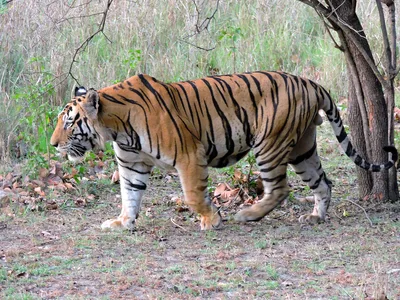
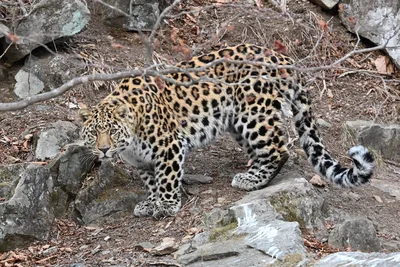
Tigers and leopards are the main predators, along with large snakes and crocodiles. The civet's night habits and its tree-top rest sites are thought to have evolved as a defence against them. Its foul gland secretion is a last defence when it is cornered.
People are a greater threat than any predator. Hunters and trappers take civets in southern China, and some tribes in India eat the meat. In Indonesia, poachers supply the pet trade and the kopi luwak farms. Plantation owners kill civets that raid their fruit. Logging and clearing for oil palm shrink its forest, though it survives in disturbed habitat.
Population and conservation
The IUCN has listed the species as Least Concern since 2008. It has a wide range, a large population and a stable trend, and it copes with many habitats. No global count exists, and the 2008 assessment judged the population unlikely to be falling. The Mentawai subspecies is listed as Vulnerable, and China's red list calls the species vulnerable from over-hunting.
The species is on CITES Appendix III, listed by India. India protects it under the Wildlife Protection Act of 1972, and Malaysia and Sichuan also protect it by law. Indonesia sets a quota and allows only 10% of civets taken from the wild to be sold at home. Traders largely ignore the quota, and the authorities do not enforce it. Civets have become popular pets in Indonesia, and most of those in the markets of Java and Bali come from the wild.
Relationship with humans
The civet is best known for kopi luwak, a coffee made from beans it has eaten and passed. The animal picks only the ripest cherries, and the gut gives the beans a strong flavour. Kopi luwak sells for more than one hundred dollars a pound, which makes it the dearest coffee in the world. Demand has led to farms where civets sit in battery cages, a practice criticised on welfare grounds.
For centuries people scraped the scent gland for musk, once a scabies cure and now a perfume base. The scraping is difficult and painful for the animal if done badly. In India, oil from small pieces of civet meat kept in linseed oil is still used as a folk cure for scabies. Villagers also keep civets to catch rats and mice.
Civets raid orchards and plantations, and growers kill them in return. Animals that move into a roof or a barn make noise all night and are treated as a nuisance. In India the civet has picked up unkind local names, such as gravedigger in Delhi and onion thief in Maharashtra.
In culture and myth
In the mythology of the Bagobo people of the Philippines, Lakivot was a huge palm civet that could talk. Lakivot slew Ogassi, a monster with one eye, and then the busaw spirits guarding the Tree of Gold. He won the Flower of Gold, took the shape of a handsome youth and wed the woman who received it. The Philippine twenty-peso note now shows the civet on its reverse side.
In Chinese tradition, an opera tells of a civet cat swapped for a newborn prince, and the civet became a symbol of tricks and disguise. That story is about the masked palm civet, another species, but people often confuse the two. In Kolkata the civet is the bhaam, or baby stealer, a name born of fear rather than fact. Spirit-animal websites call the civet a sign of luck, stealth and resilience, but these claims are probably modern inventions.
A sentence with a dotted underline is inferred: it describes the group the animal belongs to, or is a reading of the sources, rather than a measured or reported fact about this species.
Questions
Asian palm civet questions, answered
What is an Asian palm civet?
It is a small, cat-like member of the civet family, Viverridae, from South and Southeast Asia. It climbs trees at night to eat fruit and small animals.
How big is an Asian palm civet?
The head and body measure 43 to 71 centimetres, and the tail adds about 48 centimetres. Adults weigh 2 to 5 kilograms.
What do Asian palm civets eat?
Mostly fruit, such as figs, mango, banana and rambutan, plus palm sap. They also eat rats, mice, birds, eggs, insects and snails.
Where do Asian palm civets live?
From India and Sri Lanka through Southeast Asia to southern China, Borneo, Java and the Philippines. They use forest, plantations, gardens and roofs.
Are Asian palm civets dangerous?
No. A civet may bite or spray a foul scent if handled, but it does not attack people.
What is kopi luwak?
It is coffee made from beans that a civet has eaten and passed in its droppings. It sells for over one hundred dollars a pound, and many civets are caged to produce it.
Are Asian palm civets endangered?
No. The IUCN lists the species as Least Concern. The Mentawai subspecies is Vulnerable, and the pet trade and coffee farms are growing threats.
Can you keep an Asian palm civet as a pet?
It is a poor pet and, in most countries, a protected animal. Most pet civets come from the wild, and the trade drives poaching.
Are Asian palm civets nocturnal?
Yes. They are active from dusk to dawn and sleep by day in a tree hole or among vines. They stay home on bright moonlit nights.
How long do Asian palm civets live?
About 15 to 20 years in the wild. One captive civet lived 24.5 years.
Why is it called a toddy cat?
It drinks the sap of the sugar palm, which people ferment into a drink called toddy.
How many babies does a palm civet have?
A litter holds 2 to 5 kittens, born after about 60 days. A female can have two litters a year.
What eats an Asian palm civet?
Tigers, leopards, large snakes and crocodiles. People trap and hunt far more civets than any predator takes.
Do Asian palm civets smell?
Yes. Both sexes have a scent gland under the tail that they drag along branches to mark their range. When frightened they release a foul secretion.
Is the Asian palm civet a cat?
No. It belongs to the civet family, Viverridae, though it shares the order Carnivora with cats. It walks on the whole sole of its foot, like a bear.
Food web
Prey and food
- fruit
- berries
- figs
- palm sap
- rats
- mice
- birds
- insects
- snails
- eggs
Food web
Predators
 Tiger
 Leopard
Ecological equivalents
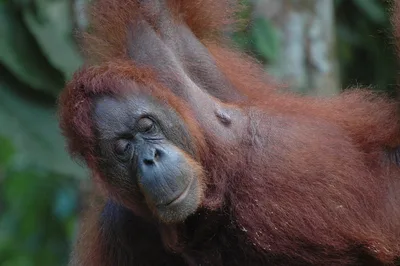
Related species on this site
African Civet (same family), Banded Palm Civet (same family), Binturong (same family), Malayan Civet (same family), Masked Palm Civet (same family), Aardwolf (same order), and more.
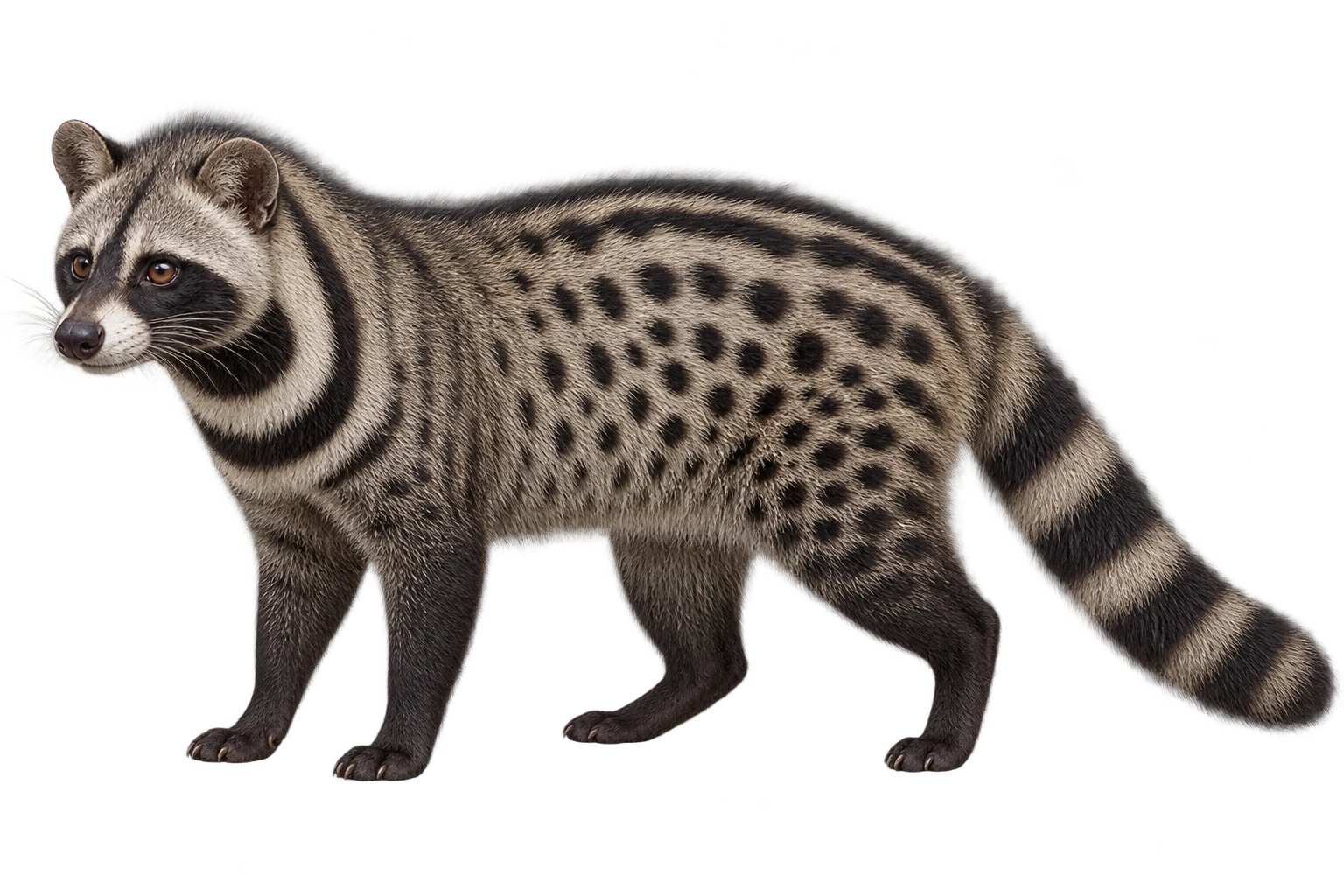
Mammals
African Civet
Civettictis civetta
Classification and source reference
LivingAI illustration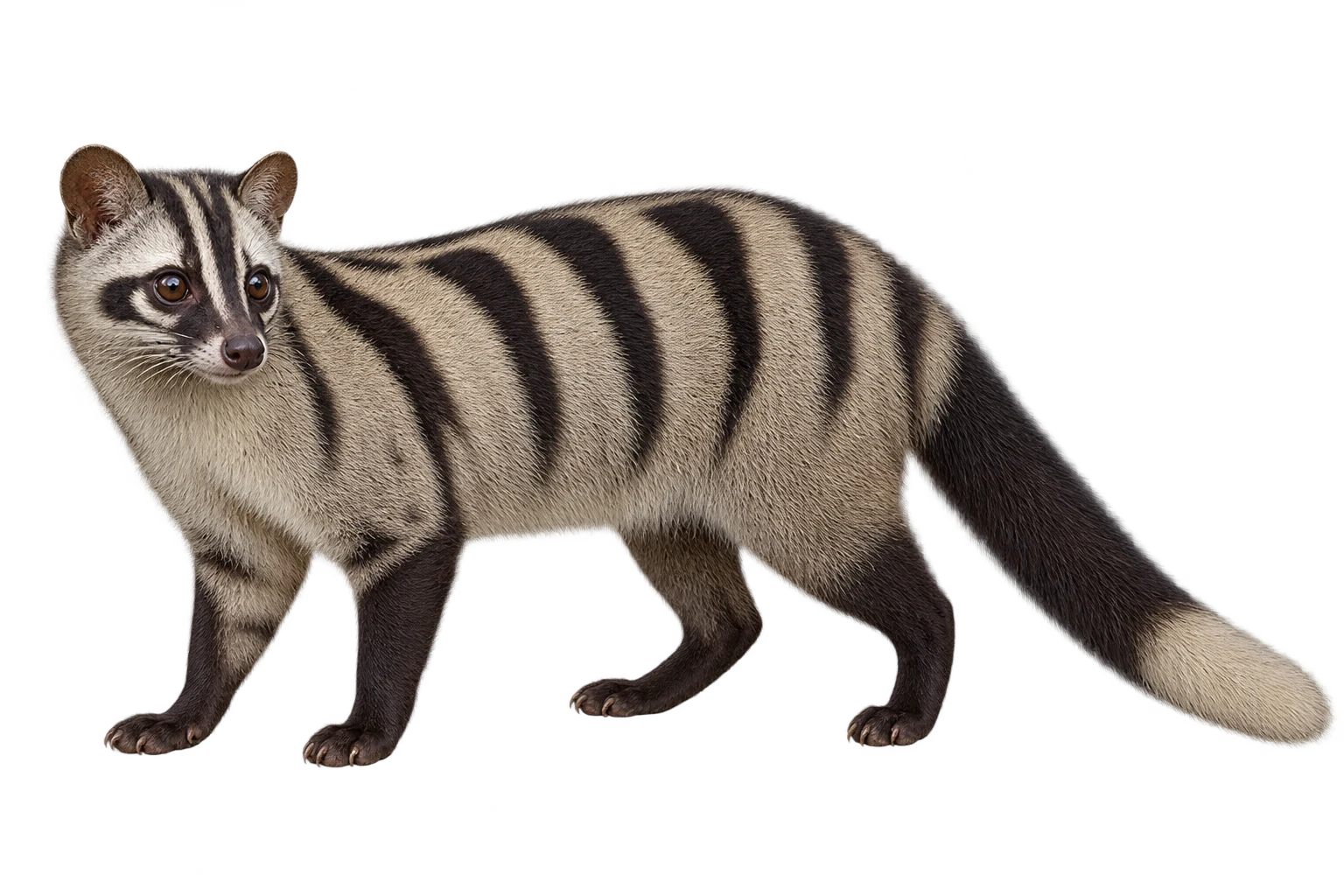
Mammals
Banded Palm Civet
Hemigalus derbyanus
Classification and source reference
LivingAI illustration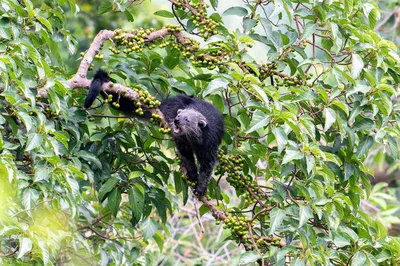 VU
Mammals
Binturong
Arctictis binturong
The binturong is a large, shaggy civet of the South and Southeast Asian forest canopy.
Living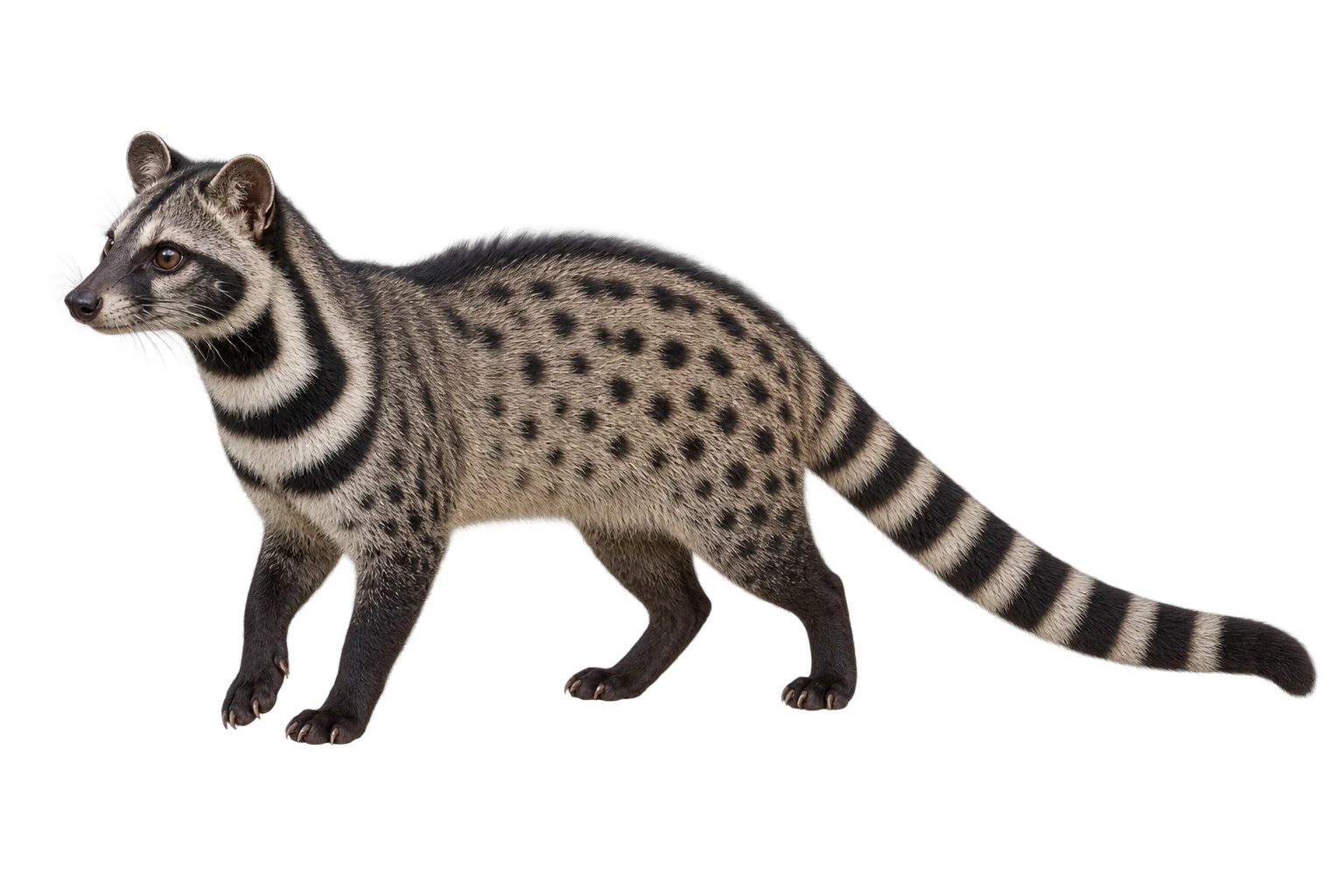
Mammals
Malayan Civet
Viverra tangalunga
Classification and source reference
LivingAI illustration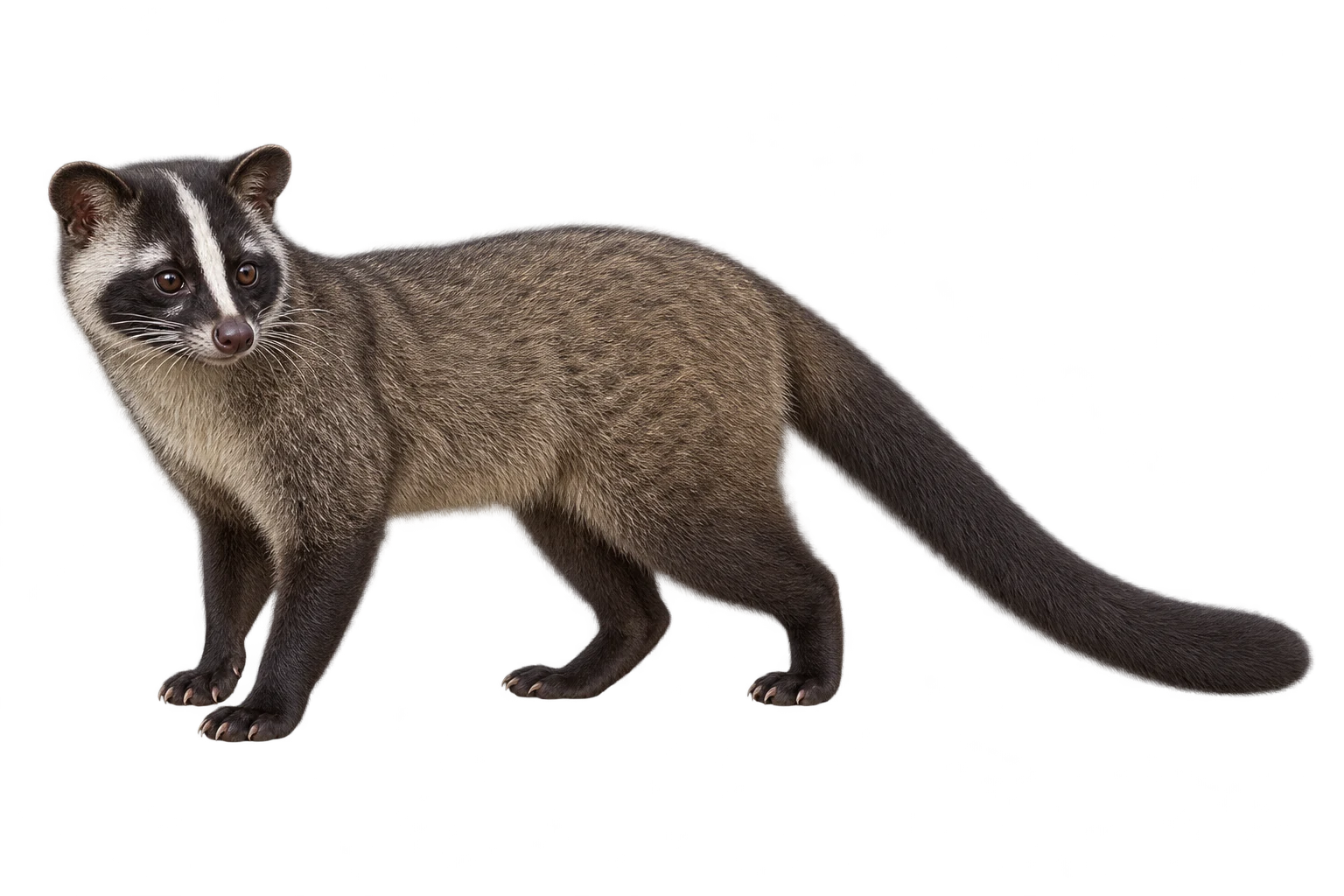
Mammals
Masked Palm Civet
Paguma larvata
Classification and source reference
LivingAI illustration LC
Mammals
Aardwolf
Proteles cristata
The aardwolf is the smallest member of the hyena family and eats almost nothing but termites.
Living