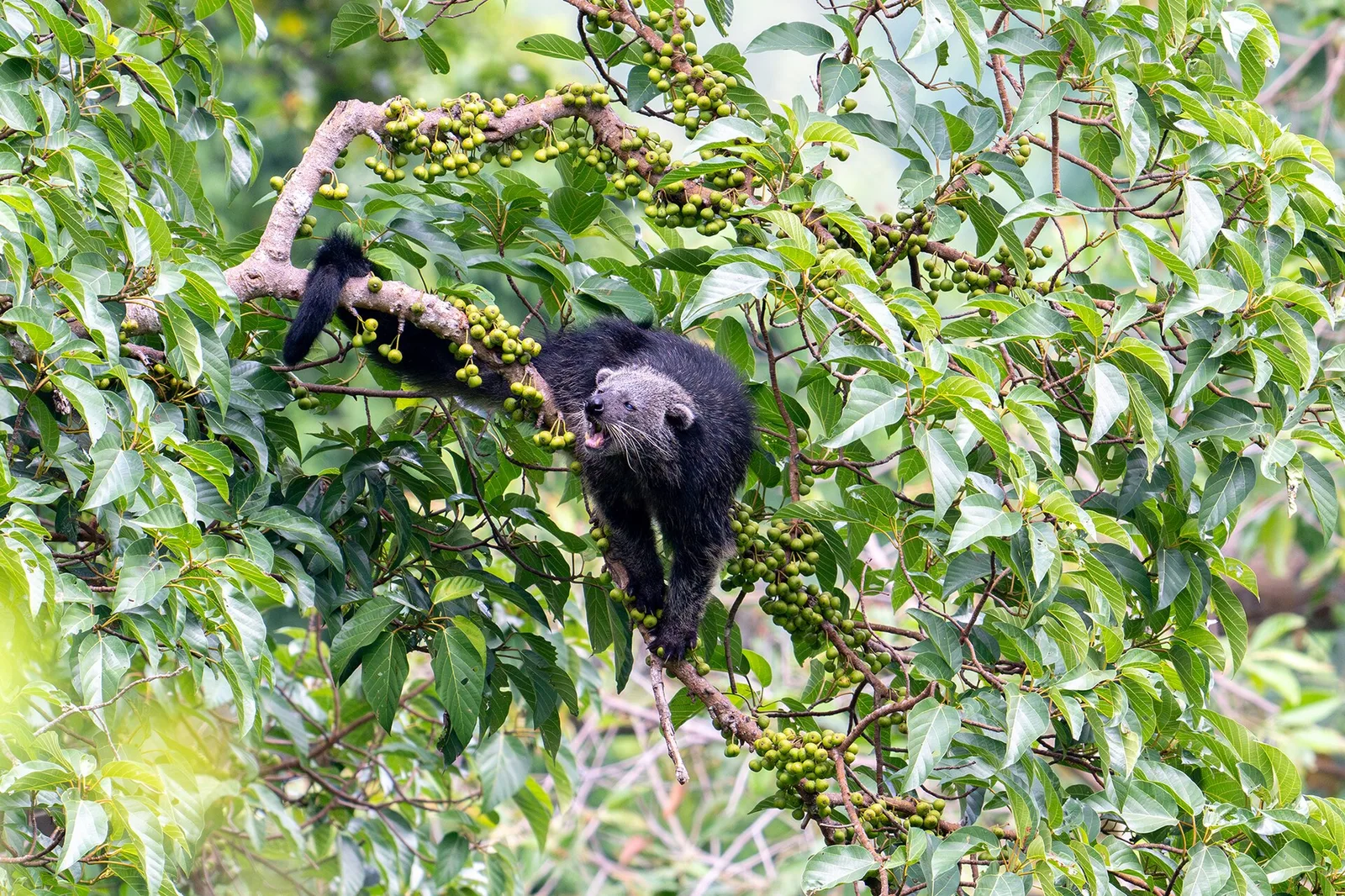
Binturong
The tree-climbing civet that smells of popcorn
Arctictis binturong
Also called Bearcat, Asian bearcat, Bear-cat
Living individuals or members of this group exist today. This does not mean they are safe from extinction.
Meet the binturong
The binturong is a large, shaggy civet of the South and Southeast Asian forest canopy. It climbs with a gripping tail, eats mostly figs, and marks its trees with a scent like buttered popcorn.
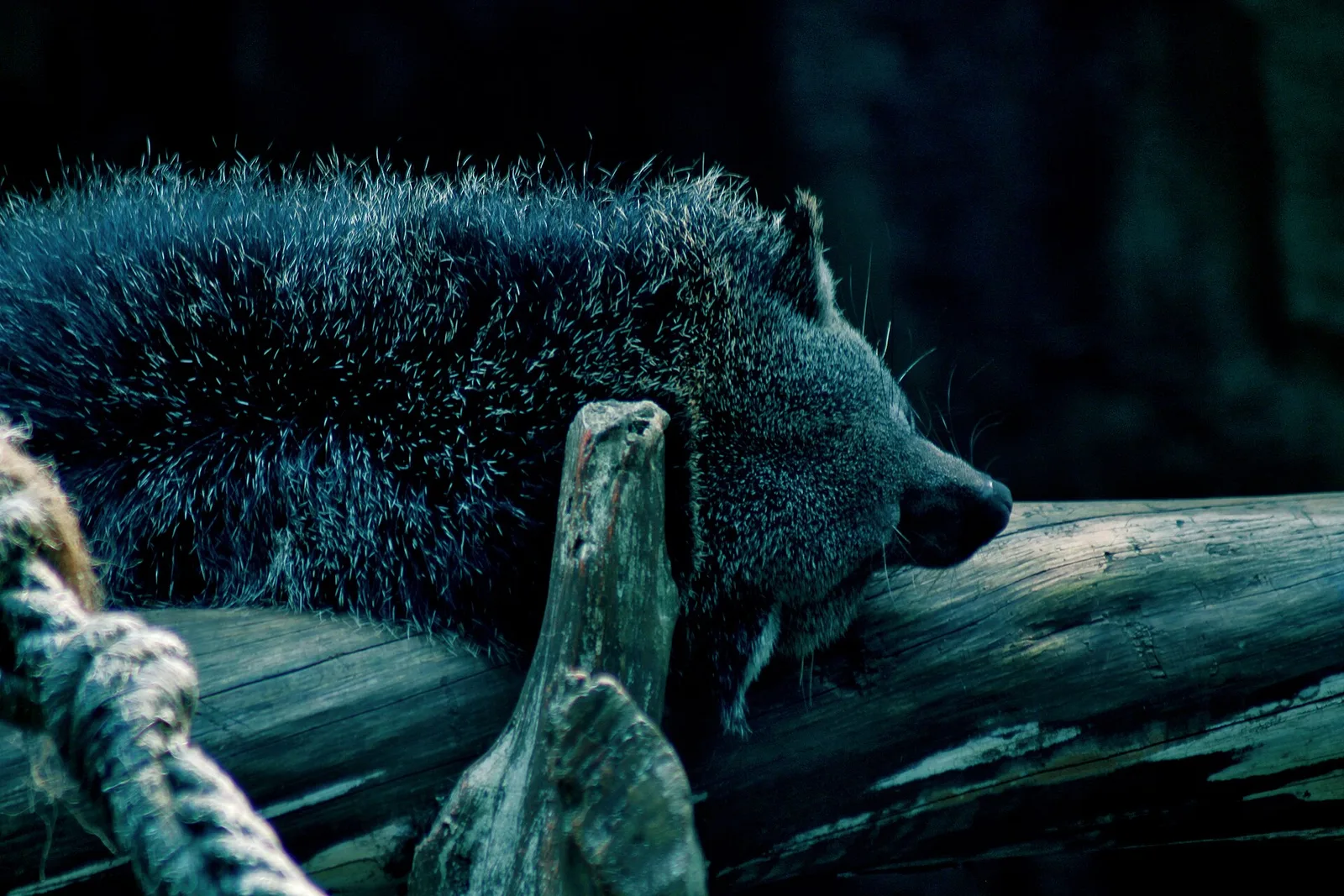
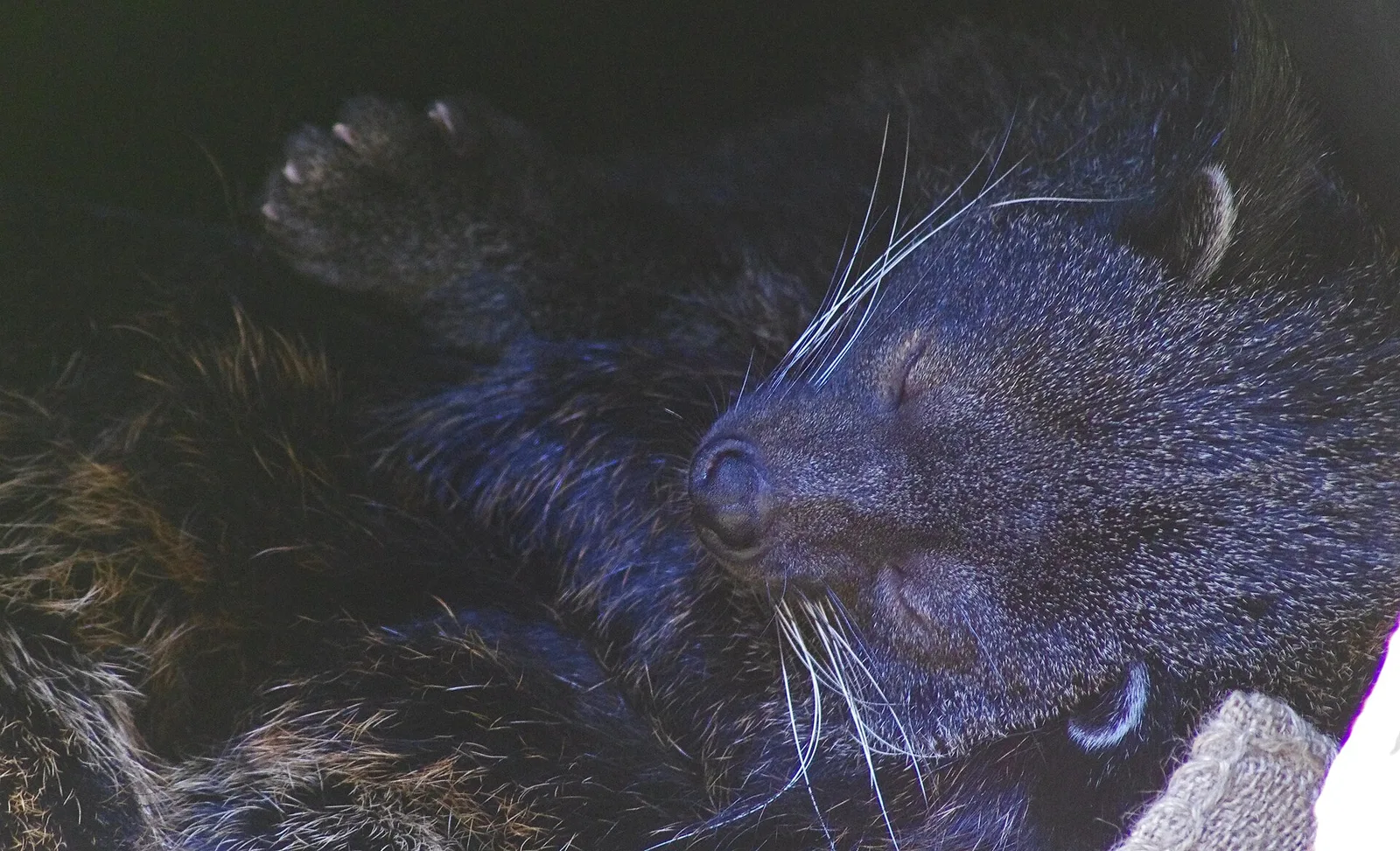
Images of the binturong
Lifespan in the wild
Up to 18 years
Weight
9 to 20 kg
Length
61 to 96 cm
Fact file
Binturong
- Location
- India and Nepal east to Vietnam, south to Indonesia and Palawan
- Habitat
- Rainforest, Temperate forest
- Diet
- Omnivore
- Prey / food
- Figs, fruit, rodents, birds, eggs, insects, carrion, shoots
- Predators
- Tiger, dhole
- Lifestyle
- Mostly nocturnal and crepuscular; climbs trees
- Group name
- Solitary; a mother with her young
- Name of young
- Binlet
- Gestation
- About 91 days
- Litter size
- 1 to 6, usually 2
- Population
- Unknown; fell by more than 30 percent in 30 years
- Biggest threat
- Logging, plantations and hunting
- Distinctive feature
- A prehensile tail and a popcorn scent
- Colour
- Black, often with grey or buff tips
- Skin type
- Fur
Size
Next to a person
Measurements
Size and speed
- Length
- 61 to 96 cm head and body, without the tail
- Tail
- 56 to 89 cm
- Weight
- 9 to 20 kg
Typical adult ranges. Source: Animal Diversity Web.
Life cycle
Lifespan
- In the wildUp to 18 years
- In captivityUp to 25 years
- 025 years
The pale bar is the record. Source: Animal Diversity Web.
Appearance
Colour and coat
- Primary colours
- black
- Secondary colours
- greybuffwhite
- Skin type
- fur
- Male and female
- Females are about 20 percent larger than males and dominate them. The coat and colour are the same in both sexes.
Life cycle
Mating and family
- Mating system
- uncertain; probably solitary with brief pairings, and some pairs may stay together
- Social structure
- solitary; a mother with her young
- Breeding
- up to two litters a year, in any month
Binturongs can breed in any month, though more births come between January and March. A female can delay implantation until conditions are good. Gestation lasts about 91 days and the litter is usually 2, with up to 6 recorded. The young are weaned at 6 to 8 weeks and mature at about 28 to 30 months. The wild record is 18 years, and the captive record is 25.
Classification
Taxonomy
- Kingdom
- Animalia
- Phylum
- Chordata
- Class
- Mammalia
- Order
- Carnivora
- Family
- Viverridae
- Genus
- Arctictis
- Species
- Arctictis binturong
Conservation
Red List status
- LC
- NT
- VU
- EN
- CR
- EW
- EX
Vulnerable on the IUCN Red List
Range
Recorded in 6 countries
Habitat layer: tropical moist broadleaf forest, temperate broadleaf and mixed forest, temperate conifer forest, boreal forest and taiga.
Countries from 130 wild records on GBIF (iNaturalist research grade), filtered and checked by hand. Country shapes: Natural Earth. Habitat: RESOLVE Ecoregions 2017, CC BY 4.0. Basemap: Natural Earth.
Habitats
Three things to know
- 1
The binturong's urine contains the same compound that gives popcorn its smell.
- 2
It is one of only two carnivorans with a tail that can grip a branch.
- 3
It is the only known animal that can spread the seeds of one strangler fig.
Did you know
Seven more facts
- 1
Females are larger than males and dominate them.
- 2
The genus name Arctictis means bear-weasel in Greek.
- 3
Zoo keepers call a newborn binturong a binlet.
- 4
A cornered binturong may urinate or defecate on the threat before it bites.
- 5
Wild binturongs live up to 18 years, and one captive animal reached 27.
- 6
A collared animal in Thailand walked over 4 kilometres in a day in the wet season.
- 7
The male binturong has no penis bone, unlike most carnivorans.
Field notes
How it looks and acts
Field notes
Distinguishing features
- A long, coarse black coat, often with grey or buff tips.
- A thick, muscular tail that grips branches.
- Small round ears with white rims and black tufts.
- Long white whiskers on a short pointed snout.
- A head and body of 61 to 96 centimetres, with a tail of 56 to 89 cm.
- Third and fourth toes joined on each foot.
Field notes
Unique adaptations
- A prehensile tail acts as a fifth limb in the canopy.
- Hind feet that rotate backwards give grip on a trunk during a head-first descent.
- Digestive enzymes soften the seed coat of the strangler fig.
- Delayed implantation lets a female time her birth to good conditions.
- Elliptical pupils adjust the eyes to bright day and dark night.
Field notes
Interesting behaviours
- Dragging the tail and scent glands along branches to mark a trail.
- Climbing along the top of a branch or hanging beneath it.
- Descending to the ground to cross between trees.
- Sleeping curled up in the branches with the head under the tail.
- Shaking the coat, grooming and scratching after rest.
Field notes
Temperament
- Shy and slow, and it avoids other binturongs.
- Loud and aggressive when harassed.
- Said to tame easily in captivity.
Field notes
Communication
- Popcorn-scented urine mixed with gland musk marks the trails.
- Growls, hisses and low grunts on the move.
- Screams and howls when threatened.
- A loud purr from a receptive female.
- A chuckle when content and a high wail when upset.
Ecology
Ecological role
The binturong plants figs. It is the only animal known to pass the seeds of one strangler fig in a state that can sprout.
- It spreads the seeds of Ficus altissima and other figs across the forest.
- It hunts rodents and small birds, and may hold their numbers down.
- It cleans up carrion and eggs it finds on its rounds.
- Its scent marks tell other forest animals that a large civet holds the area.
Stories
Myths and legends
- In English tradition, early naturalists called it a bearcat and imagined a cross between the two animals.
- In zoo tradition, the popcorn smell is a forest perfume that announces the animal.
- In some Indonesian and Philippine communities, the animal is said to bring good luck.
- In American college tradition, the bearcat is a mascot drawn as a fierce bear-cat hybrid.
People
Relationship with humans
People
Living alongside us
People hunt the binturong for meat, skins and medicine, and they catch young ones for the pet trade. Some are kept to produce kopi luwak coffee. Zoos across the world display it, and its popcorn smell makes it a visitor favourite. In the wild it helps farmers by eating rodents. Logging for timber and plantations is the biggest harm people do to it.
- It is shy and avoids people.
- A cornered animal can bite hard with strong jaws.
- It may spray urine or dung on a person who corners it.
People
Status, uses and products
- Domestication
- Wild
- As a pet
- Not suitable. The animal is said to tame easily. But it is a Vulnerable species, most pets come from the wild, and its scent marks every surface in a home.
- Uses
- zoo displayrodent controlkopi luwak production
- Products
- meatfurtraditional medicine
The full account
About the binturong
The binturong, Arctictis binturong, is the largest member of the civet family. People also call it the bearcat, though it is neither a bear nor a cat. It lives in the tree canopy of South and Southeast Asia, from India and Nepal to Indonesia and the Philippines. Adults weigh 9 to 20 kilograms, and the head and body measure 61 to 96 centimetres. The tail is almost as long again, at 56 to 89 cm, and it can grip a branch.
The animal has a long black coat, white whiskers, and tufted ears. It moves slowly through the branches and comes down to the ground to cross between trees. Its urine carries a compound that smells of buttered popcorn, and the scent marks its trails. The diet is mostly fruit, and figs matter more than anything else. The IUCN lists the species as Vulnerable, because logging and hunting have cut its numbers.
Name and taxonomy
Thomas Stamford Raffles described the species in 1822 from an animal taken at Malacca in Malaysia. He placed it in the genus Viverra, with the true civets. Coenraad Jacob Temminck created the genus Arctictis for it in 1824. The genus name joins two Greek words, one for bear and one for weasel. The word binturong comes from Malay, and older roots in the region mean a squirrel and a creature that climbs down.
The binturong is the only species in its genus. Zoologists have named nine subspecies, from Yunnan in China to Java and the island of Palawan. The Palawan form, whitei, is the one most often studied in the field. It sits in the family Viverridae, in the subfamily Paradoxurinae with the palm civets.
Evolution and relatives
The subfamily Paradoxurinae holds four living genera. Genetic work dates its origin to between 35.5 and 21.9 million years ago. The small-toothed palm civet, Arctogalidia, split off first. The binturong line separated about 15.9 million years ago, before the masked palm civet and the Asian palm civets.
The species has two genetic groups, a northern one in Indochina and a southern one in the Sunda region. The Isthmus of Kra separates them today. During the Pleistocene the animals probably moved across a land bridge, and rising seas later cut the two groups apart. Three subspecies belong to the northern group and six to the southern group.
Appearance
The binturong has a long, heavy body on short, thick legs. The head and body measure 61 to 96 centimetres, and the tail adds 56 to 89 cm. Adults weigh 9 to 20 kilograms. Females are larger than males, by about 20 percent, and they dominate the males they meet. The coat is coarse and black, and many animals carry white or buff tips that give a grey or straw look.
The face has a short, pointed snout and long white whiskers. The ears are small and round, with a white rim and a black tuft of hair on top. The tail is thick and muscular at the base and curls inwards at the tip. The feet are flat-soled, with five clawed toes, and the third and fourth toes are joined. The jaws hold 36 to 40 teeth, and the canines are long and sharp. Unlike most carnivorans, the male has no penis bone.
Habitat and range
The range runs across South and Southeast Asia. It includes India, Nepal, Bhutan, Bangladesh, Myanmar, Thailand, Laos, Cambodia, Vietnam, southern China, Malaysia, Indonesia and the Philippines. In Indonesia the animal lives on Sumatra, Java and Borneo, and on smaller islands such as Nias and Bangka. In the Philippines it occurs only on Palawan. GBIF holds records from 16 countries, though some of those are zoo animals.
The binturong lives in tall, dense tropical forest and spends most of its time in the canopy. It ranges from sea level up to about 3,000 metres, but lowland primary and secondary forest hold the most animals. In Assam it prefers wooded hills and foothills to the forested plains. In Laos it uses large tracts of evergreen forest. On Palawan it lives in lowland forest and in a mix of grassland and forest up to 400 metres. It can survive in logged forest, and in Malaysia it has been recorded in regrowth beside an oil palm estate.
Diet and feeding
The binturong belongs to the order Carnivora, but it eats mostly fruit. Figs are the main food, and the fruit of the strangler fig Ficus altissima is a favourite. It also takes small mammals, birds, eggs, insects, earthworms, carrion, shoots and leaves. It has been seen swimming and diving for food, and fish appear in the diet. Fish and worms are probably rare meals, because the animal neither swims for a living nor digs.
The binturong is a keystone species in its forest. Its gut can soften the hard coat of a strangler fig seed, so the seed sprouts after it passes through. No other animal is known to spread the seeds of Ficus altissima. As a hunter of rodents, it may also hold down the numbers of its prey.
Behaviour and social life
The binturong lives alone for most of the year. Neighbours avoid each other, but they do not defend a fixed territory. Home ranges overlap by about 35 percent on average. In Thailand the mean annual range was 6.2 square kilometres. A female in Khao Yai National Park used about 4 square kilometres, and males there used 4.5 to 20.5.
The animal is active mainly at night and around dusk and dawn. Five radio-collared animals in Phu Khieo Wildlife Sanctuary peaked in the early morning and late evening and rested in the afternoon. Daytime sightings do occur, for example in Pakke Tiger Reserve in India. The collared animals walked as little as 25 metres a day in the dry season and up to 4,143 metres in the wet season.
The binturong climbs slowly and carefully, and it seldom jumps. It walks along the top of a branch or hangs beneath it, and the tail holds on as a fifth limb. The hind feet can turn backwards, so the claws grip a trunk while the animal comes down head first. It is too heavy to leap between crowns, so it often descends and crosses the ground with a flat-footed walk. At rest it curls up with its head tucked under its tail.
Communication and senses
Scent is the binturong's main way of sending a message. Both sexes have glands beside the anus, and the female has a second pair beside the vulva. The animal drags its tail and rear over branches as it climbs, and the marks tell others where it has been. The famous popcorn smell comes from the urine, which contains 2-acetyl-1-pyrroline, the same compound formed when popcorn pops. A study at Duke University found none of that compound in the gland secretion itself. The oily musk from the glands helps the scented urine stick to bark and last in the humid canopy.
The binturong also uses its voice. It growls when annoyed, and it grunts or hisses through half-open lips as it moves. An angry animal screams, howls or cackles, and a content one makes a chuckling sound. A female in oestrus purrs loudly during mating. The pupils are elliptical and open wide, so the eyes work in both bright and dim light.
Reproduction and life cycle
Most of what is known about breeding comes from zoos. The animals mate in any month, but more births fall between January and March. A female can delay implantation, so a fertilised egg waits until food and weather are right. When the female is not receptive she keeps away from males, and the males act defensively towards her. In oestrus she calls to attract a mate, and mating takes place up in the canopy.
Gestation lasts about 91 days, with a reported range of 84 to 99 days. A litter holds 1 to 6 young, and 2 is typical. Zoo keepers call the newborns binlets. They are born blind and helpless and hide in their mother's fur for the first days. Weaning comes at 6 to 8 weeks. Females mature at about 30 months and males at about 28 months.
The mother cares for her young until they can fend for themselves, and daughters may stay with her afterwards. One zoo report describes a father that stayed with the mother and young, so some pairs may be monogamous. Wild animals live up to 18 years, and captive ones up to 25.
Predators and threats
Few animals can kill an adult binturong. Tigers and dholes take one now and then. In one study, 172 dhole scats from binturong country held no trace of the species. The thick, coarse coat makes a clean bite hard to land. The strong smell warns other animals that a large, well-armed civet is near. A cornered animal may urinate or defecate on the threat, then bite with the skull and jaws of a true carnivore.
People are the real danger. Logging and the conversion of forest to plantations have destroyed much of the lowland habitat, above all in the Sunda region. Hunters take the animal for meat, for skins, and for traditional medicine. Young animals are caught for the pet trade, and some are kept to produce kopi luwak coffee. Degraded forest can still hold binturongs, but it also brings more hunters.
Population and conservation
The IUCN Red List classes the binturong as Vulnerable. The population fell by more than 30 percent over 30 years. No one appears to have a good count of the animals left in the wild. The China Red List classes it as Critically Endangered, and Malaysia and Myanmar protect it by law.
CITES lists the species in Appendix III, at the request of India. Zoos breed the animal, but a 2006 study found low genetic diversity in the captive stock. Poor records of origin risk inbreeding or the mixing of subspecies. Since 2016 the charity ABConservation has run the Bearcat Study Programme on Palawan to track wild animals. Conservationists ask for stronger action against poaching and forest loss.
Relationship with humans
Zoos across the world keep binturongs for education and display. Visitors often notice the popcorn smell before they see the animal. In the wild the species eats rodents, which helps farmers near the forest. Its meat is a delicacy in some countries, and its fur is traded.
The animal is said to tame easily, and some people keep it as a pet. It is shy by nature and rarely attacks a person. A harassed animal can bite hard, and its scent is hard to wash out. Captured young feed the pet trade, so a pet probably costs a wild mother her cub.
In culture and myth
Early English writers named the animal bearcat, since its walk reminded them of a bear and its face of a cat. Old travel books cast it as a strange tree-bear of the rainforest canopy. Zoo keepers speak of its smell as a forest perfume that tells you an animal is close. The names in Thai, Chinese and Malay seem to describe a bear, a cat or a civet, and none of them names a myth.
A general animal blog suggests some forest peoples treat the binturong as a sacred guardian of the trees and a bringer of luck. That claim names no culture, so it is probably best read with care. In parts of Indonesia and the Philippines the animal is said to be a symbol of good fortune. In the United States the bearcat is a sports mascot at Binghamton University and the University of Cincinnati. The artists give those mascots the body of a bear and the face of a cat, not the look of a civet. ABConservation marks World Binturong Day on the second Saturday of May.
A sentence with a dotted underline is inferred: it describes the group the animal belongs to, or is a reading of the sources, rather than a measured or reported fact about this species.
Questions
Binturong questions, answered
Why does a binturong smell like popcorn?
Its urine contains 2-acetyl-1-pyrroline, the same compound that forms when popcorn pops. The animal spreads the scent as it drags its tail over branches.
Is a binturong a bear or a cat?
Neither. It is a civet in the family Viverridae. The name bearcat comes from its bear-like walk and cat-like face.
Where do binturongs live?
They live in the forests of South and Southeast Asia. The range runs from India and Nepal east to Vietnam and south to Indonesia and Palawan.
What do binturongs eat?
Mostly fruit, and above all figs. They also eat rodents, birds, eggs, insects, carrion, shoots and leaves.
How big is a binturong?
The head and body measure 61 to 96 centimetres, with a tail of 56 to 89 cm. Adults weigh 9 to 20 kilograms.
Are binturongs endangered?
The IUCN lists them as Vulnerable. Numbers fell by more than 30 percent in 30 years because of logging and hunting.
Can a binturong hang by its tail?
The tail grips branches and works as a fifth limb. The animal uses it for balance and support while it climbs, rather than to hang free.
Are binturongs dangerous to people?
No. They are shy and avoid people. A cornered one can bite and may spray urine or dung.
Can you keep a binturong as a pet?
Some people do, and it is said to tame easily. It is a Vulnerable species, and most pets are taken from the wild, so it is not a good choice.
Are binturongs nocturnal?
Mostly. They are most active at night and around dawn and dusk, but daytime sightings happen.
How long do binturongs live?
The wild record is 18 years and the zoo record is 25. One captive animal reached 27.
How many babies does a binturong have?
Usually 2, after about 91 days of pregnancy. Litters of up to 6 have been recorded in zoos.
What eats a binturong?
Tigers and dholes take one now and then, but adults have few predators. People are the main threat.
Why is the binturong a keystone species?
Its gut softens the hard seed coat of the strangler fig Ficus altissima, and no other animal is known to do that. The seeds then sprout across the forest.
Do binturongs live in groups?
No. Adults live alone, and a mother stays with her young until they are independent.
Food web
Prey and food
- figs
- fruit
- rodents
- birds
- eggs
- insects
- carrion
- shoots
Food web
Predators
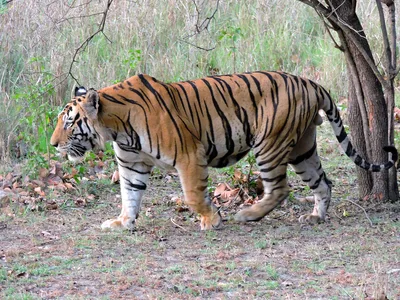 Tiger
- dhole
Ecological equivalents
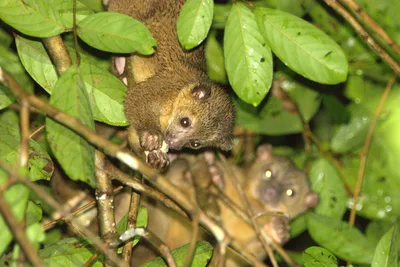
Related species on this site
African Civet (same family), Asian palm civet (same family), Banded Palm Civet (same family), Malayan Civet (same family), Masked Palm Civet (same family), Aardwolf (same order), and more.
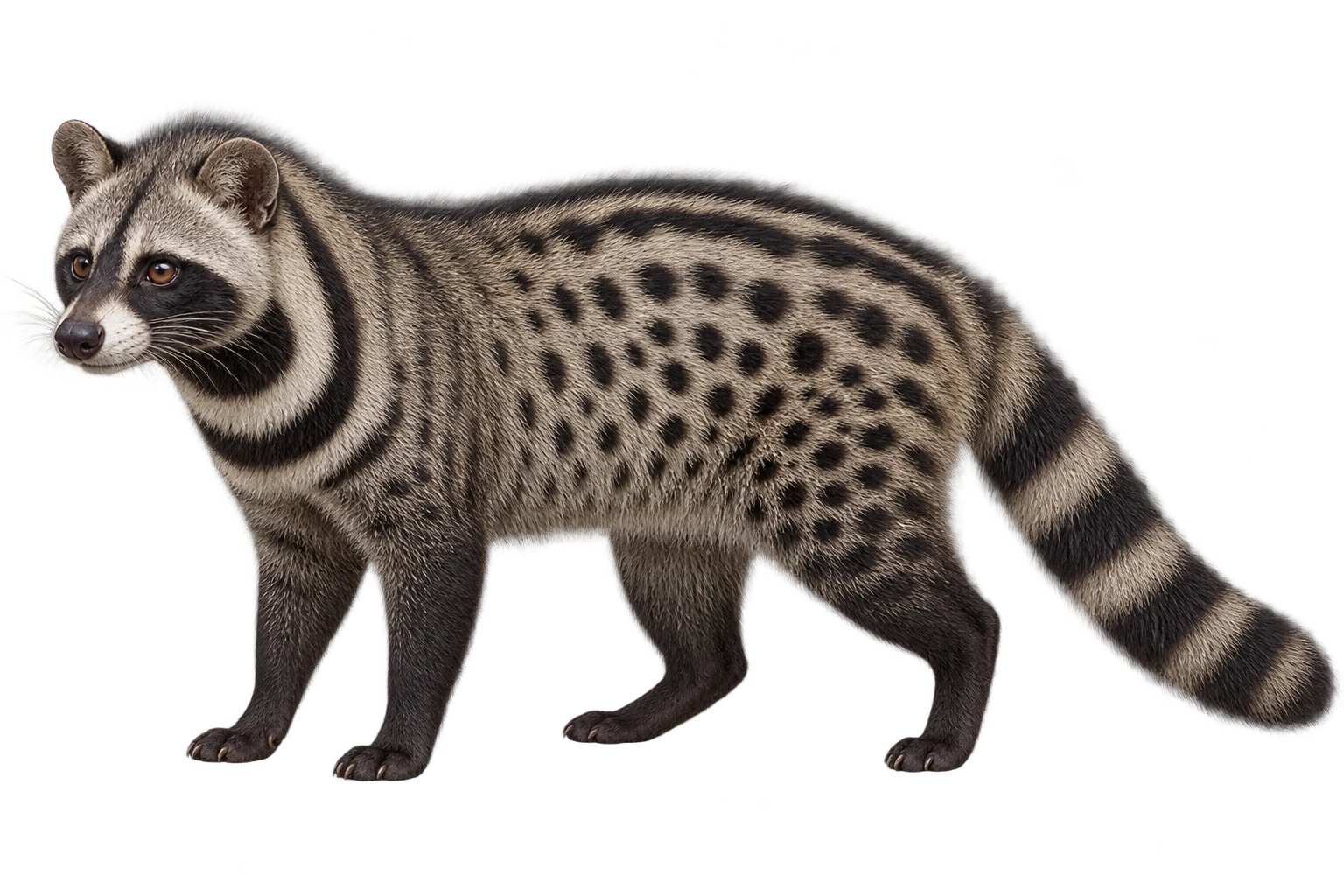
Mammals
African Civet
Civettictis civetta
Classification and source reference
LivingAI illustration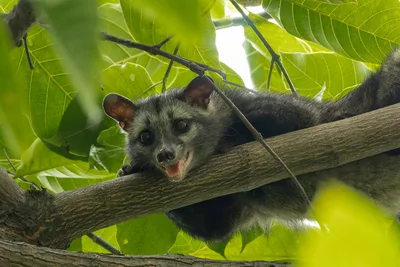 LC
Mammals
Asian palm civet
Paradoxurus hermaphroditus
The Asian palm civet is a small, cat-like viverrid of South and Southeast Asia that climbs trees at night to eat fruit.
Living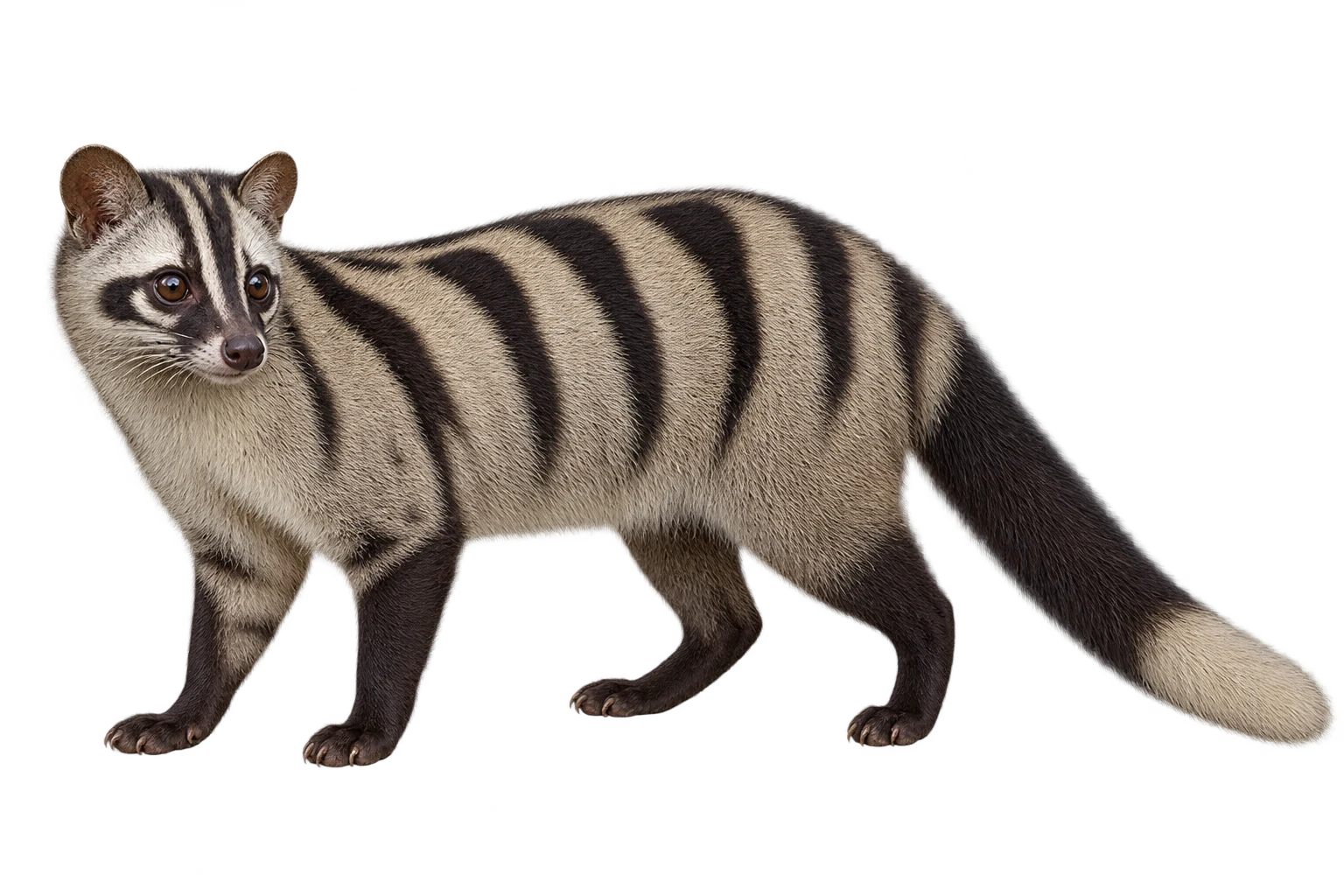
Mammals
Banded Palm Civet
Hemigalus derbyanus
Classification and source reference
LivingAI illustration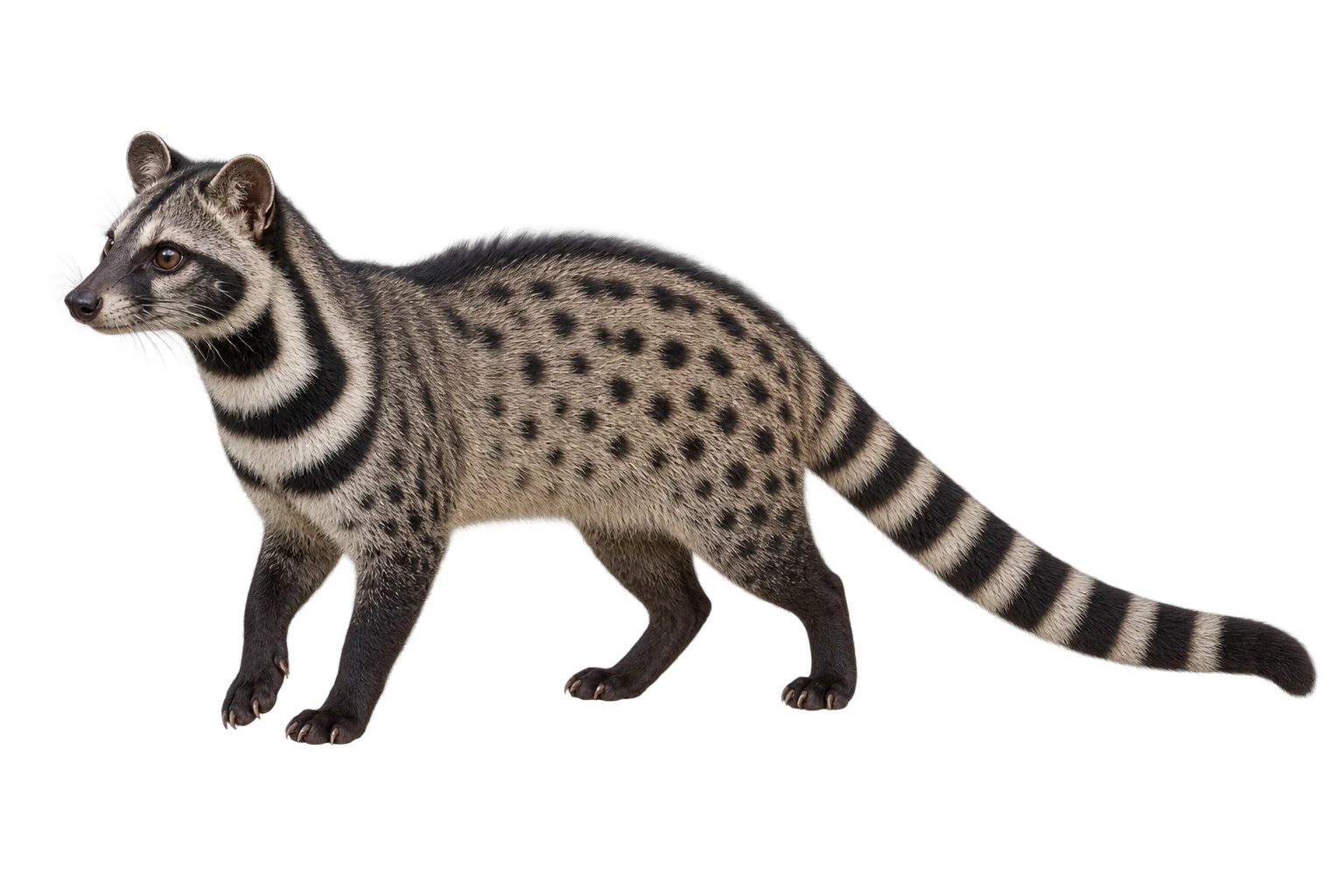
Mammals
Malayan Civet
Viverra tangalunga
Classification and source reference
LivingAI illustration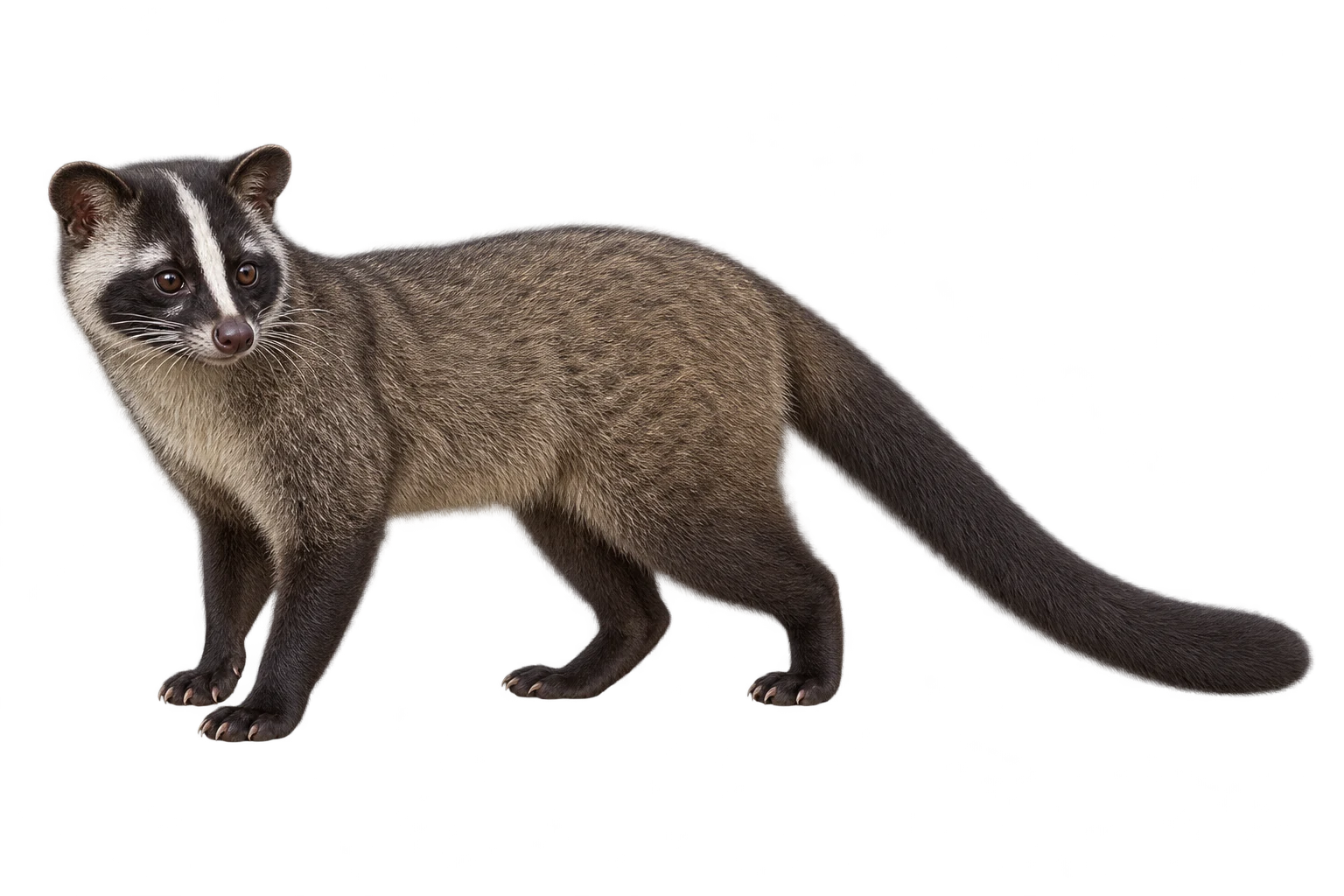
Mammals
Masked Palm Civet
Paguma larvata
Classification and source reference
LivingAI illustration LC
Mammals
Aardwolf
Proteles cristata
The aardwolf is the smallest member of the hyena family and eats almost nothing but termites.
Living