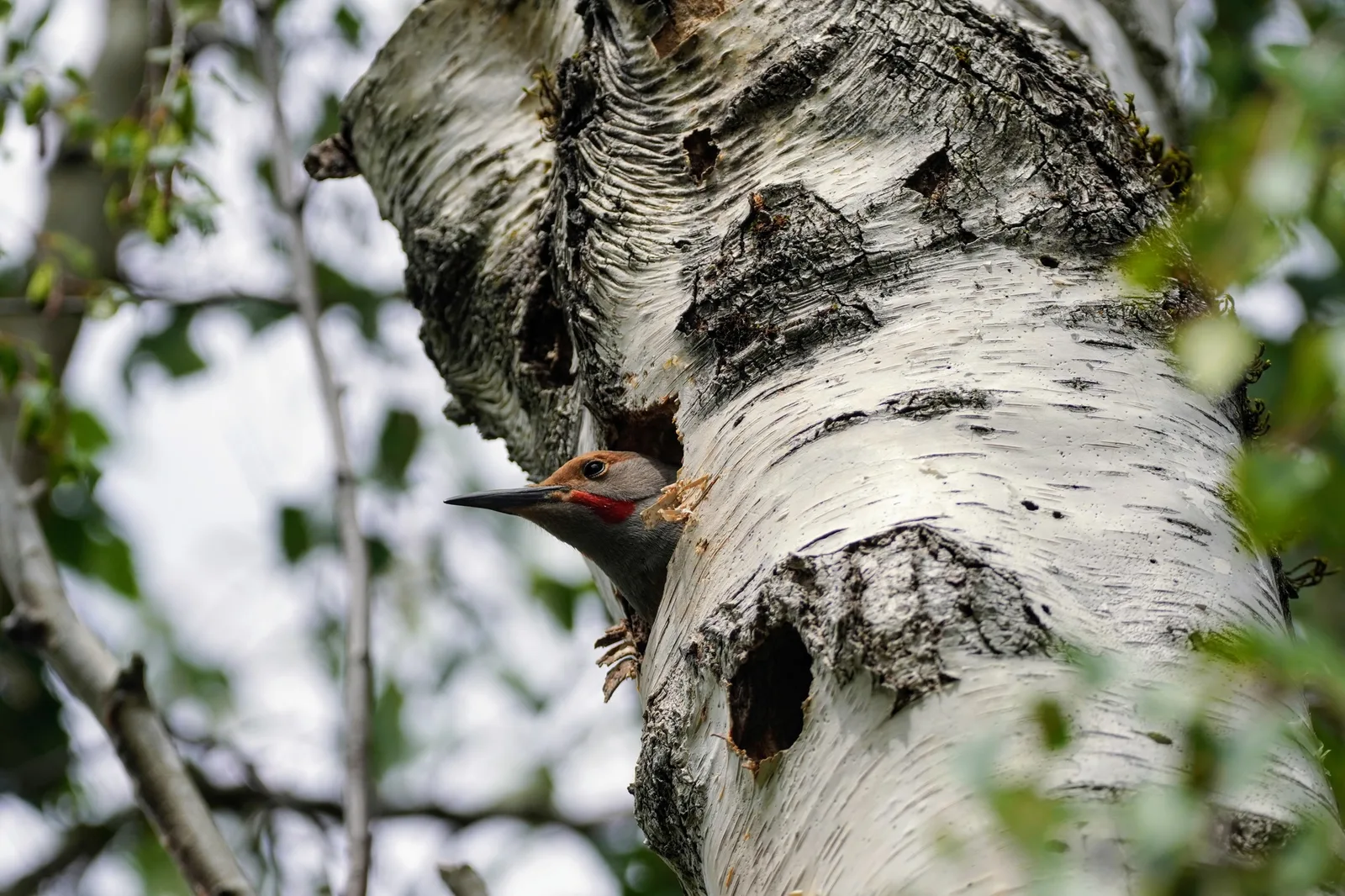
Northern flicker
The woodpecker that hunts ants on the ground
Colaptes auratus
Also called Common flicker, Yellowhammer, Yellow-shafted flicker, Red-shafted flicker, Clape, Gaffer woodpecker
Living individuals or members of this group exist today. This does not mean they are safe from extinction.
Meet the northern flicker
The northern flicker is a large brown woodpecker of North America that feeds mainly on ants taken from the ground. It digs a nest hole in a dead trunk, flies in deep waves, and shows a white rump patch and yellow or red wing shafts.
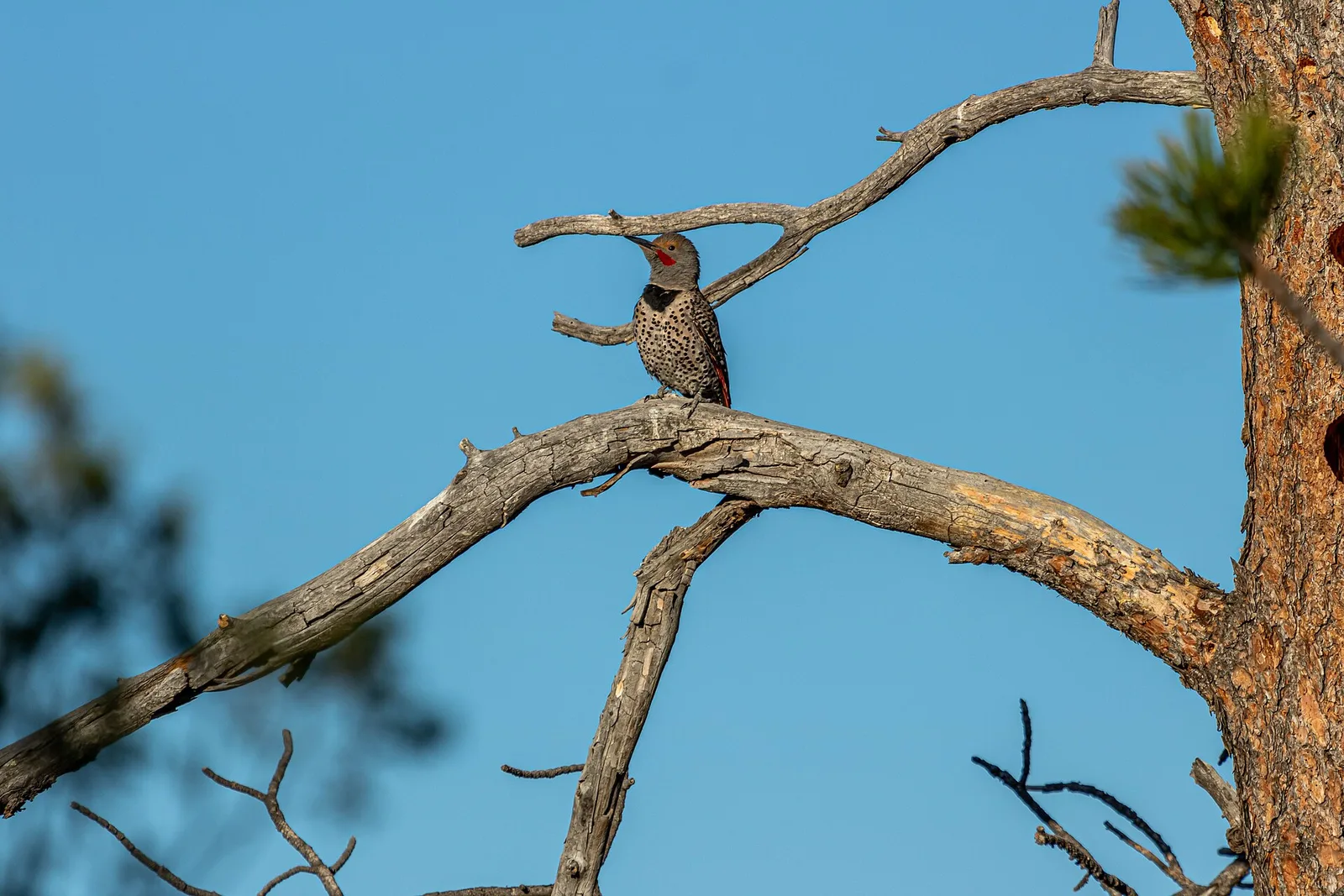
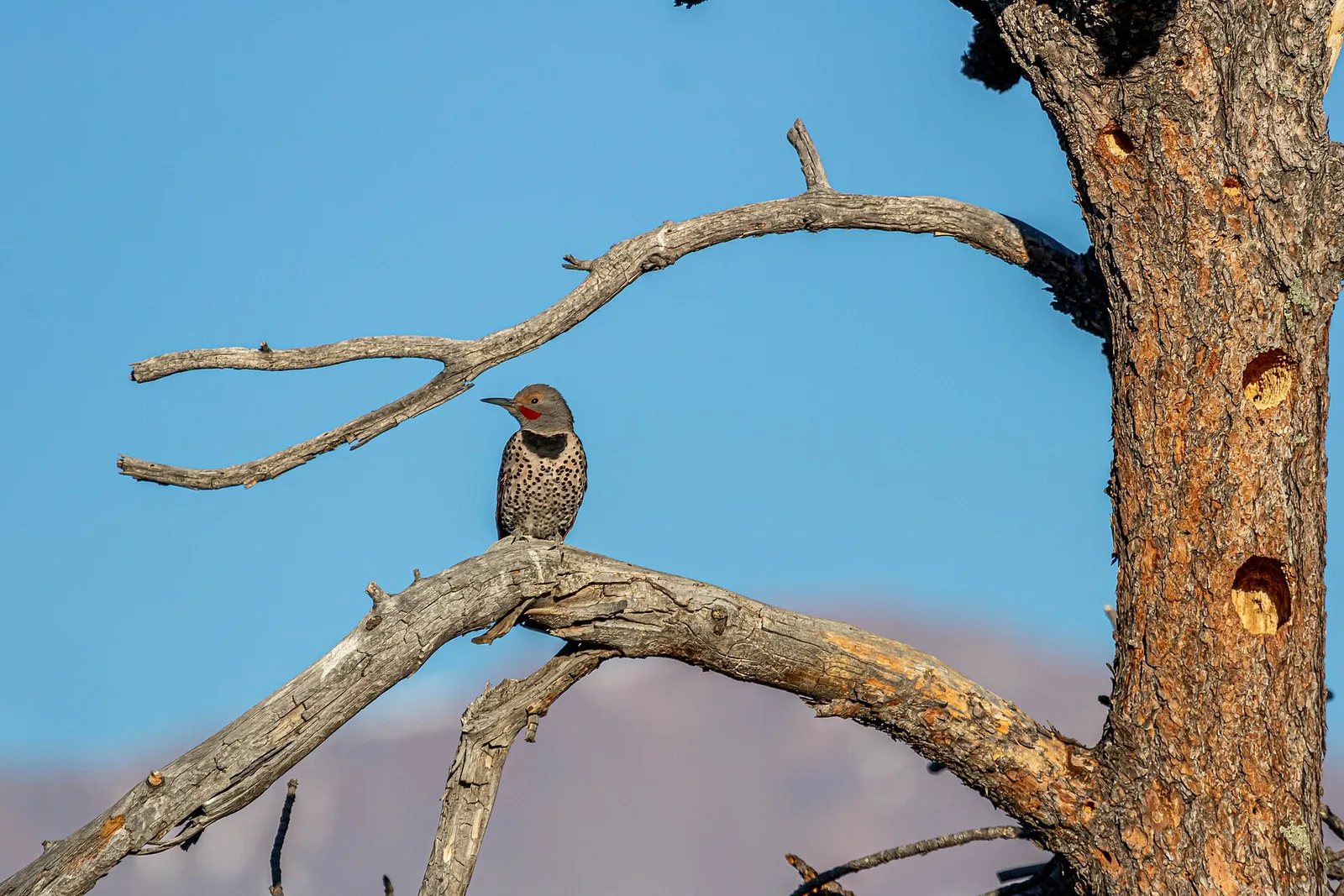
Images of the northern flicker
Lifespan in the wild
Up to 12.5 years the oldest wild bird on record; most live only a few years
Weight
86 to 167 g
Length
28 to 36 cm
Wingspan
42 to 54 cm
Fact file
Northern flicker
- Location
- North America to Nicaragua, plus Cuba and Grand Cayman
- Habitat
- Temperate forest, Towns and cities, Mountains
- Diet
- Omnivore
- Prey / food
- Ants, beetles, termites, caterpillars, grasshoppers, crickets, spiders, snails
- Predators
- Cooper's hawks, sharp-shinned hawks, raccoons, squirrels, snakes
- Lifestyle
- Active by day, partly migratory
- Group name
- Flock
- Name of young
- Chick
- Incubation
- Incubation 11 to 16 days
- Clutch size
- Usually six to eight eggs
- Population
- Common and widespread, but falling since the 1960s
- Biggest threat
- Loss of dead trees and starlings taking nest holes
- Distinctive feature
- White rump patch and a black crescent on the breast
- Colour
- Barred brown above, spotted below, with yellow or red wing shafts
- Skin type
- Feathers
Size
Next to a person
Measurements
Size and speed
- Length
- 28 to 36 cm
- Wingspan
- 42 to 54 cm
- Tail
- 7.5 to 11.5 cm
- Weight
- 86 to 167 g 86 to 167 grams
Typical adult ranges. Source: Wikipedia.
Life cycle
Lifespan
- In the wildUp to 12.5 years the oldest wild bird on record; most live only a few years
- 012.5 years
The pale bar is the record. Source: AnAge.
Appearance
Colour and coat
- Primary colours
- brownblackbuff
- Secondary colours
- whiteyellowred
- Skin type
- feathers
- Male and female
- Slight. Males show a moustache stripe beside the bill, black in eastern birds and red in western birds. Females lack the stripe and match the male in size.
Life cycle
Mating and family
- Mating system
- monogamous pairs for one season
- Social structure
- pairs in the breeding season, loose flocks on migration
- Breeding
- one or two clutches a year between February and July
A pair forms in late winter and holds together until the young are independent. Both birds dig a cavity in dead wood over one to two weeks. The female lays six to eight white eggs, and both parents incubate them for 11 to 16 days. Chicks leave the hole 25 to 28 days after hatching and follow their parents for food. Young birds moult into adult plumage between June and October.
Classification
Taxonomy
- Kingdom
- Animalia
- Phylum
- Chordata
- Class
- Aves
- Order
- Piciformes
- Family
- Picidae
- Genus
- Colaptes
- Species
- Colaptes auratus
Conservation
Red List status
- LC
- NT
- VU
- EN
- CR
- EW
- EX
Least Concern on the IUCN Red List
Range
Recorded in 3 countries
Habitat layer: temperate broadleaf and mixed forest, temperate conifer forest, boreal forest and taiga, montane grassland and shrubland.
Countries from 115,922 wild records on GBIF (iNaturalist research grade), filtered and checked by hand. Country shapes: Natural Earth. Habitat: RESOLVE Ecoregions 2017, CC BY 4.0. Basemap: Natural Earth.
Habitats
Three things to know
- 1
It is one of the few woodpeckers that migrates, and northern birds fly south each autumn.
- 2
Ants can make up 45% of its food, and its tongue reaches 50 millimetres past the bill tip.
- 3
Alabama calls itself the Yellowhammer State after this bird.
Did you know
Seven more facts
- 1
The flicker hammers into soil to open ant nests, not into wood.
- 2
Yellow-shafted and red-shafted birds interbreed, so orange-shafted birds appear where they meet.
- 3
About 75% of migrating flickers still sleep inside a cavity at night.
- 4
Its eggs are the second largest of any woodpecker in North America.
- 5
The bird rubs ants through its plumage, a habit called anting.
- 6
Flickers drum on metal because the noise carries farther than a drum on wood.
- 7
One subspecies from Guadalupe Island has not been seen since 1906.
Field notes
How it looks and acts
Field notes
Distinguishing features
- A white rump patch shows clearly whenever the bird takes off.
- The upper breast carries a solid black crescent.
- The pale underparts are covered in round black spots.
- Wing and tail shafts are lemon yellow in the east and salmon red in the west.
- Males wear a moustache stripe at the base of the bill and females do not.
- The bird is 28 to 36 cm long, larger than most garden woodpeckers.
Field notes
Unique adaptations
- The bill is slightly curved, which suits probing soil better than chiselling bark.
- The tongue extends 50 mm past the bill tip to reach deep into ant tunnels.
- Like other woodpeckers, it props itself on stiff tail feathers while it works a trunk.
- Undulating flight probably saves energy by mixing short bursts of flapping with glides.
- Migration lets the bird follow snow-free ground where its prey stays reachable.
Field notes
Interesting behaviours
- It hops across open ground and probes the turf for ants.
- It drums fast rolls on trees, gutters and signs to claim a territory.
- Rivals swing and bob the head and fan the tail instead of fighting.
- Pairs dig a fresh cavity together over one to two weeks.
- Birds roost inside holes at night, even in unfamiliar country on migration.
Field notes
Temperament
- The flicker is wary, but it seems to tolerate people in gardens and parks.
- It responds weakly to predators and prefers to move away.
- Aggression is aimed at rivals of the same sex and stays mostly ritual.
Field notes
Communication
- A long laughing series of notes carries across open woodland.
- A single loud klee-yer serves as a contact note.
- A squeaky repeated phrase passes between a male and his mate.
- Drumming on a hard surface announces ownership of a patch.
- Head bobbing, bill pointing and tail fanning carry threats without a sound.
Ecology
Ecological role
The flicker keeps ant colonies in check and builds housing that many other animals reuse.
- It removes large numbers of ants, beetles and moth larvae from soil and grassland.
- Its old nest holes shelter other cavity nesters and small mammals.
- It preys on the European corn borer, a costly pest of maize.
- Fruit eating in autumn probably spreads the seeds of dogwood, sumac and hackberry.
Stories
Myths and legends
- In Alabama tradition, the yellowhammer name honours Confederate cavalry who wore yellow trim.
- In many western Native traditions, woodpeckers count as lucky birds linked to friendship.
- In California Native traditions, woodpecker feathers and scalps are medicine and dress ceremonial regalia.
- In Northwest Coast tradition, the woodpecker serves as a clan crest carved on poles.
- In Lenape, Caddo and Apache stories, animals try to copy the woodpecker and fail.
People
Relationship with humans
People
Living alongside us
The northern flicker is a familiar garden bird over most of North America. It feeds on lawns, uses nest boxes and takes suet in winter. It removes pest insects, including the European corn borer and the aphids that ants tend. It can also dig holes in stucco and thin siding, and its dawn drumming on metal annoys householders. United States law protects it as a migratory bird.
- The flicker does not attack people and flies off when approached.
- It defends itself with bill jabs only when a predator reaches the nest.
- The worst damage it causes is a nest hole in stucco or wooden siding.
People
Status, uses and products
- Domestication
- Wild
- As a pet
- Not suitable. A flicker needs open ground to forage, dead timber to dig and space to migrate. It is protected by law in the United States and Canada, so keeping one is illegal. Put up a nest box instead.
- Uses
- pest controlbirdwatchingstate symbol
- Products
- None recorded
The full account
About the northern flicker
The northern flicker is a large woodpecker that spends much of its time on the ground. It hunts ants in lawns, meadows, parks and forest clearings across North America. Adults measure 28 to 36 centimetres long and span 42 to 54 cm across the wings. The bird flies in deep waves, and a white rump patch flashes each time it rises. People know it by more than 100 folk names, and most copy the sound of its calls.
Two forms share the name. Eastern birds show yellow under the wings and tail, and western birds show red. The two meet in the middle of the continent and breed together, so science treats them as one species. The flicker also migrates, which few woodpeckers do. It is listed as Least Concern, though numbers have fallen since the 1960s. Introduced starlings take over many of the holes it digs.
Name and taxonomy
The scientific name of the northern flicker is Colaptes auratus. The genus name comes from a Greek verb that means to peck or to strike. The species name is Latin for gilded, and it points to the golden shafts under the wings. The English naturalist Mark Catesby drew the bird for a book issued between 1729 and 1732. Carl Linnaeus gave it a two part name in 1758 and placed it, wrongly, among the cuckoos. Nicholas Aylward Vigors set up the genus Colaptes in 1825 with this bird as the type species.
Ten subspecies are recognised, and one of them is extinct. They fall into a yellow-shafted group in the east and north, and a red-shafted group in the west. Ornithologists once treated the two groups as separate species, then joined them because they interbreed freely. The highland birds of southern Mexico and Nicaragua are now split off as the Guatemalan flicker. Other languages give it names of their own, such as Goldspecht in German and Pic flamboyant in French.
Evolution and relatives
The flicker belongs to the woodpecker family, Picidae, in the order Piciformes. Its genus holds fourteen living woodpeckers, all of them from the Americas. Several of these relatives also feed on the ground, so the habit is probably old in the group. Like other woodpeckers, the flicker has two toes forward and two back, and stiff tail feathers that prop it against bark. Its bill is slimmer and more curved than the chisel of a bark-drilling woodpecker. That shape probably suits soil and ant nests better than hard wood.
The pileated woodpecker shares much of the flicker's range but is larger and blacker. The two sound different, and a listener can separate them by call alone. The split between the yellow-shafted and red-shafted forms appears recent, because the two still mix. Birds with orange shafts and mixed face patterns turn up where the two ranges meet.
Appearance
The back and wings are brown with close black bars. The lower breast and belly are pale buff with round black spots. A black crescent sits across the upper breast like a bib. The tail is dark above and gives way to a white rump that shows in flight. An adult is 28 to 36 cm long and weighs 86 to 167 grams. The wingspan runs from 42 to 54 cm, and the tail is 7.5 to 11.5 cm long.
Colour under the wing separates the two groups. Yellow-shafted birds have lemon shafts and linings, a grey cap and a red bar on the nape. Red-shafted birds have salmon shafts, a brown cap and a grey face, and no red nape bar. Males carry a moustache stripe at the base of the bill, black in the east and red in the west. The largest birds come from Alaska and Labrador, and the smallest from Grand Cayman.
Habitat and range
The flicker breeds from Alaska and Quebec south through the United States and into Mexico. Populations also live on Cuba and on Grand Cayman, and the range reaches the highlands of Nicaragua. It likes open country with trees nearby, such as woodland edges, burnt ground, farmland, gardens and parks. In the western mountains it climbs to the tree line. Stands of dead timber probably matter most, because a soft trunk is easy to dig.
Southern birds stay put, while northern birds move. Spring migration starts in early April, and the return flight falls between September and October. Birds that breed farthest north travel farthest, so northern and southern birds often winter together. The Rocky Mountains divide the species into an eastern and a western migration route. Prairie birds winter in Texas, Oklahoma and Arkansas, and Pacific birds winter from California to Baja California. Ground feeding likely explains the movement, because a flicker cannot reach prey under snow.
Diet and feeding
Ants are the main food, and they can supply 45% of the diet. The bird hops over open ground and probes the soil with its bill. It hammers into buried ant nests the way other woodpeckers hammer into wood. The tongue then shoots 50 millimetres past the tip of the bill and gathers the grubs. Like other woodpeckers, it holds the insects on a sticky, barbed tongue tip.
Beetles, termites, caterpillars, grasshoppers, crickets, wasps, flies, moths, spiders and snails fill out the menu. The flicker sometimes takes insects in the air, and it breaks up cattle dung to reach the flies inside. Fruit and seeds matter in autumn and winter, when more than half the food may be fruit. It eats the berries of dogwood, sumac, poison ivy, hackberry, elder and wild cherry, plus sunflower and thistle seed. The bird also eats the European corn borer, a moth that costs American farmers a great deal each year.
Behaviour and social life
The flicker is active by day and forages alone or in a pair. Flight comes in bursts of flapping followed by a glide, which gives a rolling, wave-like path. Birds sleep in cavities, and about 75% still find a hole to roost in while on migration. Flocks form on passage, though the species is not a colonial nester. Pairs return to the same nest hole in later years, which saves the work of digging a new one.
Rivals of the same sex settle disputes with display rather than combat. A bird points its bill at an opponent with the head tilted forward. It may swing the head from side to side, bob it, or fan the tail to flash the bright shafts. Both sexes practise anting, using acid from the ants they catch while preening. The acid probably helps to keep feather parasites down.
Communication and senses
The common call is a long, laughing run of notes, written as ki ki ki ki. A single note sounds like a sharp klee-yer, and courting birds give a squeaky repeated phrase. Many of the bird's folk names copy these sounds, which is why so many of them exist. Males use a call and a head-bobbing display to attract a female. The same call aimed at another male is a warning about territory.
Drumming appears to carry the same message without a voice. The bird beats a fast roll on a resonant surface to say that a patch is taken. Loudness is the point, so flickers drum on metal gutters, chimney caps and street signs. Sight guides the ground search and lets a male recognise a female. Like other woodpeckers, the flicker probably senses prey movement through the bill as it probes.
Reproduction and life cycle
Breeding runs from February to July, and the start depends on how warm the season is. A pair stays together through the season and splits up afterwards. Both birds dig the nest, and the work takes one to two weeks. They choose a dead trunk, a dead branch on a living tree, a post or a nest box. Old burrows of belted kingfishers and sand martins sometimes serve instead. The hole is about 8 cm wide and the chamber runs 33 to 41 cm down.
The chamber widens at the base and holds nothing but a layer of wood chips. Most entrances face east or south-east. A clutch holds six to eight white glossy eggs, the second largest of any North American woodpecker. Both parents incubate for 11 to 16 days, and the male usually takes the night shift. Chicks are fed by regurgitation and leave the hole 25 to 28 days after hatching. At about 17 days old they stop lying on the floor and cling to the wall instead.
Young birds beg from their parents for a while after they fledge. They moult into adult plumage between June and October. A pair may raise one or two broods in a season. Few adults grow old, and only one or two birds in every 300 pass seven years. The oldest wild flicker on record reached 12.5 years.
Predators and threats
Cooper's hawks and sharp-shinned hawks take adult flickers in eastern North America. Raccoons, squirrels and snakes climb to the nest and take eggs and chicks. Nestlings have almost no defence once a predator is inside the hole. Adults react mildly, flying short circuits around the intruder or jabbing with the bill. Like most cavity nesters, they gain more from a deep hole than from a fight.
Common starlings are the sharpest pressure on nest sites. The starling arrived from Europe and evicts flickers from holes they dug themselves. Tidy forestry may remove the dead trunks the bird needs. Flickers sometimes dig into stucco walls and soft wooden siding, which brings them into conflict with owners. Warmer springs now start migration early, which may put arrival out of step with the food supply.
Population and conservation
The IUCN lists the northern flicker as Least Concern. The bird is common over a huge range and turns up in gardens across the continent. GBIF holds occurrence records from 23 countries for the species. iNaturalist alone carries 166,329 observations. NatureServe ranks it as secure in Canada and in most states and provinces that assess it.
Numbers have still slipped steadily since the 1960s. Competition for cavities and the loss of standing dead wood are the likely explanations. One subspecies, the flicker of Guadalupe Island, is gone, and the last record dates from 1906. Mainland red-shafted birds were seen breeding on that island in 1996. Few targeted measures exist, because the species is not treated as threatened. Leaving dead trees standing is probably the cheapest help a landowner can give.
Relationship with humans
The flicker lives easily beside people and feeds on mown grass and garden lawns. It will use a nest box of the right size in the right place. Suet and sunflower seed may draw it to feeders in winter. The bird eats pest insects, including the European corn borer and the aphids that ants farm. Holes it abandons become homes for owls, ducks, small songbirds and squirrels.
The main complaint against it seems to be noise and damage. A male drumming on a metal chimney cap at dawn may wake a whole household. Birds also excavate nest holes in stucco and thin siding. The species is protected in the United States as a migratory bird, so removal needs care. Blocking a favoured surface or offering a nest box probably settles the problem.
In culture and myth
Alabama took the yellowhammer, a folk name for this bird, as its state bird. The nickname began in the American Civil War with a cavalry company from Huntsville. Their new uniforms carried yellow trim, and other soldiers greeted them as yellowhammers. The name spread to all Alabama troops, and the state is still called the Yellowhammer State.
Many Native nations, above all in the west, count the woodpecker as a bird of luck and friendship. California nations count them as medicine birds and set their scalps and feathers into regalia and headdresses. Northwest Coast nations carve the woodpecker as a clan crest on poles. Stories about woodpeckers appear among the Lenape, Mi'kmaq, Caddo, Odawa and Apache. Several of them are jokes in which another animal copies the woodpecker and fails.
The bird's folk names seem to be a record of how people heard it. Wake-up, walk-up, yarrup, heigh-ho, clape and gawker bird all echo the call. More than 100 such names are on record, which is unusual for any bird.
A sentence with a dotted underline is inferred: it describes the group the animal belongs to, or is a reading of the sources, rather than a measured or reported fact about this species.
Questions
Northern flicker questions, answered
What does a northern flicker eat?
Ants above all, which can supply 45% of its food. It also takes beetles, termites, caterpillars, grasshoppers and spiders, plus fruit and seeds in autumn and winter.
Why does a woodpecker feed on the ground?
The flicker specialises in ants, and most ant nests are in soil. Its slightly curved bill and long tongue suit digging into turf.
How big is a northern flicker?
An adult is 28 to 36 cm long with a wingspan of 42 to 54 cm. It weighs 86 to 167 grams.
How can you tell a male from a female?
Look at the base of the bill. Males have a moustache stripe there, black in the east and red in the west, and females have none.
What is the difference between a yellow-shafted and a red-shafted flicker?
The colour under the wings and tail. Eastern and northern birds are yellow, western birds are red, and they interbreed where the ranges overlap.
Do northern flickers migrate?
Northern populations do, which is unusual for a woodpecker. Southern birds stay in place all year.
Why do flickers drum on metal?
Drumming is a territorial signal, and the point is loudness. A metal gutter or chimney cap carries the sound much farther than a tree.
Where do northern flickers nest?
In a cavity they dig themselves, usually in a dead trunk or a dead branch. They also use posts, old kingfisher burrows and nest boxes.
How many eggs does a northern flicker lay?
Usually six to eight white eggs. Both parents incubate them for 11 to 16 days.
How long do northern flickers live?
Most live only a few years. The oldest wild bird on record reached 12.5 years.
Are northern flickers endangered?
No. The IUCN lists the species as Least Concern, though numbers have fallen since the 1960s.
What eats a northern flicker?
Cooper's hawks and sharp-shinned hawks catch adults. Raccoons, squirrels and snakes raid the nest for eggs and chicks.
What is the call of a northern flicker?
A long laughing run of notes, plus a sharp klee-yer given singly. Courting birds repeat a squeaky phrase to each other.
Why is the flicker called a yellowhammer?
The name describes the yellow shafts under the wings of eastern birds. Alabama adopted it after Civil War troops from Huntsville were greeted as yellowhammers.
How do I attract flickers to my garden?
Leave dead trees standing where it is safe to do so and avoid treating the lawn for ants. A large nest box and winter suet also help.
How do I stop a flicker drumming on my house?
Cover or pad the surface it likes, because the bird is after the noise rather than the material. Offering a nest box nearby often moves it on.
Food web
Prey and food
- ants
- beetles
- termites
- caterpillars
- grasshoppers
- crickets
- spiders
- snails
Food web
Predators
- cooper's hawks
- sharp-shinned hawks
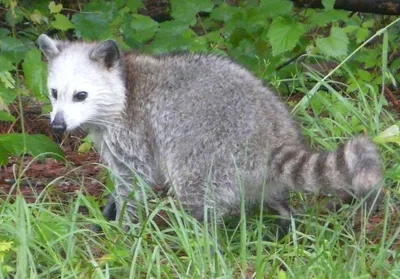 Raccoon
- squirrels
- snakes
Ecological equivalents
Related species on this site
Downy Woodpecker (same family), Hairy Woodpecker (same family), Ivory-billed woodpecker (same family), Pileated Woodpecker (same family), Red-Bellied Woodpecker (same family), Woodpecker (same family), and more.
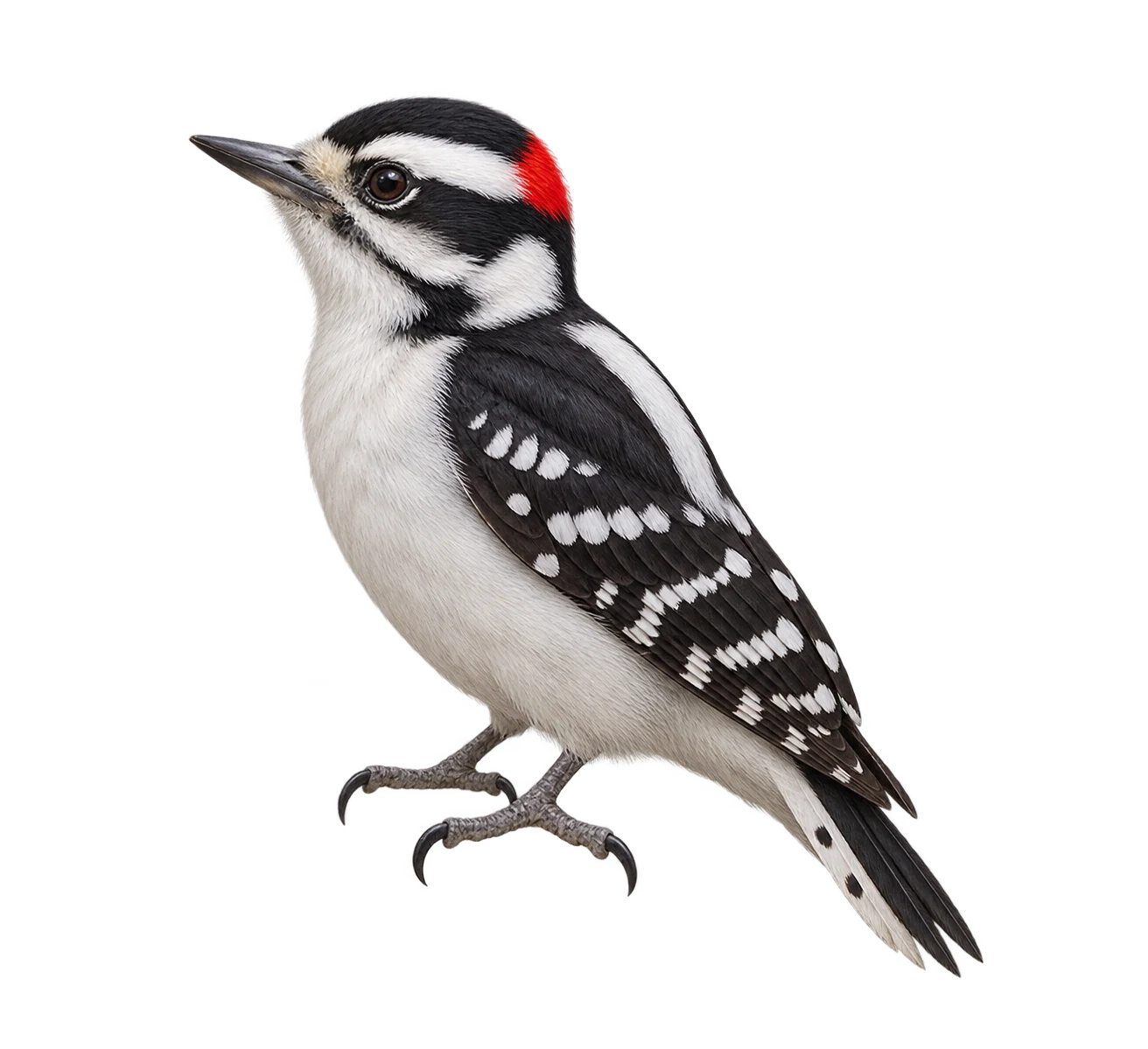
Birds
Downy Woodpecker
Dryobates pubescens
Classification and source reference
LivingAI illustration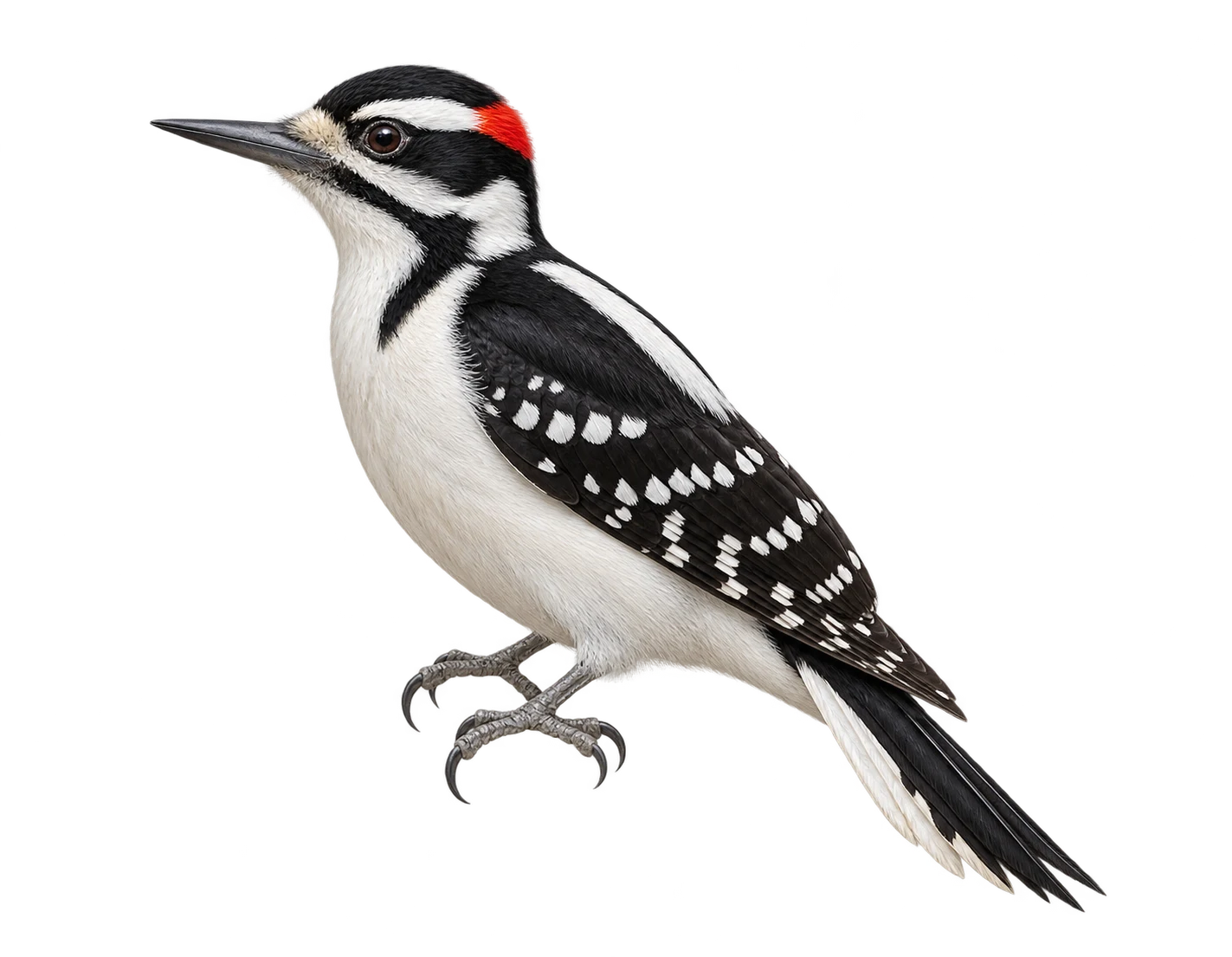
Birds
Hairy Woodpecker
Dryobates villosus
Classification and source reference
LivingAI illustration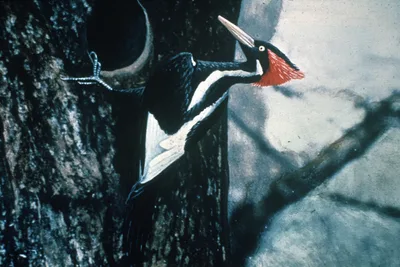 CR
Birds
Ivory-billed woodpecker
Campephilus principalis
The ivory-billed woodpecker is a huge black and white woodpecker of the southern United States and Cuba.
Possibly extinct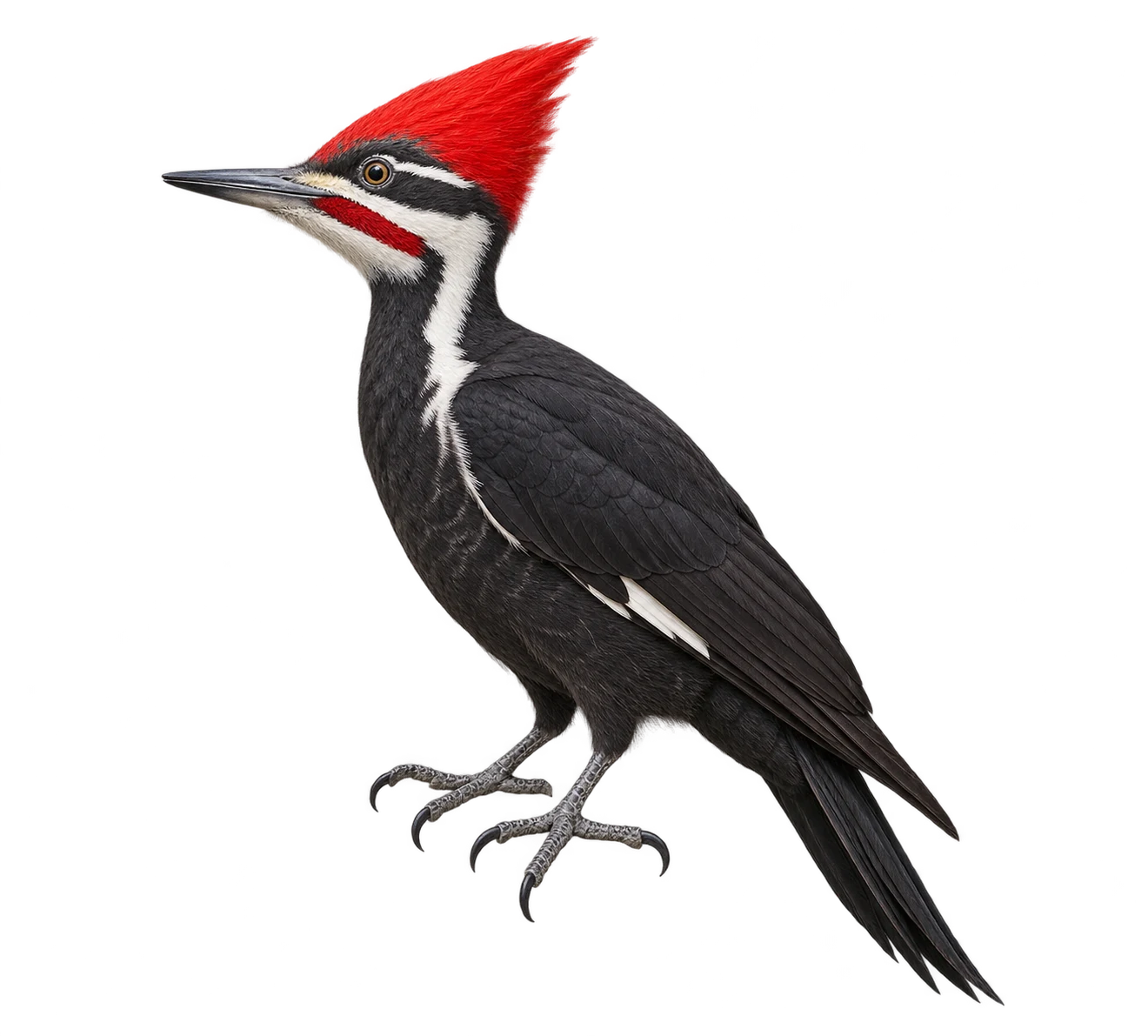
Birds
Pileated Woodpecker
Dryocopus pileatus
Classification and source reference
LivingAI illustration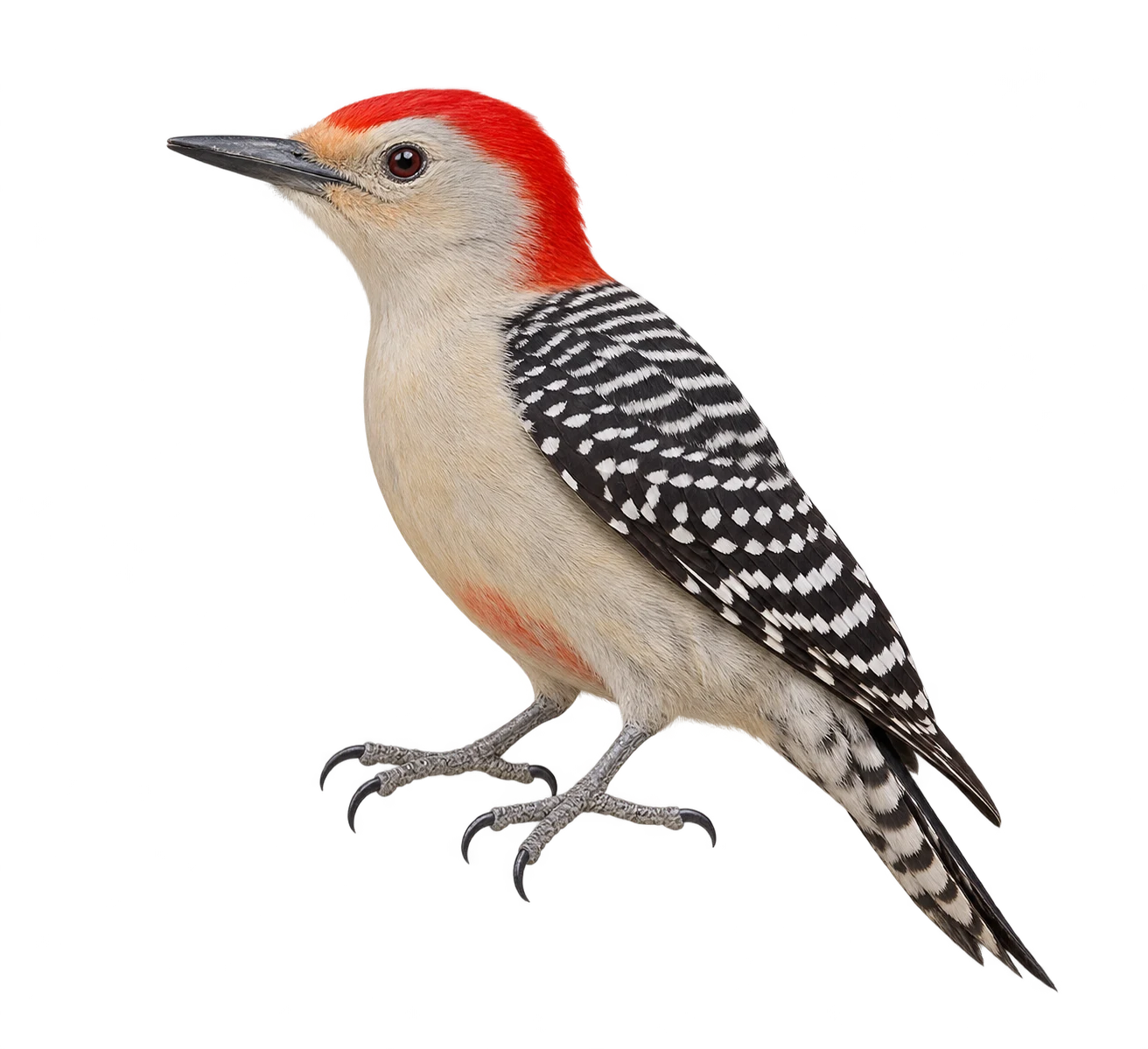
Birds
Red-Bellied Woodpecker
Melanerpes carolinus
Classification and source reference
LivingAI illustration
Birds
Woodpecker
Picidae
Woodpeckers are birds adapted to climbing and excavating wood.
Living