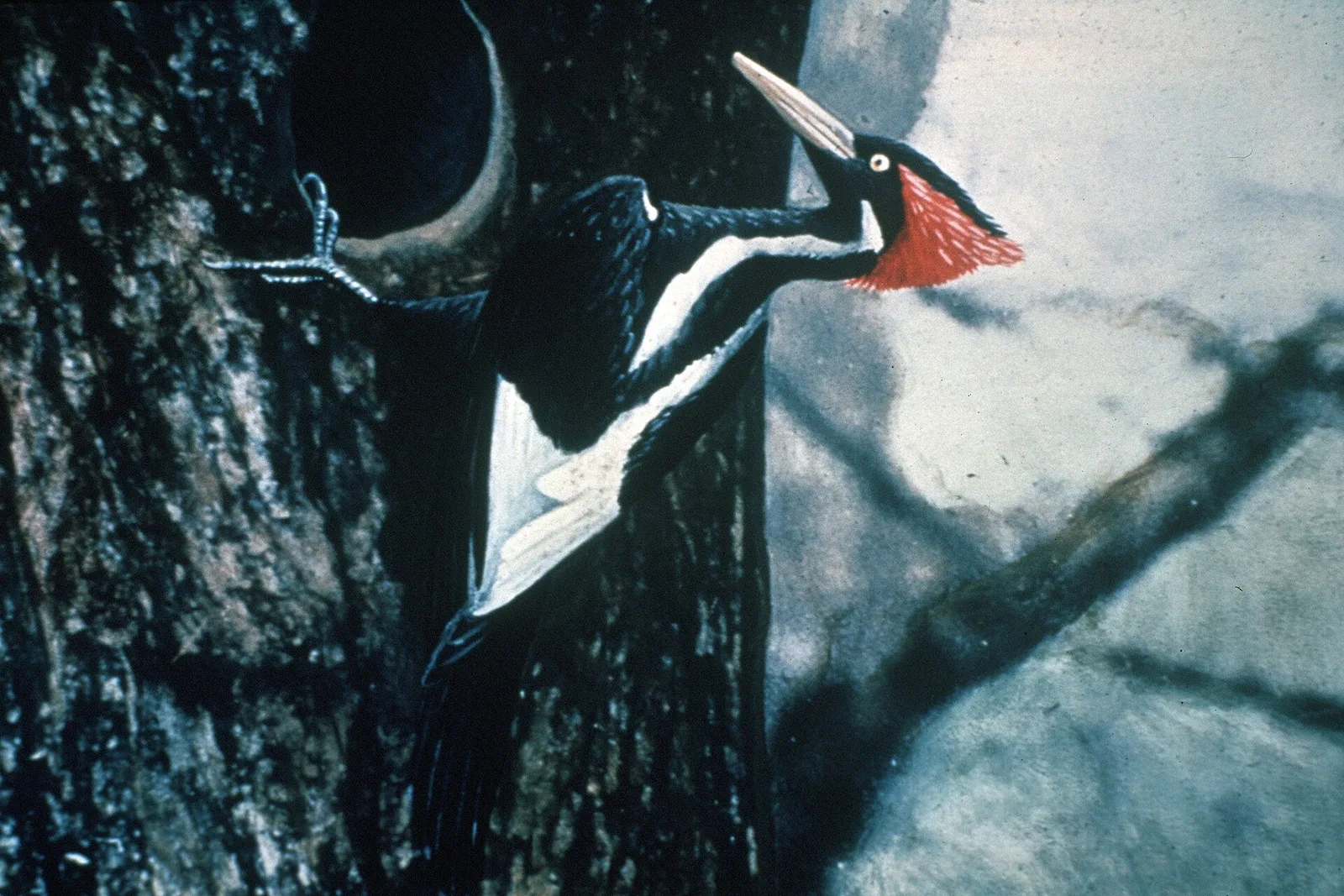
Ivory-billed woodpecker
The bird that logging took, and nobody can find
Campephilus principalis
Also called Lord God Bird, Grail Bird, Log God, Kent, Poule de Bois
Possibly extinct. Reports of survival remain disputed, and the U.S. Fish and Wildlife Service review recommends delisting based on extinction. This profile keeps the uncertainty explicit.
Status sourceMeet the ivory-billed woodpecker
The ivory-billed woodpecker is a huge black and white woodpecker of the southern United States and Cuba. It needs old forest with dying trees, and no sighting has been widely accepted since 1944.
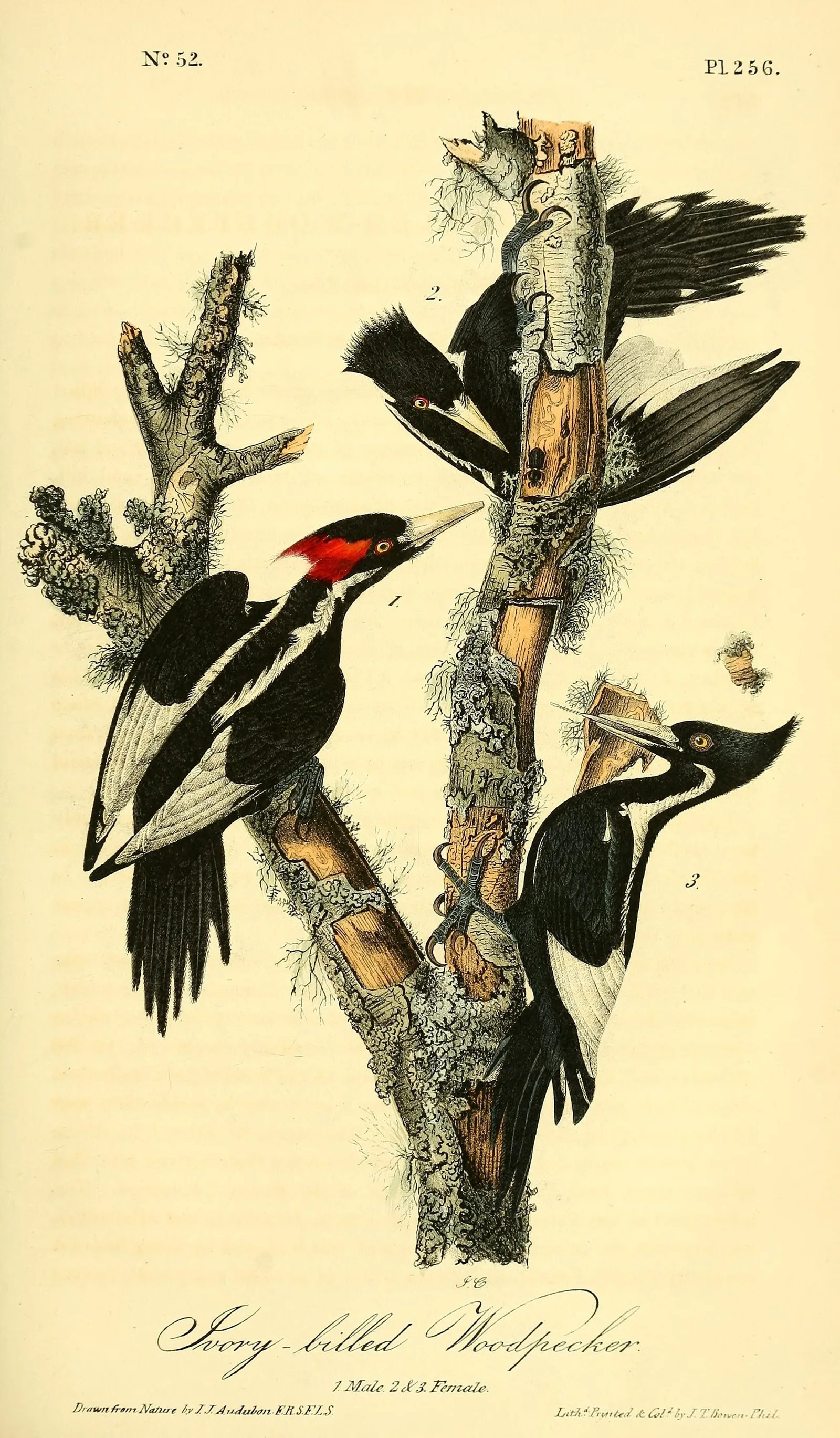
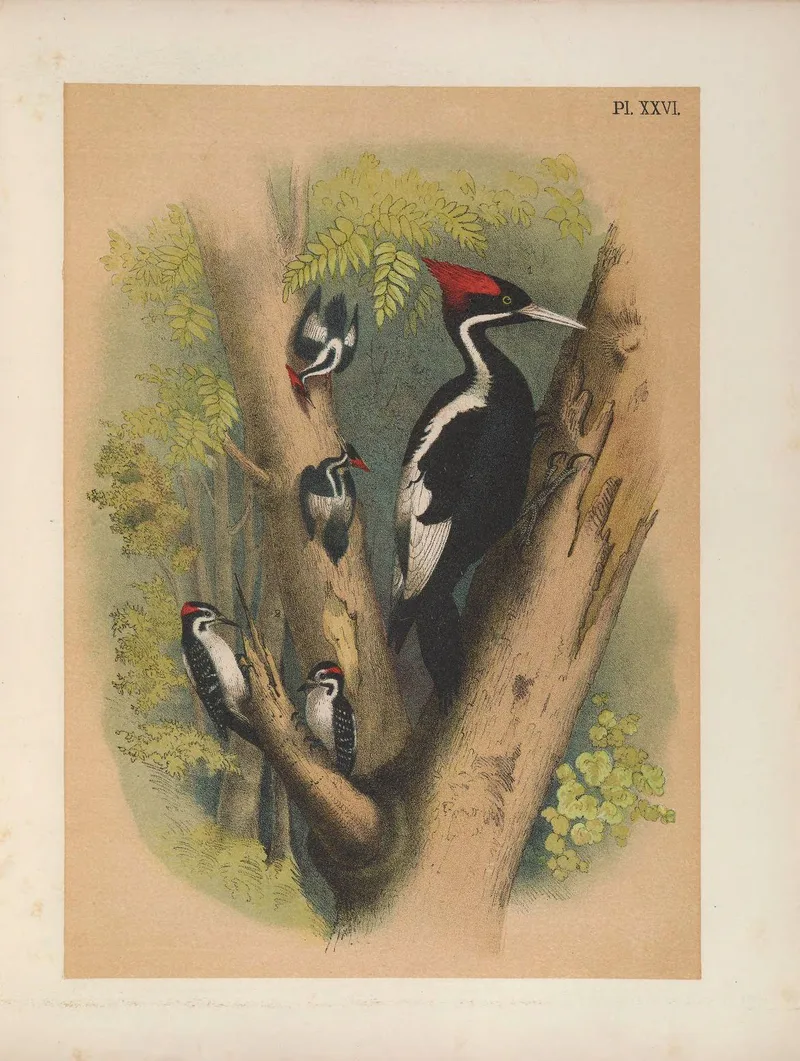
Images of the ivory-billed woodpecker
Lifespan in the wild
Up to 15 years no bird was ever followed to its death; other Campephilus woodpeckers rarely pass 15 years
Weight
450 to 570 g
Length
48 to 53 cm
Wingspan
76 to 78 cm
Fact file
Ivory-billed woodpecker
- Location
- Southeastern United States and Cuba
- Habitat
- Temperate forest, Wetlands
- Diet
- Omnivore
- Prey / food
- Beetle larvae, termites, acorns, hickory nuts, pecans, grapes, persimmons
- Predators
- None recorded except people; snakes, raccoons, hawks and owls may take eggs and young
- Lifestyle
- Active by day, paired for life
- Group name
- Pair or family party
- Name of young
- Chick
- Incubation
- Incubation about 20 days
- Clutch size
- 1 to 6 eggs, usually 2 or 3
- Population
- Unknown, and possibly none
- Biggest threat
- Logging of old bottomland forest
- Distinctive feature
- An ivory-white chisel bill and a white shield on the folded wings
- Colour
- Glossy black with white stripes; a red crest on the male
- Skin type
- Feathers
Size
Next to a person
Measurements
Size and speed
- Length
- 48 to 53 cm
- Wingspan
- 76 to 78 cm Wikipedia gives about 76 cm, Animal Diversity Web about 78 cm
- Tail
- 14 to 17 cm
- Weight
- 450 to 570 g 450 to 570 grams, from a small number of specimens
Typical adult ranges. Sources: Animal Diversity Web, Wikipedia.
Life cycle
Lifespan
- In the wildUp to 15 years no bird was ever followed to its death; other Campephilus woodpeckers rarely pass 15 years
- 015 years
The pale bar is the record. Source: Wikipedia.
Appearance
Colour and coat
- Primary colours
- blackwhite
- Secondary colours
- redyellow
- Skin type
- feathers
- Male and female
- Slight in size, clear in the crest. A male has red on the side and rear of the crest. A female and a young male have a crest that is black throughout. Males are a little larger.
Life cycle
Mating and family
- Mating system
- monogamous pairs, thought to last for life
- Social structure
- pairs and small family parties, with no defended territory
- Breeding
- one brood a year, between January and May
A pair cuts a nest cavity in a living or part-dead trunk, several metres above the ground. The female lays 1 to 6 glossy white eggs, and 2 or 3 is the usual number. Both birds incubate for about 20 days, with the male sitting overnight. The young fly 5 to 8 weeks after hatching and feed themselves by three months. Parents keep feeding them for two more months, and the family may hold together for a year.
Classification
Taxonomy
- Kingdom
- Animalia
- Phylum
- Chordata
- Class
- Aves
- Order
- Piciformes
- Family
- Picidae
- Genus
- Campephilus
- Species
- Campephilus principalis
Conservation
Red List status
- LC
- NT
- VU
- EN
- CR
- EW
- EX
Critically Endangered on the IUCN Red List
Range
Recorded in 1 country
Records may include historical observations or conservation releases. They do not establish a surviving, self-sustaining wild population.
Habitat layer: temperate broadleaf and mixed forest, temperate conifer forest, boreal forest and taiga, flooded grassland and savanna, mangrove.
Countries from 3 wild records on GBIF (iNaturalist research grade), filtered and checked by hand. Country shapes: Natural Earth. Habitat: RESOLVE Ecoregions 2017, CC BY 4.0. Basemap: Natural Earth.
Habitats
Three things to know
- 1
Its pale bill has a flattened tip and works like a carpenter's chisel.
- 2
About half of its food was large beetle grubs cut from under the bark of dying trees.
- 3
A single pair needed roughly 50 square kilometres of forest to feed itself.
Did you know
Seven more facts
- 1
Only two of the bird's four described calls were ever recorded, and that was in 1935.
- 2
A flock of ducks colliding in flight can make a knock that sounds like the bird's double rap.
- 3
The nostrils are covered by white feather tufts that keep wood chips out.
- 4
Thomas Jefferson listed the species among the birds of Virginia.
- 5
A nest cavity can be 150 cm deep, roughly the height of a child.
- 6
The eyes are pale lemon yellow, which is unusual among woodpeckers.
- 7
Theodore Roosevelt wrote of seeing three of the birds on a bear hunt in Louisiana in 1907.
Field notes
How it looks and acts
Field notes
Distinguishing features
- An ivory-white bill with a chisel-shaped tip, chalky white in a young bird.
- A pointed crest, red at the side and rear in males and black in females.
- A white triangle low on the back, showing whenever the bird folds its wings.
- Broad white trailing edges to both wings, seen from above and below.
- A body length of 48 to 53 cm, larger than any other woodpecker in its range.
- Pale lemon-yellow eyes set in a glossy black head.
Field notes
Unique adaptations
- A flattened bill tip that levers tight bark off a dead trunk.
- A long, hard-tipped, barbed tongue that hooks grubs out of their tunnels.
- Feather tufts over the nostrils that keep out flying chips.
- Long toes with sharp curved claws for gripping vertical bark.
- A wingspan near 78 cm that carries the bird above the canopy on long flights.
Field notes
Interesting behaviours
- Peeling slabs of bark from a freshly dead tree to reach beetle tunnels.
- Roosting alone in a cavity it cut for itself and reusing it for months.
- Feeding in parties of four or five in one tree.
- Moving into forest struck by fire, flood or storm to work the fresh dead wood.
- Slipping to the far side of a trunk when a hawk passes overhead.
Field notes
Temperament
- Tolerant of its own kind, with no record of one bird driving off another.
- Calm beside pileated woodpeckers feeding in the same tree.
- Bold at the nest, where a pair will chase a hawk away.
- Wary of people, which probably helped the last birds survive as long as they did.
Field notes
Communication
- A nasal kent note, repeated in a series like a toy trumpet.
- A faster, higher, doubled kent when the bird is disturbed.
- A double rap on a trunk, the first blow louder than the second.
- Soft chatter between family members feeding in the same tree.
- The male's red crest, raised as a visual signal at close range.
Ecology
Ecological role
The ivory-billed woodpecker was the only bird in its forest that could strip tight bark, and its holes housed other animals.
- It took beetle grubs that no other bird in the range could reach.
- Its abandoned cavities probably sheltered wood ducks, bluebirds, squirrels, opossums and honeybees.
- It swallowed nuts and fruit whole, so it may have carried seeds away from the parent tree.
- It carried a feather mite, Pterotrogus principalis, found only on this bird.
Stories
Myths and legends
- In Omaha tradition, bills painted with red pigment were buried with wealthy men.
- In Iowa tradition, bills and scalps were bound into ceremonial pipes.
- In Sauk and Meskwaki tradition, the bill went into amulets, headbands and sacred bundles.
- In Seminole speech the bird was Tit-ka, and in Cajun French it was the wood hen.
- In American folk speech the name Lord God Bird probably came from a cry of surprise at its size.
People
Relationship with humans
People
Living alongside us
People valued the ivory-bill long before they studied it. Native American nations traded its bill and worked it into pipes, amulets and bundles. Settlers shot it for food, for curiosity and for collections, and loggers took its forest. Since 1944 it has been the most searched-for bird in North America. Rewards, expeditions and disputed video have all followed, and no result has convinced everyone.
- The bird has never hurt anybody, and it kept well away from people.
- It defends its nest against hawks, but no record describes an attack on a person.
- The only danger it poses now is probably to a birdwatcher's judgement.
People
Status, uses and products
- Domestication
- Wild
- As a pet
- Not suitable. No. The species may be extinct, and it is protected in the United States as an endangered species. A pair needs tens of square kilometres of old forest and a constant supply of dying trees.
- Uses
- birdwatching tourismmuseum research
- Products
- billsskinsfeathers
The full account
About the ivory-billed woodpecker
The ivory-billed woodpecker is a very large woodpecker of the southern United States and Cuba. Adults measure 48 to 53 centimetres from bill to tail tip. That length makes it the biggest woodpecker ever recorded in the United States. The wings span about 76 to 78 cm, and a bird weighs 450 to 570 grams. The plumage is glossy black with white stripes down the neck, and the male wears a red crest.
The bird belongs to old bottomland forest and cypress swamp, and in Cuba to pine woods. It strips bark from dying trees to reach the fat grubs of longhorn beetles. Timber companies cleared most of that forest in the decades after the American Civil War. The IUCN places the species in the Critically Endangered band and adds that it may already be gone. No sighting in the United States has been accepted by everyone since 1944, and none in Cuba since 1987. People still report the bird, and the United States Fish and Wildlife Service has not declared it extinct.
Name and taxonomy
Mark Catesby illustrated the bird in his natural history of Carolina, Florida and the Bahamas in 1731. Linnaeus used that account in 1758 and gave the species the name Picus principalis. George Robert Gray set up the genus Campephilus in 1840 with this bird as its type. The common name points at the bill, which is ivory white in an adult. The International Ornithologists' Union settled on ivory-billed woodpecker as the official English name.
Two subspecies are recognised, one in the southeastern United States and one in Cuba. The Cuban bird is a little smaller, and Brewer and Ridgway pointed to two feather differences in 1874. Some workers argue that the Cuban bird deserves species rank of its own. The American Ornithologists' Union has said that more testing is needed before it makes that split. Older country names include Log God, Kent, Poule de Bois in Cajun French and Tit-ka in Seminole.
Evolution and relatives
Campephilus is a genus of big woodpeckers spread across the Americas. A DNA study in 2006 compared the American bird, the Cuban bird and the imperial woodpecker of Mexico. The three proved genetically distinct, and together they form a North American group inside the genus. The study placed their split in the middle of the Pleistocene. It also hinted that the Cuban bird sits closer to the imperial woodpecker than to the American one. The imperial woodpecker of western Mexico is larger still, and it is probably gone as well.
The pileated woodpecker shares the range and much of the look, but it belongs to a different genus. The resemblance is close enough that most modern reports of ivory-bills turn out to be pileated birds. Like other members of its genus, the ivory-bill answers a rival with a sharp double rap.
Appearance
An adult measures 48 to 53 cm long, with a tail of 14 to 17 cm. The wingspan is about 76 to 78 cm, and body weight runs from 450 to 570 g. Those weights come from a handful of specimens, so they are a thin figure. Males run slightly larger than females. The body is shining black with a blue or purple sheen in good light.
White lines run from each cheek down the neck and meet on the back. The inner flight feathers are white, so a perched bird shows a white triangle low on its back. In flight the trailing edge of each wing is broadly white above and below. The bill is straight and heavy, and its tip is flattened sideways like a wood chisel. The iris is pale lemon yellow, and white feather tufts cover the nostrils against flying chips.
The crest is pointed and stands up when the bird is alert. A male has a black front edge to the crest and red on the side and rear. A female has a crest that is black all over, and so does a young male. A juvenile has a ragged crest and a chalky white bill rather than a polished one. Observers described the flight as strong, straight and duck-like.
Habitat and range
The species needs a wide, unbroken forest with big trees and a steady supply of dying ones. It used bottomland hardwood forest of sweetgum, oak, green ash, sugarberry and American elm. It also used bald cypress swamp and, before the loggers came, upland pine. Cuban birds lived in pine and hardwood forest and nested in large dead pines. Open canopies matter, because a bird of this size needs room to fly between trunks.
Edwin Hasbrouck drew the first range map in 1891, and James Tanner drew a second in 1942. Both drew a range reaching from east Texas across to the Carolina coast, and north as far as southern Illinois. The birds kept to low ground, roughly below 30 m above sea level. Scattered records lie outside both maps, including bones from mounds in Georgia and Ohio. Thomas Jefferson listed the bird among the birds of Virginia, under the name white bill woodpecker.
Numbers were always thin, because each pair worked a large area. Along the Tensas River, Tanner counted about one pair for every 44 square kilometres of forest. He found denser ground in Florida, with a pair for every 16 square kilometres on the Wacissa River. GBIF holds records from 4 countries, and almost all of them are old museum specimens.
Diet and feeding
About half of the stomach contents on record were large beetle grubs. Most came from longhorn beetles of the family Cerambycidae, which tunnel under fresh dead bark. Bark beetles, click beetles, jewel beetles and tree-dwelling termites also turn up in the records. The bird works a dying trunk by driving its bill under the bark and levering slabs of it away. That exposes the grub tunnels underneath, and the long barbed tongue lifts the grubs out.
No other bird in the range could peel tight bark that way, so competition for the grubs was slight. The other half of the diet was plant food, mostly nuts and fruit. Recorded items include pecans, hickory nuts, acorns, poison ivy seeds and southern magnolia fruit. Birds were also watched eating wild grapes, persimmons, hackberries and cherries. They sometimes dropped to the ground or to fallen logs to hunt insects in a burnt patch.
Behaviour and social life
The ivory-bill is active by day and sleeps alone in a roost hole it cut itself. Birds leave the roost near dawn and feed hard through the early morning. Activity falls away around midday and picks up again in the late afternoon. Each bird returns to its roost hole at dusk, and it often uses the same hole for a long time. Much of what is known comes from Tanner, who watched a few birds on the Tensas River in the 1930s.
A pair holds a home range rather than a defended territory. Birds have been tracked feeding up to 4 km from the nest, which gives a range of about 50 square kilometres. A Cuban study put the figure nearer 65 square kilometres. Ivory-bills tolerate each other, and no record describes one driving another off. Groups of four or five have fed in one tree, and eleven birds were once counted in one place.
They do not migrate, and pairs nested within a few hundred metres of an old nest year after year. Writers still call the species nomadic, because birds moved to fresh windfall, burns and flood damage. Dead wood of that kind fills with beetle grubs within a season or two. They also fed beside pileated woodpeckers without any sign of a quarrel.
Communication and senses
The best known call is a nasal kent, which listeners compared to a note from a tin trumpet. A disturbed bird raises the pitch, doubles the note and repeats it faster. A pair at the nest swaps a softer version back and forth through the day. Four calls are described in the old literature, and only two were ever recorded, in 1935. Family members trade notes while they feed and fall quiet towards evening.
The other signal is a drum, delivered as a single or double rap on a hard trunk. In the double rap the first blow is louder, so the second sounds like an echo. The male's red crest is a bright flag at close range, though its exact use was never studied. Like most birds, the ivory-bill probably relies on sharp eyesight and good hearing. Both kinds of signal have caused trouble for searchers. Blue jays and nuthatches make kent-like notes, and a flock of ducks can knock its wings like a drum.
Reproduction and life cycle
Pairs are thought to stay together for life and to travel as a couple all year. Breeding runs between January and May, and a pair raises one brood a year. A second clutch has only been seen after a first one failed. The two birds cut a nest cavity, usually 4.6 to 21.3 m above the ground. They favour a living or part-dead trunk and avoid rotten wood, which is too easy for a predator to open.
The hole is oval to oblong, about 12 to 14 cm tall and 10 cm wide. It usually sits under a broken stub, which shades the entrance and keeps the rain out. A typical cavity is about 50 cm deep, and the deepest on record reached 150 cm. Clutches of 1 to 6 eggs are reported, with an average near 2.7. The eggs are glossy and china white and average about 3.5 by 2.5 cm.
Tanner estimated an incubation period near 20 days, from a related species rather than direct counts. Both parents sit, the male through the night and the two in turn by day. Both parents then carry food, and feeding is heaviest in the first days after hatching. Young fly about 5 to 8 weeks after hatching and can feed themselves at three months. The parents keep feeding them for two more months, and a family may hold together for a year. No bird was ever followed to its death, and 15 years is a guess taken from its relatives.
Predators and threats
Nobody has ever recorded a wild animal killing an ivory-billed woodpecker. Birds did react to danger, and a pair once chased a Cooper's hawk away from the nest. A female called a warning and flew nearer her fledgling as a red-shouldered hawk came into view. Watchers also saw birds slip round the far side of a trunk when a raptor passed. Rat snakes, raccoons, squirrels and large owls may have taken eggs and nestlings.
The real threat was the axe and the saw. Timber companies cleared millions of acres of southern forest after the Civil War. That left small, separate patches, which cannot feed a bird with a home range this size. Shooting mattered too, for food, for curiosity and for museum drawers. Noel Snyder has argued that hunting, rather than logging, drove the first collapse.
Population and conservation
The IUCN rates the ivory-billed woodpecker Critically Endangered and marks it as possibly extinct. NatureServe treats it as presumed extinct, and the United States lists it as endangered from 1967. By the 1930s observers thought that fewer than 25 birds were left in the country. Tanner put the figure at 22 to 24 birds, with 6 to 8 of them on the Singer tract in Louisiana. Loggers finished the Singer tract by the late 1940s.
Don Eckelberry watched a bird there in April 1944, and that record is the last one everybody accepts. Cuban birds held on in the east of the island until at least 1987. Reports have never stopped, and several have brought searches, papers and arguments. A Cornell team filmed a large woodpecker in Arkansas in 2004 and identified it as this species. Other ornithologists read the same four seconds of video as a pileated woodpecker.
Teams in Florida, Texas and Louisiana have offered feathers, sound recordings and blurred film. In 2023 Project Principalis published trail camera pictures and drone video from a site in Louisiana. The team stopped short of calling the evidence conclusive, and critics read the birds as pileated. The Fish and Wildlife Service proposed declaring the species extinct in September 2021. After public comment it drew back, and in October 2023 it said it would keep reviewing the evidence. Habitat protection and forest restoration continue in the places where the bird might still hang on.
Relationship with humans
The bill was a valuable trade good long before Europeans reached the Mississippi. Bills and scalps travelled far outside the bird's range, some of them hundreds of kilometres. Catesby recorded a north to south trade in which one bill fetched two or three deerskins. European settlers hung dried heads on shot pouches or carried them as watch fobs. Some groups also ate the bird, and remains turn up in kitchen middens.
Hunting for food went on in the southeast into the 1950s, and fishermen used the flesh as bait. Collectors paid heavily for skins in the late nineteenth century. About 413 specimens sat in museums and universities as of 2007, over 60 of them at Harvard. The bird then became a prize for birdwatchers instead of a prize for gunners. Cornell offered 50000 dollars in 2008 for anyone who could lead scientists to a roost or nest.
The 2004 Arkansas reports sent visitors to Brinkley, where tourist spending rose by about 30 per cent. The town held a celebration for the bird in February 2006, with tours, talks and stalls. Access to about 5000 acres of refuge forest was closed to hunting and fishing. Local people worried about the closure, since hunting and fishing carry the local economy. Searching for the bird is probably a small industry of its own now.
In culture and myth
The bird carries more nicknames than almost any other American species. Lord God Bird is the best known, and it probably began as an exclamation at the size of the bird. Log God, Log Cock, Indian Hen and Kent all appear in older writing. Cajun French speakers called it Poule de Bois, the wood hen. Birdwatchers now call it the Grail Bird, because so many have looked and none have proved it.
Native American nations used the bill and the scalp in ceremony across a wide area. Bills marked with red pigment lay among grave goods at an Omaha village. The Iowa people worked bills and scalps into ceremonial pipes. The Sauk and the Meskwaki placed the same parts in amulets, headbands and sacred bundles. Because the bills carried this weight, they probably signalled rank as well as skill in war.
John James Audubon called it the great chieftain of the woodpecker tribe. William Faulkner named it in his 1942 novella The Bear as a bird of the old Mississippi woods. Eudora Welty wrote about its loss in an essay in 1944. Sufjan Stevens wrote a song about it after the Arkansas reports, and it went out on public radio. Arkansas has printed the bird on a car number plate. A painting by Joseph Bartholomew Kidd, taken from Audubon, hangs in the Metropolitan Museum of Art.
A sentence with a dotted underline is inferred: it describes the group the animal belongs to, or is a reading of the sources, rather than a measured or reported fact about this species.
Questions
Ivory-billed woodpecker questions, answered
Is the ivory-billed woodpecker extinct?
Nobody agrees. The IUCN lists it as Critically Endangered and possibly extinct, and NatureServe presumes it gone. The United States Fish and Wildlife Service proposed declaring it extinct in 2021, then drew back and said it would keep reviewing evidence.
When was the last confirmed sighting?
April 1944, on the Singer tract in Louisiana, by the artist Don Eckelberry. The last widely accepted Cuban record dates from 1987. Later reports exist, and none has been accepted by everyone.
How big is an ivory-billed woodpecker?
An adult is 48 to 53 cm long with a wingspan of about 76 to 78 cm. It weighs 450 to 570 g. That makes it the largest woodpecker ever recorded in the United States.
What did the ivory-billed woodpecker eat?
About half its diet was large beetle grubs, mostly longhorn beetles from under dead bark. The rest was nuts and fruit, including pecans, hickory nuts, acorns, wild grapes and persimmons.
Why is it called the Lord God Bird?
The story is that people who saw the bird for the first time called out in surprise at its size. The same nickname has also been used for the pileated woodpecker.
Where did the ivory-billed woodpecker live?
In the southeastern United States, from east Texas across to the Carolina coast and north to southern Illinois, plus Florida. A separate subspecies lived in Cuba. It kept to low ground, roughly below 30 m.
What is the difference between an ivory-billed and a pileated woodpecker?
The ivory-bill is bigger, with a white bill and broad white trailing edges on both wings. A perched ivory-bill shows a white triangle on its lower back. A pileated woodpecker has a dark bill and a white chin.
Why did the ivory-billed woodpecker decline?
Logging removed the old bottomland forest it needed after the American Civil War. Shooting for food, curiosity and museum collections added to the loss. One researcher argues that hunting mattered more than logging.
How long did an ivory-billed woodpecker live?
Nobody knows, because no bird was ever followed for its whole life. Other woodpeckers in the same genus rarely pass 15 years, so that figure is used as a rough guide.
How many eggs did it lay?
Clutches of 1 to 6 eggs are recorded, with an average near 2.7. The eggs are glossy and china white. Both parents sit on them for about 20 days.
What sound did the ivory-billed woodpecker make?
A nasal kent note, often repeated, that listeners compared to a toy trumpet. It also struck a trunk with a double rap, the first blow louder than the second.
Are there any recordings of the bird?
Yes. A Cornell team recorded sound and film on the Singer tract in the 1930s, and those remain the only universally accepted recordings. Only two of its four described calls were captured.
What was the 2004 Arkansas sighting?
A Cornell team searched the Cache River refuge after a report and filmed a large woodpecker for four seconds. They identified it as an ivory-bill. Other ornithologists argued the video shows a pileated woodpecker.
Is anyone still searching for it?
Yes. Teams have worked in Louisiana, Florida, Texas and Arkansas, and Project Principalis published camera and drone evidence in 2023. No search has produced a photograph that ends the argument.
Is there a reward for finding an ivory-billed woodpecker?
Cornell University offered 50000 dollars in 2008 to whoever could take scientists to an active roost or nest. That offer has closed. A Louisiana project offered 12000 dollars in 2020.
Can I still see an ivory-billed woodpecker?
Almost certainly not. Most modern reports turn out to be pileated woodpeckers or red-headed woodpeckers. Museum skins and the 1930s film are the only sure ways to see the bird.
Food web
Prey and food
- beetle larvae
- termites
- acorns
- hickory nuts
- pecans
- grapes
- persimmons
Food web
Predators
- none recorded except people
- snakes
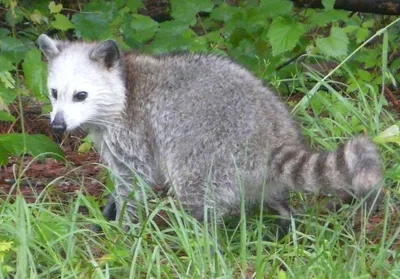 Raccoon
- hawks
- owls may
Ecological equivalents
Related species on this site
Downy Woodpecker (same family), Hairy Woodpecker (same family), Northern flicker (same family), Pileated Woodpecker (same family), Red-Bellied Woodpecker (same family), Woodpecker (same family), and more.
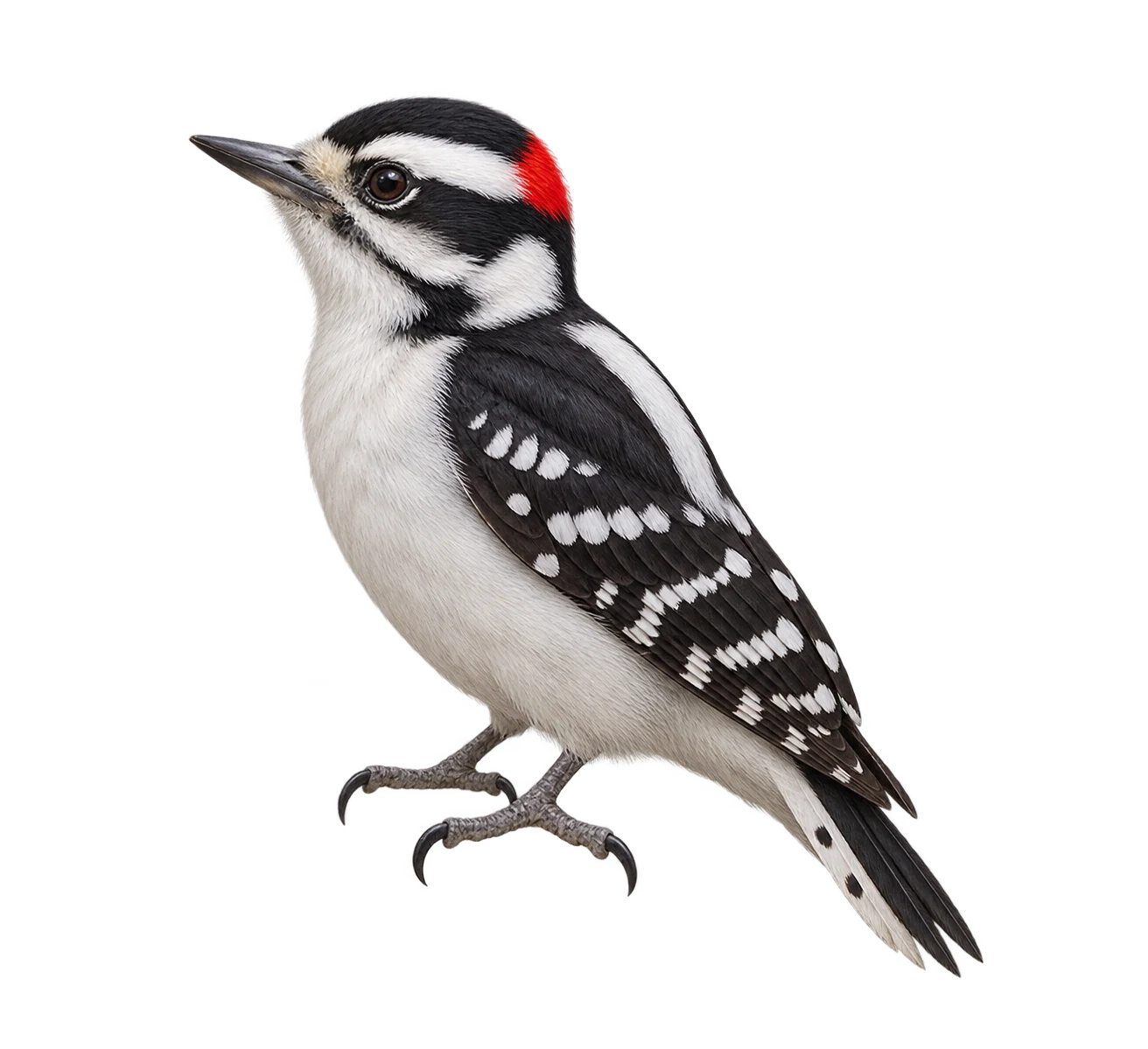
Birds
Downy Woodpecker
Dryobates pubescens
Classification and source reference
LivingAI illustration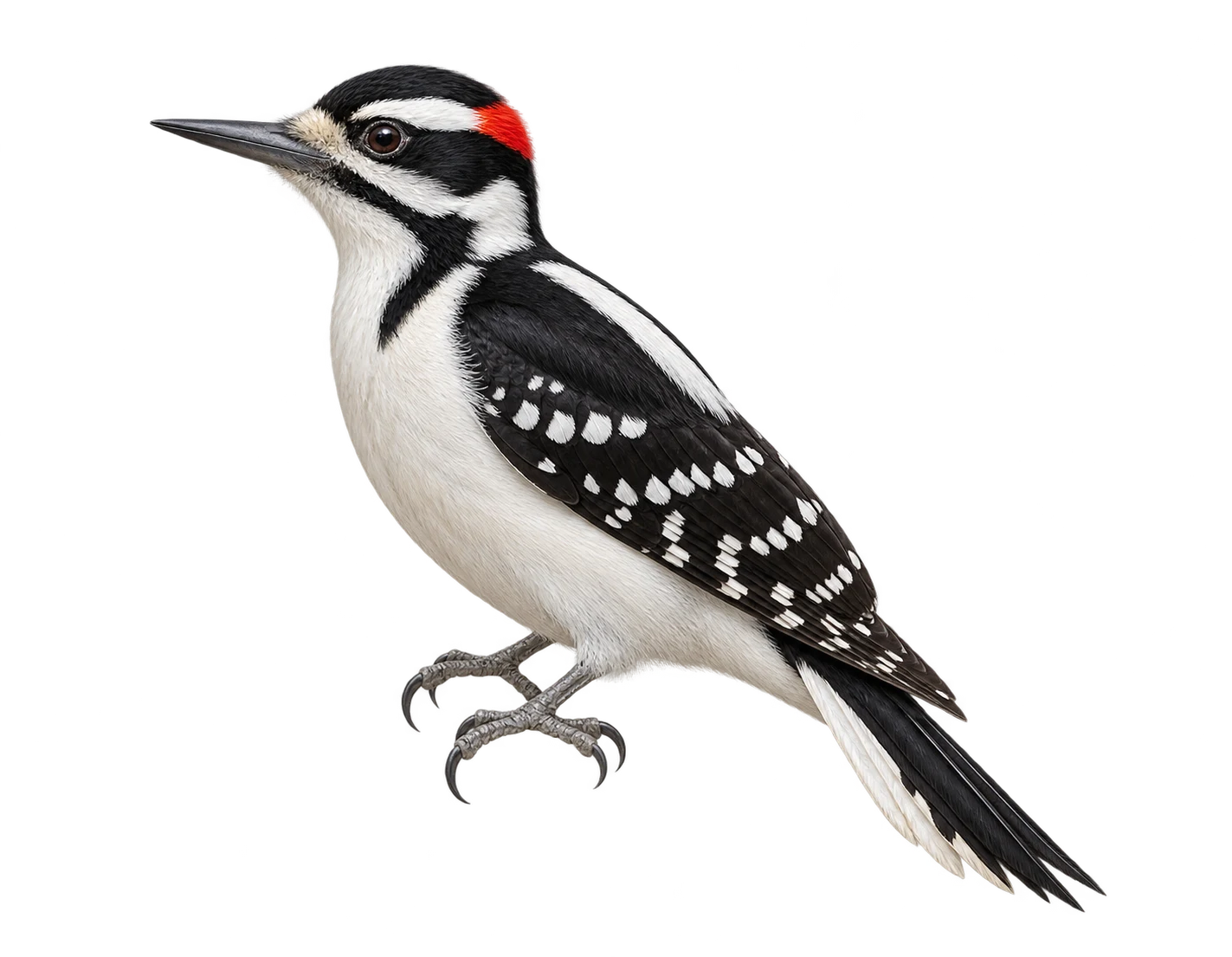
Birds
Hairy Woodpecker
Dryobates villosus
Classification and source reference
LivingAI illustration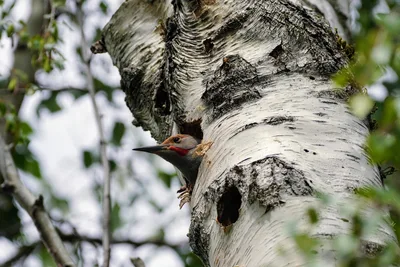 LC
Birds
Northern flicker
Colaptes auratus
The northern flicker is a large brown woodpecker of North America that feeds mainly on ants taken from the ground.
Living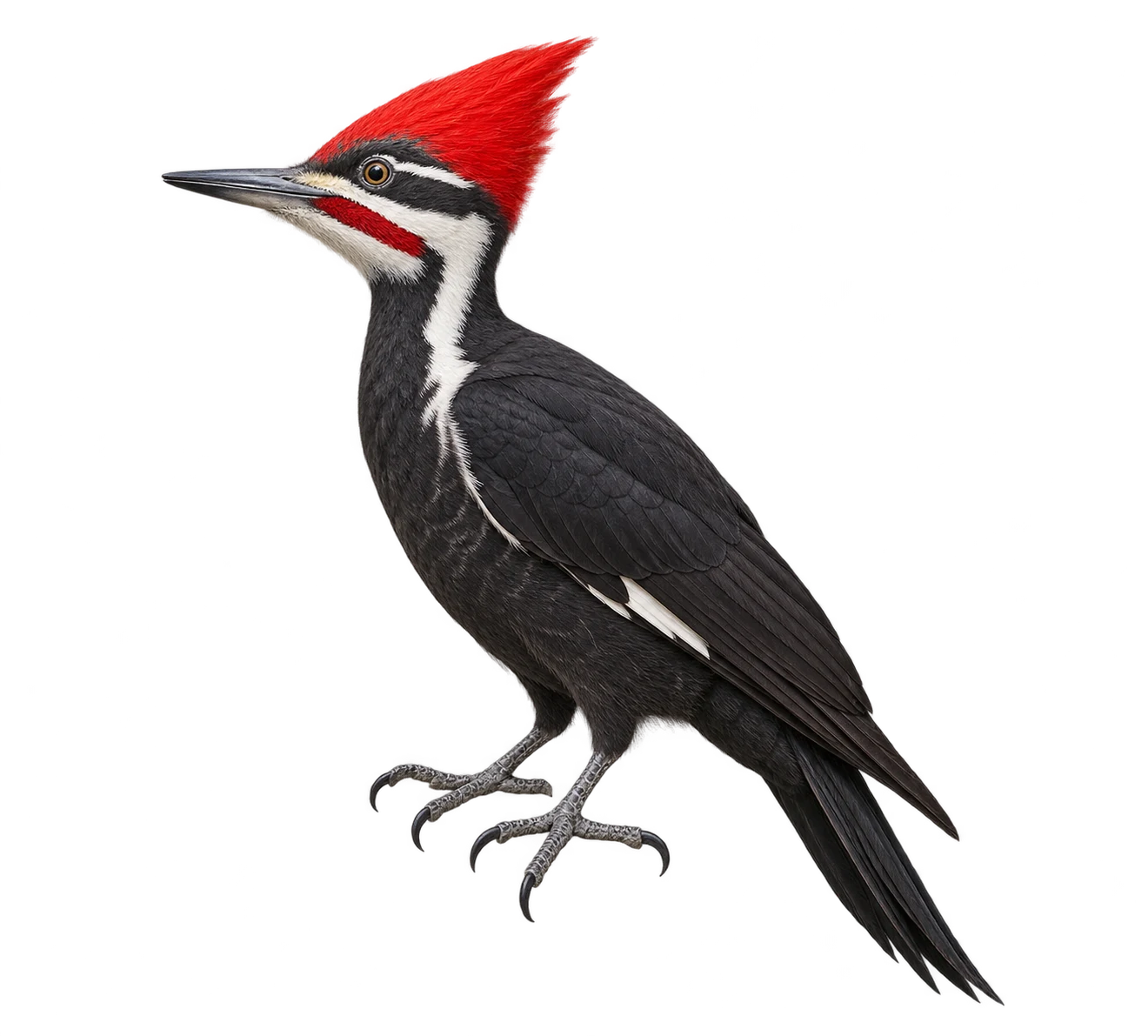
Birds
Pileated Woodpecker
Dryocopus pileatus
Classification and source reference
LivingAI illustration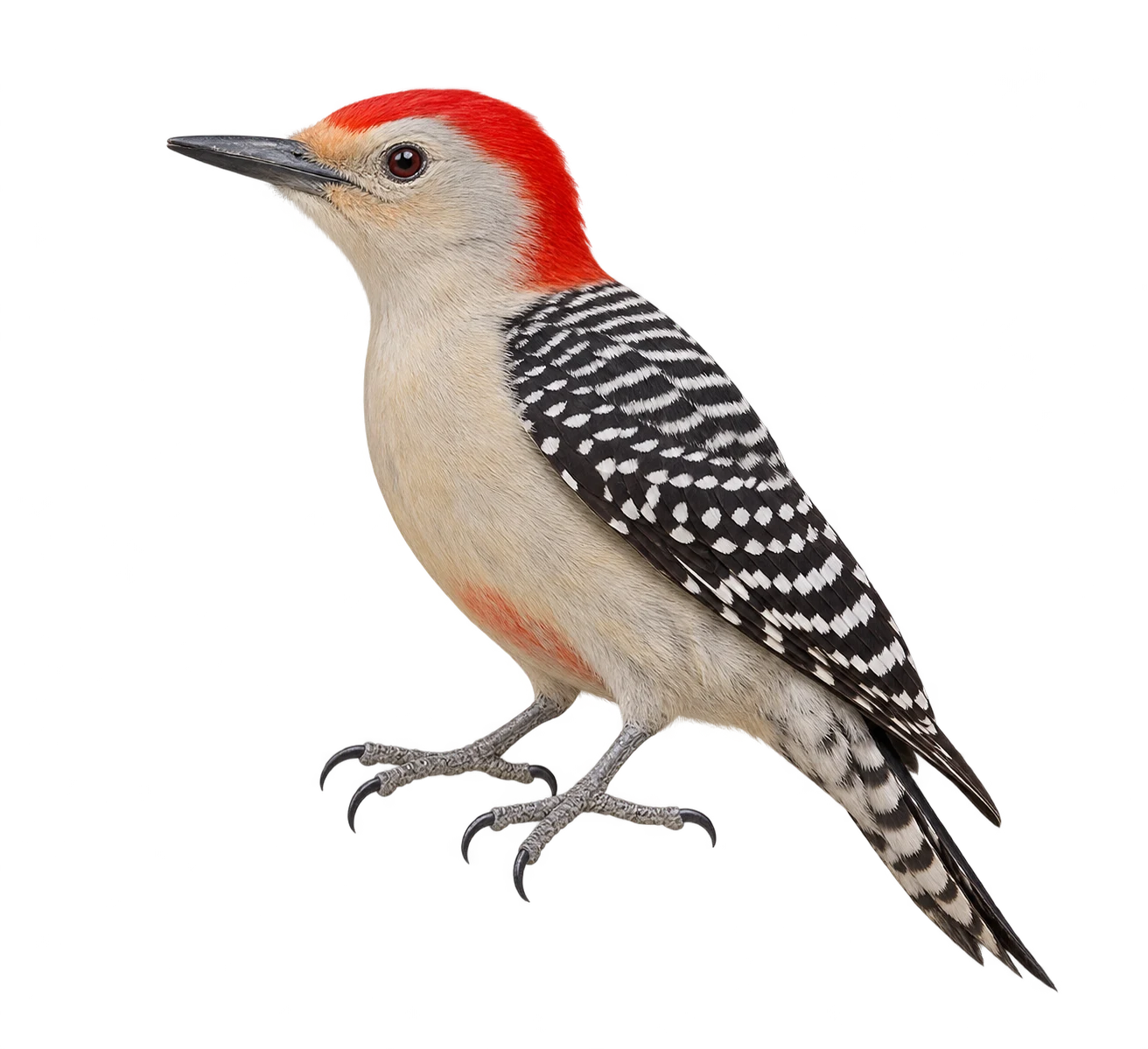
Birds
Red-Bellied Woodpecker
Melanerpes carolinus
Classification and source reference
LivingAI illustration
Birds
Woodpecker
Picidae
Woodpeckers are birds adapted to climbing and excavating wood.
Living