Greater flamingo
The tallest flamingo, painted pink by its food
Phoenicopterus roseus
Living individuals or members of this group exist today. This does not mean they are safe from extinction.
Meet the greater flamingo
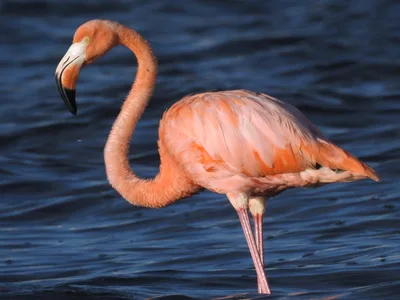
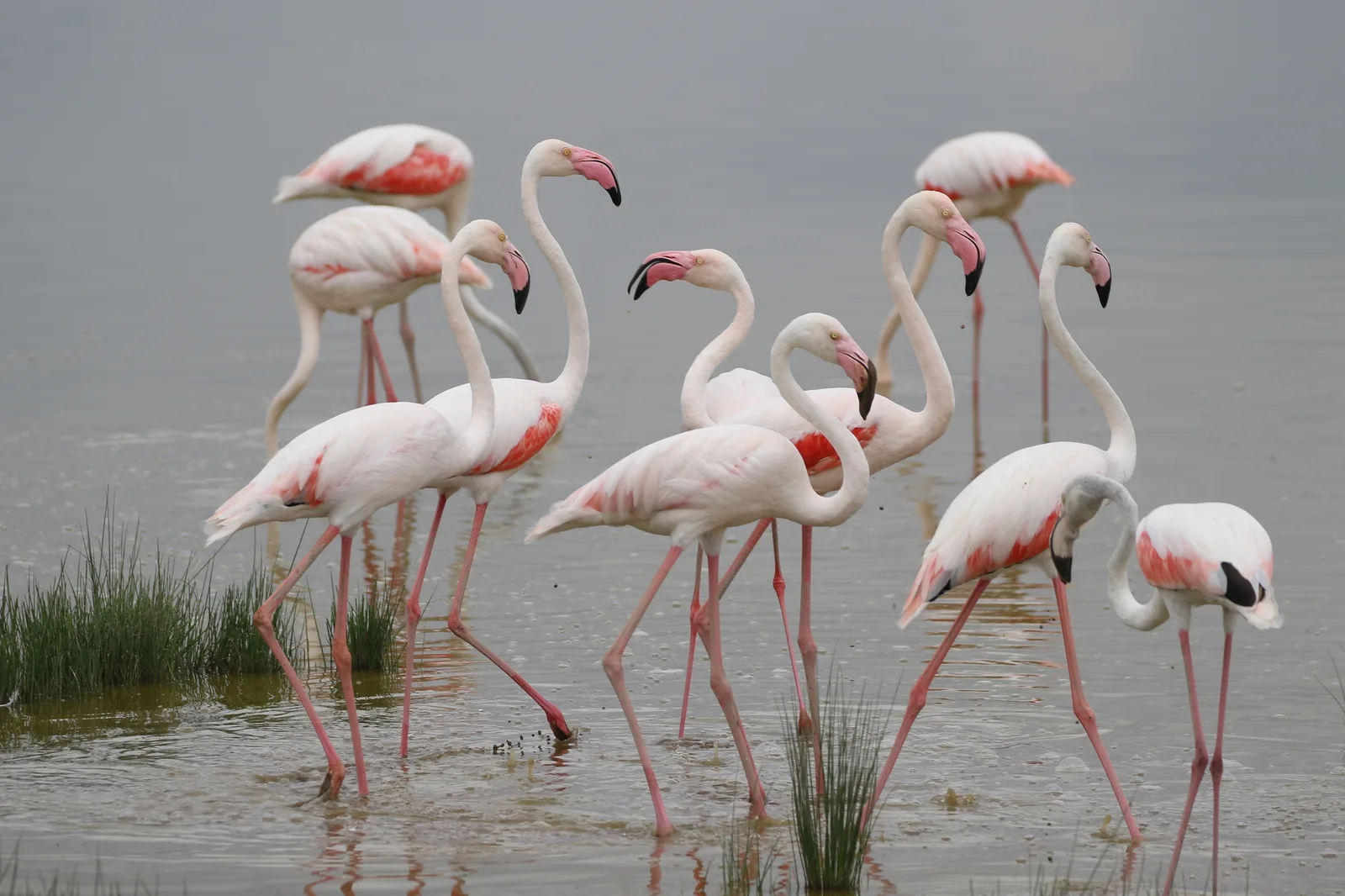
The greater flamingo is the largest and most widespread flamingo. It feeds upside-down in salty lagoons, and its pink colour comes from pigments in the shrimp and algae it eats.
Images of the greater flamingo
Lifespan in the wild
Up to 50 years
Weight
1.9 to 3 kg
Length
0.8 to 1.5 m
Wingspan
1.4 to 1.7 m
Fact file
Greater flamingo
- Location
- Africa, southern Europe, the Middle East, South Asia
- Habitat
- Wetlands, Coast
- Diet
- Filter feeder
- Prey / food
- Brine shrimp, algae, small molluscs
- Predators
- Eagles, jackals, hyenas take eggs and chicks
- Lifestyle
- Diurnal and nocturnal
- Group name
- Flamboyance
- Name of young
- Chick
- Incubation
- About 29 days of incubation
- Clutch size
- 1 egg
- Biggest threat
- Wetland drainage and disturbance
- Distinctive feature
- A bent, filtering bill and long pink legs
- Colour
- Pale pink with crimson and black wings
- Skin type
- Feathers
Size
Next to a person
Measurements
Size and speed
- Length
- 0.8 to 1.5 m
- Wingspan
- 1.4 to 1.7 m
- Weight
- 1.9 to 3 kg
Typical adult ranges. Source: Animal Diversity Web.
Life cycle
Lifespan
- In the wildUp to 50 years
- In captivityUp to 58.8 years
- 058.8 years
The pale bar is the record. Sources: Animal Diversity Web, AnAge.
Appearance
Colour and coat
- Primary colours
- pale pinkwhite
- Secondary colours
- crimsonblack
- Skin type
- feathers
- Male and female
- Slight. Males and females share the same plumage. Like other flamingos, the male is thought to stand a little taller and heavier than the female.
Life cycle
Mating and family
- Mating system
- polygynandrous, with new pairs each season
- Social structure
- large nomadic flocks and dense breeding colonies
- Breeding
- one egg per pair, at most once a year
The flock courts together in group displays and nests at about the same time. Each pair builds a mud cone and the female lays one egg, which both parents incubate for 27 to 31 days. The chick takes crop milk, joins a crèche within days and fledges at 65 to 90 days. Most birds first breed at 5 to 6 years. A greater flamingo can live for up to 50 years in the wild.
Classification
Taxonomy
- Kingdom
- Animalia
- Phylum
- Chordata
- Class
- Aves
- Order
- Phoenicopteriformes
- Family
- Phoenicopteridae
- Genus
- Phoenicopterus
- Species
- Phoenicopterus roseus
Conservation
Red List status
- LC
- NT
- VU
- EN
- CR
- EW
- EX
Least Concern on the IUCN Red List
Range
Recorded in 30 countries
- United Arab Emirates
- Albania
- Botswana
- Cyprus
- Algeria
- Egypt
- Spain
- Ethiopia
- France
- Greece
- Israel
- India
- Iran
- Italy
- Kenya
- Kazakhstan
- Morocco
- Mauritania
- Mozambique
- Namibia
- Oman
- Pakistan
- Portugal
- Saudi Arabia
- Senegal
- Tunisia
- Turkey
- Tanzania
- South Africa
- Zimbabwe
Habitat layer: flooded grassland and savanna, mangrove.
Countries from 26,326 wild records on GBIF (iNaturalist research grade), filtered and checked by hand. Country shapes: Natural Earth. Habitat: RESOLVE Ecoregions 2017, CC BY 4.0. Basemap: Natural Earth.
Habitats
Three things to know
- 1
A chick is born grey and turns pink over about two years.
- 2
The nest is a cone of mud about 30 cm high.
- 3
A flamingo stands on one leg to save body heat.
Did you know
Seven more facts
- 1
The greater flamingo is the largest of the six flamingo species.
- 2
A chick hatches in grey down and can take about four years to gain full pink plumage.
- 3
The nest is a cone of sun-baked mud about 30 cm high with a cup on top for one egg.
- 4
The most northerly colony sits at Lake Tengiz in Kazakhstan, near 50 degrees north.
- 5
Zoo escapees breed in the wild at Zwillbrocker Venn in Germany.
- 6
The flamingo's courtship display grows more complex each year until it is about 20 years old.
- 7
iNaturalist holds 39,091 observations of the species, and GBIF has records from 119 countries.
Field notes
How it looks and acts
Field notes
Distinguishing features
- A downward-bent bill, pink with a black tip.
- Long pink legs and a long, curved neck.
- Pinkish white body feathers with red wing coverts and black flight feathers.
- A wingspan of 140 to 170 centimetres.
- A body length of 80 to 150 centimetres, the largest of any flamingo.
- A honking call like that of a goose.
Field notes
Unique adaptations
- Fine plates inside the bill strain shrimp and algae from water pumped through it.
- A movable upper jaw lets the bird filter with its head upside down.
- Long legs probably let it wade into water too deep for most shore birds.
- It tolerates salt and soda lakes with a pH of up to 11, where few competitors can feed.
- Crop milk lets parents feed a chick before its bill is ready to filter.
Field notes
Interesting behaviours
- Feeds by treading mud with its feet and sweeping the inverted bill through the water.
- Stands on one leg to rest.
- Performs group displays of marching, head flagging and wing saluting before breeding.
- Leaves its chick in a crèche guarded by non-breeding adults.
- Moves between wetlands as water levels change.
Field notes
Temperament
- Highly social and rarely alone.
- Like most colonial water birds, wary of people and quick to leave a disturbed site.
- Hostile to strange chicks at a crèche unless its own chick is there.
Field notes
Communication
- Honks like a goose to keep contact in the flock.
- Murmurs quietly while feeding.
- Tells calls apart by their timing and pitch.
- Signals with head flags, wing salutes and twist preening during courtship.
Ecology
Ecological role
The greater flamingo is a top consumer of tiny life in salt and soda lakes, where few other large animals can feed.
- Eats large amounts of brine shrimp, algae and midge larvae from shallow saline water.
- Stirs the mud as it feeds, which probably recycles nutrients through the lake.
- Supplies eggs and chicks to gulls, storks, raptors, jackals and hyenas.
- Hosts several species of chewing lice found on no other bird.
Stories
Myths and legends
- In ancient Egyptian tradition, the flamingo stood for the colour red and belonged to the sun god Ra.
- In Roman tradition, the flamingo's tongue was a delicacy served at rich tables.
- In Greek and Egyptian legend, the fiery phoenix may have been inspired by the flamingo.
- In modern American tradition, the plastic pink flamingo has stood for suburban kitsch since 1957.
People
Relationship with humans
People
Living alongside us
People have admired, eaten and painted the greater flamingo for thousands of years. Romans served its tongue at feasts, and Egyptians drew it as the sign for red. Today the bird is hunted in parts of the Middle East and North Africa, and its eggs are collected. Zoos breed it, and wetland reserves draw visitors to see the flocks. It does farmers little harm beyond some damage to rice fields.
- The greater flamingo does not attack people and flies off when disturbed.
- Its bill is built to filter, not to bite, so it is thought unable to injure a person.
- The only real conflict is with rice farmers whose fields the flocks visit.
People
Status, uses and products
- Domestication
- Wild
- As a pet
- Not suitable. A flamingo needs a flock, a shallow saline pool and a diet rich in carotenoids. Without all three it fades, sickens and develops foot lesions. It is a zoo bird, not a pet.
- Uses
- ecotourismzoo exhibitionwild meat
- Products
- eggs
The full account
About the greater flamingo
Phoenicopterus roseus, the greater flamingo, is the biggest of the six flamingo species and the one with the widest range. It lives on salt lagoons, soda lakes and mudflats across Africa, southern Europe, the Middle East and South Asia. The bird feeds with its head upside down and strains tiny shrimp and algae from the water through its bent bill. Pigments in that food give the feathers their pink colour. A chick hatches grey and takes years to turn pink.
An adult weighs 1.9 to 3 kilograms and measures 80 to 150 centimetres, with a wingspan of 140 to 170 cm. The species breeds in huge colonies, and each pair raises a single chick on a cone of dried mud. Flocks can hold thousands of birds, and the whole colony courts, nests and hatches at about the same time. The IUCN lists the greater flamingo as Least Concern, and iNaturalist holds 39,091 observations of it. A wild bird can live for up to 50 years, and the oldest captive record in the AnAge database is 58.8 years.
Name and taxonomy
Peter Simon Pallas described the greater flamingo in 1811. For a long time naturalists treated it as one species with the American flamingo, Phoenicopterus ruber. The two are now separate species, because the colour of the head, neck, body and bill differs between them. The greater flamingo has no subspecies, so every population belongs to the same form. It sits in the family Phoenicopteridae and the order Phoenicopteriformes, a group that holds only the flamingos.
The genus name Phoenicopterus comes from Greek and means crimson wing. The English word flamingo came from Spanish or Portuguese, where it meant flame-coloured. French speakers call the bird flamant rose, Germans say Rosaflamingo, and in Spain it is flamenco común. GBIF also lists the names European flamingo and Mediterranean flamingo in English. iNaturalist gives the genus Phoenicopterus the common name large flamingos.
Evolution and relatives
Flamingos form an order of their own, so the greater flamingo has no close living relatives outside the six flamingo species. Genetic studies are thought to place the grebes as the nearest living group to the flamingos, a pairing that surprised earlier taxonomists. Wikidata traces the lineage from the genus Phoenicopterus up through the class Aves to the ancient bird clade Avialae. The closest relative of the greater flamingo is the American flamingo, which was once counted as the same species.
The Chilean flamingo belongs to the same genus, and escaped Chilean birds breed beside greater flamingos at Zwillbrocker Venn in Germany. In sub-Saharan Africa the greater flamingo sometimes joins flocks of the lesser flamingo, Phoeniconaias minor, a smaller bird in a different genus. Like other flamingos, it probably evolved its filtering bill and long legs to exploit shallow salt water that few other birds can use.
Appearance
The greater flamingo is the biggest living flamingo. Animal Diversity Web gives a body length of 80 to 150 centimetres, and Wikipedia puts the standing height at 110 to 150 cm. Adults weigh 1.9 to 3 kilograms, though some sources report birds of up to 4 kg. The wingspan runs from 140 to 170 centimetres. Wikidata records a length of 132.5 cm for a typical bird.
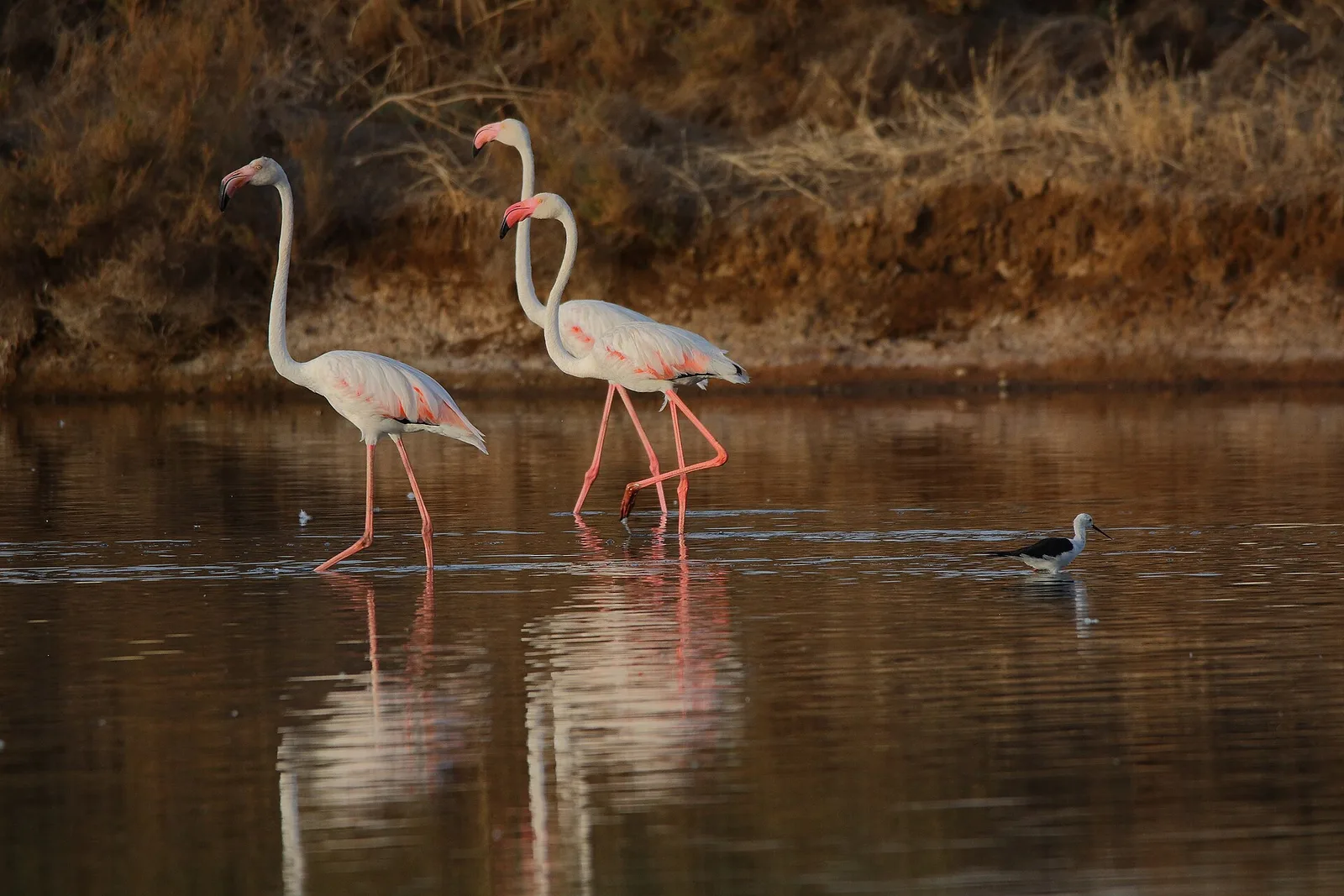
Most of the plumage is pinkish white. Red wing coverts sit above black flight feathers, so an open wing flashes crimson and black. The bill is pink with a small black tip, and the legs are pink from top to bottom. Chicks wear grey down, and young birds stay paler than adults with dark legs.
The colour comes from carotenoid pigments in the shrimp and algae the bird eats. Oil from the preen gland above the tail also carries carotenoids. In the breeding season the birds spread this oil over their feathers more often, which deepens the pink. Scientists have described this habit as putting on make-up. Adults that feed chicks fade, but their legs keep the bright pink.
Habitat and range
The greater flamingo lives in shallow water with a high salt or soda content. Its usual homes are coastal lagoons, salt lakes, estuaries and muddy beaches. Some of these waters are so alkaline that the pH reaches 11. The bird occurs from sea level to 4,500 metres. It also visits sewage works, dams, rice fields, salt marshes and, in Africa, hot springs.
In Africa it lives along the North African coast, up the Nile in Egypt, and on the soda lakes of Kenya, Tanzania, Uganda and Rwanda. Madagascar has its own population. In Asia the species reaches Pakistan, India, Bangladesh and Sri Lanka, and it is common around the Persian Gulf and in Iran and Iraq. In Europe it breeds in Spain, in the Camargue of France, in Italy, Greece and Turkey. The most northerly colony is at Lake Tengiz in central Kazakhstan, near 50 degrees north, where several thousand pairs nest.
In Gujarat, India, large flocks spend the winter at Nal Sarovar, Khijadiya, Thol and a site called Flamingo City. Zoo escapees have founded a small feral colony at Zwillbrocker Venn in western Germany. GBIF holds records from 119 countries, but that figure includes zoos and stray birds, not the native range. The species has no fixed home range and wanders through the year in search of water at the right level.
Diet and feeding
The greater flamingo is a filter feeder. It wades into shallow water, treads the mud with its feet to stir up food, then dips its head so the bill hangs upside down. The bird pumps water through the bill and traps small animals and plants on rows of fine plates inside. Unlike most birds, it can move its upper jaw, because the jaw is not fixed to the skull. Animal Diversity Web calls this bill the most advanced filter of any bird.
The diet is mostly brine shrimp and other small crustaceans. The bird also takes molluscs, midge larvae, diatoms, blue-green algae and seeds, including rice. Carotenoids in the shrimp and algae keep the feathers pink, and zoo birds fade when their diet lacks them. Because it feeds on the bottom, the flamingo needs low water and moves on when a lake rises.
Parents feed a new chick on crop milk, a secretion from the throat, until its bill curves enough to filter for itself. Pollution settles into the mud where the birds feed, so poisons in the water reach them quickly. A chick that goes hungry in its first weeks carries the effect into poor body condition later.
Behaviour and social life
The greater flamingo is one of the most social of all birds. It feeds, flies and nests in flocks that can reach many thousands. The flock has no clear rank order, and the main thing its members share is timing: they court and breed together. Flocks are nomadic and shift between wetlands as water levels and food change. The bird is active by day and by night.
Before breeding, the whole flock performs group displays. Birds march together, turn at the same moment, flag their heads from side to side and flash their wings in a salute. These displays are larger versions of everyday stretching and preening, and they trigger hormones that bring the flock into breeding condition. A few days after hatching, chicks gather in a crèche watched by adults that are not breeding. A guard adult chases off strange chicks unless its own chick is in the same crèche.
The flamingo often rests on one leg with the other tucked into its feathers. This is thought to save body heat, because a leg in cold water loses warmth. In sub-Saharan Africa greater flamingos sometimes feed alongside flocks of lesser flamingos.
Communication and senses
The greater flamingo is a noisy bird. Its main call is a honk like that of a goose, and a flock keeps up a loud cackle. Feeding birds make a low gabbling murmur. Research shows that the birds can tell one call from another by its timing and its pitch pattern. This probably helps a parent find its own chick in a crèche of hundreds.
Visual signals matter as much as sound. Head flagging, wing saluting, twist preening and a wing-and-leg stretch all form part of the group display. The pink colour is itself a signal, and a bird that spreads more preen oil in spring looks brighter to a mate. Like other birds, the flamingo probably relies on sharp eyesight, and the bill is thought to sense food by touch as it filters.
Reproduction and life cycle
Greater flamingos do not keep the same mate from one season to the next. Both sexes prefer older, more experienced partners, so pairs tend to be of a similar age. A bird's display grows more complex until about 20 years of age, then it simplifies again. Because the whole flock breeds at once, there is no fixed season, and a colony nests at most once a year.
A pair builds a cone of mud about 30 cm high on an island or lake shore, with a shallow cup on top. The sun bakes the mud hard. The female lays one chalky white egg, and she can lay a second only if the first is lost. Both parents incubate in turns, though captive studies show the male does more of the sitting and guarding. The egg hatches after 27 to 31 days, and some sources widen the range to 26 to 32 days. If food runs short, the parents abandon the egg and try again elsewhere.
The chick hatches in grey down and takes crop milk from both parents. Within days it joins a crèche, and it fledges after 65 to 90 days, when its bill has curved into the adult shape. Most birds gain full adult plumage at 4 years, though a few manage it at 30 months. A flamingo can breed at 3 years, but most females wait until they are 5 to 6. A typical life runs 20 to 30 years, and the wild record is 50. One bird at Adelaide Zoo arrived as an adult in 1933 and was put down in 2014, aged at least 83.
Predators and threats
An adult greater flamingo has few natural enemies, because of its size and its habit of standing in open water. Eggs and chicks are another matter. Raptors, crows, gulls and the marabou stork all raid colonies. In the Mediterranean about half of all egg and chick losses to predators are caused by the yellow-legged gull. Eagles, jackals and hyenas also take eggs and young where they can reach a colony.
On soda lakes a crust of sodium carbonate can build up around a chick's legs until it cannot walk. Such chicks starve or fall to predators. Pollution is the main threat to adults: bacteria, toxins and factory run-off enter the shallow lakes where the birds feed. Lead from spent shot poisons some birds, and other heavy metals add to the toll. The drainage of wetlands and disturbance at colonies remain the biggest long-term threats. In the Middle East and North Africa people still hunt flamingos for market and collect their eggs.
Population and conservation
The IUCN Red List rates the greater flamingo as Least Concern. The species has a very wide range and breeds in large colonies on three continents. Several thousand pairs nest at the Kazakhstan colony alone. Even so, the birds probably depend on a small number of safe nesting sites, and one disturbed colony can lose a whole year's young.
Regional lists tell a mixed story. South Africa rates the species Near Threatened, and the French national list rates it Vulnerable. Portugal rates it Least Concern, while the region of Languedoc-Roussillon in France lists it as Near Threatened. Russia includes the bird in its national Red Book.
Zoos have helped to build knowledge of the species. Basel Zoo recorded the first zoo hatching in 1959. Its breeding programme has raised over 400 chicks, with 20 to 27 hatched each year since 2000. Protected wetlands such as the Camargue and the Gujarat sanctuaries now hold the key European and Indian colonies.
Relationship with humans
The greater flamingo is harmless to people and keeps its distance from them. Its main conflict with farmers is in rice fields, where flocks trample and eat the crop. In parts of the Middle East and North Africa the birds are hunted and sold, and egg collectors raid colonies for profit.
Zoos have kept flamingos for a long time, and Basel Zoo has bred them since 1959. Captive birds lose their colour unless the keepers add carotenoids to the food. Escaped zoo birds now breed in the wild in Germany. Wetland reserves such as the Camargue draw many visitors who come to see the flocks, so the bird probably earns money for local tourism.
Ancient Romans ate flamingo tongues as a luxury dish. Today the bird's value probably lies in the health of its wetlands, and its decline at a site warns of pollution.
In culture and myth
In ancient Egypt the flamingo served as the written sign for the colour red. They linked the bird to the sun god Ra. Some writers think the legend of the phoenix, the bird reborn in fire, may have grown from the flamingo. The genus name Phoenicopterus, crimson wing, shares its root with the phoenix.
In Rome the flamingo was food for the rich, and its tongue was prized above the rest of the bird. In the United States a plastic lawn flamingo became a symbol of kitsch after it went on sale in 1957. The bird's name in most European languages, from the French flamant rose to the German Rosaflamingo, points to its colour. Its pink shade seems to have become a general word for the colour in many cultures.
A sentence with a dotted underline is inferred: it describes the group the animal belongs to, or is a reading of the sources, rather than a measured or reported fact about this species.
Questions
Greater flamingo questions, answered
Why are flamingos pink?
The pink comes from carotenoid pigments in the brine shrimp and algae that the bird eats. A chick hatches grey, and a zoo bird fades if its food lacks the pigments. Flamingos also spread carotenoid-rich preen oil over their feathers in the breeding season.
How big is a greater flamingo?
An adult measures 80 to 150 centimetres and weighs 1.9 to 3 kilograms. The wingspan is 140 to 170 cm. It is the largest of the six flamingo species.
Where do greater flamingos live?
They live on salt lagoons, soda lakes and mudflats in Africa, southern Europe, the Middle East and South Asia. The northernmost colony is in central Kazakhstan. Large flocks winter in Gujarat, India.
What do greater flamingos eat?
They filter brine shrimp, other small crustaceans, molluscs, midge larvae, diatoms and blue-green algae from shallow water. In some places they also eat rice seeds.
Why do flamingos stand on one leg?
The habit is thought to save body heat, because a leg held in cold water loses warmth. The bird tucks the other leg into its feathers and can rest that way for a long time.
How do flamingos feed upside down?
The bird dips its head so the bill hangs inverted in the water, then pumps water through it. Fine plates inside the bill trap the food. Unlike most birds, the flamingo can move its upper jaw, which makes the filtering work.
Are greater flamingos endangered?
No. The IUCN lists the species as Least Concern. Some regional lists rate it higher, for example Vulnerable in France and Near Threatened in South Africa. Pollution and wetland loss are the main threats.
How long do greater flamingos live?
A typical bird lives 20 to 30 years. The wild record is 50 years, and the AnAge captive record is 58.8 years. A bird at Adelaide Zoo lived to at least 83.
How many eggs does a flamingo lay?
One. The female lays a lone chalk-white egg in the cup of a mud cone. She lays a replacement only if the first egg is lost. The egg hatches after 27 to 31 days.
What is a baby flamingo called?
A young flamingo is a chick. It hatches in grey down, drinks crop milk from both parents and joins a crèche of other chicks within a few days.
What is a group of flamingos called?
A group of flamingos is called a flamboyance. In the wild a flock can hold thousands of birds.
Can flamingos fly?
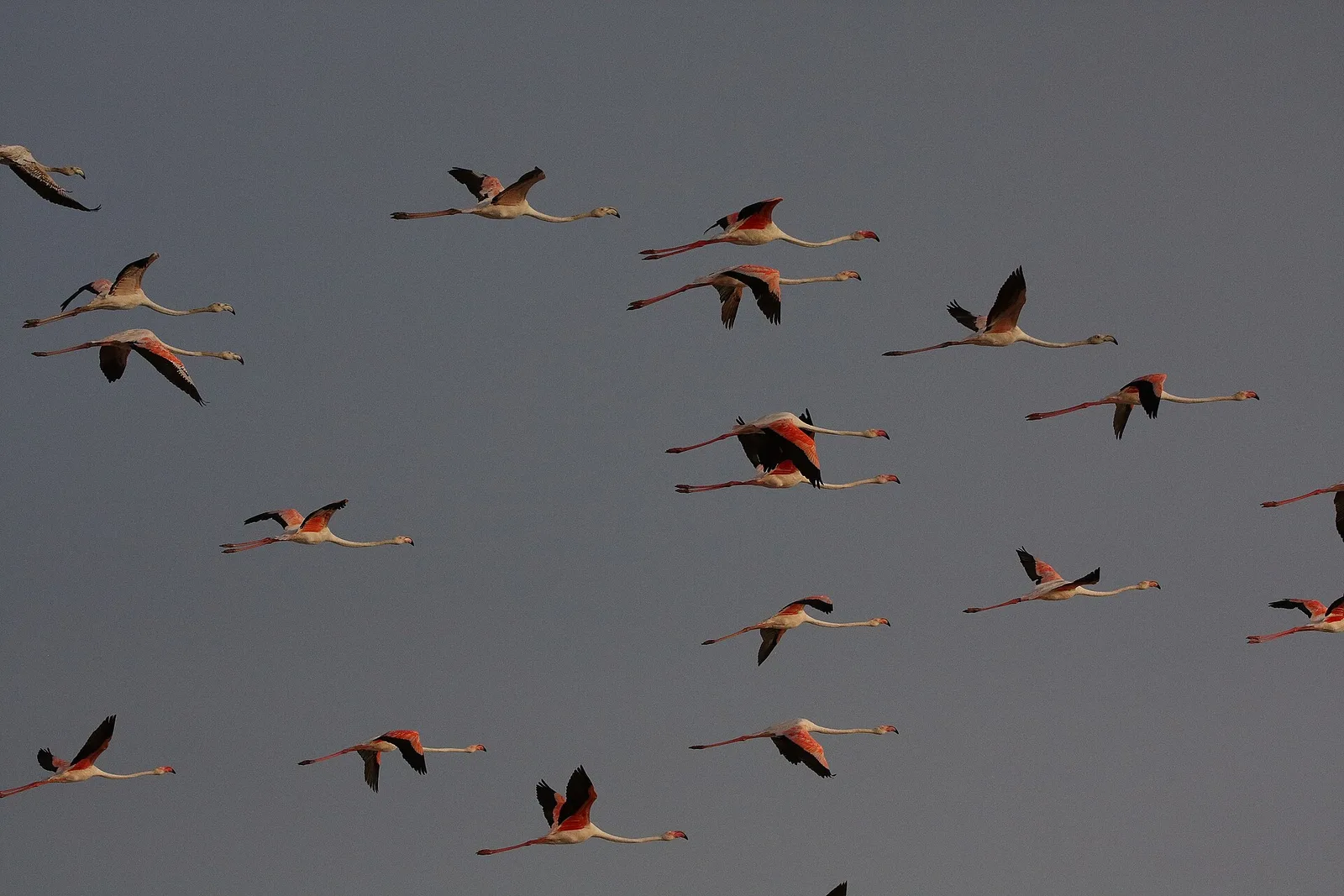
Yes. Greater flamingos fly well and travel long distances between wetlands. They are nomadic and move whenever water levels or food change.
What eats flamingos?
Adults have few predators. Gulls, crows, raptors, marabou storks, jackals and hyenas take eggs and chicks. In the Mediterranean the yellow-legged gull causes about half of all such losses.
Are flamingos dangerous to humans?
No. The greater flamingo is a shy filter feeder that flies away from people. It cannot bite hard enough to injure anyone.
How do flamingos court a mate?
The whole flock displays together. Birds march in step, flag their heads, salute with their wings and twist to preen. The displays trigger hormones so the colony breeds at the same time.
What is the difference between a greater flamingo and an American flamingo?
The two were once treated as one species. The American flamingo is a deeper pink over the whole body, while the greater flamingo is paler with red only on the wing coverts. The two also differ in bill and head colour.
Food web
Prey and food
- brine shrimp
- algae
- molluscs
Food web
Predators
- eagles
- jackals
- hyenas
Ecological equivalents
Related species on this site
Flamingo (same family).