Fin whale
The greyhound of the sea, second only to the blue whale
Balaenoptera physalus
Also called Finback whale, Common rorqual, Razorback, Herring whale
Living individuals or members of this group exist today. This does not mean they are safe from extinction.
Meet the fin whale
The fin whale is the second longest animal alive and one of the fastest of the great whales. It filters krill and small fish from the cool seas of every ocean.
Images of the fin whale
Lifespan in the wild
75 to 90 years a 1979 study put the maximum at 114 years
Weight
36 to 45 t
Length
19 to 27 m
Top speed
37 to 41 km/h
Fact file
Fin whale
- Location
- All major oceans, most common in temperate and cool seas
- Habitat
- Open ocean, Coast
- Diet
- Filter feeder
- Prey / food
- Krill, copepods, small schooling fish such as herring, capelin and anchovy, and squid
- Predators
- Orcas, mainly of calves and weak adults
- Lifestyle
- Migrates between polar feeding grounds and warm breeding waters
- Group name
- Pod
- Name of young
- Calf
- Gestation
- 11 to 12 months
- Litter size
- 1 calf every 2 to 3 years
- Population
- About 100,000 to 140,000 mature whales worldwide
- Biggest threat
- Ship strikes, ocean noise and the whaling of the 20th century
- Distinctive feature
- A white right lower jaw and a tall, curved dorsal fin set far back
- Colour
- Brownish grey above, white below
- Skin type
- Smooth skin
Size
Next to a person
Measurements
Size and speed
- Length
- 19 to 27 m males average 21 m and females 22 m; the record is 27.3 m
- Length, male
- About 21 m
- Length, female
- About 22 m
- Weight
- 36 to 45 t, up to 120 t adults average 36 to 45 tonnes; the largest are estimated at up to 120 tonnes
- Top speed
- 37 to 41 km/h, up to 50 km/h sustained cruising speed; bursts of 46 to 50 km/h recorded
Typical adult ranges. Sources: Wikipedia, Animal Diversity Web.
Life cycle
Lifespan
- In the wild75 to 90, up to 114 years a 1979 study put the maximum at 114 years
- 0114 years
The pale bar is the record. Source: Wikipedia.
Appearance
Colour and coat
- Primary colours
- brownish greywhite
- Secondary colours
- dark grey
- Skin type
- smooth skin
- Male and female
- Slight. Females are the larger sex, at about 22 metres against 21 for males, and they weigh more.
Life cycle
Mating and family
- Mating system
- males sing to attract females; no lasting pair
- Social structure
- loose pods of 6 to 10, with a mother and calf as the only firm bond
- Breeding
- one calf every 2 to 3 years
Fin whales mate in winter in warm water, and the calf is born there a year later after 11 to 12 months of gestation. It is 6 to 6.5 metres long at birth and nurses for 6 to 7 months. It then follows its mother to the polar feeding ground and learns to feed. Females mature at 6 to 12 years and calve every 2 to 3 years. The whales live 75 to 90 years.
Classification
Taxonomy
- Kingdom
- Animalia
- Phylum
- Chordata
- Class
- Mammalia
- Order
- Cetacea
- Family
- Balaenopteridae
- Genus
- Balaenoptera
- Species
- Balaenoptera physalus
Conservation
Red List status
- LC
- NT
- VU
- EN
- CR
- EW
- EX
Vulnerable on the IUCN Red List
Range
Recorded in 17 countries
- Antarctica
- Canada
- Chile
- Spain
- France
- United Kingdom
- Greenland
- South Georgia and the South Sandwich Islands
- Iceland
- Italy
- Mexico
- Norway
- New Zealand
- Peru
- Portugal
- Russia
- United States of America
Habitat layer: mangrove.
Countries from 2,878 wild records on GBIF (iNaturalist research grade), filtered and checked by hand. Country shapes: Natural Earth. Habitat: RESOLVE Ecoregions 2017, CC BY 4.0. Basemap: Natural Earth.
Habitats
Three things to know
- 1
The fin whale can hold a speed of 37 to 41 kilometres an hour, which earned it the name greyhound of the sea.
- 2
Its right lower jaw is white and its left is dark, the only lopsided colouring of any whale.
- 3
One gulp takes in about 70 cubic metres of water, and one whale can eat 1,800 kilograms of krill in a day.
Did you know
Seven more facts
- 1
The right lower jaw is white and the left is dark, so the whale looks different from each side.
- 2
The heart weighs up to 290 kilograms and the liver up to 600 kg.
- 3
When biologists first heard the song, they suspected a Soviet submarine detector.
- 4
Icelandic whalers caught a blue-fin hybrid in 2018, born to a blue whale mother.
- 5
Feeding takes the whale only about three hours a day, about the same as a person.
- 6
Whalers killed some 704,000 fin whales in the Antarctic alone between 1904 and 1975.
- 7
Whalers in Iceland took three fin whales in 2013 and 2015 that turned out to be 82, 80 and 65 years old.
Field notes
How it looks and acts
Field notes
Distinguishing features
- A long, slim body of 19 to 27 metres, brownish grey above and white below.
- A tall, hooked dorsal fin about 61 centimetres high, set far back.
- A white right lower jaw and a dark left one.
- A single ridge from the snout to the paired blowholes.
- A tall blow of 4 to 6 metres.
- A sharp ridge along the tail stock, the razorback.
Field notes
Unique adaptations
- Throat grooves that let the mouth swell to take in 70 cubic metres of water.
- Baleen plates of keratin, up to 473 a side, that strain krill from the water.
- Countershading, dark above and white below, that hides it from prey.
- A stretchy nerve system in the mouth that survives the huge expansion of a lunge.
- A streamlined body that sustains 37 to 41 kilometres an hour.
Field notes
Interesting behaviours
- Lunge feeding through krill swarms with the jaw dropped.
- Circling a school of fish to pack it into a ball before engulfing it.
- Blowing five to seven times in a row before a deep dive.
- Migrating between polar feeding grounds and warm breeding waters.
- Singing in bouts of low pulses that last for days.
Field notes
Temperament
- Calm and unaggressive, and it flees rather than fights.
- More sociable than other rorquals, in pods of 6 to 10.
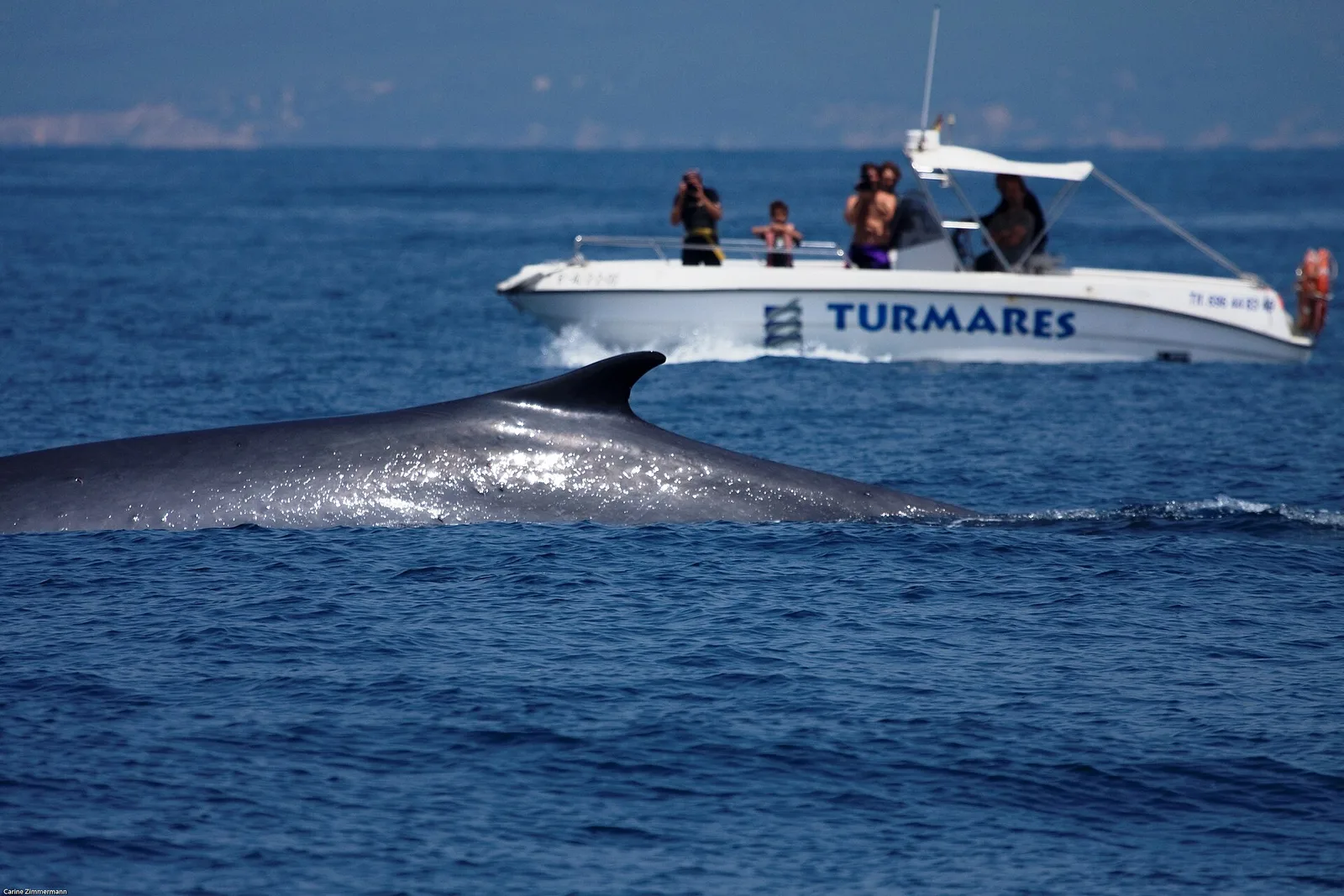
- Tolerant of whale-watching boats, though the boats can change its feeding.
Field notes
Communication
- Down-swept pulses of 16 to 40 hertz from the males.
- Patterned sequences of 7 to 15 minutes, repeated for days.
- Calls of 160 to 186 decibels that carry hundreds of miles.
- Higher sounds between nearby whales, probably about food.
Ecology
Ecological role
The fin whale is a bulk consumer of krill and small fish, and its body feeds the deep sea when it dies.
- It removes up to 1,800 kilograms of krill and fish from the water each day.
- Its carcass sinks and feeds whole communities on the sea floor for years.
- It carries barnacles, whale lice, copepods and worms.
- Like other large whales, it probably fertilises surface water with its dung.
Stories
Myths and legends
- In Icelandic folklore, the sword whale slashed ships with its fin, while the fin whale itself was a good whale.
- In the Hebrew Bible, a great fish swallows Jonah, and later art made it a whale.
- In Inuit tradition, the whale chooses to give itself to a hunter who shows respect.
- In Maori tradition, the ancestor Paikea crossed the sea to New Zealand on the back of a whale.
People
Relationship with humans
People
Living alongside us
People could not catch the fin whale until steam and the exploding harpoon arrived. Then they killed about 874,000 in the 20th century. Most nations stopped in 1976 and 1986, but Iceland and Japan still hunt a few. Ships now kill more fin whales than harpoons. Whale-watching boats seek it from California to the Mediterranean.
- No fin whale has attacked a person, and the animal flees from threats.
- Collisions with ships harm the whale far more than the ship, though passengers have been hurt in the Tsushima Strait.
- Any risk to a swimmer probably comes from the whale's size, not from any intent.
People
Status, uses and products
- Domestication
- Wild
- As a pet
- Not suitable. A fin whale is 20 metres long, weighs 40 tonnes and needs the open ocean and tonnes of krill a day. No aquarium has ever held one.
- Uses
- whale watchingsubsistence huntingcommercial whaling
- Products
- meatoilbaleen
The full account
About the fin whale
The fin whale, Balaenoptera physalus, is the second longest animal on Earth. Only the blue whale is bigger. Adults measure 19 to 27 metres and weigh 36 to 45 tonnes. The body is long and slim, brownish grey above and white below. Whalers called it the greyhound of the sea, because it can hold 37 to 41 kilometres an hour.
Fin whales live in every major ocean, from the edge of the polar ice to the tropics. They feed by lunging through swarms of krill and schools of small fish with open jaws. Males sing pulses so low that people cannot hear them, and so loud that they cross hundreds of miles of ocean. Whaling in the 20th century killed about 874,000 fin whales. The IUCN now lists the species as Vulnerable, and the North Atlantic population has recovered.
Name and taxonomy
The name fin whale refers to the tall, curved dorsal fin set far back on the body. Other names are finback, common rorqual and razorback, for the ridge along the tail stock. Carl Linnaeus named it Balaena physalus in 1758, and physalus comes from a Greek word for breath, after its tall blow. The species has been renamed many times, and in 1903 Emil Racovita gathered the scattered names into Balaenoptera physalus.
It belongs to the rorquals, the family Balaenopteridae, with the blue, humpback, sei, Bryde's and minke whales. Rorquals have throat grooves that let the mouth expand like a balloon. Four subspecies are now named: one in the North Atlantic, one in the North Pacific, one in the Southern Hemisphere and a disputed pygmy form. A 2019 genetic study confirmed that the North Pacific whales are a subspecies of their own. The three main groups rarely mix.
Evolution and relatives
The rorquals split from the other baleen whales in the middle Miocene. DNA suggests the fin whale is closer to the humpback whale, and perhaps the gray whale, than to the minke whale in its own genus. The genetic gap between fin and blue whales is about the same as that between people and chimpanzees. Even so, the two species breed together fairly often in the North Atlantic and North Pacific.
A whale caught off Iceland in 2018 had a blue whale mother and a fin whale father. A 2024 genome study found that about 3.5 percent of the North Atlantic blue whale genome comes from fin whales. The gene flow runs one way, from fin whales into blue whales. Fin whales probably manage this because they match blue whales for speed and can keep up in a courtship chase.
Appearance
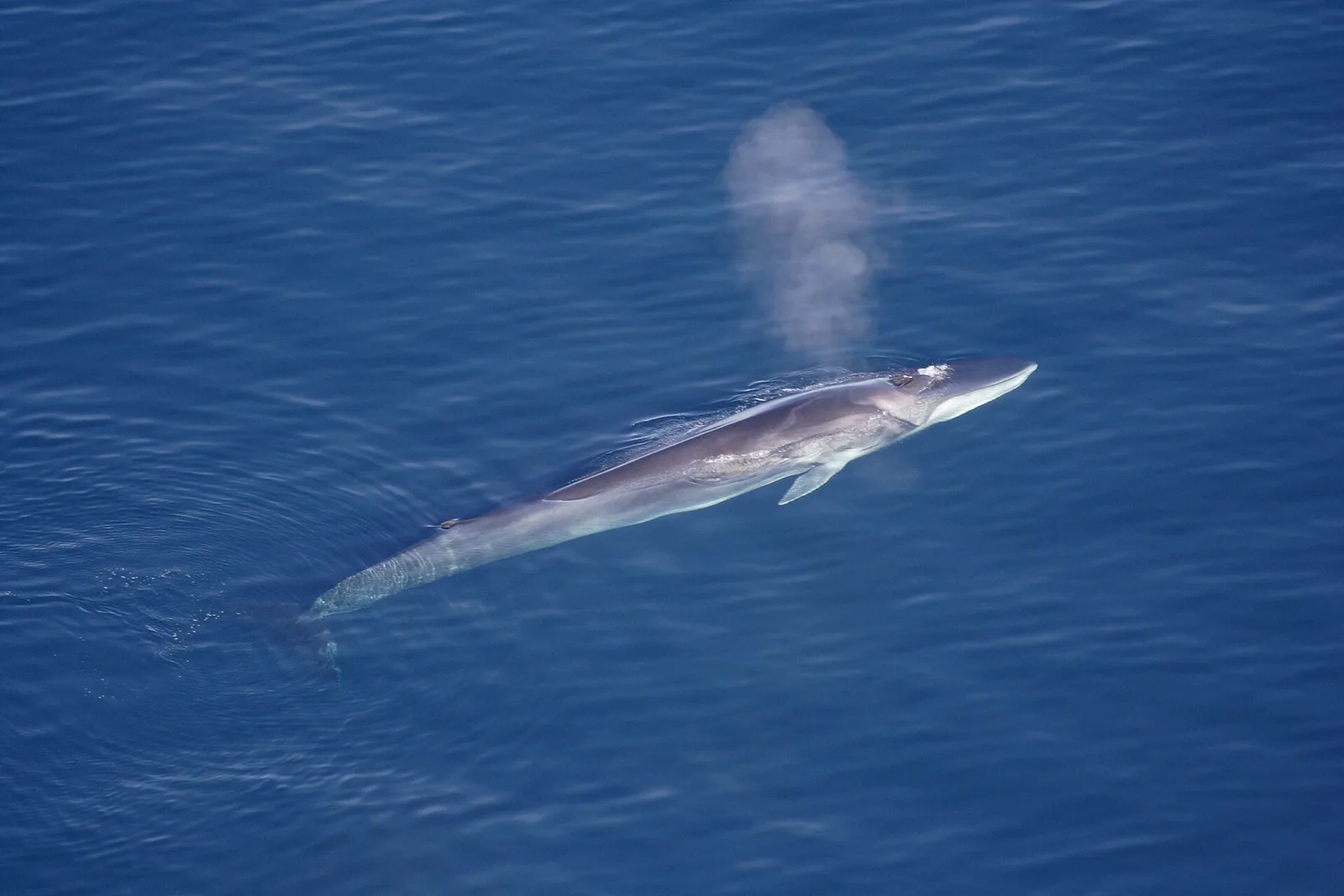
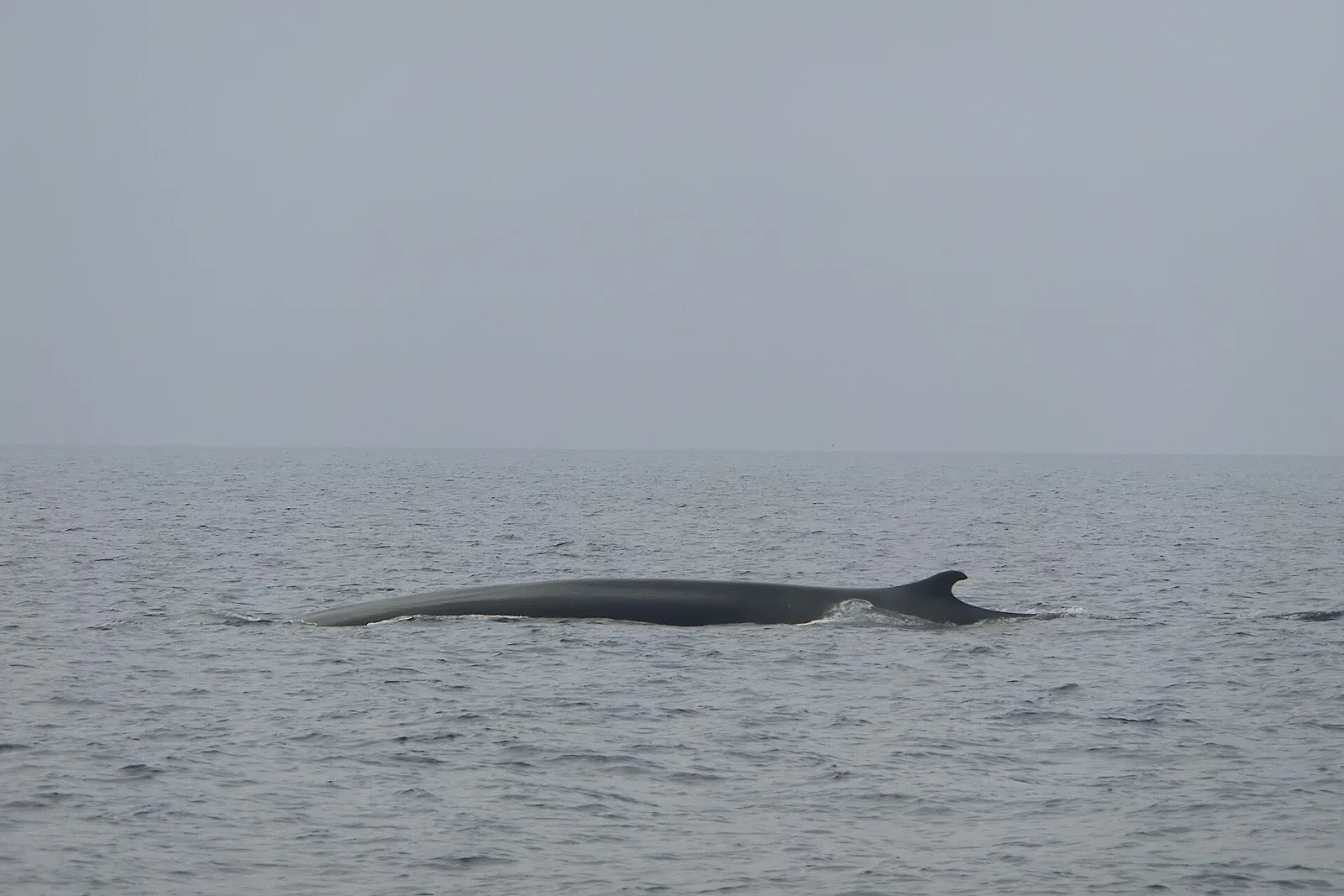
The fin whale is slender for its size, with a flat head that takes up about a fifth of the body. A single ridge runs along the top of the head from the snout to the two blowholes. The blow rises 4 to 6 metres and is easy to see from a distance. The dorsal fin stands about 61 centimetres tall and curves like a hook. The back is brownish or dark grey and the belly is white. The colouring is lopsided: the right lower jaw is white and the left is dark grey. Pale chevrons sweep back from the head on the right side.
Adults measure 19 to 27 metres, and the longest whale ever measured by a scientist was a 25.9 metre female. Males average 21 metres and females 22, so the female is the larger sex. Northern whales are smaller than southern ones. Weight is usually 36 to 45 tonnes, and the largest whales are put at 120 tonnes. The mouth holds 262 to 473 baleen plates on each side, each up to 76 cm long. The heart weighs 130 to 290 kilograms and the liver 230 to 600 kg, the largest organs of any animal.
Habitat and range
The fin whale is found in every major ocean, from polar to tropical water. It avoids the pack ice itself and small enclosed seas such as the Red Sea. It is most common in temperate and cool water and scarce near the equator. It is the only rorqual that lives year round in the Mediterranean. GBIF holds records from 88 countries.
Most populations migrate between summer feeding grounds near the poles and winter breeding waters at lower latitudes. In the North Atlantic the whales summer from Newfoundland to Svalbard and move south in autumn past Bermuda to the West Indies. In the North Pacific they feed from Baja California north to the Chukchi Sea. They crowd into the Gulf of Alaska and the Bering Sea from May to October. Southern whales feed near Antarctica and breed somewhere in the open ocean, in places that are still unknown. Resident groups stay all year in the Gulf of California and the Mediterranean, where food is steady.
Fin whales favour deep water over the continental slope and shelf, beyond the 200 metre line. Calves learn their mother's migration route and return to her feeding ground in later years.
Diet and feeding
The fin whale is a filter feeder. It eats krill, copepods, small schooling fish such as herring, capelin and anchovy, and squid. In the Southern Ocean it lives almost entirely on Antarctic krill. Of 1,609 stomachs checked at an Icelandic whaling station, 96 percent held only krill. Off Newfoundland the whales eat mostly capelin instead.
To feed, the whale swims into a swarm at about 11 kilometres an hour and drops its jaw. The throat grooves stretch, and the mouth takes in up to 70 cubic metres of water. The whale then shuts its jaws and forces the water out through the baleen, which traps the prey. Each gulp brings in about 10 kilograms of food. On a feeding dive it goes below 200 metres and makes about four lunges. A whale can eat up to 1,800 kg a day, which takes about three hours of feeding.
When it hunts fish, a fin whale circles the school at speed to pack it into a ball. Then it rolls on its side and engulfs the ball. The white right jaw may help to frighten the fish into a tighter ball, though this is not proven. Feeding dives last about 6 minutes on average, with a maximum of 16.9 minutes.
Behaviour and social life
Fin whales are the most sociable of the rorquals. They often travel in pods of 6 to 10 animals. On rich feeding grounds, groups of 100 to 250 whales can gather. The only lasting bond is between a mother and her calf, and that ends at weaning. Migrations run in order: pregnant females go first, then adult males, then mothers with calves.
When a fin whale feeds it blows five to seven times in quick succession, then dives. While travelling it blows once every minute or two. On the last blow it arches its back high but seldom lifts its flukes. Feeding dives reach 316 metres, and travelling dives about 100 m. By day the whales follow their prey into deep water, and at night they rise with it toward the surface.
The fin whale is one of the fastest of all whales. It cruises at 37 to 41 kilometres an hour and has been clocked at 46 to 50 km/h in a sprint. In the days of sail it simply outran the whaling boats.
Communication and senses
Male fin whales make some of the lowest sounds of any animal. The calls are down-swept pulses of 16 to 40 hertz, below the range that most people can hear. Each pulse lasts 1 to 2 seconds, and a patterned sequence runs 7 to 15 minutes. A male repeats these sequences in bouts that can last for days. The sounds reach 160 to 186 decibels at the source and can be picked up hundreds of miles away.
When US biologists first recorded the calls, they suspected faulty equipment, an earthquake or a Soviet submarine detector. Only males sing, and they sing in the breeding season, so the song is thought to be a mating display. The pulses pass more than 2,500 metres into the seabed, and seismologists now use them to map the crust. Ship noise over the past 100 years may have slowed the species' recovery by drowning out the males. Whales also answer each other's calls, and the delay and echo probably tell them about the water around them.
Reproduction and life cycle
Mating takes place in winter in warm, low-latitude water. Fin whales have no fixed breeding ground, so males sing to draw females from afar. A female carries her calf for 11 to 12 months and gives birth in the same warm water the next winter. Twins are very rare, though up to six foetuses have been recorded. A female calves every 2 to 3 years.
A newborn measures 6 to 6.5 metres. It swims at once and nurses for 6 to 7 months, until it is 11 to 12 metres long. It then travels with its mother to the summer feeding ground and learns to feed itself. Northern females mature at 6 to 12 years and males at 6 to 10. Whaling drove the age of maturity down, from 10 to 12 years to 6 or 7 in the north. Full size comes only at 22 to 25 years.
Fin whales live for 75 to 90 years on average. Three whales killed off Iceland in 2013 and 2015 were aged 82, 80 and 65. A 1979 study put the maximum lifespan at 114 years. A female found in 2010 was estimated at 135 to 140 years old, though that figure is less certain.
Predators and threats
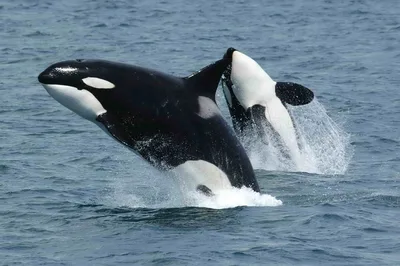
The orca is the fin whale's only known predator. At least 20 attacks or chases have been recorded, and only a few ended in a kill. In 2005, 16 orcas chased a fin whale for about an hour in the Gulf of California and killed it. In 2012 a pod killed a 15 metre whale in La Paz Bay after more than an hour. A fin whale usually flees rather than fights, though one in 2019 slapped an orca with its tail.
Today the main killer is the ship. Fast, large vessels over the continental shelf strike whales, and collisions cause many strandings. In 2014 a container ship arrived in New York Harbor with an 18 metre fin whale across its bow. Fishing gear entangles a few whales each year. Military sonar and seismic surveys disturb the whales and can mask the males' songs. A kidney worm, Crassicauda boopis, infected 94 percent of North Atlantic whales in one study and can kill.
Population and conservation
The IUCN listed the fin whale as Vulnerable in 2018. The world population is put at 100,000 to 140,000 mature whales. The North Atlantic holds about 70,000, the North Pacific about 50,000 and the Southern Hemisphere about 25,000. The North Atlantic population is thought to have recovered fully from whaling. The southern population was still under half its pre-whaling size in 2010.
The International Whaling Commission banned fin whaling in the Southern Hemisphere and North Pacific in 1976. A moratorium on all commercial whaling followed in 1986. Greenland keeps a quota of 19 fin whales a year for subsistence hunters. Iceland lodged an objection and still hunts fin whales under national quotas. Japan left the commission in 2019 and took 30 fin whales in 2024. The species is also protected under CITES Appendix I and the US Endangered Species Act.
Relationship with humans
For most of history the fin whale was too fast to catch. Steam ships and the exploding harpoon changed that in the late 19th century. As blue whales ran out, the whalers turned to fin whales for oil, blubber and baleen. Factory ships with stern slipways arrived in 1925 and raised the catch again. Some 874,000 fin whales were taken in the 20th century, 726,000 of them in the Southern Hemisphere. The Soviet Union also killed protected whales and hid the totals under false fin whale counts.
Today the fin whale earns money alive. Whale-watching boats meet it off California, in the Gulf of St Lawrence, the Bay of Biscay and the Mediterranean. Off Palos Verdes it can be seen lunge feeding from the shore. Hybrid fin and blue whale meat has turned up on sale in Japan. No fin whale has ever lived in captivity, and probably none could.
In culture and myth
No myth names the fin whale, but it lives inside the older lore of whales. In Icelandic folklore, the sword whale was an evil whale with a blade of a dorsal fin that slashed ships and other whales. Its rival was the blue whale, and Icelanders refused to eat the flesh of any evil whale. The fin whale itself, the langreydur, counted as a good whale that could be eaten. The Book of Jonah has a great fish swallow the prophet, and Christian art later turned the fish into a whale.
Arctic peoples such as the Inuit hold that a whale gives itself to the hunter, who must thank it. In Maori tradition the ancestor Paikea rides a whale to New Zealand. Chinese myth tells of the kun, a sea creature many thousands of li in length, which turns into a bird. Modern seafarers gave the fin whale its own legend as the greyhound of the sea. Its song added a Cold War myth, when the US Navy took the 20 hertz pulses for a Soviet device. Spirit-animal websites tie the fin whale to Poseidon, but no classical text does, so the link is probably modern.
A sentence with a dotted underline is inferred: it describes the group the animal belongs to, or is a reading of the sources, rather than a measured or reported fact about this species.
Questions
Fin whale questions, answered
How big is a fin whale?
An adult is 19 to 27 metres long and weighs 36 to 45 tonnes. The record length is 27.3 metres, and the heaviest whales are put at 120 tonnes.
Is the fin whale bigger than the blue whale?
No. The blue whale is longer and much heavier. The fin whale is the second longest animal on Earth.
How fast can a fin whale swim?
It cruises at 37 to 41 kilometres an hour and can sprint at 46 to 50 km/h. That speed earned it the name greyhound of the sea.
What do fin whales eat?
Krill above all, plus copepods, small schooling fish such as herring and capelin, and squid. A whale can eat up to 1,800 kilograms a day.
Are fin whales endangered?
The IUCN lists them as Vulnerable. About 100,000 to 140,000 mature whales remain, and the North Atlantic population has recovered from whaling.
Where do fin whales live?
In every major ocean, from near the polar ice to the tropics. They are most common in cool and temperate water and live year round in the Mediterranean.
How long do fin whales live?
About 75 to 90 years on average. One study put the maximum at 114 years.
Why is it called a fin whale?
For its tall, curved dorsal fin, which sits far back on the body. Whalers also called it the finback.
Do fin whales sing?
Males make deep pulses of 16 to 40 hertz, too low for people to hear. The calls carry hundreds of miles and are repeated for days.
Are fin whales still hunted?
Mostly not. Commercial whaling stopped in 1986. Iceland still hunts under its own quota, Japan took 30 in 2024, and Greenland may take 19 a year.
What eats a fin whale?
Only the orca. Pods have killed fin whales in the Gulf of California, but such kills are rare.
Do fin whales have predators other than orcas?
No. Their main killers today are ships, which strike them over the continental shelf.
Why is one side of the fin whale's jaw white?
No one knows for certain. The right lower jaw is white and the left is dark. The white side may help herd fish when the whale rolls to feed.
Can fin whales breed with blue whales?
Yes. Hybrids are known from the North Atlantic and North Pacific, and about 3.5 percent of the North Atlantic blue whale genome comes from fin whales.
How many fin whales were killed by whaling?
About 874,000 in the 20th century. The Southern Hemisphere accounted for some 726,000, the North Pacific for 75,000 and the North Atlantic for 72,000.
Food web
Prey and food
- krill
- copepods
- schooling fish such as herring
- capelin
- anchovy
- squid
Food web
Predators
 Orca
- mainly of calves
- weak adults
Ecological equivalents
Related species on this site
Blue whale (same genus), Minke Whale (same genus), Sei Whale (same genus), Humpback whale (same family), Amazon River Dolphin (Pink Dolphin) (same order), Basilosaurus (same order), and more.
 EN
Mammals
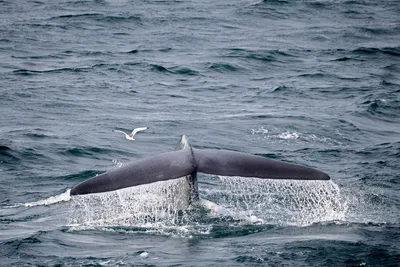
Blue whale
Balaenoptera musculus
The blue whale is the largest animal that has ever lived.
Living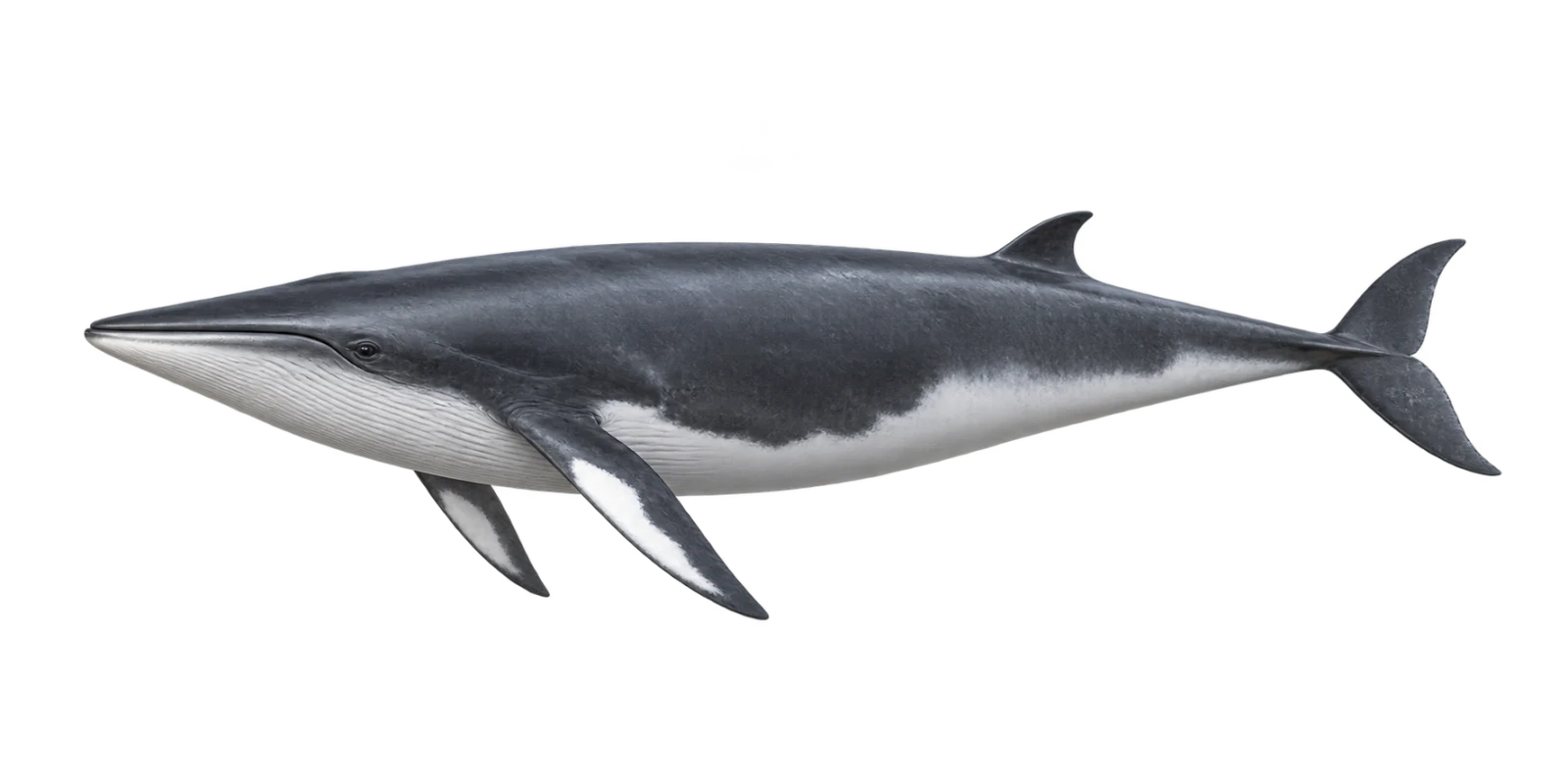
Mammals
Minke Whale
Balaenoptera acutorostrata
Classification and source reference
LivingAI illustration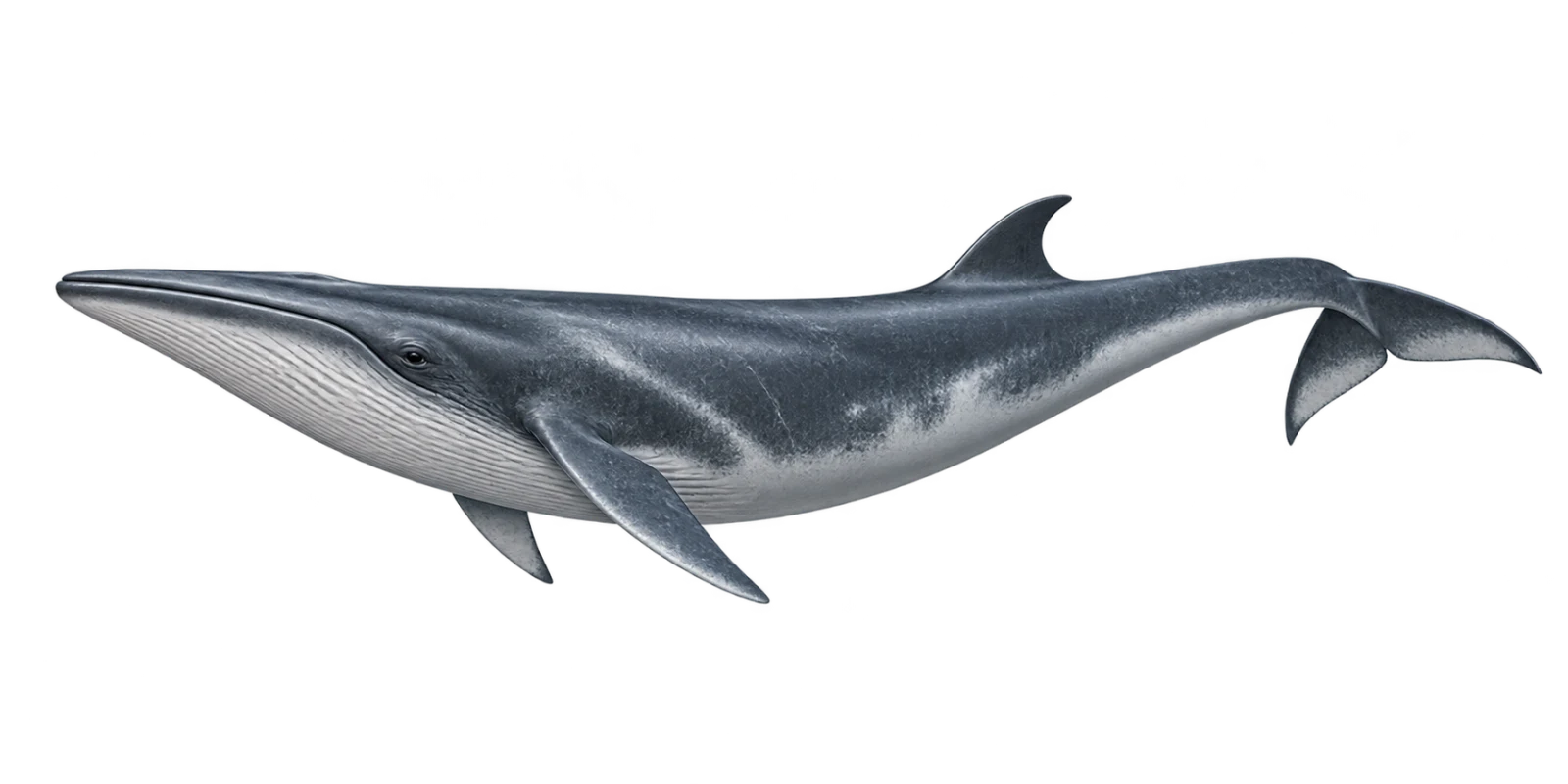
Mammals
Sei Whale
Balaenoptera borealis
Classification and source reference
LivingAI illustration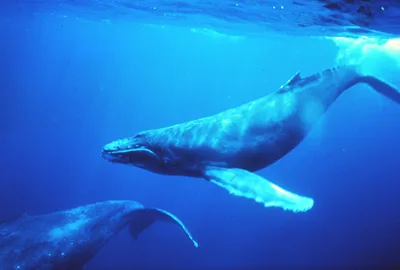 LC
Mammals
Humpback whale
Megaptera novaeangliae
The humpback whale is a large baleen whale found in every ocean.
Living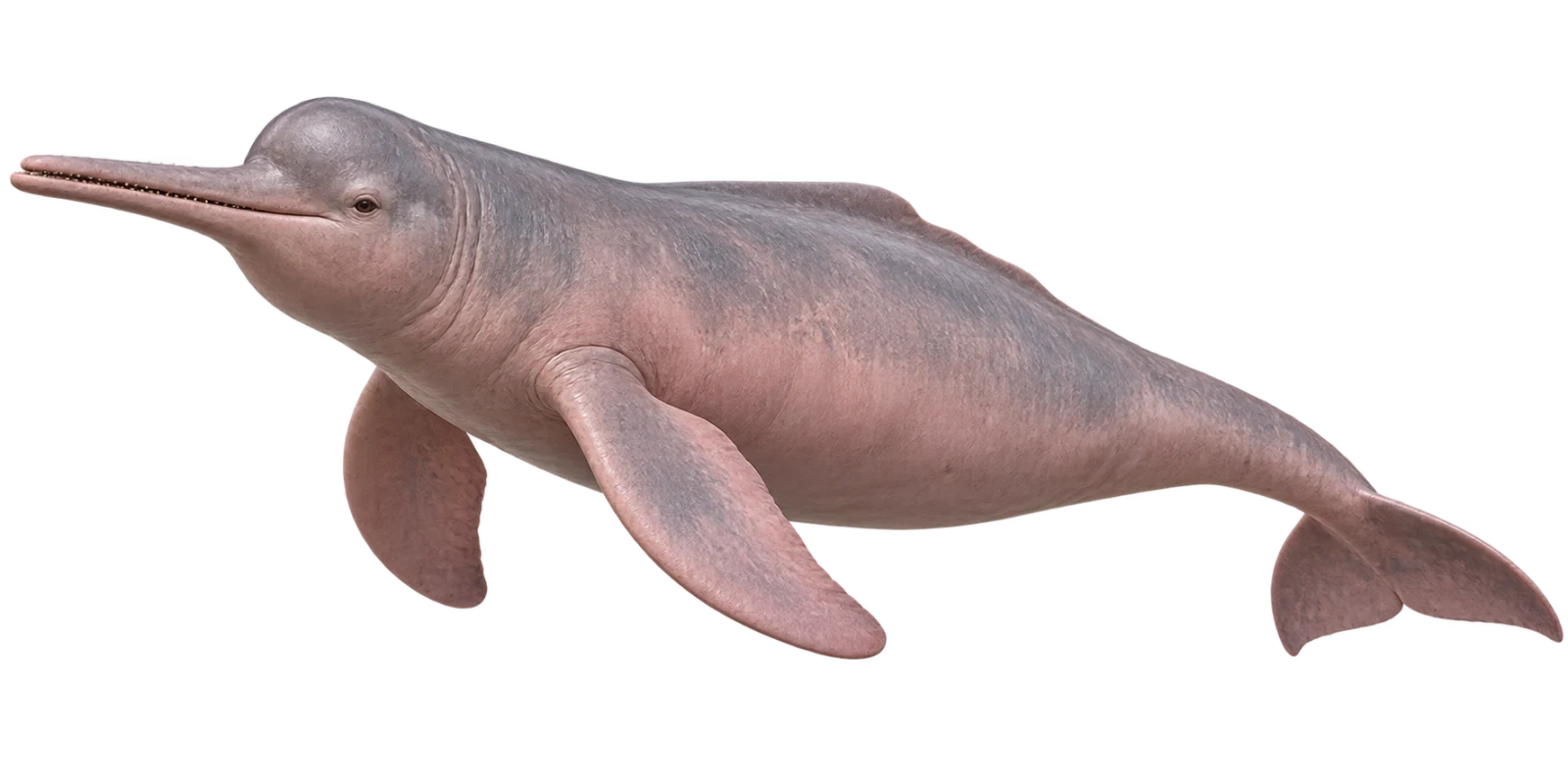
Mammals
Amazon River Dolphin (Pink Dolphin)
Inia geoffrensis
Classification and source reference
LivingAI illustration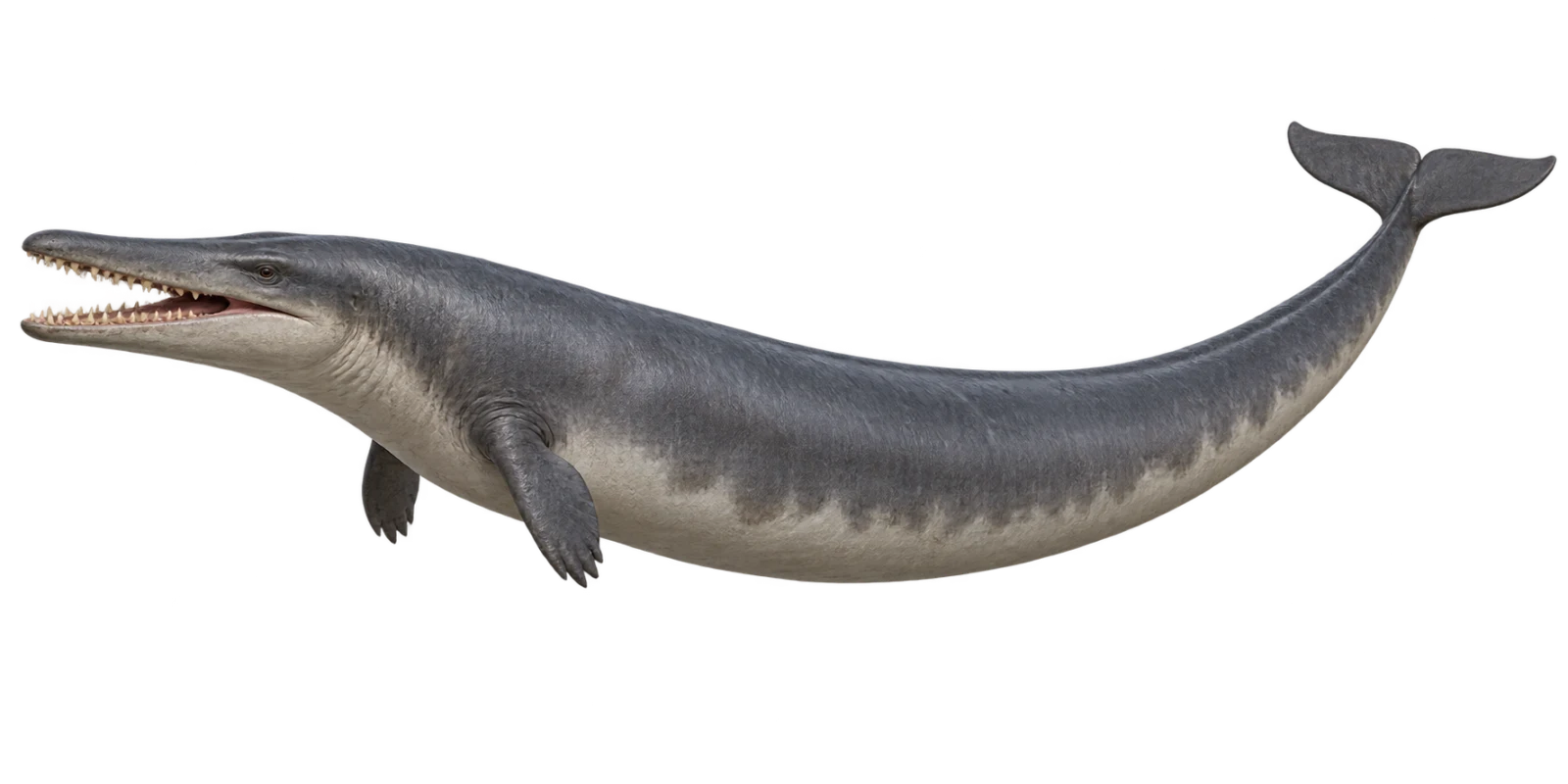
Mammals
Basilosaurus
Basilosaurus
Classification and source reference
ExtinctAI reconstruction