Living individuals or members of this group exist today. This does not mean they are safe from extinction.
Meet the whale shark
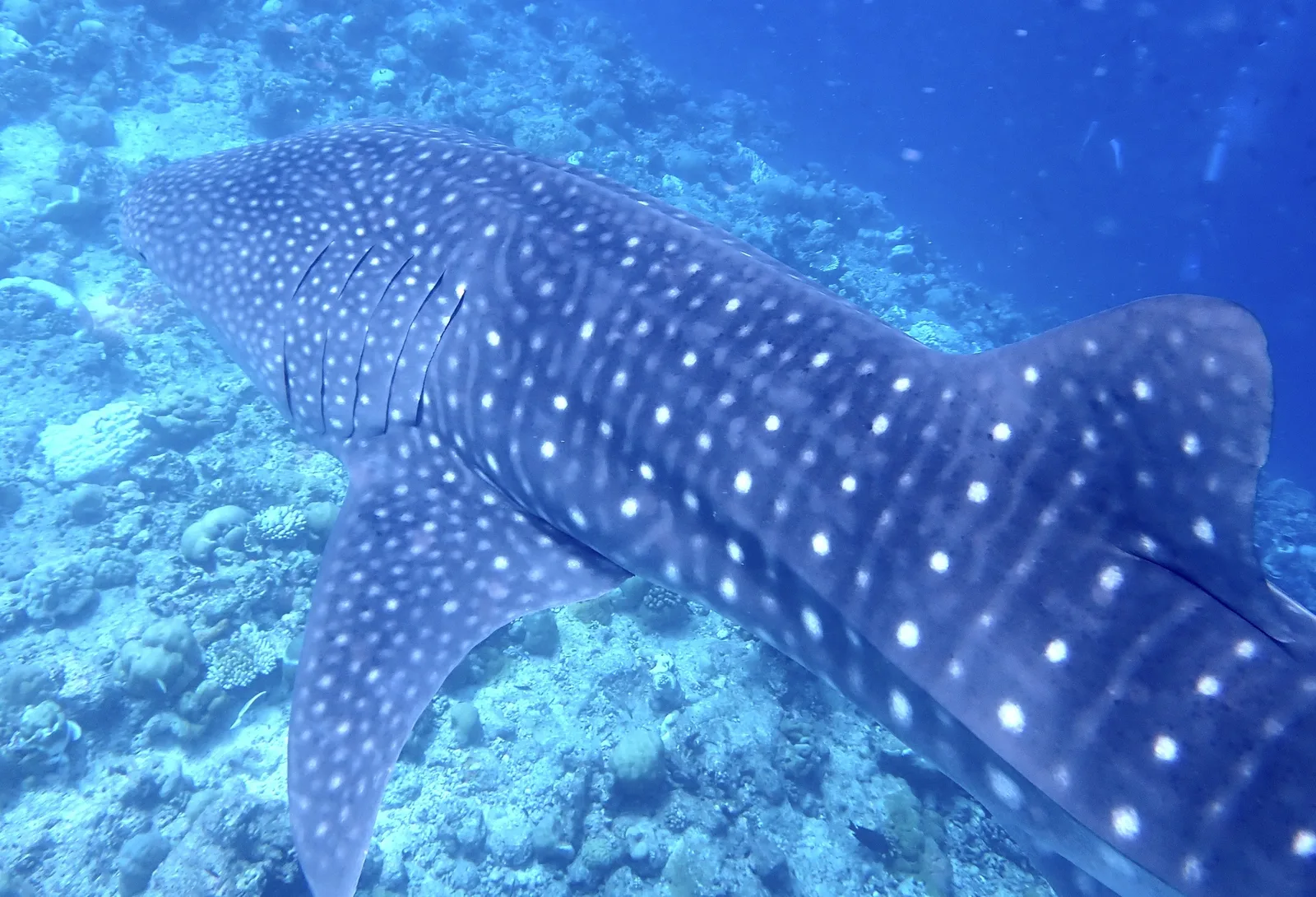
The whale shark is the largest fish in the sea. It cruises warm oceans with its mouth open, filtering plankton, and poses no threat to people.
Images of the whale shark
Lifespan in the wild
80 to 130 years an estimate from growth bands
Weight
About 12 t
Length
8 to 14.5 m
Fact file
Whale shark
- Location
- Tropical and warm-temperate seas worldwide
- Habitat
- Open ocean, Coast
- Diet
- Filter feeder
- Prey / food
- Plankton, krill, fish eggs, small fish
- Predators
- Orcas and large sharks take young
- Lifestyle
- Active at any hour
- Name of young
- Pup
- Incubation
- Unknown; eggs hatch inside the mother
- Clutch size
- Up to 300 pups
- Biggest threat
- Ship strikes and fishing bycatch
- Distinctive feature
- A pattern of white spots and stripes unique to each shark
- Colour
- Grey-blue with white spots
- Skin type
- Thick, rough skin
Size
Next to a person
Measurements
Size and speed
- Length
- 8 to 14.5 m, up to 18.8 m
- Length, male
- 8 to 9 m
- Length, female
- About 14.5 m
- Weight
- About 12 t
Life cycle
Lifespan
- In the wild80 to 130 years an estimate from growth bands
- In captivityUp to 26 years
- 0130 years
The pale bar is the record. Source: Wikipedia.
Appearance
Colour and coat
- Primary colours
- dark greywhite
- Secondary colours
- blue-greybrown
- Skin type
- rough skin with dermal denticles
- Male and female
- Females grow larger than males. Males average 8 to 9 metres and females about 14.5 metres, and males carry claspers on the pelvic fins.
Life cycle
Mating and family
- Mating system
- probably one male per litter, with stored sperm
- Social structure
- solitary, with seasonal feeding gatherings
- Breeding
- unknown frequency; pups born in batches over a long period
Whale sharks mate rarely, and nobody has seen a birth. The eggs hatch inside the mother, and one female carried about 300 embryos. Pups are born at 40 to 60 centimetres and get no care. Males mature at 8 to 9 metres, after about 25 years. The species may live 80 to 130 years.
Classification
Taxonomy
- Kingdom
- Animalia
- Phylum
- Chordata
- Class
- Fish (several classes)
- Order
- Orectolobiformes
- Family
- Rhincodontidae
- Genus
- Rhincodon
- Species
- Rhincodon typus
Conservation
Red List status
- LC
- NT
- VU
- EN
- CR
- EW
- EX
Endangered on the IUCN Red List
Range
Recorded in 22 countries
- Ashmore and Cartier Islands
- Costa Rica
- Ecuador
- Egypt
- Honduras
- Indonesia
- Madagascar
- Maldives
- Mexico
- Malaysia
- Mozambique
- New Zealand
- Panama
- Philippines
- Portugal
- Saudi Arabia
- Seychelles
- Saint Helena
- Thailand
- Tanzania
- United States of America
- South Africa
Habitat layer: mangrove.
Countries from 1,642 wild records on GBIF (iNaturalist research grade), filtered and checked by hand. Country shapes: Natural Earth. Habitat: RESOLVE Ecoregions 2017, CC BY 4.0. Basemap: Natural Earth.
Habitats
Three things to know
- 1
The mouth is about 1.5 m wide and holds around 3,000 tiny teeth.
- 2
Scientists identify individuals by their spot patterns, like fingerprints.
- 3
Its skin can be 10 cm thick.
Did you know
Seven more facts
- 1
The skin can be up to 15 centimetres thick.
- 2
The mouth holds over 300 rows of tiny teeth, and none of them is used to eat.
- 3
A whale shark can filter more than 6,000 litres of water in an hour.
- 4
The deepest recorded dive went to 1,928 metres.
- 5
Pups are born alive at 40 to 60 centimetres long.
- 6
A shark at Okinawa Churaumi Aquarium had lived there for more than 26 years by 2021.
- 7
iNaturalist holds 2,675 observations of the species.
Field notes
How it looks and acts
Field notes
Distinguishing features
- A broad, flat head with the mouth at the front rather than underneath.
- White spots and stripes in a checkerboard on a dark grey back, unique to each shark.
- Three raised ridges along each flank.
- A total length of 8 to 14.5 metres in adults.
- Five very large gill slits on each side.
- A tail fin with a much larger upper lobe in the young.
Field notes
Unique adaptations
- Filter pads inside the gills strain prey as small as 1 millimetre from the water.
- Cross-flow filtering keeps the pads from clogging, and a cough clears them.
- A rod pigment tuned to blue light lets the shark see in the deep, and it is switched off in warm shallows.
- A cartilage skeleton with no rib cage keeps the huge body light.
- Tough skin covered in dermal denticles cuts drag and resists bites.
Field notes
Interesting behaviours
- Cruises at about 1 metre per second for hours at a time.
- Stays near the surface by day and dives in the dark.
- Hangs head up in the water to suck in dense plankton.
- Gathers in hundreds at seasonal feeding sites.
- Investigates fishing nets and accepts fish from fishermen at Ningaloo.
Field notes
Temperament
- Docile and calm around divers.
- Solitary for most of the year.
- Curious enough to learn a feeding routine in captivity.
Field notes
Communication
- May use low-frequency sound, given the size of its inner ear.
- Senses water movement through the lateral line.
- Detects electric and magnetic fields with pores on the head.
- Sees swimmers at 3 to 5 metres with small side-set eyes.
Ecology
Ecological role
The whale shark is a giant grazer of plankton that links the smallest life in the sea to the largest.
- Thins out local swarms of zooplankton and small fish at feeding sites.
- Hosts two copepod species found on no other animal, one on its filter pads and one on its skin.
- Carries remoras and sharksuckers, some of which live inside the mouth and gill cavity.
- Probably moves nutrients between the surface and the deep on its long dives.
Stories
Myths and legends
- In Vietnamese tradition, the whale shark is ca ong, the sir fish, and fishermen honour it.
- In Kenyan coastal tradition, it is papa shillingi, a shark that God dressed in coins.
- In Malagasy tradition, the name marokintana means many stars, after the spots.
- In Fijian tradition, the name Dakuwaqa is thought to be shared with a shark god.
People
Relationship with humans
People
Living alongside us
People fish the whale shark for meat, fins and oil, and its slow life makes it easy to overfish. Many countries now protect it, and diving with whale sharks is a major tourist industry from Mexico to the Maldives. Boats injure sharks with propellers, and nets catch them by accident. A few aquariums in Asia and one in the United States keep the species. It is harmless to people.
- The whale shark has never been known to attack a person.
- Its teeth are tiny and take no part in feeding.
- The only risk is a bump from the tail of a 12,000 kilogram animal.
People
Status, uses and products
- Domestication
- Wild
- As a pet
- Not suitable. A whale shark grows past 8 metres, needs an ocean to feed in and lives for decades. Only a handful of the world's largest aquariums can hold one, and several captives have died young.
- Uses
- ecotourismaquarium exhibitionfood
- Products
- meatfinsliver oilskin
The full account
About the whale shark
The whale shark, Rhincodon typus, is the largest fish alive today. It is a shark, not a whale, and it has no close link to any whale. Adults reach 8 to 14.5 metres, and the most reliable record is a female of 18.8 metres. A typical adult weighs about 12,000 kilograms. Despite that size, it eats some of the smallest animals in the ocean.
The whale shark swims slowly through warm seas with its wide mouth open. It strains plankton, fish eggs and small fish out of the water with pads inside its gills. Every shark carries its own pattern of white spots and stripes on a dark grey back. Scientists read those patterns the way police read fingerprints. The IUCN lists the species as Endangered, because the global population fell by about half over 75 years.
Name and taxonomy
The species entered science in April 1828, after fishermen harpooned a 4.6 metre shark in Table Bay, South Africa. Andrew Smith, a military doctor with the British troops at Cape Town, described it the next year. The genus name Rhincodon comes from Latin words for rasp and tooth, after the file-like rows of tiny teeth. The English name points to the animal's size and shape, not to its family tree.
The whale shark is the only living species in its genus and in its family, the Rhincodontidae. Before 1984 it was filed under the spelling Rhiniodon in the family Rhinodontidae. It belongs to the order Orectolobiformes, the carpet sharks, which also holds the nurse sharks and wobbegongs. Local names describe the spots: marokintana in Madagascar means many stars, and gurano bintang in Indonesia means star from the East. In Japan it is jinbei-zame, after the pattern on a jinbei jacket, and in the Philippines it is butanding.
Evolution and relatives
The whale shark is one of the oldest shark lines still alive. The earliest fossil teeth come from the Late Oligocene of South Carolina in the United States. From the Early Miocene onward, teeth turn up across the eastern United States, in southern France and in Costa Rica. One extinct relative, Rhincodon ferriolensis, was described from Europe, probably Spain, in rocks of the Late Burdigalian stage.
Only three living sharks filter their food from the water: the whale shark, the basking shark and the megamouth shark. Each line probably evolved the habit on its own. Like other sharks, the whale shark has a skeleton of cartilage, not bone. It also lacks a rib cage, which cuts the weight of the body.
Appearance
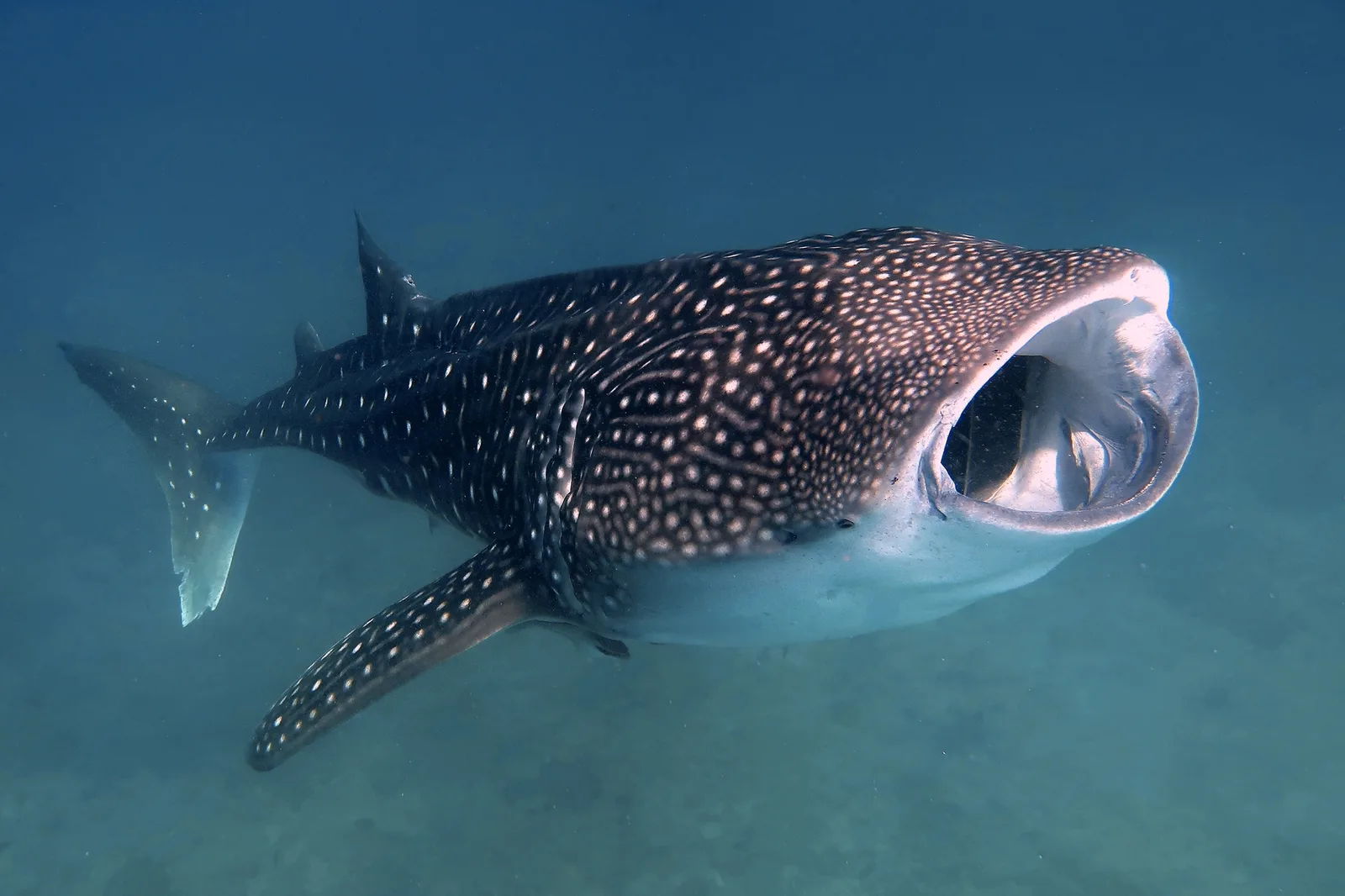
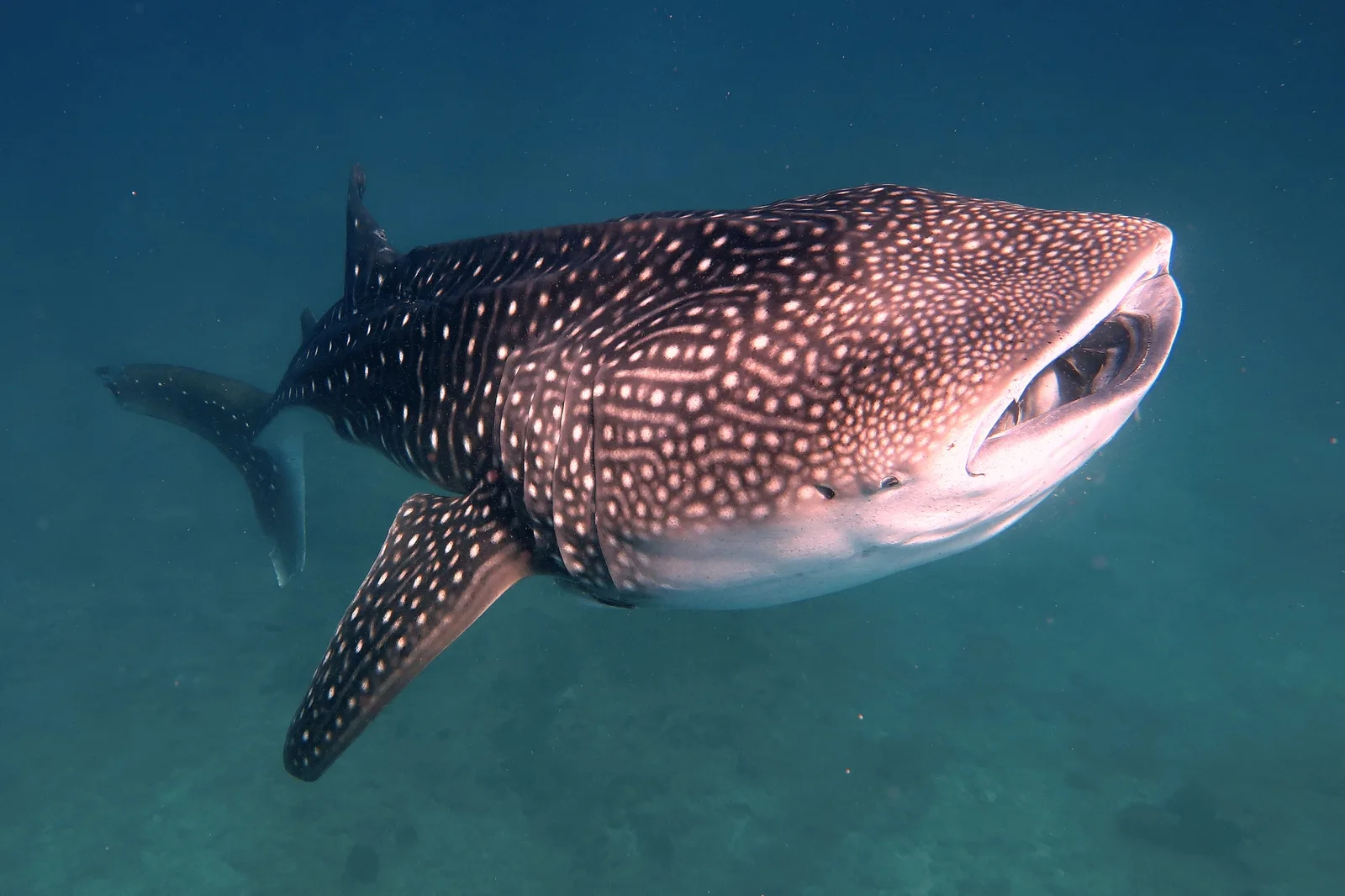
The head is broad and flat, with a mouth at the very front rather than underneath, as in most sharks. The mouth can be about 1.5 metres wide and holds over 300 rows of small teeth that play no part in feeding. Two small eyes sit at the front corners of the head, with a spiracle just behind each one. Five large gill slits open on each side, and 20 filter pads inside them sieve the food. Three ridges run along each flank from behind the head to the base of the tail.
The back is dark grey, the belly is white, and pale spots and stripes cover the upper body in a checkerboard. The pattern stays the same for life, so a photograph can identify one shark for decades. Spots even grow back over a healed wound. The skin is hard and rough, and it can be up to 15 centimetres thick. Tiny tooth-like scales called dermal denticles cover the body and even the surface of the eyeball.
Males average 8 to 9 metres long, and females grow larger, to about 14.5 metres. The largest well-measured shark was a female of 18.8 metres from the Arabian Sea in 2001. Older reports claim sharks of 18 to 20 metres, but none was measured with care. A dead shark found off Karachi in 2012 was 11 to 12 metres long and weighed around 15,000 kilograms.
Habitat and range
Whale sharks live in every tropical and warm-temperate sea. They usually stay between 30 degrees north and 35 degrees south, where the surface is warmer than 21 degrees Celsius. Wanderers have reached Canada's Bay of Fundy, Victoria in Australia and the Sea of Okhotsk beyond Japan. GBIF holds records from 86 countries, and nearly every coastal nation in the tropics has seen one.
The species is mostly pelagic, but it uses both the open ocean and the coast. Off the Yucatan, sharks swim near the surface inshore from sunrise to mid-afternoon, then move offshore and dive up and down all night. About 95% of that diving time is spent above 200 metres, with regular dives past 500 metres. The deepest dive on record reached 1,928 metres, where the water can be as cold as 7.8 degrees.
There are two subpopulations. The Atlantic one runs from Maine and the Azores to South Africa, and the Indo-Pacific one holds 75% of all whale sharks. Each year sharks gather to feed at Ningaloo Reef, Isla Mujeres, Donsol, the Galápagos, Mafia Island, Mozambique, the Seychelles and the coasts of India. In 2009 more than 400 came together off the Yucatan, one of the biggest gatherings ever seen.
Diet and feeding
The whale shark eats plankton: copepods, krill, arrow worms, jellyfish, fish eggs and crab larvae. It also takes small schooling fish such as sardines, anchovies and mackerel, plus squid and small tuna. When fish or corals spawn in mass, the shark arrives to swallow the clouds of eggs. It swallows and partly digests Sargassum seaweed too, which technically makes it an omnivore. A young shark is thought to eat about 21 kilograms of plankton a day.
There are three ways to feed. In ram feeding the shark swims forward with its mouth open and lets the water push food inside. In suction feeding it hangs still, often head up, and gulps water in and out. At the surface it can circle through dense plankton with its upper jaw out of the water. A shark can push over 6,000 litres of water an hour through its gills.
The water flows almost parallel to the filter pads, and the food particles carry on into the throat. This cross-flow method keeps the pads from clogging, and the mesh can catch prey as small as 1 millimetre. Now and then a shark coughs to flush debris from its pads. Because it feeds this way, it also swallows microplastics, which have been found in its droppings.
Behaviour and social life
Whale sharks usually travel alone, and they hold no territory and no home range. They cruise at about 1 metre per second and can keep that pace for many hours. One tagged shark covered over 13,000 kilometres in 37 months. A pregnant female nicknamed Rio Lady swam 7,772 kilometres in 150 days from the Yucatan to the Mid-Atlantic Ridge.
By day the sharks stay near the surface, and they dive after dark. This rhythm is thought to follow the daily cycle of light. Deep dives probably serve to find food when the surface of the open ocean is poor. Some sharks stayed below 50 metres for three days or more.
Seasonal gatherings bring hundreds of sharks to one patch of sea. Aerial surveys off Isla Contoy in Mexico counted up to 420 sharks in 18 square kilometres, and about 74% of them were males. Sharks stay in the Yucatan feeding area for 24 to 33 days on average, though some remain for six months. Whale sharks learn: captive sharks circle the feeding spot when a keeper appears, and wild sharks at Ningaloo take fish from fishermen.
Communication and senses
The eyes are small and set on the sides of the head, which gives a wide field of view. A whale shark can track a swimmer 3 to 5 metres away, so it sees objects and movement at close range. It can pull each eye deep into its socket to protect it. The retina's rod pigment is tuned to blue light, the colour that dominates the deep sea. The shark switches that pigment off in warm shallow water and on again in the cold at 2,000 metres.
The inner ear is the largest known in any animal, so the shark probably hears low, long-wavelength sounds best. The lateral line along the body senses water movement and helps with finding and catching prey. Like other sharks, it has pores on the head, the ampullae of Lorenzini, that sense faint electric and magnetic fields. It can register its heading against the Earth's magnetic field, which is thought to help navigation. The large, round smell organs suggest a sense of smell like that of the nurse shark.
Reproduction and life cycle
Nobody has seen a whale shark give birth, and mating has been watched only a handful of times. Two matings were seen at St Helena, and one was filmed from an aircraft off Ningaloo Reef in 2019. The eggs hatch inside the mother, and the pups are born alive. A 10.6 metre female harpooned off Taiwan carried about 300 embryos, the largest litter known in any shark. Genetic tests showed one father sired the whole litter, so the female probably stores sperm and fertilises eggs in batches.
The embryos live on their yolk, and the mother passes them no food. Pups are 40 to 60 centimetres long at birth and are not all born at once. The smallest live pup on record, 38 centimetres, was found tied to a stake on a beach in Sorsogon, Philippines, in 2009. Young pups and pregnant females turn up around St Helena, the Philippines and the Galápagos, which may be nursery areas. Like all sharks, the mother gives her pups no care after birth.
Growth bands in the backbone form once a year, as a study of Carbon-14 from nuclear tests showed in 2020. A 10 metre female proved to be 50 years old, and a 9.9 metre male was 35. Males mature at about 8 to 9 metres, which can take around 25 years, and females possibly later. Estimates from growth bands put the lifespan at 80 to 130 years. The captive record is a shark that had lived over 26 years at the Okinawa Churaumi Aquarium by 2021.
Predators and threats
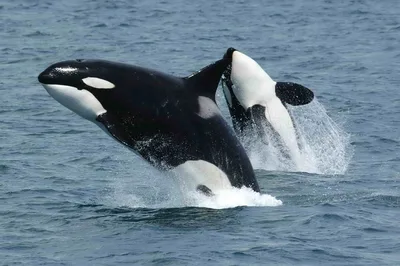
A healthy adult has almost no natural enemies. Orcas work together to flip a whale shark on its back and eat its oily liver, and they have taken sharks up to 8 metres. Tiger, blue and great white sharks attack young, sick or injured animals. Blue marlin may take very small pups. The thick, denticle-armoured skin is the main defence, and many sharks carry healed bite scars.
People are the real threat. Targeted fisheries, bycatch in nets and collisions with ships drove the decline that put the species on the Endangered list. In 2014 hundreds were still being killed illegally each year in China for fins, skin and oil. Propeller wounds are common: a 2006 survey in the Gulf of Tadjoura, Djibouti, found injuries on 65% of the sharks. The 2010 Gulf of Mexico oil spill covered a feeding area, and sharks were seen swimming through the slick.
Population and conservation
The IUCN Red List rates the whale shark as Endangered. Current estimates put the world population at 130,000 to 200,000 sharks, and it is falling. Over 75 years numbers dropped by about 50%: the Atlantic lost over 30%, and the Indian and Pacific Oceans lost roughly 63%. Counting is hard, because the sharks migrate across whole oceans.
Australia lists the species as Vulnerable under its federal law, and Mexico lists it as threatened. The Philippines banned all commercial fishing and trade in 1998, India followed in 2001 and Taiwan in 2007. Taiwan closed its whale shark fishery entirely in 2008. CITES added the species to Appendix II in 2003 to control international trade. The Bonn Convention on migratory species listed it in 1999, and it sits under a memorandum on migratory sharks.
Photo identification lets researchers follow individuals for years without tags. In the first half of 2019, WWF Philippines logged 168 sightings, 64 of them sharks already on file. Ecotourism now gives Mexico, Australia, the Philippines, the Maldives and others a reason to keep the sharks alive. At the Yucatan sites that tourism has grown to a level that is probably not sustainable.
Relationship with humans
The whale shark poses no danger to people. Young sharks are gentle and sometimes play with divers. Touching or riding a shark is banned and fined in most countries, because it harms the animal. In the Philippines snorkellers must stay 1.2 metres away, and a touch can bring a fine or prison. Divers meet the sharks in the Maldives, the Red Sea, Honduras, Mozambique, Mexico, the Galápagos and dozens of other places.
The meat is eaten in several countries and is sold in Taiwan as tofu shark. The fins are poor for soup, but restaurants display them as trophies, and live sharks have been finned in the Maldives and the Philippines. In Pakistan the liver oil was used to coat boat hulls and even as shoe polish. Sharks also tangle in nets and damage fishing gear.
Public aquariums have kept whale sharks since 1980, when Okinawa began, though the first try was a netted bay in Izu in 1934. Early captives died quickly, and the practice still draws protest. Outside Asia only the Georgia Aquarium in Atlanta holds the species, after a transport of 28 to 36 hours from Taiwan. By August 2025 it kept one male, Yushan, who arrived in 2007.
In culture and myth
In Vietnamese tradition fishermen call the shark ca ong, or sir fish, and treat it with honour. On the Kenyan coast it is papa shillingi, the shark that God covered in coins. Malagasy speakers see stars on its back, and so do people in Sulawesi, Papua and eastern Java. In Japan the name compares the spots to the pattern of a jinbei jacket.
The Philippines prints the shark on the reverse of its 100-peso note. The Maldives put it on the 1000 rufiyaa note issued in 2015 to 2017, next to a green turtle. Fijian speakers use the name Dakuwaqa, which is probably the name of a shark god in Fijian tradition too. The species is a mascot for ocean tourism, and WWF and other groups use it as a symbol of a healthy sea.
A sentence with a dotted underline is inferred: it describes the group the animal belongs to, or is a reading of the sources, rather than a measured or reported fact about this species.
Questions
Whale shark questions, answered
How big is a whale shark?
Adults measure 8 to 14.5 metres and weigh about 12,000 kilograms. The largest reliable record is a female of 18.8 metres. Females grow larger than males.
Is a whale shark a whale or a shark?
It is a shark, a fish with a cartilage skeleton and gills. The name refers only to its whale-like size.
Are whale sharks dangerous to humans?
No. The whale shark eats plankton and small fish, and its tiny teeth play no part in feeding. Divers swim beside it without harm.
What do whale sharks eat?
Plankton such as copepods, krill and jellyfish, plus fish eggs, crab larvae, small squid and schooling fish like sardines and anchovies. They also swallow some seaweed.
How do whale sharks feed?
They swim forward with the mouth open, or hang still and suck water in. Filter pads inside the gills trap the food and let the water out.
Where do whale sharks live?
In all tropical and warm-temperate seas, usually where the water is above 21 degrees Celsius. They use both the open ocean and the coast.
Where can I see a whale shark?
Seasonal gatherings happen at Ningaloo Reef in Australia, Isla Mujeres in Mexico, Donsol in the Philippines, the Maldives, Mozambique and the Galápagos. Do not touch the sharks.
How long do whale sharks live?
Growth bands in the backbone suggest 80 to 130 years. One shark has lived over 26 years in an aquarium in Okinawa.
Are whale sharks endangered?
Yes. The IUCN lists the species as Endangered after a fall of about 50% in 75 years. Between 130,000 and 200,000 remain.
How many pups does a whale shark have?
One female carried about 300 embryos, the largest litter of any shark. Pups are born alive at 40 to 60 centimetres.
How deep can a whale shark dive?
The deepest recorded dive reached 1,928 metres. Most time is spent above 200 metres.
How fast does a whale shark swim?
It cruises at about 1 metre per second, and tagged sharks reached speeds up to 3.9 kilometres per hour. It can keep going for hours.
Why do whale sharks have spots?
The spots break up the body outline, and they are unique to each shark. Researchers use photographs of them to identify individuals.
How thick is a whale shark's skin?
Up to 15 centimetres, and it is rough with tooth-like scales. It is the shark's main defence against bites.
What eats a whale shark?
Orcas flip young sharks to eat the liver, and tiger, blue and great white sharks attack weak animals. A healthy adult has almost no predators.
Do whale sharks have teeth?
Yes, over 300 rows of tiny teeth, but they are not used for feeding.
Food web
Prey and food
- plankton
- krill
- fish eggs
- fish
Food web
Predators
 Orca
- sharks
Ecological equivalents
Related species on this site
Bamboo Shark (same order), Nurse Shark (same order).