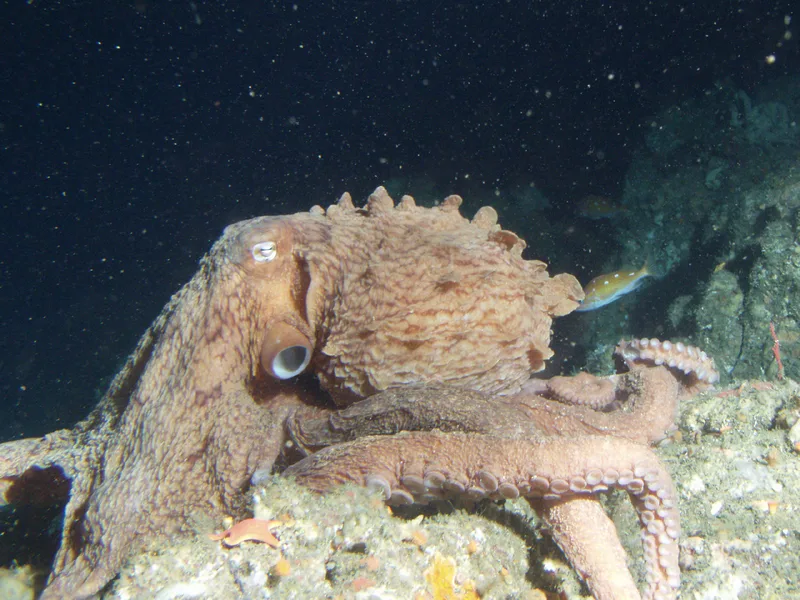
Giant Pacific octopus
The largest octopus, with three hearts and a sharp mind
Enteroctopus dofleini
Living individuals or members of this group exist today. This does not mean they are safe from extinction.
Meet the giant pacific octopus
The giant Pacific octopus is the largest octopus. It lives in the cold North Pacific, changes colour and texture in an instant, and solves puzzles in laboratory tests.
Images of the giant pacific octopus
Lifespan in the wild
4.5 to 5 years
Weight
About 15 kg
Fact file
Giant Pacific octopus
- Location
- The North Pacific from Japan to Alaska and California
- Habitat
- Coast, Open ocean
- Diet
- Carnivore
- Prey / food
- Crabs, clams, shrimp, fish, other octopuses
- Predators
- Seals, sea otters, sharks, sperm whales
- Lifestyle
- Nocturnal
- Name of young
- Paralarva
- Incubation
- 5 to 7 months of egg brooding
- Clutch size
- Up to 100,000 eggs
- Biggest threat
- Fishing bycatch
- Distinctive feature
- Red-brown skin that changes colour and texture
- Colour
- Red-brown; changes at will
- Skin type
- Soft, boneless skin
Size
Next to a person
Measurements
Size and speed
- Span
- Up to 4.3 m arm span
- Weight
- About 15 kg, up to 270 kg
Typical adult ranges. Source: Wikipedia.
Life cycle
Lifespan
- In the wild4.5 to 5 years
- 05 years
Source: Animal Diversity Web.
Appearance
Colour and coat
- Primary colours
- red-brown
- Secondary colours
- whitegrey
- Skin type
- soft, boneless skin that changes colour and texture
- Male and female
- Slight. The male carries a hectocotylus, a sucker-free tip on the third arm, which transfers sperm. Otherwise the sexes look alike.
Life cycle
Mating and family
- Mating system
- both sexes mate with several partners, and each breeds only once
- Social structure
- solitary
- Breeding
- one clutch of 20,000 to 100,000 eggs in a lifetime
The octopus matures at one to two years and breeds once. The male places two sperm packets inside the female and dies within three months. She lays 20,000 to 100,000 eggs in her den and guards them for about 6 months without feeding. She dies soon after the young hatch. The hatchlings drift as plankton for 1 to 3 months, settle, and live 4.5 to 5 years in all.
Classification
Taxonomy
- Kingdom
- Animalia
- Phylum
- Mollusca
- Class
- Cephalopoda
- Order
- Octopoda
- Family
- Enteroctopodidae
- Genus
- Enteroctopus
- Species
- Enteroctopus dofleini
Conservation
Red List status
- LC
- NT
- VU
- EN
- CR
- EW
- EX
Least Concern on the IUCN Red List
Range
Recorded in 6 countries
Habitat layer: mangrove.
Countries from 1,188 wild records on GBIF (iNaturalist research grade), filtered and checked by hand. Country shapes: Natural Earth. Habitat: RESOLVE Ecoregions 2017, CC BY 4.0. Basemap: Natural Earth.
Habitats
Three things to know
- 1
It has three hearts and blue blood.
- 2
A mother guards her eggs for months without eating and dies after they hatch.
- 3
It can squeeze through any gap larger than its beak.
Did you know
Seven more facts
- 1
The species has about 300 million neurons, and each arm carries its own cluster of nerves.
- 2
A single large sucker can hold 16 kilograms.
- 3
An octopus stays hidden or still 94% of the time.
- 4
A wild octopus was photographed drowning a seagull in 2012.
- 5
The male's sperm packet is more than 1 metre long.
- 6
A hatchling weighs 0.03 grams and grows to 20 to 40 kilograms, an increase of about 0.9% a day.
- 7
DNA suggests the species may be three subspecies, in Japan, Alaska and Puget Sound.
Field notes
How it looks and acts
Field notes
Distinguishing features
- An arm span up to 4.3 metres and a typical weight of about 15 kilograms.
- Reddish skin that changes colour and texture at will.
- Eight arms with up to 280 suckers each.
- A sack-shaped mantle with two large, sharp eyes.
- A hard chitin beak at the centre of the arms.
- A sucker-free tip on the male's third arm.
Field notes
Unique adaptations
- Skin that changes colour and texture in an instant for camouflage.
- A boneless body that passes through any gap wider than the beak.
- Suckers packed with chemical receptors that taste what they touch.
- A jet siphon for fast escape and an ink cloud as a screen.
- Toxic saliva and a drilling beak that open hard shells.
Field notes
Interesting behaviours
- Hides in a den by day and hunts mostly after midnight.
- Carries prey home and piles the shells outside the den.
- Holds one den for a month or more, then moves a short distance.
- Crawls on its arms over the sea floor and jets through open water.
- Solves puzzles and opens containers in captivity.
Field notes
Temperament
- Timid with divers, and it retreats into its den when approached.
- Curious and playful in aquariums, with distinct personalities.
- Solitary, and it tolerates another octopus only at mating.
Field notes
Communication
- Changes colour and skin texture, and aims these displays at particular people it knows.
- Jets water at keepers it recognises.
- Tastes and touches with thousands of receptors on each arm.
- Releases ink as a screen while it escapes.
Ecology
Ecological role
The giant Pacific octopus is a mid-level predator of the cold North Pacific coast, and it feeds seals, otters and whales.
- Eats clams, crabs, fish and squid, and its numbers move opposite to those of its prey.
- Feeds harbour seals, sea otters, sperm whales and sleeper sharks.
- Hosts dicyemid parasites in its kidney appendages.
- Its middens of shells outside the den feed scavengers.
Stories
Myths and legends
- In Norse tradition, the kraken drags ships under, and the giant Pacific octopus is one source of the legend.
- In Ainu tradition, the Akkorokamui is a giant red octopus that lives in Funka Bay.
- In Hawaiian tradition, the god Kanaloa is linked with the octopus.
- In Japanese tradition, Hokusai's print of a fisherman's wife and two octopuses is a famous work of art.
People
Relationship with humans
People
Living alongside us
People fish the giant Pacific octopus for food in Alaska, Japan and Korea, and it once served as halibut bait. It is a star of public aquariums, where it opens jars and learns to know its keepers. Scientists study it for its intelligence. It is timid with divers, and it has never been known to harm a person.
- It is timid and rarely aggressive toward people unless challenged.
- ADW records no known adverse effect on humans.
- A large octopus could probably hold a diver, but it lets go and retreats when it can.
People
Status, uses and products
- Domestication
- Wild
- As a pet
- Not suitable. It needs a large tank of cold seawater, live prey and a secure lid, and it lives under five years. Public aquariums keep it well, and a home tank cannot.
- Uses
- commercial fishingaquarium exhibitionscientific research
- Products
- meat
The full account
About the giant pacific octopus
The giant Pacific octopus, Enteroctopus dofleini, is the largest octopus in the world. An adult usually weighs about 15 kilograms, and the arms can span up to 4.3 metres. The largest specimen on record weighed 270 kg. It lives in the cold, oxygen-rich water of the North Pacific, from Japan and Korea round to Alaska and down to Mexico. It hides in a den by day and hunts crabs, clams, fish and other octopuses, mostly at night.
The species has three hearts, blue blood and a brain with about 300 million neurons. In aquariums it opens jars, solves puzzles and learns to tell one keeper from another. It lives only 4.5 to 5 years, which is long for an octopus but short for so large an animal. A female lays one clutch of up to 100,000 eggs, and she starves while she guards them, then dies once they hatch. The IUCN lists the species as Least Concern.
Name and taxonomy
Gerhard Wülker of Leipzig University described the species in 1910, in a work on Japanese cephalopods. He chose the name dofleini to honour the German scientist Franz Theodor Doflein. Wülker noted a great deal of variation within the species, a point that later DNA work would return to. Eric Hochberg moved the species into the genus Enteroctopus in 1998. GBIF now gives the family as Enteroctopodidae, while Wikidata still places the genus in Octopodidae.
The species is a cephalopod, a class of molluscs that also holds the squids, cuttlefish and nautiluses. Within the octopuses it belongs to the suborder Incirrata, the octopuses without fins or cirri on the arms. Other English names are the North Pacific giant octopus and the giant octopus, and divers often say GPO. In Japanese it is mizudako, and in Korean it is muneo.
Evolution and relatives
The genus Enteroctopus holds the giant octopuses, and E. dofleini is the biggest of them. Like other coleoid cephalopods, it descends from shelled ancestors, and it has lost the shell entirely. DNA analysis suggests that the species may in fact be three subspecies: one in Japan, one in Alaska and one in Puget Sound. Genetic techniques are now used to trace the evolutionary past of the species.
One study built a DNA test to tell this species from two other octopuses that are sold as food. Its large spermatophores, more than 1 metre long, are typical of the genus and probably mark a shared ancestry. Like other octopuses, it has a large, folded brain, which is thought to have evolved separately from the vertebrate brain.
Appearance
An adult usually weighs about 15 kilograms, and the arm span reaches 4.3 metres. The record specimen weighed 270 kg, with a radial span of 9.8 metres. ADW gives a typical mantle length of 50 to 60 centimetres. The skin is usually reddish, but the animal changes colour and texture in an instant to match the rock or the kelp around it. The body is soft and has no bones, so an octopus can push through any gap larger than its beak, down to 50 millimetres.
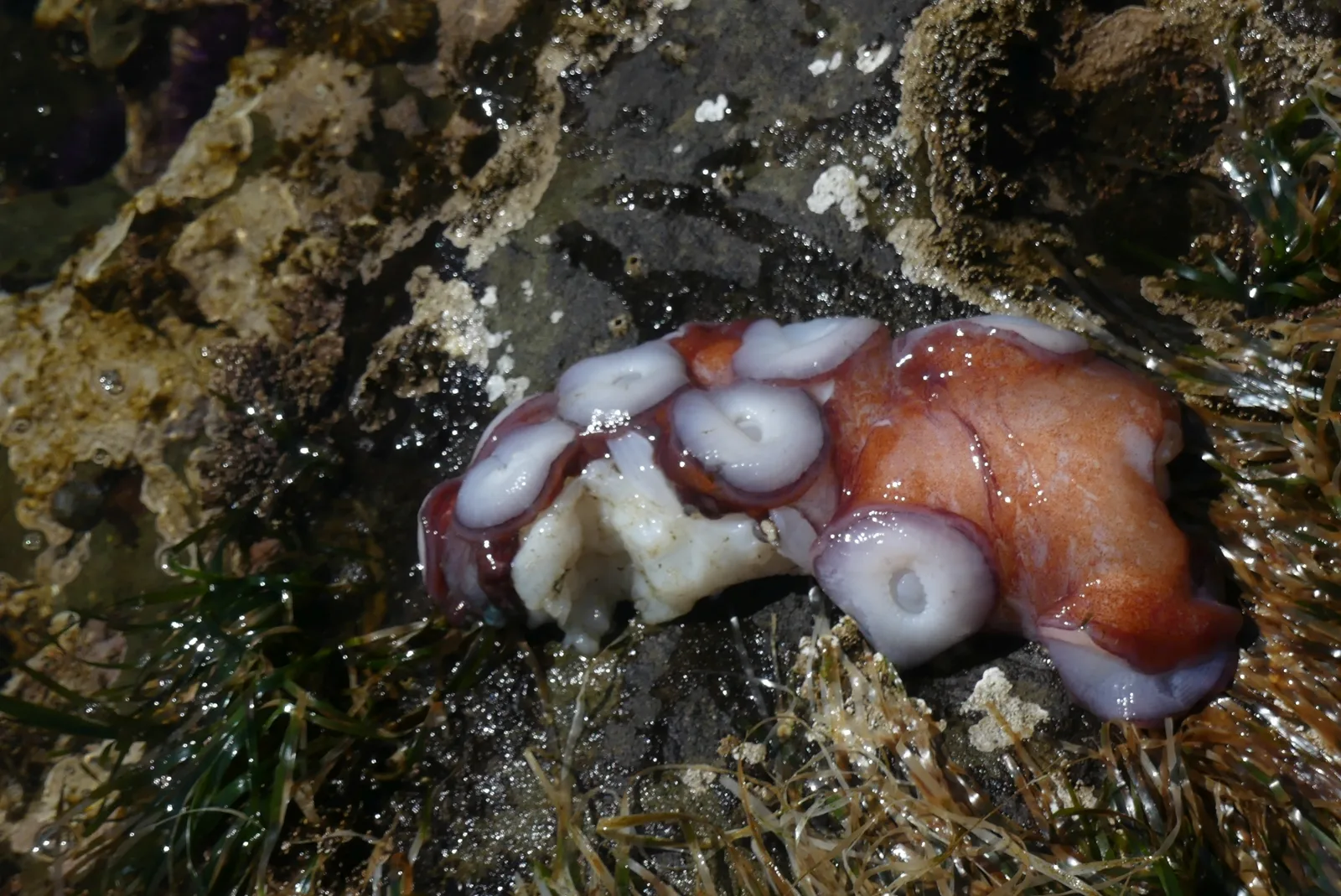
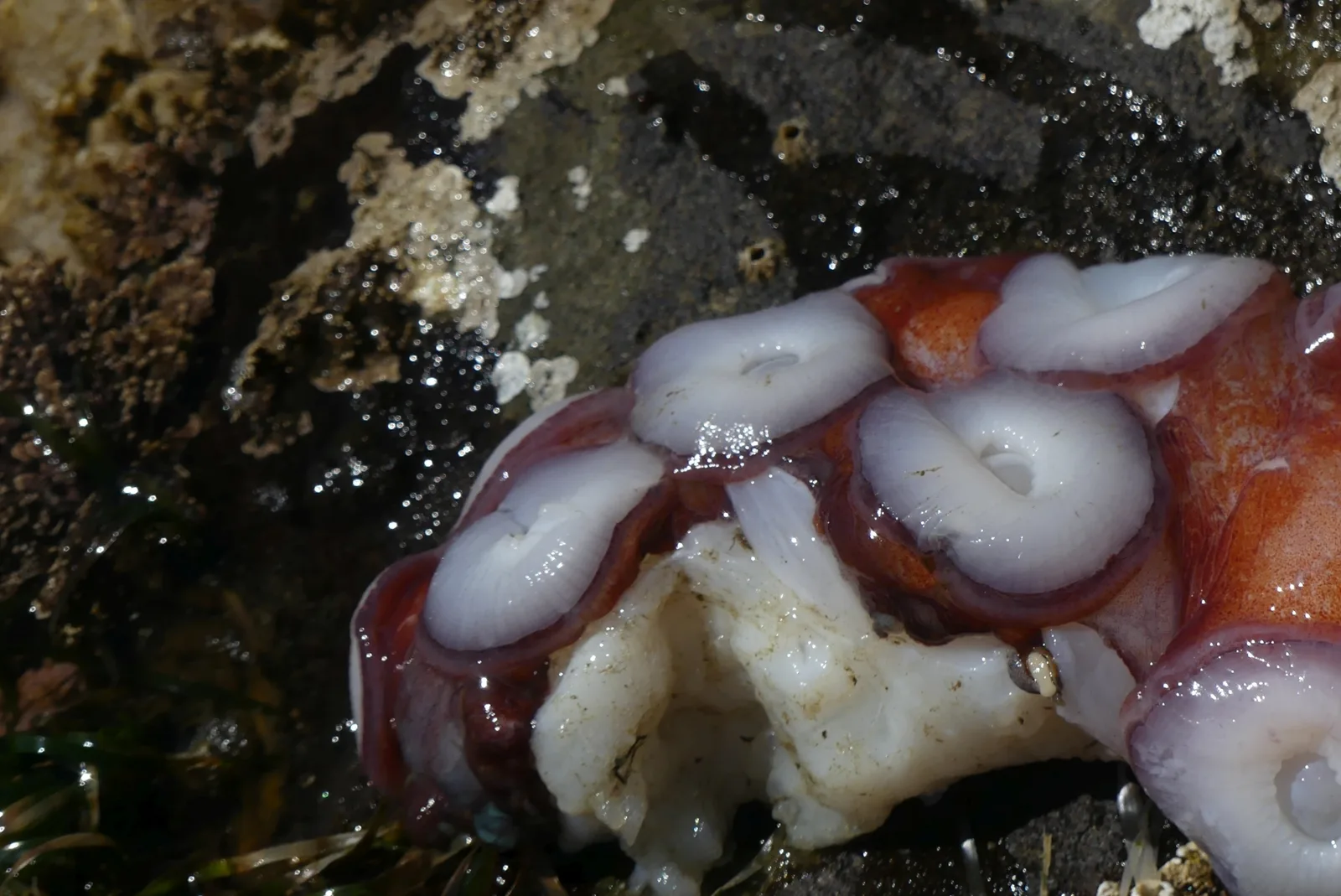
The sack-shaped mantle holds the brain, the gut, the reproductive organs and two eyes with very sharp vision. Eight arms extend from the mantle, and each carries up to 280 suckers. The largest suckers measure about 6.4 centimetres across, and each can hold 16 kg. A hard beak of chitin sits at the centre of the arms. The male's third arm ends in a hectocotylus, a section without suckers that transfers sperm.
Habitat and range
The species lives in the coastal North Pacific. On the American side it ranges from Baja California in Mexico north through California, Oregon, Washington and British Columbia to Alaska and the Aleutian Islands. On the Asian side it lives off Kamchatka, in the Sea of Okhotsk, around Japan and Korea, and south to the East China Sea. It occurs from tide pools down to 2,000 metres deep, though ADW puts most animals above 110 metres.
The octopus does best in cold water rich in oxygen, at about 8 to 12 degrees Celsius. Its blue blood carries oxygen with copper rather than iron, and it carries oxygen poorly, so warm water is a problem. The ideal sea floor is mud, sand or gravel with large boulders for dens, close to dense kelp. Dens can be caves, holes dug under rocks, or rubbish such as bottles, tyres, pipes and barrels.
The home range is small, under 5 square kilometres. GBIF holds records from 23 countries, but that count includes aquariums and misidentified animals, and it is not the native range. iNaturalist holds 2,839 observations, most of them from divers in the United States and Canada.
Diet and hunting
The giant Pacific octopus eats shrimp, crabs, clams, cockles, scallops, abalone, snails, lobsters, fish, squid and other octopuses. It is a generalist, and the shells piled outside a den show that clams, crabs, fish and squid make up most meals. In captivity it has caught spiny dogfish up to 1.2 metres long, and dogfish remains turn up in wild middens too. In 2012 a photographer recorded a wild octopus seizing and drowning a seagull.
It hunts by sight, and it stalks, chases or waits in camouflage to ambush prey. It grips prey with its suckers and then bites with the beak. To open a shell it pulls the halves apart, crushes them, or drills a hole and injects toxic saliva. It carries food back to the den to eat in safety, and it dumps the remains at the entrance. Scientists and divers use this den litter to find an octopus.
Behaviour and social life
The species is solitary, and each adult keeps its own den. An octopus stays hidden or still 94% of the time, in a den, in kelp or under camouflage. It is active through the day but most active from midnight to early morning. It holds one den for at least a month and often longer, and it returns after short trips away. When it does move house, the new den is usually close, on average about 13.2 metres away.
The octopus crawls on its arms over the sea floor. In open water it swims by jet propulsion, drawing water into the mantle and forcing it out through the siphon. Large animals travel farther than small ones, and they choose rocky ground with dense kelp. Off Japan the population moves inshore in early summer and winter and offshore in late summer and winter. The Alaskan and north-east Pacific populations show no such migration.
In aquariums it opens childproof bottles, solves simple puzzles and uses tools. It also opens tank valves and takes equipment apart, and keepers report distinct personalities from playful to destructive. It is timid with people, and it rarely acts aggressively unless challenged.
Communication and senses
The eyes give very sharp vision, and the octopus hunts and navigates by sight. It finds its way by landmarks such as cliff edges and the shape of the sea floor. Each sucker holds thousands of chemical receptors, so the arms taste and touch at the same time. The brain has folded lobes with separate centres for visual and tactile memory, and each arm carries its own cluster of nerves.
In aquariums it recognises the people it meets often, and it jets water or changes texture at particular individuals. ADW reports that it is the only invertebrate known to learn by watching. Like other octopuses, it signals mood through colour and skin texture, and a pale animal is probably calm while a dark one is alarmed. Ink is a last resort: the octopus fights with its arms first, then jets away and leaves an ink cloud as a screen.
Reproduction and life cycle
The octopus matures at one to two years, and it breeds only once. Breeding happens all year, with a peak in winter. The male uses his hectocotylus to place two spermatophores, each about 1 metre long, inside the female's mantle. Mating takes 2 to 3 hours. The female can store the sperm for months, and one female in Seattle kept it for seven months before laying. Egg clutches show that both sexes mate with several partners.
Over several days the female lays 20,000 to 100,000 eggs, though Wikipedia cites figures up to 400,000. Each egg is shaped like a grain of rice, and she hangs them from the den roof in clusters of 200 to 300. She blows water over the eggs, cleans off algae and never leaves to feed. Hatching takes about 6 months in most water, and from 150 days to almost a year depending on temperature. The female starves during the brooding and dies soon after the young hatch. The male dies within three months of breeding.
Hatchlings are about 9.5 to 10.1 millimetres long, and they swim up to live as plankton for 1 to 3 months. Then they settle on the sea floor and grow fast, from 0.03 grams to 20 to 40 kg as adults. The whole life lasts 4.5 to 5 years, in the wild and in aquariums alike. After breeding, both sexes enter senescence: they stop eating, wander, and develop white lesions before they die.
Predators and threats
Harbour seals, sea otters and sperm whales all eat the giant Pacific octopus, and Pacific sleeper sharks take it too. Scavengers try to eat the eggs even while the female guards them. The paralarvae are eaten by birds, fish and other plankton feeders. Adults have few predators apart from people.
Fishing bycatch is the biggest threat named in our fact file. Warmer water speeds up egg development and can shorten the lifespan by up to 20%. Each autumn in Hood Canal, Washington, dying plankton use up the oxygen and create a dead zone. Oxygen there falls to 2 parts per million, against a normal 7 to 9 ppm. Ocean acidification cuts the clams, crabs and scallops that the octopus eats. A small fall in pH also reduces how much oxygen its copper-based blood can carry. Researchers have found heavy metals and PCBs in its tissues, probably from red rock crabs that live in polluted sediment.
Population and conservation
The IUCN lists the species as Least Concern, and it is not on any CITES appendix. NatureServe rates it N4, apparently secure, in Canada. Nobody has counted the population, because the animals are solitary and hard to find. Scientists use catch numbers as a proxy, but mislabelling in the seafood trade makes even that unreliable.
In Puget Sound a legal catch caused a public outcry, and Washington then protected the octopus at seven sites. The Puget Sound population is not considered threatened. Seafood Watch rates Alaskan giant Pacific octopus as a Best Choice. Some research suggests that fishing of other species has helped the octopus, by removing its predators and competitors.
Relationship with humans
People have caught octopuses for thousands of years with lures, spears, pots, nets and bare hands. Octopus, squid and cuttlefish together supply about 3.3 million tonnes of food a year, worth about 6 billion dollars. This species is fished commercially in parts of the Pacific and eaten in several countries. In the 1950s and 1960s fishermen used it as bait for Pacific halibut, but that practice has faded.
The species is a favourite in public aquariums because of its size and its behaviour. It is also a subject of research into intelligence and learning. The species is wild, and it is harmless to people: ADW records no adverse effect on humans. Divers describe it as shy, and it will usually retreat into its den rather than approach.
In culture and myth
The giant Pacific octopus is one source of the Norse kraken, the sea monster that dragged ships under. In Ainu tradition the Akkorokamui, a huge red octopus, lives in Funka Bay in Hokkaido. Hawaiian tradition links the sea god Kanaloa with the octopus. Hokusai's print of a fisherman's wife with two octopuses is the most famous image of the animal in Japanese art.
Today the octopus stands for intelligence, adaptability and mystery. Its escapes from aquarium tanks are widely reported, and they probably do more for its reputation than any myth. Nature films and books on animal minds often use this species, probably because it is large and easy to keep on display.
A sentence with a dotted underline is inferred: it describes the group the animal belongs to, or is a reading of the sources, rather than a measured or reported fact about this species.
Questions
Giant Pacific octopus questions, answered
How big is a giant Pacific octopus?
A typical adult weighs about 15 kilograms, and its arms span as much as 4.3 metres. The largest on record weighed 270 kg with a span of 9.8 metres.
How long does a giant Pacific octopus live?
It lives 4.5 to 5 years, in the wild and in aquariums. Most other octopuses live about a year.
What do giant Pacific octopuses eat?
They eat crabs, clams, scallops, shrimp, snails, fish, squid and other octopuses. Large ones have caught small sharks and even a seagull.
Are giant Pacific octopuses intelligent?
Yes. Octopuses rank as the most intelligent invertebrates, and this species opens jars, solves puzzles, uses tools and learns to recognise individual keepers. Its brain has about 300 million neurons.
Does a giant Pacific octopus have three hearts?
Yes. Two hearts pump blood through the gills, and the third pumps it round the body. The blood is blue because it carries oxygen with copper.
Where do giant Pacific octopuses live?
They live in the cold North Pacific, from Japan and Korea round to Alaska and south to Baja California. They occur from tide pools down to 2,000 metres.
Are giant Pacific octopuses dangerous to humans?
No. They are timid with divers and retreat into their dens. ADW records no known harm to a person.
Why does the female octopus die after laying eggs?
She guards her eggs for about 6 months and never leaves to feed. She lives on her body fat, and she starves soon after the young hatch.
How many eggs does a giant Pacific octopus lay?
A female lays 20,000 to 100,000 eggs, and some sources report up to 400,000. She hangs them from the den roof in clusters of 200 to 300.
How does a giant Pacific octopus change colour?
Its skin changes colour and texture in an instant to match rock or kelp. It also uses these changes to signal, and in aquariums it aims them at particular people.
Are giant Pacific octopuses endangered?
No. The IUCN rates the species Least Concern. The main pressure is fishing bycatch, and nobody has counted the population.
Can a giant Pacific octopus squeeze through small gaps?
Yes. Its body has no bones, so it can pass through any gap larger than its beak, as small as 50 millimetres.
What eats a giant Pacific octopus?
Harbour seals, sea otters, sperm whales and Pacific sleeper sharks eat adults. Birds and fish eat the young while they drift as plankton.
Do people eat giant Pacific octopus?
Yes. It is fished commercially in parts of the Pacific and eaten in Japan, Korea and North America. Seafood Watch rates the Alaskan catch as a Best Choice.
How fast does a giant Pacific octopus grow?
A hatchling weighs 0.03 grams and grows to 20 to 40 kilograms as an adult. That is an increase of about 0.9% a day.
Food web
Prey and food
- crabs
- clams
- shrimp
- fish
- octopuses
Food web
Predators
- seals
- sea otters
- sharks
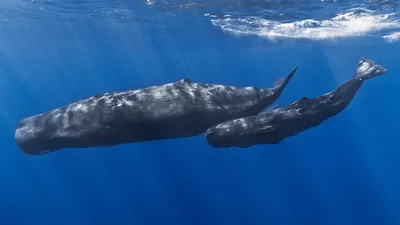 Sperm whale
Ecological equivalents
Related species on this site
Blue-Ringed Octopus (same order).