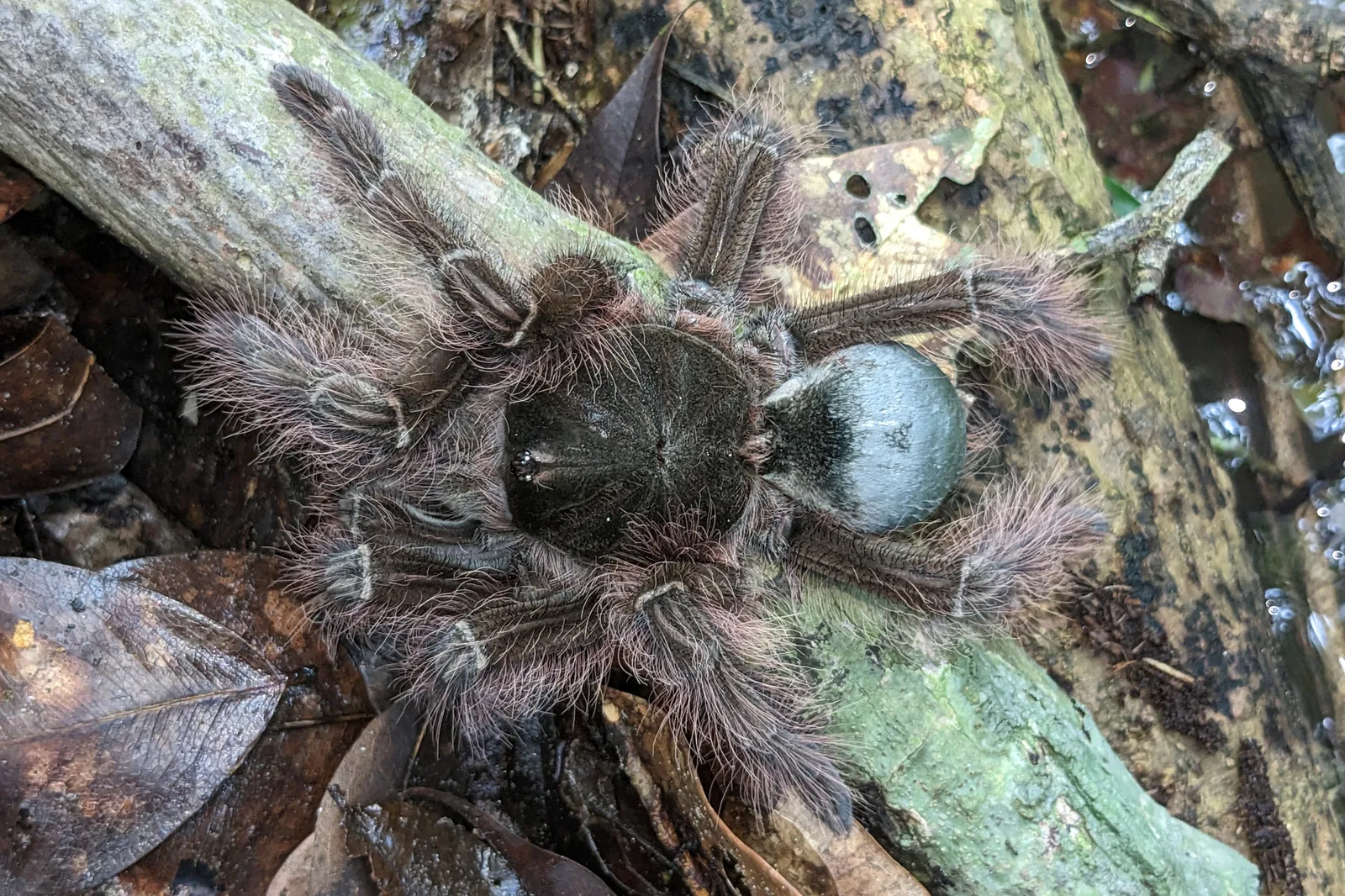
Goliath birdeater
The heaviest spider on Earth, and it rarely eats a bird
Theraphosa blondi
Living individuals or members of this group exist today. This does not mean they are safe from extinction.
Meet the goliath birdeater
The Goliath birdeater is the heaviest spider in the world. It lives in burrows on the Amazon rainforest floor and, despite its name, rarely eats birds.
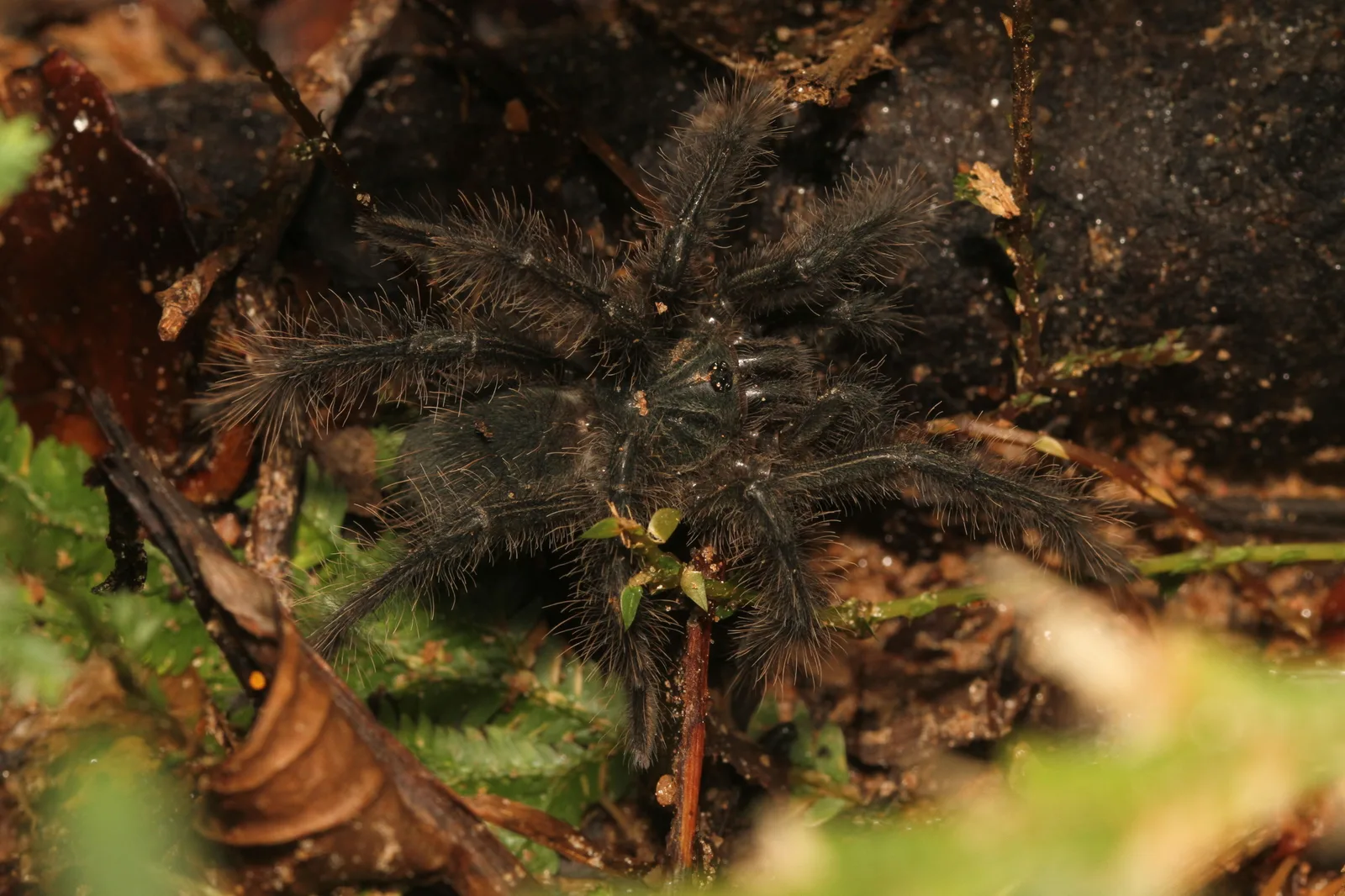
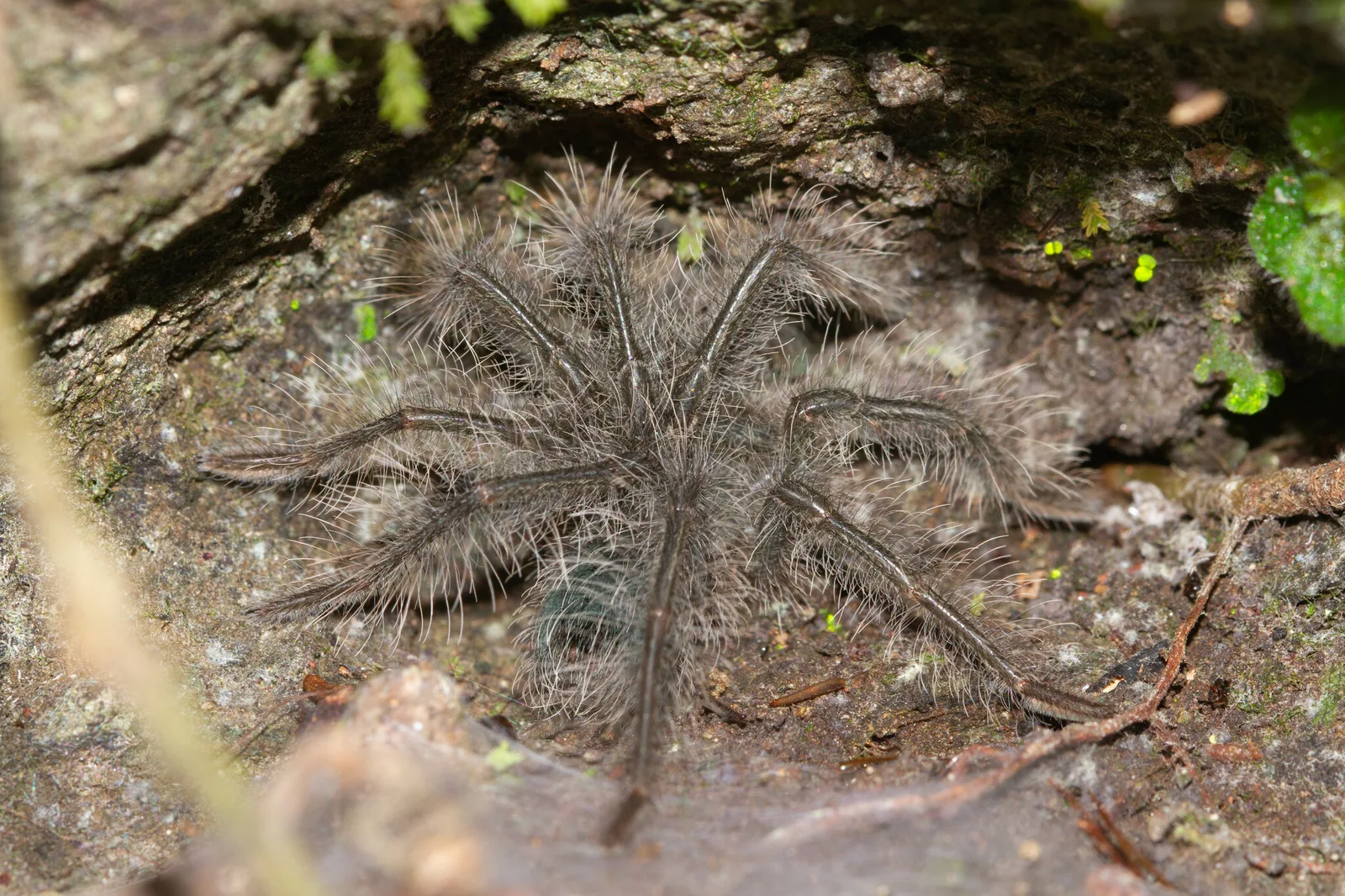
Images of the goliath birdeater
Lifespan in the wild
15 to 25 years for a female
Weight
Up to 175 g
Length
Up to 13 cm
Fact file
Goliath birdeater
- Location
- Northern South America: Brazil, Venezuela, Guyana, Suriname
- Habitat
- Rainforest
- Diet
- Carnivore
- Prey / food
- Insects, worms, frogs, rodents
- Predators
- Tarantula hawk wasps, coatis, snakes
- Lifestyle
- Nocturnal
- Name of young
- Spiderling
- Incubation
- 6 to 8 weeks of egg development
- Clutch size
- 50 to 200 eggs
- Biggest threat
- Habitat loss and collection for the pet trade
- Distinctive feature
- Fangs up to 4 cm long
- Colour
- Brown
- Skin type
- Hairy exoskeleton
Size
Next to a person
Measurements
Size and speed
- Length
- Up to 13 cm body
- Span
- Up to 30 cm leg span
- Weight
- Up to 175 g
Typical adult ranges. Source: Wikipedia.
Life cycle
Lifespan
- In the wild15 to 25 years for a female
- 025 years
Males live only a few years after they mature.
Source: Wikipedia.
Appearance
Colour and coat
- Primary colours
- brown
- Secondary colours
- tangold
- Skin type
- hairy exoskeleton
- Male and female
- Moderate. The female is heavier and lives far longer. The male is lighter with longer legs, and he lacks the leg spurs that most male tarantulas carry.
Life cycle
Mating and family
- Mating system
- a wandering male mates with a burrow-holding female, and she rarely eats him
- Social structure
- solitary
- Breeding
- one egg sac of 100 to 200 eggs, which hatch in 6 to 8 weeks
A female matures in 3 to 6 years and can then live 15 to 25 years. A male dies within months of his final moult. The female lays 100 to 200 eggs in a silk sac in her burrow, and spiderlings hatch within 6 to 8 weeks. The young grow by moulting, and each moult renews the barbed hairs. The female rarely eats the male during mating.
Classification
Taxonomy
- Kingdom
- Animalia
- Phylum
- Arthropoda
- Class
- Arachnida
- Order
- Araneae
- Family
- Theraphosidae
- Genus
- Theraphosa
- Species
- Theraphosa blondi
Conservation
Red List status
- LC
- NT
- VU
- EN
- CR
- EW
- EX
Not Evaluated. The IUCN has no category for this species yet.
Range
Recorded in 4 countries
Habitats
Three things to know
- 1
It makes a hissing sound by rubbing its leg bristles together.
- 2
It flicks barbed hairs at attackers that irritate skin and eyes.
- 3
Its venom is about as harmful to a person as a wasp sting.
Did you know
Seven more facts
- 1
Despite its name, the spider rarely eats birds, and its usual prey are insects, worms and frogs.
- 2
The bird-eater name comes from an engraving of a tarantula with a hummingbird, made in the early 1700s.
- 3
The fangs are 2 to 4 centimetres long and can break human skin, but the bite feels like a wasp sting.
- 4
The barbed hairs it flicks from its abdomen irritate skin and eyes more than the bite does.
- 5
The female rarely eats the male after mating, unlike some other spiders.
- 6
iNaturalist holds only 507 observations of the species.
- 7
The largest fossil spider, Mongolarachne, had a body of 2.46 centimetres, a fraction of this spider's 13.
Field notes
How it looks and acts
Field notes
Distinguishing features
- A body up to 13 centimetres long and a leg span up to 30 cm.
- A brown body covered in hair, with faint markings on the legs.
- Fangs 2 to 4 centimetres long that strike downward.
- Barbed hairs on the abdomen that the spider can flick at an attacker.
- No spurs on the front legs of the male, unlike most tarantulas.
Field notes
Unique adaptations
- Barbed hairs that the spider throws with its hind legs to irritate an attacker's skin and eyes.
- Bristles that rub together to make a hissing warning.
- Large fangs and venom that turn the inside of prey to liquid.
- A deep burrow that shelters the spider by day and hides it while it eats.
- Like other tarantulas, fine hairs on the legs that sense vibration in the dark.
Field notes
Interesting behaviours
- Hunts at night by ambush from its burrow.
- Drags prey underground before it eats.
- Hisses, rears and shows its fangs when disturbed.
- Rubs its hind legs over its abdomen to flick barbed hairs.
- Stays alone in its burrow except at mating.
Field notes
Temperament
- Defensive rather than aggressive, and it bites only as a last resort.
- Quick to hiss and flick hairs when disturbed.
- Like other tarantulas, calm when left alone in its burrow.
Field notes
Communication
- Hisses by rubbing bristles on its legs and pedipalps together.
- Probably senses the vibration of nearby animals through the hairs on its legs.
- Is thought to find mates through chemical traces on silk.
- Males of related tarantulas drum on the ground, and this species may do the same.
Ecology
Ecological role
The Goliath birdeater is a night-time ambush predator of the rainforest floor, and it is food for wasps, coatis and snakes.
- Eats large insects, earthworms, frogs and toads, and sometimes rodents, lizards and snakes.
- Feeds tarantula hawk wasps, which use it to feed their larvae.
- Its burrow probably shelters other small animals after the spider leaves.
Stories
Myths and legends
- In Piaroa tradition in Venezuela, the spider is roasted in banana leaves and eaten as ordinary food.
- In European tradition, the picture of a tarantula eating a hummingbird is thought to have started the bird-eater name.
- In Hebrew tradition, Goliath was a giant, and the spider is thought to carry his name for its size.
- In Italian tradition, the tarantella dance is thought to have been a cure for a spider bite in Taranto.
People
Relationship with humans
People
Living alongside us
People fear the Goliath birdeater for its size, but its bite is no worse than a wasp sting. The barbed hairs it flicks are the real hazard, because they irritate skin and eyes. People in Venezuela and neighbouring countries eat the spider, roasted in banana leaves. It is also collected for the pet trade and shown in zoos.
- A bite breaks the skin and hurts like a wasp sting, but the venom is mild.
- The barbed hairs irritate the skin and the eyes badly, so never hold the spider near your face.
- It bites only in self-defence, and some bites deliver no venom.
People
Status, uses and products
- Domestication
- Wild
- As a pet
- Not suitable. Keepers do hold this species, but it is a poor pet. It flicks irritating hairs, it bites when handled, and a female may live 25 years. Buy only a captive-bred spider if you must keep one.
- Uses
- pet tradezoo exhibitionfood
- Products
- None recorded
The full account
About the goliath birdeater
The Goliath birdeater, Theraphosa blondi, is a tarantula from the rainforests of northern South America. It is the heaviest spider in the world, at up to 175 grams, and its body reaches 13 centimetres. Its legs span up to 30 cm, and only the giant huntsman spider spreads wider. The spider lives in a deep burrow on the forest floor and comes out at night to hunt. Its name comes from an old engraving of a tarantula eating a hummingbird, but birds are rare in its diet.
Most of its prey are large insects, worms, frogs and toads, with the odd rodent, lizard or snake. When threatened it hisses by rubbing bristles together, and it flicks barbed hairs from its abdomen. Its bite hurts about as much as a wasp sting. A female lives 15 to 25 years, but a male dies within months of reaching maturity. The IUCN has not assessed the species, and people in Venezuela roast and eat it.
Name and taxonomy
Pierre André Latreille described the species in 1804, and GBIF gives the name as Theraphosa blondi (Latreille, 1804). The species name blondi is thought to honour a collector named Leblond, and the French name Mygale de Leblond keeps that link. The spider belongs to the family Theraphosidae, the tarantulas, in the order Araneae. Within the tarantulas it sits in the subfamily Theraphosinae and the genus Theraphosa, which iNaturalist calls the Goliath tarantulas. Tarantulas are mygalomorph spiders, a suborder whose fangs strike downward rather than pinching sideways.
English speakers also call it the Goliath bird-eating spider or the Goliath tarantula. Portuguese speakers call it aranha-golias, and Spanish speakers call it tarántula Goliat. The Goliath part of the name is thought to borrow the biblical giant, because the spider is so much bigger than its relatives. The bird-eating part goes back to a copper engraving from the early 1700s by Maria Sibylla Merian. Her picture showed a tarantula with a hummingbird, and the label stuck to the whole family.
Evolution and relatives
Tarantulas belong to the Mygalomorphae, the older of the two main groups of living spiders. Like other mygalomorphs, the Goliath birdeater keeps a body plan that is thought to have changed little for a very long time. The largest known fossil spider, Mongolarachne, had a body only 2.46 centimetres long, so the Goliath birdeater is far larger. The genus Theraphosa holds the largest tarantulas, and T. blondi is its best known member.
The Goliath birdeater lacks the tibial spurs that most adult male tarantulas carry on the first pair of legs. Those spurs usually hold the female's fangs during mating, so this species probably mates in a different way from most tarantulas. Its closest relatives are probably the other Theraphosa species of the Guiana Shield and the Amazon.
Appearance
The body of a large female reaches 13 centimetres, and the leg span reaches 30 cm. The heaviest recorded specimen weighed 175 grams. The colour runs from dark brown to light brown, often with a tan or golden tint, and the legs carry faint markings. Hair covers the body, the abdomen and the legs. Some of the hairs on the abdomen are barbed, and the spider can flick them at an attacker.
The fangs are 2 to 4 centimetres long, and they are big enough to break human skin. Like other tarantulas, it has eight legs, two leg-like pedipalps at the front and eight small eyes grouped on the head. Like other tarantulas, the male is lighter in build than the female and has longer legs for its body size. Unlike most male tarantulas, the male has no spurs on its front legs.
Habitat and range
The Goliath birdeater lives in upland rainforest in northern South America. Its range covers southern Venezuela, eastern Colombia, Guyana, Suriname, French Guiana and northern Brazil. It is most often seen in the Amazon rainforest, and it favours marshy or swampy ground. The spider lives on the ground, in a deep burrow, and it is active at night.
The burrow is probably a deserted rodent hole or a hollow under a root, which the spider lines with silk. GBIF holds records from 9 countries, but that count includes captive animals and is not the native range. iNaturalist holds only 507 observations of the species, which is few for such a famous animal. That low count probably reflects how hard the spider is to find, because it stays in the burrow by day. The same burrow probably floods in the wet season, and the spider is thought to move to higher ground when it must.
Diet and hunting
Despite the name, the Goliath birdeater rarely eats a bird. In the wild its diet is mostly large arthropods, earthworms and amphibians. Its size lets it take small vertebrates too, and people have seen it eat rodents, frogs, toads, lizards and snakes. It is an opportunist, and it kills a wide range of insects and small ground animals.
The spider hunts at night by ambush, from the mouth of its burrow or close to it. Like other tarantulas, it does not spin a web to catch prey and instead grabs with its front legs and bites. It never eats in the open, and it drags the prey back into the burrow first. It injects fluids that turn the inside of the prey to liquid, and then it sucks the body dry. A spider of this size probably needs only a few large meals a month, as other big tarantulas do. In captivity it has taken prey much larger than an insect, and it will eat almost anything it can overpower. Like other tarantulas, it can probably go for weeks without food after a big meal.
Behaviour and social life
The Goliath birdeater is solitary, and each adult keeps its own burrow. It is nocturnal, and it spends the day hidden underground. Like other tarantulas, it probably stays close to home and returns to the same burrow for years. Females are thought to hold a burrow for most of their long lives, while mature males wander in search of mates.
When disturbed the spider first hisses, then rears up and shows its fangs. If the threat stays, it rubs its hind legs over its abdomen and throws barbed hairs into the air. It bites only as a last defence, and a bite does not always deliver venom. The spider tolerates another of its kind only at mating, and the female probably attacks a male that lingers. Even so, this species is calmer than its reputation, and the female rarely kills the male.
Communication and senses
The spider makes a hissing sound by rubbing bristles on its pedipalps and legs together, a habit called stridulation. The hiss warns an attacker before the spider uses its hairs or its fangs. Like other tarantulas, it sees poorly, and its eight small eyes are thought to detect little more than light and movement. It relies instead on touch, and the hairs on its legs probably sense the vibration of an animal walking nearby.
Like other spiders, it tastes and smells with fine hairs on its legs and pedipalps, a sense called chemoreception. A male probably finds a female by following chemical traces on her silk, as other tarantulas do. Males of many tarantulas drum on the ground to announce themselves, and this species may do the same.
Reproduction and life cycle
A female matures in 3 to 6 years. A male matures in a similar time, but he dies within months of his final moult, so his whole life lasts three to six years. Unlike some spiders, the female rarely eats the male during mating. The female lays 100 to 200 eggs in a silk sac inside the burrow. Spiderlings emerge from the eggs after 6 to 8 weeks.
Like other tarantulas, a spiderling grows by moulting, and it sheds its whole exoskeleton each time. A young spider probably moults several times a year, and an adult female is thought to moult about once a year. A moult also renews the barbed hairs that the spider flicked away. Females live 15 to 25 years, which is long for any spider. Spiderlings probably leave the mother's burrow after their first moults and dig small burrows of their own.
Predators and threats
Tarantula hawk wasps hunt this spider, and they sting it and drag it away as food for their larvae. Coatis and snakes also eat it. The barbed hairs and the hiss are its main defences, and the venomous bite comes last. A spider in its burrow is probably safe from most predators, and the danger comes when it hunts or wanders.
The site's fact file names habitat loss and collection for the pet trade as the biggest threats. Logging and clearing of the Amazon rainforest probably reduce the number of burrows year by year. People in northern South America also catch and eat the spider.
Population and conservation
The IUCN has not evaluated the species, so its code is NE, Not Evaluated. iNaturalist records a French national listing of NE, and one other listing of Vulnerable without a stated place. No one has counted the population. The species is thought to be widespread across the Guiana Shield and the northern Amazon, and it is not known to be rare.
Collection for the pet trade is one of the two threats named for the species. Captive breeding probably supplies most pet spiders now, which may lower the pressure on wild burrows. Habitat loss is probably the larger long-term threat, because a spider that lives 25 years needs a forest that lasts as long.
Relationship with humans
The Goliath birdeater is famous for its size, and many people fear it more than it deserves. Its venom is mild, and a bite feels about like a wasp sting. The barbed hairs are the greater hazard, because they irritate the skin and the eyes badly. The spider bites only when threatened, and a bite is sometimes dry, with no venom.
People in north-eastern South America eat the spider. They singe off the hairs, wrap the body in banana leaves and roast it, and the flavour is said to be like shrimp. The species is also kept as a pet and displayed in zoos, which is why GBIF holds records outside its range. The spider is wild, and nobody has domesticated it.
In culture and myth
Maria Sibylla Merian, a German naturalist, drew a tarantula eating a hummingbird in Suriname around 1705. Her engraving gave every large tarantula the name bird-eater, and this species kept the name after everything else changed. The Piaroa people of Venezuela roast the spider in banana leaves and eat it, and the custom is well recorded. In Piaroa tradition, the spider hunt is thought to be a skill that children learn, and the meal is an ordinary one.
The name Goliath is thought to come from the giant of the Hebrew Bible, whom David killed with a sling. The word tarantula is thought to come from Taranto in Italy, where a folk dance was said to cure the bite of a local spider. The Goliath birdeater appears in many lists of record animals, and it may be the spider most people picture as a tarantula.
A sentence with a dotted underline is inferred: it describes the group the animal belongs to, or is a reading of the sources, rather than a measured or reported fact about this species.
Questions
Goliath birdeater questions, answered
How big is a Goliath birdeater?
The body reaches 13 centimetres and the legs span up to 30 cm. The record weight is 175 grams. Only the giant huntsman spider has a wider leg span.
Is the Goliath birdeater the biggest spider in the world?
Yes, by weight and body length. It weighs up to 175 grams. The giant huntsman spider beats it on leg span alone.
Is a Goliath birdeater bite dangerous?
No. The venom is mild, and a bite feels about like a wasp sting. The fangs are 2 to 4 centimetres long and break the skin, but the spider bites only when threatened.
Do Goliath birdeaters eat birds?
Rarely. The name comes from an engraving of a tarantula eating a hummingbird. The usual prey are insects, worms, frogs and toads, with the odd rodent, lizard or snake.
Where do Goliath birdeaters live?
They live in upland rainforest in northern South America, in Venezuela, Colombia, Guyana, Suriname, French Guiana and northern Brazil. They dig burrows in marshy ground and hide by day.
How long does a Goliath birdeater live?
A female lives 15 to 25 years. A male dies within months of reaching maturity, so his whole life lasts three to six years.
Why does the Goliath birdeater hiss?
It rubs bristles on its legs and pedipalps together to make a hissing sound. The hiss warns an attacker before the spider flicks its hairs or bites.
What are urticating hairs?
They are barbed hairs on the abdomen. The spider rubs them off with its hind legs and throws them at an attacker. They irritate the skin and the eyes badly.
Can you keep a Goliath birdeater as a pet?
Keepers do, but it is a poor choice. It flicks irritating hairs, bites when handled and may live 25 years. Choose a captive-bred spider if you must.
Are Goliath birdeaters endangered?
The IUCN has not evaluated the species, so its code is NE. The main threats named are habitat loss and collection for the pet trade.
What eats the Goliath birdeater?
Tarantula hawk wasps sting it and feed it to their larvae. Coatis and snakes eat it too, and people in northern South America roast it as food.
Do people eat Goliath birdeaters?
Yes. In Venezuela and neighbouring countries people singe off the hairs, wrap the spider in banana leaves and roast it. They say it tastes like shrimp.
How many eggs does a Goliath birdeater lay?
The female lays 100 to 200 eggs in a silk sac in her burrow. The spiderlings hatch within 6 to 8 weeks.
Does the female eat the male?
Rarely. Unlike some spiders, the Goliath birdeater female usually lets the male leave after mating. He dies of old age within months anyway.
Does a Goliath birdeater spin a web?
Not to catch prey. Like other tarantulas, it hunts by ambush and lines its burrow with silk. It also spins a sac for its eggs.
Food web
Prey and food
- insects
- worms
- frogs
- rodents
Food web
Predators
- tarantula hawk wasps
- coatis
- snakes
Ecological equivalents
Related species on this site
Arizona Blonde Tarantula (same family), Black Tarantula (same family), Brazilian Black Tarantula (same family), California Tarantula (same family), Chilean Rose Tarantula (same family), Cobalt Blue Tarantula (same family), and more.
Arachnids
Arizona Blonde Tarantula
Aphonopelma chalcodes
Classification and source reference
LivingArachnids
Black Tarantula
Grammostola pulchra
Classification and source reference
LivingArachnids
Brazilian Black Tarantula
Grammostola pulchra
Classification and source reference
LivingArachnids
California Tarantula
Aphonopelma eutylenum
Classification and source reference
LivingArachnids
Chilean Rose Tarantula
Grammostola rosea
Classification and source reference
LivingArachnids
Cobalt Blue Tarantula
Cyriopagopus lividus
Classification and source reference
Living