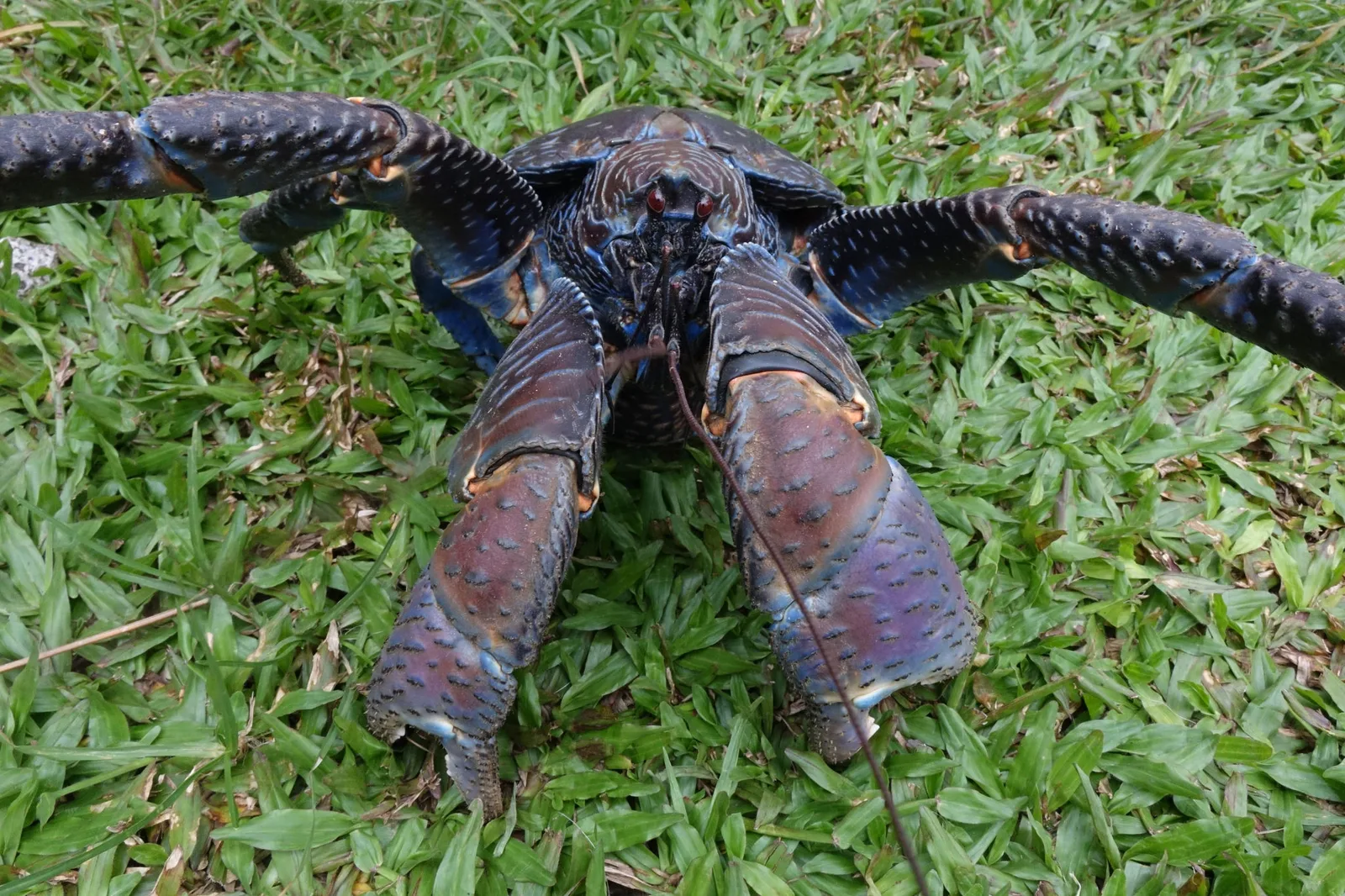
Coconut crab
A hermit crab that outgrew its shell and climbs palms
Birgus latro
Also called Robber crab
Living individuals or members of this group exist today. This does not mean they are safe from extinction.
Meet the coconut crab
The coconut crab is the largest land-living arthropod. It climbs palm trees, opens coconuts with its claws, and drowns if it stays in the sea.
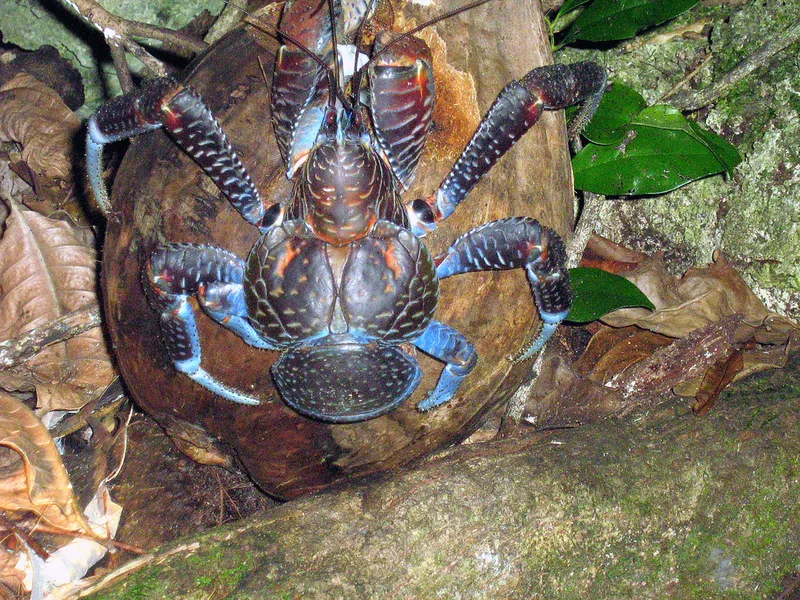
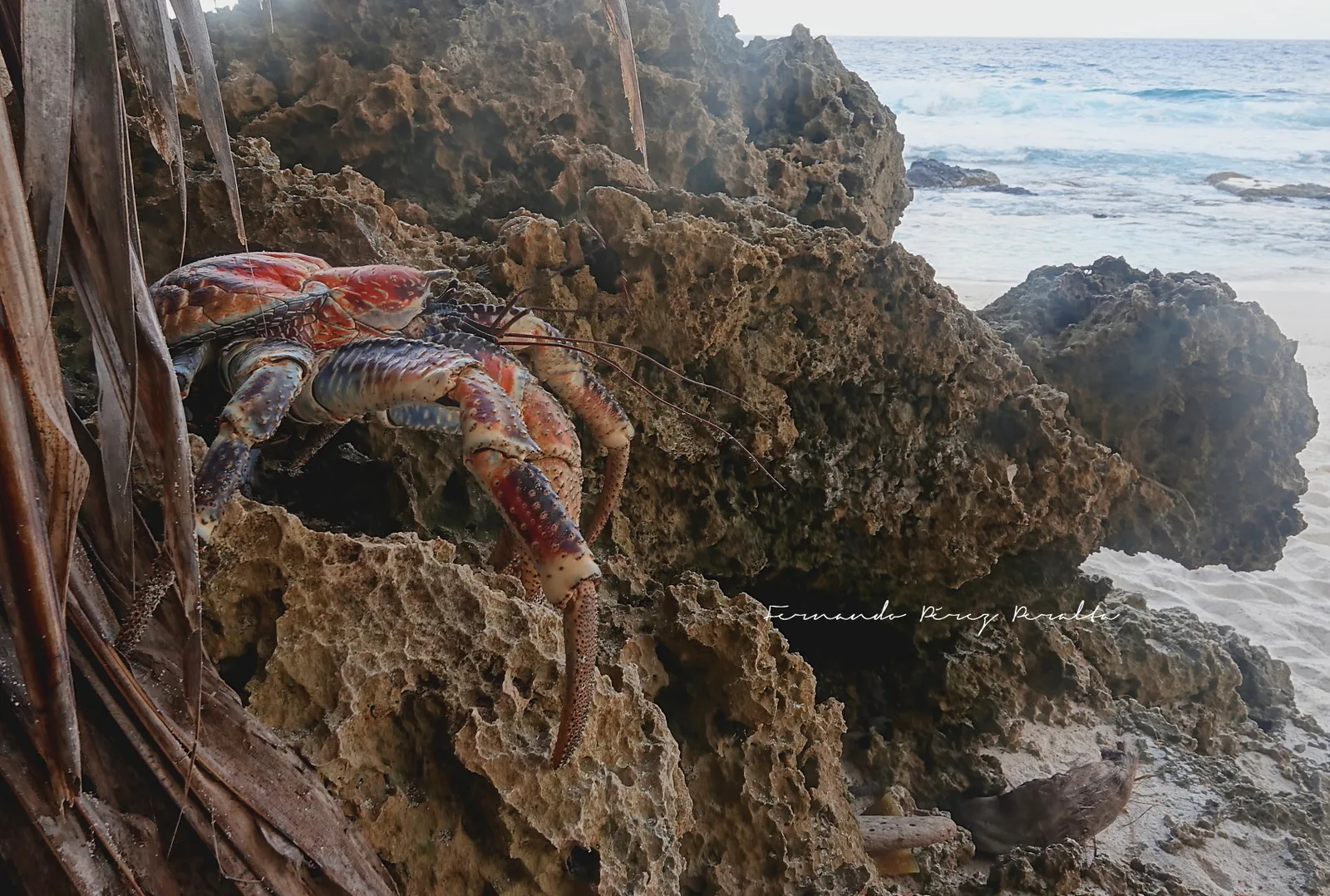
Images of the coconut crab
Lifespan in the wild
Up to 60 years
Weight
Up to 4.1 kg
Length
Up to 40 cm
Fact file
Coconut crab
- Location
- Islands of the Indian and Pacific oceans
- Habitat
- Coast, Rainforest
- Diet
- Omnivore
- Prey / food
- Coconuts, fruit, carrion, other crabs
- Predators
- People; large birds take young
- Lifestyle
- Nocturnal
- Name of young
- Larva, then a shell-carrying juvenile
- Incubation
- About 4 weeks of egg brooding
- Clutch size
- Tens of thousands of eggs
- Biggest threat
- Over-harvesting for food and habitat loss
- Distinctive feature
- Huge claws and a hard abdomen with no borrowed shell
- Colour
- Blue, purple or red-brown
- Skin type
- Exoskeleton
Size
Next to a person
Measurements
Size and speed
- Length
- Up to 40 cm body
- Span
- Up to 91 cm leg span
- Weight
- Up to 4.1 kg
Typical adult ranges. Source: Wikipedia.
Life cycle
Lifespan
- In the wildUp to 60 years
- 060 years
The pale bar is the record. Source: Animal Diversity Web.
Appearance
Colour and coat
- Primary colours
- bluepurple
- Secondary colours
- redorange
- Skin type
- exoskeleton
- Male and female
- Moderate. Males are larger, with an average carapace of 75 millimetres against 50 mm in females. Females carry three feathery pleopods under the abdomen to hold the eggs.
Life cycle
Mating and family
- Mating system
- promiscuous, with brief mating on land and no lasting pair
- Social structure
- solitary
- Breeding
- one egg mass of 50,000 to 138,000 eggs a year, in summer
Crabs mate on land between May and September. The female carries the orange eggs under her abdomen for a few months, then shakes them into the sea at high tide. The larvae drift for 3 to 4 weeks, settle, and walk ashore inside a snail shell. A young crab changes shells as it grows and then hardens its own abdomen. It matures at about 5 years and may live more than 60.
Classification
Taxonomy
- Kingdom
- Animalia
- Phylum
- Arthropoda
- Class
- Malacostraca
- Order
- Decapoda
- Family
- Coenobitidae
- Genus
- Birgus
- Species
- Birgus latro
Conservation
Red List status
- LC
- NT
- VU
- EN
- CR
- EW
- EX
Vulnerable on the IUCN Red List
Range
Recorded in 33 countries
- American Samoa
- Ashmore and Cartier Islands
- Cook Islands
- Fiji
- Federated States of Micronesia
- Guam
- Indonesia
- India
- British Indian Ocean Territory
- Japan
- Kenya
- Kiribati
- Madagascar
- Marshall Islands
- Northern Mariana Islands
- Maldives
- Malaysia
- Mozambique
- New Caledonia
- Niue
- French Polynesia
- Papua New Guinea
- Philippines
- Palau
- Solomon Islands
- Seychelles
- Thailand
- Tonga
- Tuvalu
- Taiwan
- Tanzania
- Vanuatu
- Samoa
Habitat layer: tropical moist broadleaf forest, mangrove.
Countries from 1,117 wild records on GBIF (iNaturalist research grade), filtered and checked by hand. Country shapes: Natural Earth. Habitat: RESOLVE Ecoregions 2017, CC BY 4.0. Basemap: Natural Earth.
Habitats
Three things to know
- 1
Its claws pinch with a force close to a lion's bite.
- 2
Young crabs use empty shells like hermit crabs, then grow out of them.
- 3
It smells with its antennae much as an insect does.
Did you know
Seven more facts
- 1
The young carry a snail shell like any hermit crab, and they switch to a broken coconut shell when no snail shell fits.
- 2
The crab smells with its antennae much as an insect does, and it flicks them to catch more scent.
- 3
It lines its burrow with fine coconut fibre and shuts the door with a claw to keep the air damp.
- 4
A female releases her larvae at high tide near a new or full moon, and she drowns if a wave takes her.
- 5
A crab that has eaten sea mango becomes poisonous to people.
- 6
In 2016 a crab on the Chagos Archipelago climbed a tree and killed a red-footed booby.
- 7
Naturalists doubted that the crab could open a coconut until the 1980s.
Field notes
How it looks and acts
Field notes
Distinguishing features
- A body up to 40 centimetres long and a leg span up to 91 cm.
- Huge claws, with the left larger than the right.
- A hard, plated abdomen with no borrowed shell in the adult.
- Blue, purple or red colouring that varies by island.
- Long, pointed walking legs that grip bark.
- Compound eyes on stalks.
Field notes
Unique adaptations
- A branchiostegal lung that takes oxygen from air.
- A hardened abdomen that protects the body and cuts water loss.
- Antennae adapted to smell in air, much like an insect's.
- Claws strong enough to tear a coconut husk and break the nut.
- Pointed leg tips that let it climb a vertical trunk.
Field notes
Interesting behaviours
- Hides in a burrow by day and forages at night.
- Climbs palms and pandanus trees for fruit and to escape danger.
- Carries food back to the burrow to eat and store.
- Moults once a year in a sealed burrow and eats the old shell.
- Walks to the sea at dusk to release larvae.
Field notes
Temperament
- Solitary, and it avoids other crabs except at mating.
- Not a fighter: a smaller crab backs down when a larger one signals.
- Bold around camps, where it carries off unattended objects.
Field notes
Communication
- Signals by sight, moving claws and legs up and down to warn a smaller crab.
- Finds food by smell, over long distances.
- Feels with bristles on the claws.
Ecology
Ecological role
The coconut crab is the top scavenger and one of the largest animals on many small tropical islands.
- Clears carrion, dead crabs and shed crab skins from the forest floor.
- Spreads coconut seeds, because it drops fruit before it carries it home.
- Preys on red crabs and other land crabs, and on seabird chicks.
- Feeds seabirds while young and people when adult.
Stories
Myths and legends
- In Nicobarese tradition on Kamorta Island, eating the crab brings illness, and a wooden crab is carried to the capture site to lift it.
- In Chamorro tradition in the Mariana Islands, the ayuyu can carry an ancestral spirit, a taotaomo'na.
- In Tao tradition in Taiwan, and on Flores in Indonesia, taboos limit the hunting and eating of the crab.
- In internet legend, coconut crabs are said to have eaten Amelia Earhart, a story that historians reject.
People
Relationship with humans
People
Living alongside us
Islanders across the Indian and Pacific oceans hunt the coconut crab for its meat, and it has vanished from most places with many people. It is a feast food and a tourist attraction, and several countries now limit or ban the hunt. Some communities hold taboos against eating it. The crab pinches hard but is not dangerous.
- The pinch is painful and the crab may hold on for a long time.
- Tickling the soft underside makes it let go.
- A crab that has eaten sea mango can poison a person who eats it.
People
Status, uses and products
- Domestication
- Wild
- As a pet
- Not suitable. The species is Vulnerable and protected on many islands. It needs a warm, humid enclosure with room to climb, and it may live more than 60 years. Leave it in the wild.
- Uses
- foodecotourism
- Products
- meat
The full account
About the coconut crab
The coconut crab, Birgus latro, is the largest arthropod that lives on land. A big adult weighs up to 4.1 kilograms and has a body up to 40 centimetres long. Its legs span up to 91 cm. It is a hermit crab, but only the young carry a borrowed snail shell. The adult hardens its own abdomen with chitin and lime and walks free.
The crab lives in burrows on tropical islands of the Indian Ocean and the Pacific, from Zanzibar east to the Gambier Islands. It breathes air with a lung-like organ, and an adult drowns if it stays under water for more than an hour. It eats fruit, nuts, carrion and other crabs, and it can tear open a coconut over several days. People also call it the robber crab or palm thief, because it carries off anything left on the ground. The IUCN lists the species as Vulnerable, because people hunt it for its meat.
Name and taxonomy
Francis Drake's crew met the crab around 1580, and William Dampier described it around 1688. Georg Eberhard Rumphius described it in 1705 and called it Cancer crumenatus. Carl Linnaeus named it Cancer latro in 1767, from the Latin latro, a robber. William Elford Leach created the genus Birgus for it in 1816, and it has been Birgus latro since. It is the only species in its genus.
The crab belongs to the family Coenobitidae, the land hermit crabs, which holds one other genus, Coenobita. That family sits in the superfamily Paguroidea, the hermit crabs, inside the order Decapoda. Its English names are coconut crab, robber crab and palm thief, and the German Palmendieb means the same as the last. In Japan it is yashigani, the palm crab, and in the Mariana Islands it is ayuyu. In the Cook Islands it is unga or kaveu, and in the Philippines it has many names, among them tatus and umang kagang.
Evolution and relatives
The coconut crab is a hermit crab that has taken to the land more fully than any other decapod. Its closest relatives are the land hermit crabs of the genus Coenobita, which still carry shells as adults. Fossils of the coconut crab go back to the Miocene. Free of a borrowed shell, it has grown far larger than any other member of its family.
Like a true crab, it folds its tail under its body, a result of the process biologists call carcinisation. Its sense of smell evolved separately from that of insects, yet the two ended up with similar organs on the antennae. Like other hermit crabs, its ancestors probably had a soft, twisted abdomen, and the hard plates of the adult are a later addition.
Appearance
The body reaches 40 centimetres, the weight reaches 4.1 kilograms, and the leg span passes 91 cm. The carapace reaches 78 millimetres long and 200 mm wide. Males are larger than females, with an average carapace of 75 mm against 50 mm. The colour varies by island, from orange-red to purple-blue, and blue is the usual colour in most places. In the Seychelles most crabs are red.
Like all decapods it has 10 legs. The first pair carries the great claws, and the left claw is larger than the right. The next two pairs are long, strong walking legs with pointed tips that grip bark and let the crab climb a vertical trunk. The fourth pair is small and ends in tweezer-like pincers, which the young use to hold the inside of their shell. The last pair is tiny and stays tucked in the breathing chamber, where it cleans the lungs and, in females, tends the eggs.
The adult abdomen is covered in hard plates of chitin and calcium carbonate, with leathery skin and tufts of bristles between them. A female carries three large feathery pleopods under her abdomen, which hold the egg mass. The compound eyes sit on stalks.
Habitat and range
The coconut crab lives on tropical islands in the Indian Ocean and the Pacific, and its range follows that of the coconut palm. The western limit is Zanzibar, off Tanzania, and the eastern limit is the Gambier Islands. The range stops at the two tropics, north and south, with a few outposts beyond them such as the Ryukyu Islands. Christmas Island in the Indian Ocean holds the largest and densest population in the world. Other strongholds are Aldabra in the Seychelles, the Chagos Archipelago, the Cook Islands and Teraina in the Line Islands.
The crab has vanished from most places with many people, including mainland Australia, Madagascar, Easter Island and the Marquesas. It cannot swim as an adult, so it reached every island as a drifting larva, often on a floating log or coconut. GBIF holds records from 44 countries, but that count includes zoos and imports and is not the native range. iNaturalist holds 1,561 observations, with Japan and Christmas Island giving the most.
The crab digs a burrow in sand or loose soil, or uses a rock crevice, and lines it with fine coconut fibre. It closes the entrance with a claw to keep the air inside moist, because its lungs need damp air. It lives almost entirely on land and goes to the sea only to release its larvae. On Christmas Island it is common 6 kilometres from the shore.
Diet and feeding
The adult eats mostly fleshy fruit, nuts and seeds, together with the soft pith of fallen trees. Pandanus fruit is a main food on many islands. It is an omnivore and a scavenger, and it also eats carrion, dead crabs, shed crab skins and tortoise hatchlings. It kills and eats red crabs on Christmas Island, and one tagged crab killed and ate a Polynesian rat. In 2016 a large crab climbed a tree on the Chagos Archipelago and killed a red-footed booby.
Despite the name, coconuts are only a small part of the diet. To open one, the crab tears strips of husk from the end with the three germination pores. Then it hammers a pore with its claw until it breaks and pulls out the flesh with its smaller pincers. Opening a coconut can take several days, and a large crab can break the whole nut into pieces. A crab may also carry a nut up a tree 10 metres high and drop it. The crab itself often drops from a tree, and a fall of 4.5 metres does it no harm.
Naturalists doubted the coconut story for a century. Thomas Hale Streets described the behaviour in 1877, and Holger Rumpf confirmed it in the wild in the 1980s. The crab carries large food items back to its burrow to eat and store. Larvae eat other plankton, and captive crabs will eat lettuce, cabbage and live giant African snails.
Behaviour and social life
The coconut crab is solitary and mostly nocturnal. It hides by day to avoid losing water to the heat, and it comes out in rain or humid weather, when it breathes more easily. On islands with many people it is active only at night. Where crabs are dense, some feed by day to get ahead in the search for food.
Crabs do not fight, but they show a size-based order, and a smaller crab gives way to a larger one. On large islands a crab is nomadic and changes burrows often, while on small islands it keeps one burrow. The home range is 40 to 250 square metres, depending on the island. It climbs coconut and pandanus trees, and climbing is its quickest escape when it is far from its burrow. It often comes down by simply dropping to the ground.
An adult moults about once a year. It digs a burrow up to 1 metre long, overeats beforehand, and hides while the new shell hardens over 1 to 3 weeks. It stays in the burrow for 3 to 16 weeks, longer for a big crab, and then eats its shed skin.
Communication and senses
Smell is the crab's main sense, and it uses it to find food. The smell organs on its antennae are short and blunt, unlike those of sea crabs, and they work like an insect's. It flicks its antennae as an insect does to pick up more scent. It can smell rotting meat, bananas and coconuts from a long way off. The smell centre of its brain is large compared with the rest.
The crab has full compound eyes on stalks, and it probably sees and feels vibration much as other decapods do. Bristles on the claws give it a sense of touch. Crabs signal to each other by sight: a larger crab moves its claws and legs up and down to make a smaller crab back off. It drinks from small puddles by passing water from its claws to its mouthparts.
Reproduction and life cycle
Mating takes place on land, quickly and often, from May to September, with a peak from early June to late August. There is little courtship. The male holds the female's claws, turns her on her back and passes a mass of sperm packets to her abdomen. The female lays soon after mating and glues the eggs under her abdomen, where she carries them for a few months. ADW gives 50,000 to 138,000 embryos per spawn, and the eggs are orange.
When the eggs are ready she walks to a rocky shore at dusk, usually at high tide near a new or full moon. She shakes the eggs into the water, and they hatch on contact. This is the most dangerous moment of her life, because she cannot swim and will drown if a wave takes her. The empty egg cases stay on her body, and she eats them within a few days. The larvae drift as plankton for 3 to 4 weeks and pass through several zoea stages, which together take 25 to 33 days.
The larva then becomes a glaucothoe, settles on the sea floor, finds a snail shell of the right size and walks ashore. Once on land it never breathes water again. The young crab changes shells as it grows, and it uses a piece of coconut shell when no snail shell fits. When it outgrows every shell it hardens its abdomen and goes without. It matures at about 5 years, reaches full size only after 40 to 60 years, and may live more than 60 years. Our fields put the lifespan at up to 60 years.
Predators and threats
An adult coconut crab has no known predator except people and larger coconut crabs. Sea birds eat the young, and larvae in the plankton are eaten in huge numbers. Monitor lizards, cane toads and feral pigs may take small crabs, but this is not confirmed. A crab that is not near its burrow escapes by climbing a tree.
The biggest threats are hunting for food and the loss of coastal forest. The crab grows slowly and is easy to catch, so a population is easy to wipe out. It is now very rare on islands with a large human population. A crab that has eaten sea mango fruit becomes poisonous, and people have been poisoned by eating such crabs.
Population and conservation
The IUCN listed the coconut crab as Vulnerable in 1981. It changed that to Data Deficient in 1996 for lack of data, and it returned the crab to Vulnerable in 2018. Japan's Ministry of the Environment lists it as Vulnerable on its 2020 red list. Taiwan protects it as a listed wild animal. Populations in several areas have shrunk or vanished through habitat loss and hunting.
Guam and Vanuatu set minimum legal sizes, and Guam and the Federated States of Micronesia ban the taking of egg-bearing females. The Northern Mariana Islands allow a licensed season in September, October and November, with a limit of five crabs a day and 15 a season. In Tuvalu the crab lives on the islets of the Funafuti Conservation Area, which covers 33 square kilometres. The Philippines declared the crab locally threatened in 2001 and banned its catch and sale, but the law is weakly enforced. Crabs are still caught openly for tourists in the Batanes Islands.
Relationship with humans
Islanders have eaten the coconut crab for centuries, and its meat is a delicacy served at weddings and feasts. On some islands people regard it as an aphrodisiac. Tourists pay to see and to eat it, so hunters find it an easy income, and some small islands now import large crabs. On other islands taboos limit the hunt: the Nicobar Islands, Flores in Indonesia, and the Tao people of Taiwan all have them.
The claws can give a painful pinch, and the crab often holds on for a long time. Streets recorded a trick from the Line Islands: tickle the soft underside with something light and the crab lets go. One measurement put the pinch at about 3,300 newtons, which no other crustacean matches. ADW records no adverse effect of the crab on people, and the species is wild.
In culture and myth
On Kamorta Island in the Nicobars, people believe that eating the crab brings bad luck and serious illness. When someone falls ill after a meal, the family carves a wooden crab and takes it to the place of capture for a ritual. In the Mariana Islands the crab, called ayuyu, is linked with the taotaomo'na, ancestral spirits that can return as animals. Charles Darwin thought the crab lived on only one coral island north of the Society Islands.
An internet legend says that coconut crabs ate the remains of Amelia Earhart on Nikumaroro after her plane came down in 1937. A partial skeleton was found there in 1940, and in one experiment crabs dragged the bones of a pig carcass into their burrows. Historians discount the story, because no trace of her plane has been found on or near the island. The crab's size and its habit of stealing camp gear probably explain why so many stories gather around it.
A sentence with a dotted underline is inferred: it describes the group the animal belongs to, or is a reading of the sources, rather than a measured or reported fact about this species.
Questions
Coconut crab questions, answered
How big is a coconut crab?
A large adult weighs up to 4.1 kilograms, with a body up to 40 centimetres long and a leg span up to 91 cm. It is the largest arthropod that lives on land.
Can a coconut crab really open a coconut?
Yes, though it takes several days. The crab strips the husk from the end with the three pores, hammers a pore until it breaks, and pulls out the flesh. Coconuts are still only a small part of its diet.
Do coconut crabs climb trees?
Yes. Their pointed leg tips grip bark, and they climb palms and pandanus trees for fruit or to escape. They often come down by dropping and can survive a fall of 4.5 metres.
How strong is a coconut crab's pinch?
One measurement put the pinch at about 3,300 newtons, more than any other crustacean. It hurts, and the crab tends to hold on.
Are coconut crabs dangerous to humans?
Not seriously. A pinch is painful, but the crab only defends itself. The real risk is eating a crab that has fed on sea mango, which makes its meat poisonous.
Where do coconut crabs live?
They live on tropical islands of the Indian Ocean and the Pacific, from Zanzibar east to the Gambier Islands. Christmas Island has the largest population.
How long do coconut crabs live?
They may live more than 60 years. They mature at about 5 years and reach full size only after 40 to 60 years.
Are coconut crabs endangered?
The IUCN lists the species as Vulnerable, as of 2018. Hunting for food and habitat loss are the main threats, and the crab has vanished from many islands with large populations of people.
Can coconut crabs swim?
No. Only the larvae live in the sea. An adult drowns if it stays under water for more than an hour, because it breathes air with a lung-like organ.
What do coconut crabs eat?
Mostly fleshy fruit, nuts, seeds and tree pith. They also scavenge carrion, eat other crabs and shed crab skins, and have killed rats and seabirds.
Is a coconut crab a hermit crab?
Yes. The young carry snail shells like other hermit crabs. Adults harden their own abdomen and stop carrying a shell, which lets them grow far larger.
Did coconut crabs eat Amelia Earhart?
There is no evidence for it. The story rests on a partial skeleton found on Nikumaroro in 1940. No trace of her plane has been found there, and historians reject the idea.
Can you eat coconut crab?
Yes, and islanders regard it as a delicacy. The hunt is banned or limited in many places, including the Philippines, Guam and the Northern Mariana Islands. A crab that has eaten sea mango is poisonous.
How do coconut crabs breed?
They mate on land in summer. The female carries her eggs for a few months, then releases the larvae into the sea at high tide. The larvae drift for 3 to 4 weeks before they come ashore in a snail shell.
Why is it called the robber crab?
The crab investigates anything left on the ground and often carries it off. The Latin name latro, given by Linnaeus, means robber.
Food web
Prey and food
- coconuts
- fruit
- carrion
- crabs
Food web
Predators
- people
- birds
Ecological equivalents
Related species on this site
Strawberry Hermit Crab (same family), Amano Shrimp (same order), Christmas Island Red Crab (same order), Crayfish (same order), Decorator Crab (same order), Dungeness Crab (same order), and more.
Crustaceans
Strawberry Hermit Crab
Coenobita perlatus
Classification and source reference
LivingCrustaceans
Amano Shrimp
Caridina multidentata
Classification and source reference
Living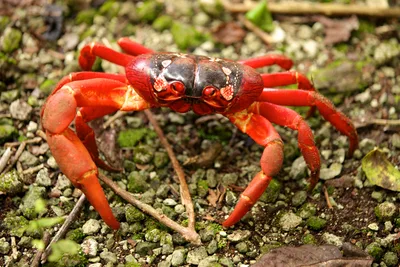
Crustaceans
Christmas Island Red Crab
Gecarcoidea natalis
The Christmas Island red crab is a land crab that spends most of its life on the forest floor.
Living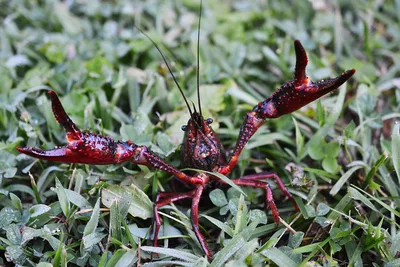
Crustaceans
Crayfish
Decapoda
Crayfish are freshwater crustaceans.
LivingCrustaceans
Decorator Crab
Majidae
Classification and source reference
Living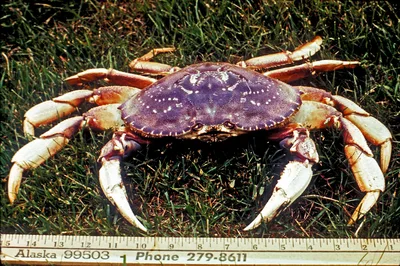
Crustaceans
Dungeness Crab
Metacarcinus magister
The Dungeness crab inhabits the Pacific coast of North America.
Living