Sugar glider
A pocket-sized possum that glides between the gum trees
Petaurus breviceps
Also called Lesser flying phalanger, Short-headed flying phalanger, Sugar squirrel
Living individuals or members of this group exist today. This does not mean they are safe from extinction.
Meet the sugar glider
The sugar glider is a small nocturnal marsupial of eastern Australia that glides between trees on a furred membrane. It lives in family groups, eats sap, gum, nectar and insects, and is a popular exotic pet abroad.
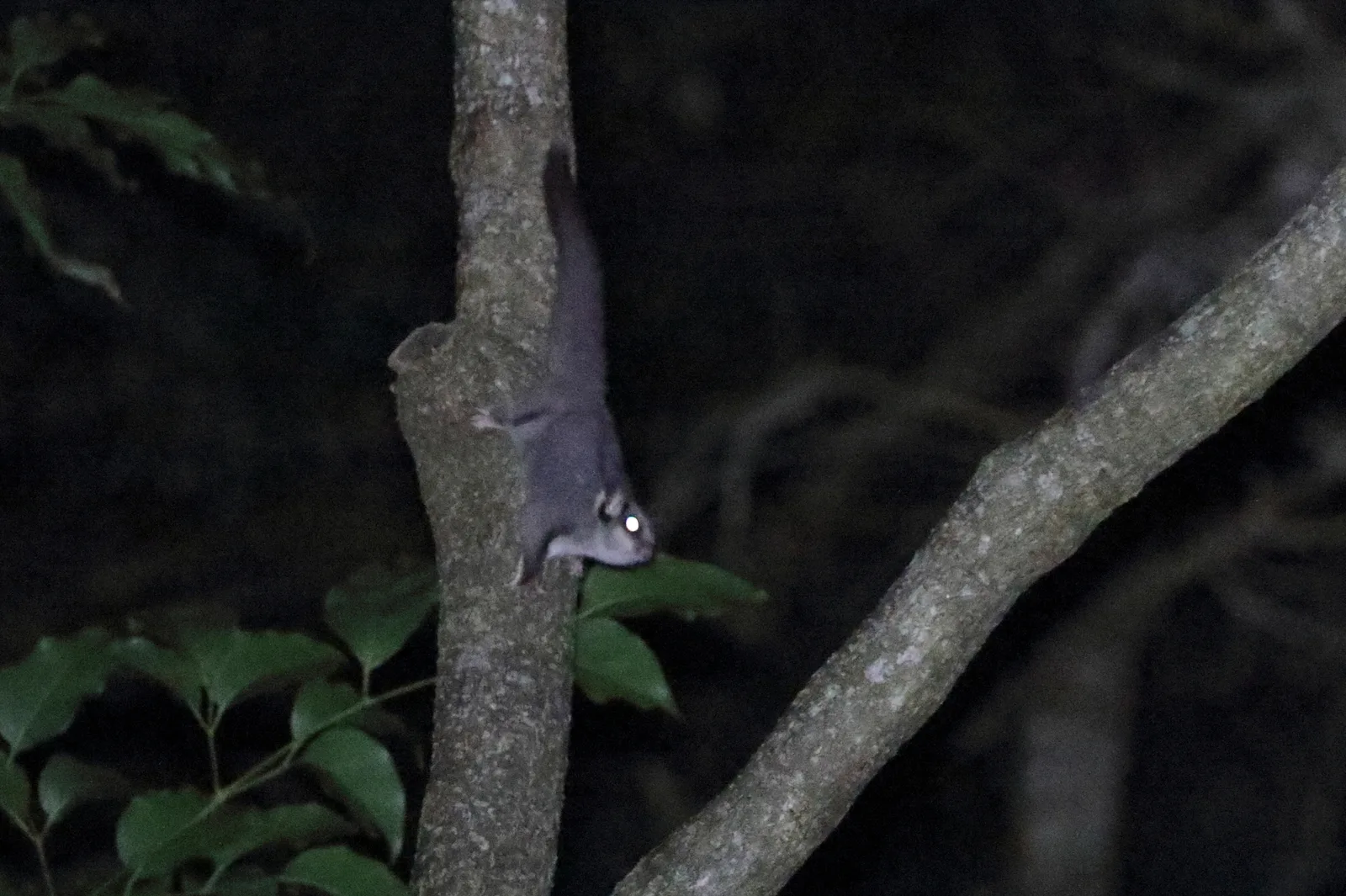
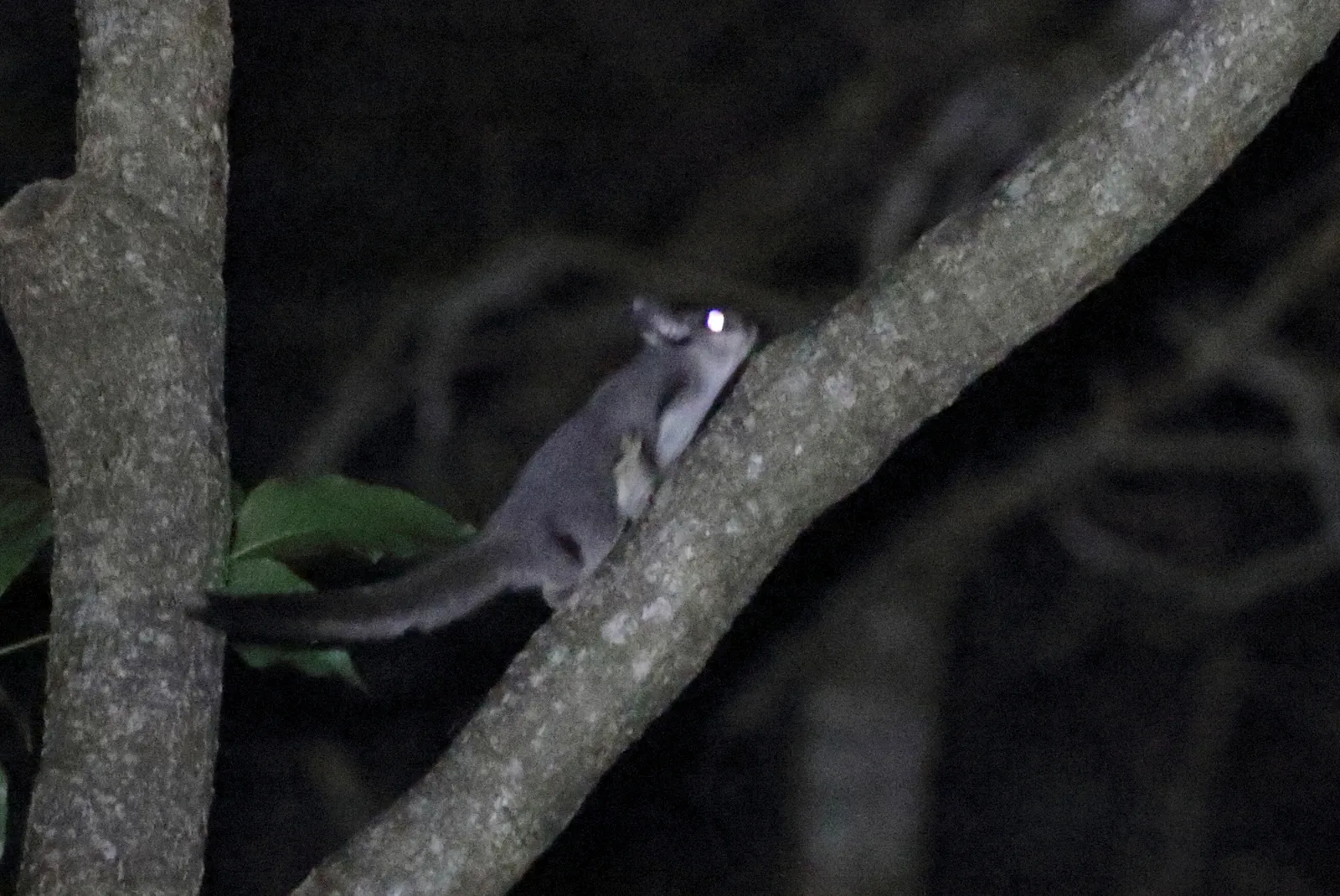
Images of the sugar glider
Lifespan in the wild
Up to 9 years
Weight
115 to 140 g
Length
24 to 30 cm
Fact file
Sugar glider
- Location
- Coastal forests of southern Queensland and New South Wales, Australia
- Habitat
- Temperate forest
- Diet
- Omnivore
- Prey / food
- Moths, beetles, spiders, small lizards, small birds, bird eggs
- Predators
- Owls, kookaburras, goannas, snakes, quolls, feral cats
- Lifestyle
- Nocturnal, arboreal, lives in colonies
- Group name
- Colony
- Name of young
- Joey
- Gestation
- 15 to 17 days, then about 60 days in the pouch
- Litter size
- 1 or 2 joeys, usually 2
- Population
- Common in its range, but no count exists; the range is smaller than once thought
- Biggest threat
- Bushfire and the loss of hollow trees; feral cats
- Distinctive feature
- A gliding membrane from the wrist to the ankle and a dark stripe along the back
- Colour
- Blue-grey above, cream below, with a black stripe
- Skin type
- Fur
Size
Next to a person
Measurements
Size and speed
- Length
- 24 to 30 cm nose to tail tip, including the tail
- Weight
- 115 to 140 g females about 115 grams, males about 140 grams
- Weight, male
- About 140 g
- Weight, female
- About 115 g
Typical adult ranges. Source: Wikipedia.
Life cycle
Lifespan
- In the wildUp to 9 years
- In captivityAbout 12, up to 17.8 years
- 017.8 years
The pale bar is the record. Source: Wikipedia.
Appearance
Colour and coat
- Primary colours
- blue-grey
- Secondary colours
- creamblack
- Skin type
- fur
- Male and female
- Moderate. Males weigh about 140 grams against 115 g for females, and only males carry the bald scent glands on the forehead and chest.
Life cycle
Mating and family
- Mating system
- polygynous; two co-dominant males share the females of the colony
- Social structure
- colonies of up to seven adults and their young
- Breeding
- one or two litters a year in the wild, born June to November in the south-east
A female sugar glider is pregnant for only 15 to 17 days. She gives birth to one or, more often, two joeys of about 0.2 grams, which crawl into her pouch. They stay there for 60 days, open their eyes at about 80 days and leave the nest at about 110 days. Both parents warm the young until they can hold their own body heat at about 100 days. A wild glider lives up to 9 years, and the captive record is 17.8.
Classification
Taxonomy
- Kingdom
- Animalia
- Phylum
- Chordata
- Class
- Mammalia
- Order
- Diprotodontia
- Family
- Petauridae
- Genus
- Petaurus
- Species
- Petaurus breviceps
Conservation
Red List status
- LC
- NT
- VU
- EN
- CR
- EW
- EX
Least Concern on the IUCN Red List
Range
Recorded in 1 country
Habitat layer: temperate broadleaf and mixed forest, temperate conifer forest, boreal forest and taiga.
Countries from 643 wild records on GBIF (iNaturalist research grade), filtered and checked by hand. Country shapes: Natural Earth. Habitat: RESOLVE Ecoregions 2017, CC BY 4.0. Basemap: Natural Earth.
Habitats
Three things to know
- 1
A sugar glider can glide 50 metres or more, and it drops only 1 metre for every 1.82 m it travels forward.
- 2
A newborn sugar glider weighs about 0.2 grams and crawls into its mother's pouch, where it stays for 60 days.
- 3
The scientific name Petaurus breviceps means short-headed rope-dancer, a nod to its acrobatics in the canopy.
Did you know
Seven more facts
- 1
The name Petaurus breviceps means short-headed rope-dancer.
- 2
Most pet gliders in the United States descend from West Papua and are probably Krefft's gliders.
- 3
The fourth finger is long and sharp for hooking insects from under bark.
- 4
Two toes on each hind foot are fused into a comb for grooming.
- 5
A glider's heart beats 200 to 300 times a minute.
- 6
The glider drops 1 metre for every 1.82 m it travels forward.
- 7
Male sugar gliders help to rear the young, which is rare among mammals.
Field notes
How it looks and acts
Field notes
Distinguishing features
- A furred gliding membrane from the fifth finger to the first toe.
- A black stripe from the nose to the middle of the back.
- Blue-grey fur above and cream fur below.
- A total length of 24 to 30 centimetres, tail included.
- Large, wide-set eyes and swivelling ears.
- Bald scent-gland patches on the forehead and chest of a male.
Field notes
Unique adaptations
- A gliding membrane that lets it cross gaps of 50 metres without touching the ground.
- Daily torpor that cuts energy use when food runs short in winter.
- An enlarged caecum that digests the sugars in gum and sap.
- Wide-set eyes that judge the distance of a landing before the jump.
- A clawless opposable toe on each hind foot for gripping branches.
Field notes
Interesting behaviours
- Sleeps by day in a tree hollow lined with leaves.
- Glides from tree to tree and rarely descends to the ground.
- Strips bark and bites bore holes to reach sap and gum.
- Huddles with colony members in cold weather.
- Attacks any glider that lacks the colony scent.
Field notes
Temperament
- Sociable within the colony, with grooming and shared nests.
- Hostile to strangers of its own kind.
- Prone to depression and self-harm when kept alone.
Field notes
Communication
- Barks and hisses, with an alarm call like a small dog.
- Marks colony members and territory with saliva and gland scent.
- Reads health and rank from the smell of other gliders.
- Uses body posture as a visual signal.
Ecology
Ecological role
The sugar glider is a pollinator, an insect eater and a prey animal in the eucalyptus forests of eastern Australia.
- Carries pollen between Banksia flowers as it feeds, which probably makes it an important pollinator.
- Eats moths, beetles and other insects in summer.
- Feeds owls, goannas, snakes, quolls and kookaburras.
- Opens sap flows in bark that other animals may then use.
Stories
Myths and legends
- In the Daly River tradition of the Nauiyu Nambiyu community, the sugar glider moves the clouds across the sky and brings the rain.
- In a tale of uncertain origin, a kangaroo is said to have given the glider its skin, a story form of the membrane.
- In modern spirit-animal writing, the glider is said to be a totem of the night, a claim with no traditional source.
People
Relationship with humans
People
Living alongside us
The sugar glider is a protected native animal in Australia, where most states ban keeping it as a pet. Abroad it is a popular pocket pet, though DNA shows that the American stock is probably Krefft's glider. Keeping one well is hard: it is nocturnal, it needs company, and a poor diet paralyses its hind legs. Wildlife groups in Australia oppose the pet trade on welfare grounds.
- A sugar glider is harmless to people, and it is thought to avoid them in the wild.
- A frightened pet may bite, but the bite is small.
- It appears to carry no disease of note to humans, as far as the sources record.
People
Status, uses and products
- Domestication
- Wild
- As a pet
- Kept by some. Only for an experienced keeper with a permit where one is needed. A glider needs at least one companion, a night-time schedule, a large cage and a diet with twice as much calcium as phosphorus. Australia's wildlife groups advise against it.
- Uses
- exotic pet trade
- Products
- None recorded
The full account
About the sugar glider
The sugar glider, Petaurus breviceps, is a little marsupial of eastern Australia that glides from tree to tree on a skin membrane. It looks and behaves much like a flying squirrel, though the two are not related. The common name points to its taste for sweet food, such as sap and nectar, and to the glide. The scientific name means short-headed rope-dancer, a description of its acrobatics in the canopy.
An adult is 24 to 30 centimetres long, tail included. A male weighs about 140 grams and a female about 115 g. The fur is soft and blue-grey, with a cream belly and a black stripe from the nose down the back. Sugar gliders are active at night and sleep by day in a tree hollow lined with leaves. They live in colonies of up to seven adults plus the young of the year.
The IUCN lists the species as Least Concern. A 2020 study cut the species down to a strip of coastal forest in southern Queensland and New South Wales. That smaller range was hit hard by the bushfires of 2019 and 2020. Gliders of this group are popular pets in several countries, though most of those animals are probably Krefft's gliders.
Name and taxonomy
George Waterhouse named the species in 1839. Petaurus comes from a Greek word for a rope-dancer, and breviceps is Latin for short-headed. The sugar glider belongs to the family Petauridae, the wrist-winged gliders, in the marsupial order Diprotodontia. Older names include the lesser flying phalanger, the short-headed flying phalanger and the sugar squirrel.
For a long time the species was said to range across eastern and northern Australia and New Guinea, in seven subspecies. Those subspecies rested on small differences in colour and size. A 2010 study of mitochondrial DNA found that they did not match separate genetic groups. The Biak Island form was split off first as the Biak glider, Petaurus biacensis. In 2020 a larger study found three hidden species inside the old sugar glider. Krefft's glider, Petaurus notatus, holds most of eastern Australia and was introduced to Tasmania. The savanna glider, Petaurus ariel, lives in the north, and the true sugar glider keeps only the coastal forest of the south-east.
Evolution and relatives
The genus Petaurus is thought to have arisen in New Guinea in the middle Miocene, about 18 to 24 million years ago. The Australian gliders split from their nearest New Guinean relatives about 9 to 12 million years ago. They probably crossed to Australia between 4.8 and 8.4 million years ago, when low sea levels opened land bridges. The oldest Petaurus fossil in Australia is 4.46 million years old.
The sugar glider and Krefft's glider parted about 1 million years ago. The Great Dividing Range rose and the interior dried. The sugar glider's ancestors were probably cut off in refuges on the wet coastal side. That is a textbook case of allopatric speciation, where a barrier splits one population into two species. The likeness to the flying squirrels of the northern hemisphere is convergent evolution: the same solution reached twice. It shares its forests with the squirrel glider and the yellow-bellied glider, and each species uses food in a different way.
Appearance
The sugar glider has a squirrel-like body and a long tail that can grip a little. From the nose to the tail tip it measures 24 to 30 centimetres. Males weigh about 140 grams, females about 115 g, so the species is sexually dimorphic. The size gap is wider at higher latitudes, where more food means more competition between males. The heart beats 200 to 300 times a minute, and the animal breathes 16 to 40 times a minute.
The coat is thick and soft and usually blue-grey, though yellow, tan and rare albino animals occur. A black stripe runs from the nose to the middle of the back, and a similar stripe runs from each eye to the ear. The belly, throat and chest are cream. A male has four scent glands: on the forehead, on the chest and two beside the cloaca. The forehead and chest glands show as bald patches. A female has a cloacal gland and a gland inside the pouch, but none on the head or chest.
The gliding membrane, or patagium, stretches from the fifth finger of each hand to the first toe of each foot. Each foot has five digits, and each hind foot has a clawless opposable toe that works like a thumb. The second and third toes are partly fused into a comb for grooming. The fourth finger is long and sharp, and the glider uses it to hook insects out from under bark. The large eyes sit far apart, which helps the animal judge the distance of a landing before it jumps. Tests show colour vision in the ultraviolet, blue, green and red ranges.
Habitat and range
The sugar glider, in its narrow modern sense, lives in the coastal forests of southern Queensland and most of New South Wales. It reaches 2,000 metres in the eastern ranges. In parts of that range it overlaps with Krefft's glider. The wider species group, as older books defined it, stretched along the east and north coasts of Australia and across New Guinea. GBIF holds records from 9 countries, but that count includes captive animals and older, broader identifications.
Animal Diversity Web says the glider can live in any forest type with enough food. Eucalyptus and acacia trees matter most, because they give sap, gum and nesting hollows. By day the animals sleep in a tree hollow lined with leafy twigs. A home range averages 0.5 hectares, and the size follows the food supply. Density runs from two to six gliders per hectare.
The species copes with cleared land better than many forest animals. It survives in small patches of remnant bush, as long as it does not have to cross wide open ground. Selectively logged forest still supports gliders if three to five hollow-bearing trees remain on each hectare.
Diet and feeding
The sugar glider is an omnivore whose menu shifts with the season. In summer it eats mostly insects and other arthropods, chiefly moths and beetles. In winter, when insects are scarce, it turns to plant exudates: acacia gum, eucalyptus sap, manna, honeydew and lerp. An enlarged caecum helps it digest the complex sugars in gum and sap. It forages mainly in the lower layers of the canopy.
To reach sap or gum, a glider strips bark or bites bore holes into the trunk with its lower incisors. Chasing insects costs energy, so it waits for them to fly in or feeds on them at flowers. It also takes nectar, pollen, acacia seeds, bird eggs, fungi and native fruit, and it will kill small lizards and birds. Pollen can be a large share of the diet, so the glider is probably an important pollinator of Banksia.
A glider eats about 11 grams of dry food a day, near 8% of a male's body weight and 9.5% of a female's. Up to half of its water comes from rain, and the rest from its food. It saves energy through torpor: when food runs short, body temperature drops to between 10.4 and 19.6 degrees Celsius for 2 to 23 hours. Wild gliders use torpor more often than captive ones, mostly in winter. To survive the cold season, a glider lays down fat in autumn.
Behaviour and social life
The sugar glider launches from a tree with all four limbs stretched out at right angles to the body. The open membrane forms an aerofoil, and the animal can glide 50 metres or more. It loses 1 metre of height for every 1.82 m it travels forward. To steer, it moves its limbs and changes the tension of the membrane: dropping the left forearm turns it left. Gliding is the usual way to move between trees, and the species rarely comes to the ground. The glide also keeps it away from predators on the ground and in the trees, and it saves time when food is scattered.
Sugar gliders are highly social. A colony holds up to seven adults and the young of the season, and it may span four age classes. Some animals live alone. Members groom each other, which keeps the fur clean and binds the group. Two co-dominant males lead the colony, and they are closer kin to each other than to the males below them. They share food, nests and mates, and they do the scent marking.
The males rub saliva and the scent of their forehead and chest glands on every colony member and on the territory. An intruder without the group scent is attacked at once. Inside a colony there are threats but no fights, while fights break out when colonies meet. Each colony defends about 1 hectare of forest where eucalyptus trees give a steady food supply. In cold weather the group huddles to keep warm, and it enters torpor when huddling is not enough. In heat of up to 40 degrees Celsius, a glider licks its fur and lets the wet patch cool it.
Communication and senses
Large eyes give the sugar glider good night vision, and its ears swivel to locate prey in the dark. It sees in colour, including ultraviolet, which few mammals can do. The wide-set eyes help it judge the length of a glide before it leaps.
The glider signals with calls, postures and a complex mix of scents. Scent does most of the work, as in many night animals. Odours mark the territory, show an animal's health and record its rank in the colony. Calls include barking and hissing. The alarm call sounds like the bark of a small dog.
Reproduction and life cycle
Like most marsupials, a female has two ovaries and two uteri, and a male has a forked penis to match. She comes into heat several times a year, on a cycle of about 29 days. Males mature at 4 to 12 months and females at 8 to 12 months. In south-east Australia the young are born only between June and November. In Arnhem Land, in the north, there seems to be no fixed season. Wild gliders breed once or twice a year, and captive ones more often.
Pregnancy lasts only 15 to 17 days. A litter holds one joey in 19% of births and two in 81%. Each newborn weighs about 0.2 grams, has no fur and can only smell. A scent gland in the pouch guides the blind joey up from the birth canal. An arch of cartilage in the shoulder, which vanishes soon after birth, braces the forelimbs for the climb. The pouch opens at the front and has four nipples, and a wall inside shields the joeys from the shock of landing.
The joeys stay sealed in the pouch for 60 days. Their eyes open at about 80 days, and they leave the nest at about 110 days. They cannot control their body heat until about 100 days, so one parent stays to warm them while the other feeds. The oldest co-dominant male gives much of this care, because he is the likely father. Male parental care is rare among mammals. A wild glider lives up to 9 years, and a captive one usually up to 12, with a record of 17.8 years.
Predators and threats
Native owls of the genus Ninox are the main predators. Kookaburras, goannas, snakes and quolls also take gliders. Feral cats are a serious added threat. Gliding lets the animal escape in three dimensions, and it rarely meets a predator on the ground.
The biggest danger is fire. Because gliders sleep in tree hollows, an intense bushfire kills them and destroys the hollows they need. The fires of 2019 and 2020 burned much of the true sugar glider's small range. Clearing removes old hollow-bearing trees, and gliders cannot cross wide open ground. Bright artificial light may make it harder for them to feed and to spot predators. In captivity, a diet short of calcium causes hind leg paralysis, and iron overload can be fatal.
Population and conservation
The IUCN Red List rates the sugar glider as Least Concern. That rating was given under the old taxonomy, when the species seemed to cover most of eastern Australia and New Guinea. Animal Diversity Web calls it common in Australia. The 2020 study shrank the true species to a coastal strip, so its exposure to threats is now judged much higher. No formal count of the population exists.
Australia protects the glider as a native species at federal, state and local levels. The Environment Protection and Biodiversity Conservation Act of 1999 is the central law. Catching or selling wild gliders without a permit is illegal. In South Australia a person may keep one glider without a permit if it came from a licensed source. Despite two centuries of habitat loss, the species has held on in small patches of forest.
Relationship with humans
Outside Australia the glider is a popular exotic pet, sometimes called a pocket pet. Animal Diversity Web notes a boom in the American pet population. DNA tests trace the pet gliders of the United States to West Papua. They are therefore probably Krefft's gliders rather than true sugar gliders. Australia's largest wildlife rescue group, WIRES, opposes keeping native animals as pets. Three jurisdictions allow pet gliders: Victoria, South Australia and the Northern Territory. The other states ban them.
A captive glider needs a diet with a calcium to phosphorus ratio of 2 to 1, or its bones weaken and the hind legs fail. One recommended mix is 50% insects or other protein, 25% fruit and 25% vegetables. A glider kept alone can become depressed, stop eating or injure itself. It is a night animal that lives in a colony, so it does poorly as a solitary daytime companion.
In the wild the glider is thought to do people no harm, and it takes nothing from farms. It probably helps native plants by carrying pollen between Banksia flowers.
In culture and myth
Aboriginal peoples have lived beside the sugar glider for tens of thousands of years, and it appears in their stories. A film made with the Nauiyu Nambiyu community on the Daly River records one such story. In it the glider crosses the sky and shoves the clouds around, and that brings the rain. One pet-hobby history repeats a tale in which a kangaroo is said to have given the glider its skin to fly with. That story is not tied to a named community, so it may be a modern invention.
Modern spirit-animal writing says the glider is a totem of the night, but that claim appears to have no traditional source. In popular culture the glider is probably best known as a pet, and its big eyes and gliding make it a favourite on social media. Its Latin name, the short-headed rope-dancer, is the oldest tribute to its skill in the trees.
A sentence with a dotted underline is inferred: it describes the group the animal belongs to, or is a reading of the sources, rather than a measured or reported fact about this species.
Questions
Sugar glider questions, answered
Can sugar gliders fly?
No, they glide. A sugar glider spreads a skin membrane between its wrists and ankles. It can cover 50 metres or more from one tree to the next, losing 1 metre of height for every 1.82 m of travel.
What do sugar gliders eat?
Insects such as moths and beetles in summer, and acacia gum, eucalyptus sap, manna, honeydew and lerp in winter. They also take nectar, pollen, fruit, bird eggs and the odd small lizard or bird.
Where do sugar gliders live?
In the coastal forests of southern Queensland and New South Wales, up to 2,000 metres. Gliders once lumped with the species also live across northern Australia and New Guinea, but most of those are now other species.
How big is a sugar glider?
About 24 to 30 centimetres from nose to tail tip. Males reach about 140 grams and females about 115 g.
How long do sugar gliders live?
Up to 9 years in the wild. In captivity they usually reach 12 years, and the record is 17.8 years.
Are sugar gliders good pets?
Only for a committed keeper. They are nocturnal, they need at least one companion, and a diet low in calcium paralyses the hind legs. Most Australian states ban them as pets, and welfare groups there oppose the trade.
Are sugar gliders endangered?
The IUCN lists them as Least Concern. A 2020 study found the true species has a much smaller range than once thought. The 2019 to 2020 bushfires burned a large part of it, so the risk is now judged higher.
Are sugar gliders marsupials?
Yes. The female carries her joeys in a pouch that opens at the front. A newborn weighs about 0.2 grams and stays in the pouch for 60 days.
Are sugar gliders related to flying squirrels?
No. Flying squirrels are rodents and sugar gliders are marsupials. They look alike because both evolved a gliding membrane for the same job, which is called convergent evolution.
Do sugar gliders live in groups?
Yes. A colony holds up to seven adults and their young, led by two related males who share food, nests and mates. Members groom each other and attack any glider that lacks the colony scent.
What eats sugar gliders?
Native owls are the main predators. Kookaburras, goannas, snakes and quolls also take them, and feral cats are a serious threat.
How many babies does a sugar glider have?
Usually two joeys, sometimes one, after a pregnancy of 15 to 17 days. In the south-east they are born between June and November.
Are sugar gliders nocturnal?
Yes. They feed at night and sleep by day in a tree hollow lined with leaves. Their large eyes and swivelling ears suit the dark.
Do sugar gliders hibernate?
Not fully. They enter daily torpor for 2 to 23 hours when food is short, and body temperature drops as low as 10.4 degrees Celsius. They also huddle together to stay warm.
Why are they called sugar gliders?
Because they like sweet food, such as sap and nectar, and because they glide. The scientific name Petaurus breviceps means short-headed rope-dancer.
Food web
Prey and food
- moths
- beetles
- spiders
- lizards
- birds
- bird eggs
Food web
Predators
- owls
- kookaburras
- goannas
- snakes
- quolls
- feral cats
Ecological equivalents
Related species on this site
Common Spotted Cuscus (same order), Kangaroo (same order), Koala (same order), Nabarlek (same order), Pademelon (same order), Potoroo (same order), and more.
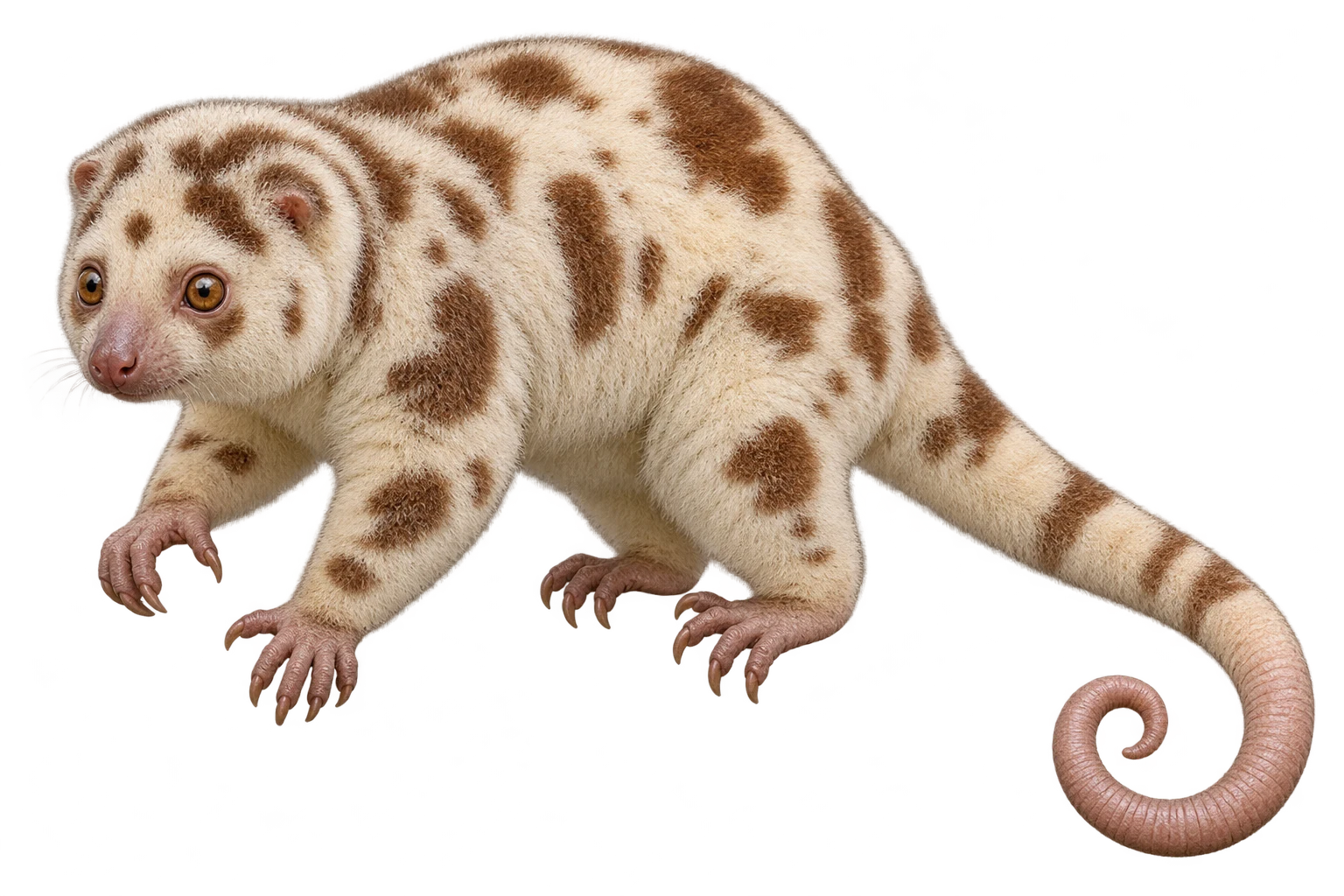
Mammals
Common Spotted Cuscus
Spilocuscus maculatus
Classification and source reference
LivingAI illustration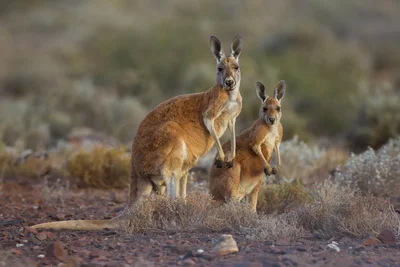
Mammals
Kangaroo
Macropodidae
Kangaroos are hopping marsupials in the macropod family.
Living VU
Mammals
Koala
Phascolarctos cinereus
The koala is a tree-living marsupial from eastern Australia.
Living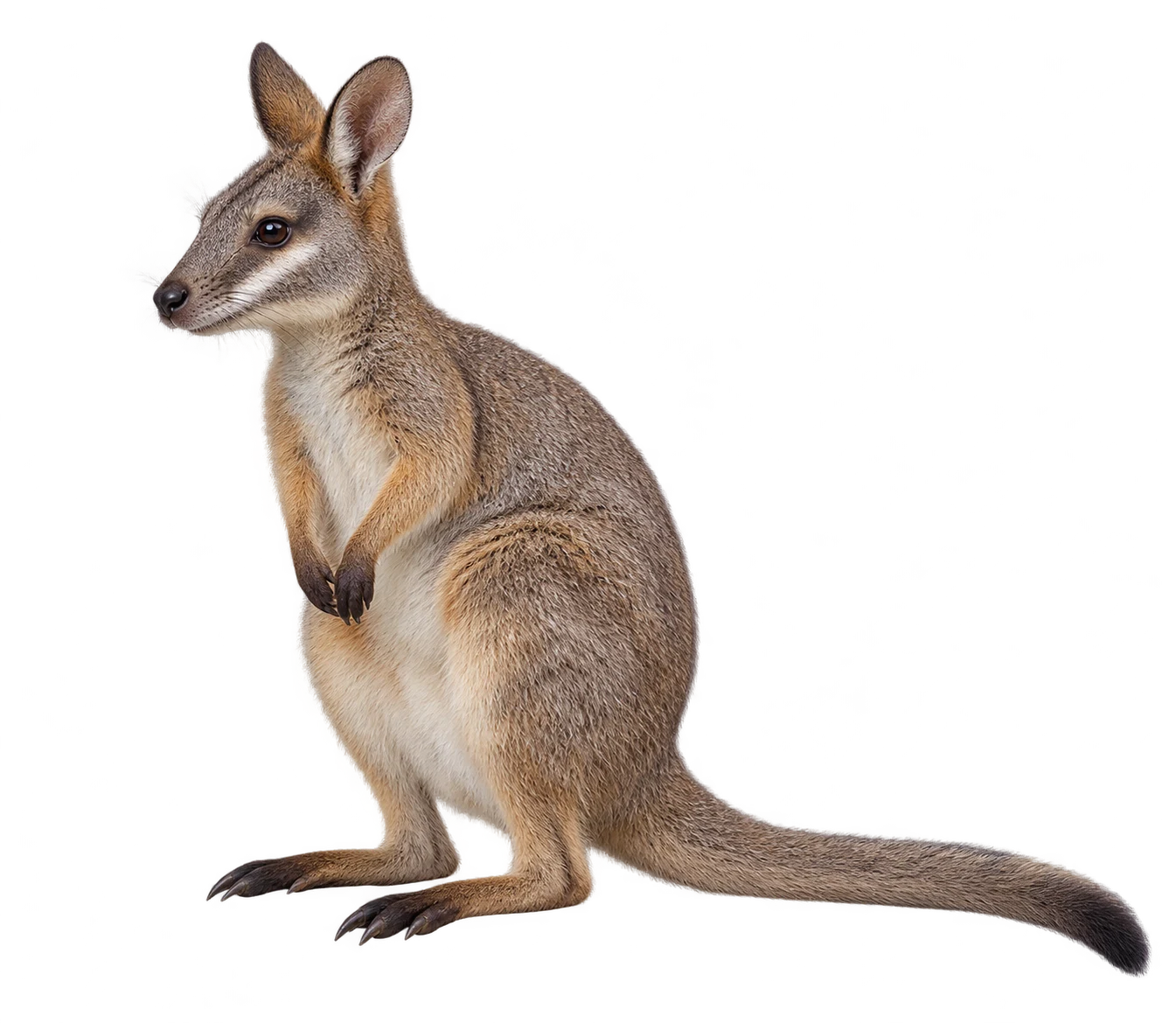
Mammals
Nabarlek
Petrogale concinna
Classification and source reference
LivingAI illustration
Mammals
Pademelon
Thylogale
Classification and source reference
LivingAI illustration
Mammals
Potoroo
Potoroidae
Classification and source reference
LivingAI illustration