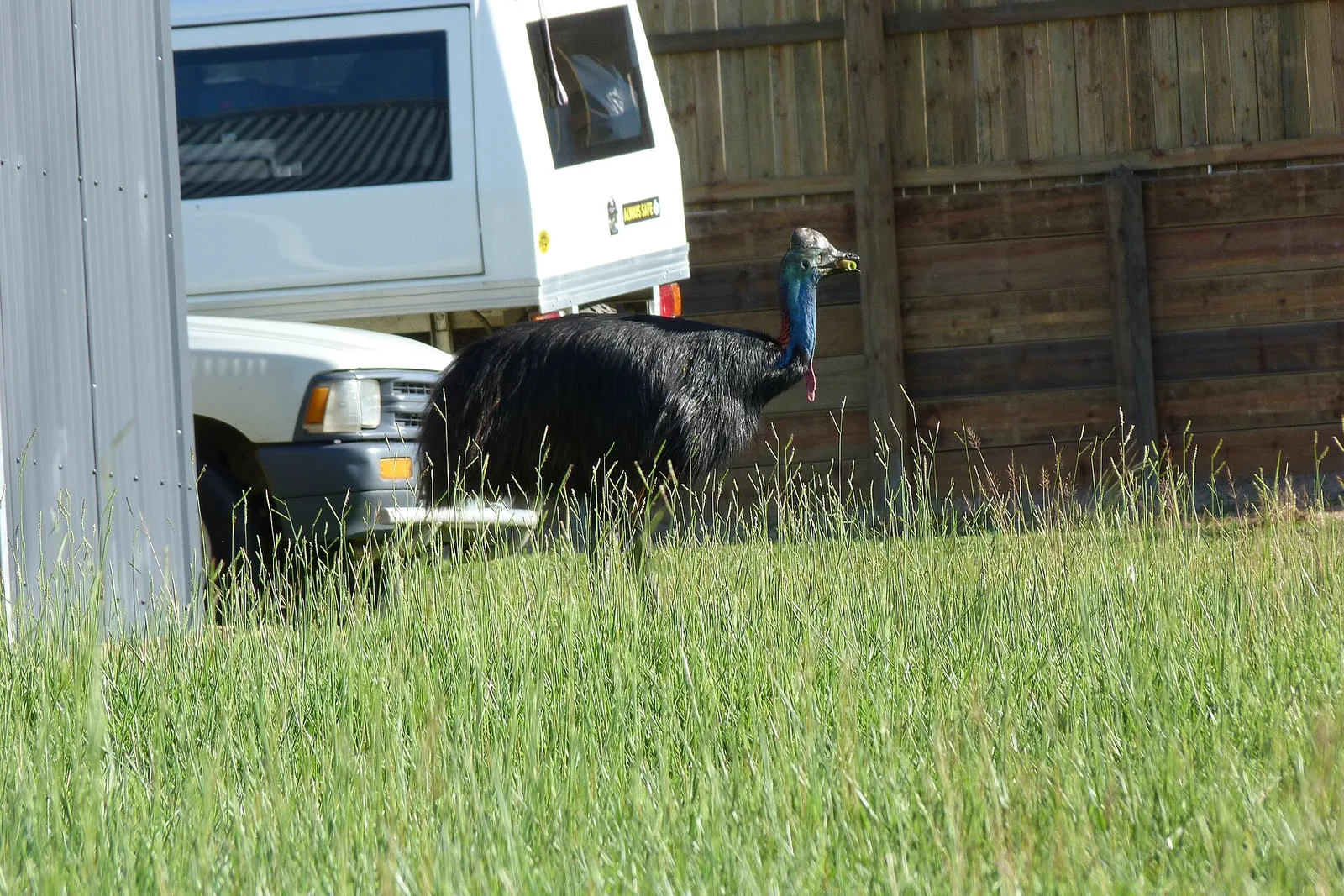
Southern cassowary
A rainforest giant with a helmet and a dagger claw
Casuarius casuarius
Also called Double-wattled cassowary, Australian cassowary, Two-wattled cassowary
Living individuals or members of this group exist today. This does not mean they are safe from extinction.
Meet the southern cassowary
The southern cassowary is a huge flightless bird of the rainforests of New Guinea and northeast Australia. It eats fallen fruit, carries a bony helmet on its head and defends itself with a dagger-like claw.
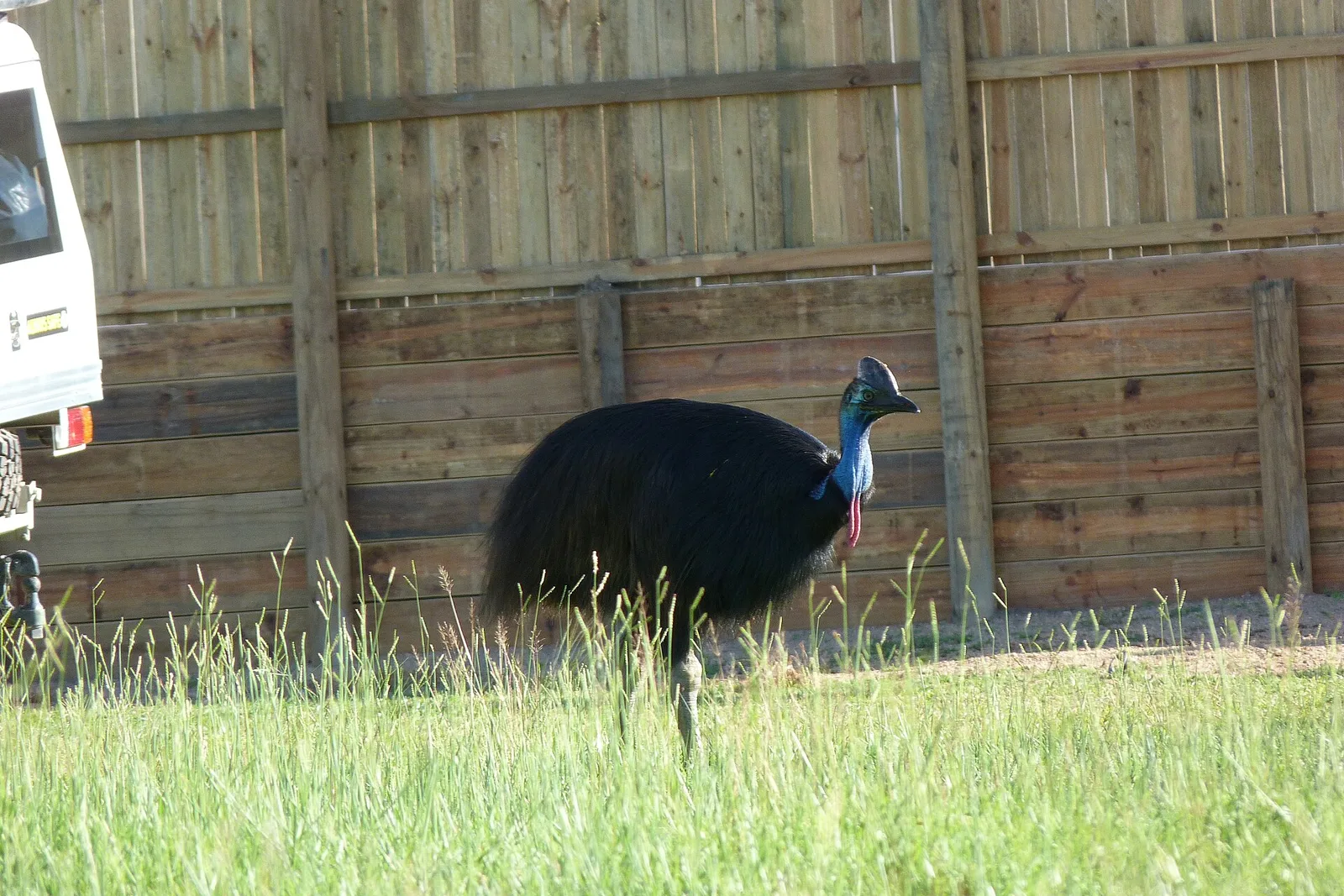
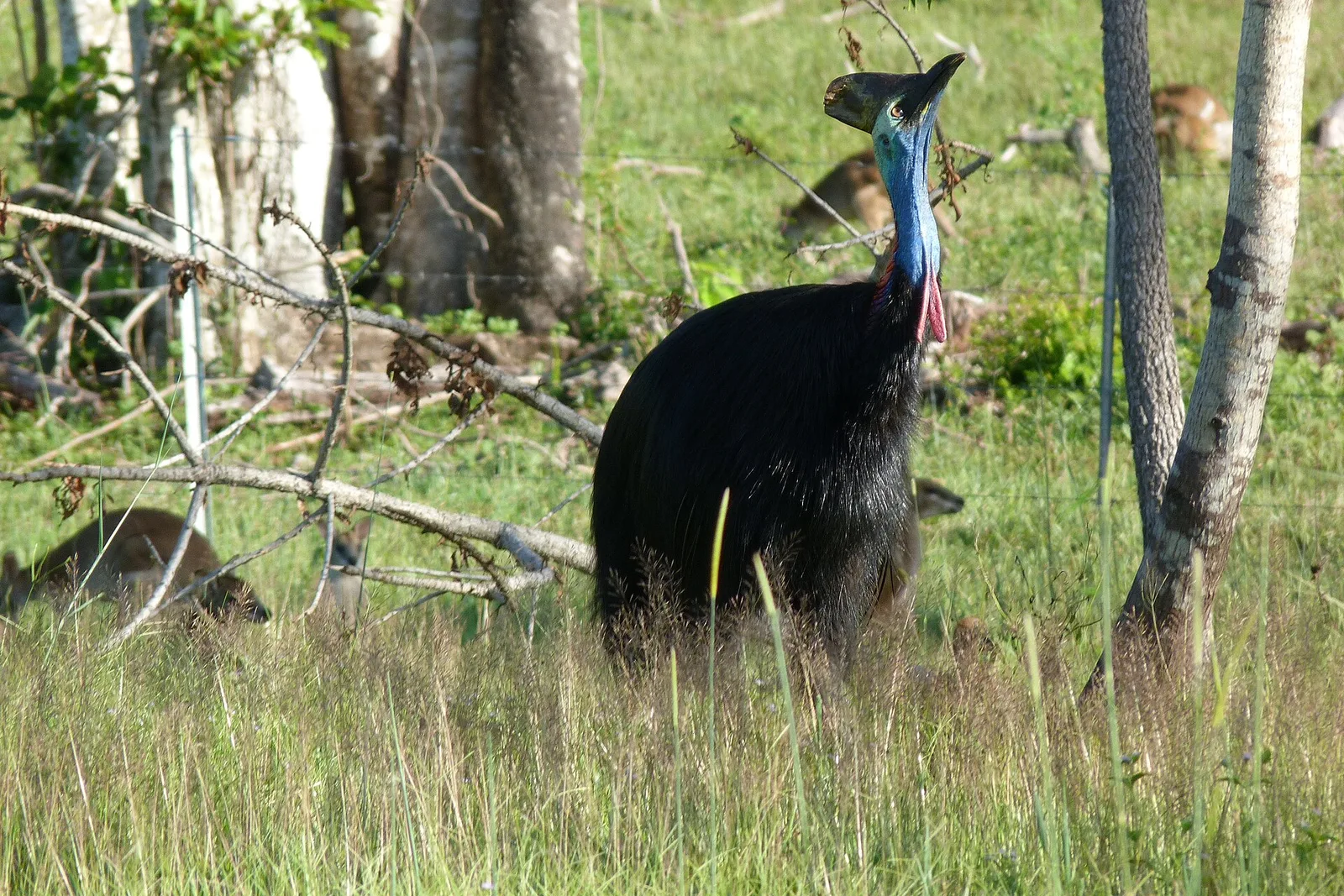
Images of the southern cassowary
Lifespan
20 to 40 years little is known about the wild lifespan
Weight
29 to 76 kg
Length
1.02 to 1.7 m
Top speed
Up to 50 km/h
Fact file
Southern cassowary
- Location
- New Guinea, the Aru Islands, Seram and northeast Queensland
- Habitat
- Rainforest, Temperate forest, Savanna
- Diet
- Omnivore
- Prey / food
- Fallen fruit, fungi, insects, snails, small vertebrates, carrion
- Predators
- None known as adults; feral pigs and dogs take eggs and chicks
- Lifestyle
- Solitary, active by day, and silent when it wants to be
- Group name
- None, the bird lives alone
- Name of young
- Chick
- Incubation
- Eggs hatch after about 50 days
- Clutch size
- 3 to 5 eggs
- Population
- 10,000 to 20,000 birds, with 1,500 to 2,500 in Australia
- Biggest threat
- Habitat loss, vehicle strikes and feral animals
- Distinctive feature
- A tall brown casque and two red throat wattles
- Colour
- Black body with a blue neck and a red nape
- Skin type
- Feathers
Size
Next to a person
Measurements
Size and speed
- Height
- 1.5 to 1.8 m, up to 2 m
- Length
- 1.02 to 1.7 m
- Weight
- 29 to 76 kg, up to 85 kg males 29.2 to 55 kg, females 46.7 to 76 kg
- Weight, male
- 29.2 to 55 kg
- Weight, female
- 46.7 to 76 kg, up to 85 kg
- Top speed
- Up to 50 km/h
Typical adult ranges. Sources: Wikipedia, Animal Diversity Web.
Life cycle
Lifespan
- In captivity20 to 40 years little is known about the wild lifespan
- 040 years
Source: Animal Diversity Web.
Appearance
Colour and coat
- Primary colours
- blackblue
- Secondary colours
- redbrown
- Skin type
- feathers
- Male and female
- Reverse dimorphism. The female is larger and dominant, with a taller casque, a bigger bill and brighter bare skin. The plumage of the two sexes is the same.
Life cycle
Mating and family
- Mating system
- polyandrous, with a female taking two or three males
- Social structure
- solitary, with a defended home range
- Breeding
- several clutches a season, one per male
A female pairs with two or three males in a season and lays a clutch for each. The male builds a mat of plant material on the ground and lays claim to the eggs. He incubates three to five bright green eggs for about 50 days. Chicks hatch feathered and walking, and their father raises them alone. They leave him at nine to twelve months and reach full adult form at four or five years.
Classification
Taxonomy
- Kingdom
- Animalia
- Phylum
- Chordata
- Class
- Aves
- Order
- Casuariiformes
- Family
- Casuariidae
- Genus
- Casuarius
- Species
- Casuarius casuarius
Conservation
Red List status
- LC
- NT
- VU
- EN
- CR
- EW
- EX
Least Concern on the IUCN Red List
Range
Recorded in 2 countries
Habitat layer: tropical moist broadleaf forest, temperate broadleaf and mixed forest, temperate conifer forest, boreal forest and taiga, tropical grassland, savanna and shrubland.
Countries from 1,796 wild records on GBIF (iNaturalist research grade), filtered and checked by hand. Country shapes: Natural Earth. Habitat: RESOLVE Ecoregions 2017, CC BY 4.0. Basemap: Natural Earth.
Habitats
Three things to know
- 1
The inner toe carries a claw up to 12 centimetres long.
- 2
Its call reaches down to about 23 hertz, near the bottom of human hearing.
- 3
One pile of its dung can hold a kilogram of seeds from rainforest trees.
Did you know
Seven more facts
- 1
Only the ostrich outweighs the cassowary among living birds.
- 2
The female is bigger than the male and takes two or three mates a season.
- 3
The wings are reduced to five or six long white spines.
- 4
A cassowary egg is bright pea green when fresh and fades with age.
- 5
The casque is made of spongy bone and cartilage, not solid horn.
- 6
A single dropping can hold a kilogram of rainforest seeds.
- 7
Guinness World Records named it the most dangerous bird in the world in 2004.
Field notes
How it looks and acts
Field notes
Distinguishing features
- A brown casque 13 to 20 cm high sits on top of the head.
- Two red wattles up to 18 cm long hang from the throat.
- The bare face and neck are blue, with red at the back of the neck.
- The black plumage is stiff and looks like coarse hair.
- The inner toe carries a claw of up to 12 cm.
- The bird stands 1.5 to 1.8 m tall.
Field notes
Unique adaptations
- The casque probably shields the head as the bird runs through thick undergrowth.
- A very low call probably carries through dense forest better than a high one would.
- A gut that handles toxic fruit opens food that other animals cannot use.
- Powerful legs give both a running speed of 50 km/h and a fighting kick.
- Coarse bristly plumage seems to shed rain and resist thorns.
Field notes
Interesting behaviours
- It forages alone on the forest floor for fallen fruit.
- It swims across rivers and streams.
- It kicks forward with the inner claw when it is cornered.
- It defends a home range against other cassowaries with deep roars.
- It swallows earth when food is short.
Field notes
Temperament
- Shy and quiet, and it moves through the forest almost in silence.
- Solitary outside the breeding season.
- Aggressive when fed by people, when cornered or when guarding chicks.
- Bold enough to charge an adult human.
Field notes
Communication
- A deep roar marks a home range and carries far through the trees.
- A booming call with a swollen throat belongs to courtship.
- Hissing and rumbling serve outside the mating season.
- Chicks whistle and chirp to keep contact with their father.
- Bright bare skin and a tall casque probably signal size and condition.
Ecology
Ecological role
The southern cassowary swallows large fruit whole and carries the seed far from the parent tree. No other animal in these forests does the same job.
- It disperses seeds of dozens of rainforest trees in a form that still germinates.
- It handles fruits that are toxic to other animals, so those trees depend on it.
- Its droppings probably deliver seeds with a package of fertiliser around them.
- Its loss would probably thin the large-seeded trees of the Wet Tropics over time.
Stories
Myths and legends
- Among the Kalam people of New Guinea a cassowary counts as a relative, not as a bird.
- Among the Maring of Kundagai the bird was sacrificed in ritual.
- In New Guinea highland custom a reared cassowary is a ceremonial gift.
- In Aboriginal Australian tradition the bunyip may owe some of its shape to this bird.
- In Ngarrindjeri telling the same water spirit is the Mulyawonk, who punished greedy fishers.
People
Relationship with humans
People
Living alongside us
People in New Guinea have reared cassowary chicks in villages for centuries. The feathers went into headdresses and the quills into nose ornaments, and the grown bird was eaten. That trade has run through Southeast Asia for more than 500 years. In Australia the relationship is different, and the main issues are roads, dogs and people who feed wild birds. Feeding draws cassowaries to houses and traffic, which kills them and puts people at risk.
- The bird kicks forward with a claw of up to 12 cm and can cause deep wounds.
- Records hold two human deaths from this bird since 1900, one in 1926 and one in 2019.
- Three quarters of recorded attacks came from birds that people had fed.
People
Status, uses and products
- Domestication
- Wild
- As a pet
- Not suitable. No. A southern cassowary can weigh 76 kg, jump nearly 2 m and kick with a dagger claw. It killed its own keeper in Florida in 2019, and it is protected by law in Australia.
- Uses
- ceremonial exchangefeathers for headdressesmeat
- Products
- feathersquillsbonemeat
The full account
About the southern cassowary
The southern cassowary, Casuarius casuarius, is a large flightless bird of tropical rainforest. It stands 1.5 to 1.8 metres tall, and the tallest birds reach 2 m. Males weigh 29.2 to 55 kilograms and females 46.7 to 76 kg. Only the ostrich is heavier on average among living birds. The bird lives in Indonesia, Papua New Guinea and northeastern Australia.
A brown bony casque rides on the head and two red wattles hang at the throat. The face and neck are bare blue skin with red at the back. Each foot has three toes, and the inner toe carries a claw up to 12 cm long. The diet is mostly fallen fruit, so the bird spreads the seeds of hundreds of rainforest trees. The IUCN lists the species as Least Concern, but Australia lists its own population as Endangered.
Name and taxonomy
Carl Linnaeus described the bird in 1758 as Struthio casuarius, from a specimen collected on Seram. The species now stands as the type of the genus Casuarius. The scientific name comes from kesuari, the Malay name for the bird. English also calls it the double-wattled cassowary and the Australian cassowary. Many other scientific names were published over the years and all are now treated as synonyms.
Most authorities treat the species as monotypic today. Several subspecies were described, but none has held up. The skin colours that the descriptions rested on fade in a museum specimen. People have also traded live cassowaries for centuries, so a bird's origin may not be where it was found.
Evolution and relatives
The cassowary is a ratite, which places it with the emu, ostrich, rhea and kiwi. The emu is the sister lineage, and both sit in the family Casuariidae. Two other cassowaries are alive, the dwarf cassowary and the northern cassowary. The southern cassowary is the largest of the three and the only one with two wattles.
The wings have shrunk to almost nothing. What remains of the primary feathers is five or six long white spines. Like other ratites, the bird traded flight for size and for legs that run and kick. The casque is built from spongy bone and cartilage rather than solid horn. Scientists found in 2026 that cassowary casques glow under ultraviolet light.
Appearance
The plumage is black, stiff and bristly, so it looks more like coarse hair than feathers. The head and neck carry no feathers and show bright blue skin with red on the nape. Two red wattles hang from the throat and reach up to 18 cm long. The casque stands 13 to 20 cm high on top of the head. The bill measures 9.8 to 19 cm.
A typical adult stands 1.5 to 1.8 m tall. The largest birds on record reached about 85 kg and 2 m in height. Females are the larger sex, at 46.7 to 76 kg against 29.2 to 55 kg for males. A female also carries a taller casque, a bigger bill and brighter bare skin. Queensland hunters between 1870 and 1894 shot and weighed birds of 76 to 119 kg.
The legs are thick and the feet have three toes. The claw on the inner toe grows up to 12 cm and comes to a point like a dagger. A chick is brown, marked with black stripes that run from head to tail. They keep those stripes for three to six months and then turn plain brown. The bright neck colours arrive at about one year, and the casque takes four or five years to finish.
Habitat and range
The species lives in New Guinea, on Seram and the Aru Islands, and on Cape York in Australia. Lowland tropical rainforest is the core habitat. Birds also use eucalyptus forest, savanna woodland, palm scrub, mangroves and forested swamp. In Australia they stay below about 1,100 metres, and in New Guinea below about 500 m. The occurrence range covers about 396,000 square kilometres.
A cassowary keeps a home range and defends it against other cassowaries. Nobody has measured how much forest one bird needs. The number and kind of fruiting trees a cassowary depends on suggests the area is large. The bird swims well and crosses rivers and streams without trouble. It also jumps, and a startled bird can clear nearly 2 m from a standing start.
Diet and feeding
Fruit is the heart of the diet. The bird cannot fly, so it works the forest floor and takes what has dropped. It swallows fruit whole and can digest some fruits that would poison other animals. Fungi, insects, snails and other invertebrates go down as well. Small fish, frogs, birds, eggs, nestlings, small mammals and carrion round out the list.
Dung studies name the trees the bird eats from. Davidsonia pruriens and Syzygium divaricatum turn up often, along with palms and laurels. Members of the quandong and myrtle families appear as well. One study recovered seeds of 78 plant species from cassowary droppings. Seeds of 70 of those species still germinated after passing through the bird.
Wild and captive birds have both been seen swallowing soil when food runs short. That behaviour probably supplies minerals the fruit does not give. A single dropping can carry as much as a kilogram of seeds. Nothing else in these forests moves large seeds that far, so the bird acts as a keystone species.
Behaviour and social life
The southern cassowary lives alone for most of the year. Pairs form only in the breeding season, in late winter or spring. A bird moving slowly through the forest makes almost no sound. An alarmed bird crashes through the undergrowth at up to 50 km/h. It uses the casque to shove vegetation aside as it runs.
The bird is shy and avoids people where it can. It turns aggressive when cornered, when guarding chicks or when it expects food. Defence means jumping and kicking forward with the long inner claw. Adults appear to have no natural predator in the forest. People are the exception, because cassowaries are hunted for meat in parts of New Guinea.
Communication and senses
The voice of a cassowary is a very deep roar that travels far through dense forest. The call runs about 40 decibels above the background noise of the forest. It reaches down to about 23 hertz, which is near the lower limit of human hearing. Few birds have been recorded making sounds that low. The roars work as territory markers and tell other cassowaries where a bird is.
Researchers wonder whether the casque has a part in this. One idea is that the casque helps produce the deep calls, and another is that it helps receive them. Heat loss and visual signalling are the other explanations on offer. The ultraviolet glow found in 2026 differs between the southern and northern species, which may support a signal role.
Other sounds appear to fill out the range. A thunderous call belongs to the mating season, and hissing and rumbling serve the rest of the year. A courting male gives a booming call while he swells his throat. Chicks whistle and chirp at a high pitch to keep in touch with their father.
Reproduction and life cycle
The female runs the mating system in this species. She pairs with two or three males in a season and starts a new nest with each one. Breeding falls in the southern winter, from about June to July, when fruit is plentiful. The male builds the nest, a mat of plant material on the ground. It is 5 to 10 centimetres thick and up to 100 cm across, so water drains away from the eggs.
A clutch holds three to five eggs. Each egg is 11.8 to 15.8 cm long and 8.2 to 10.2 cm wide, and weighs 567 to 634 grams. The shell has a grainy surface and starts bright pea green before it fades. The male alone incubates, for about 50 days. The female takes no part in the sitting and moves on to her next mate.
Chicks hatch fully feathered and can walk and explore within hours. The father raises them alone and teaches them where to find food. They become independent at nine to twelve months old. Adult plumage and a full casque take four to five years to develop. Captive birds have lived 20 to 40 years, and the wild lifespan is not known.
Predators and threats
Habitat loss is the largest threat to the species. Logging and land clearing probably break the forest into patches that a bird cannot cross safely. Road building brings traffic into the range, and vehicle strikes kill many birds. Feral pigs and dogs disturb nests and eat eggs and chicks. Hunting still takes birds in parts of New Guinea.
Feeding by people makes the danger worse in Australia. Fed birds move towards houses and roads, where cars and dogs are waiting. Queensland trialled a system that uses artificial intelligence to spot birds near a road and warn drivers. Fatal crashes may have dropped by up to a third, though a lower speed limit came in at the same time. Animal Diversity Web reports a decline of about 30 percent over thirty years.
Population and conservation
The IUCN assessed the southern cassowary as Least Concern in 2018. A 2002 study put the world total at 10,000 to 20,000 birds. Between 1,500 and 2,500 of those lived in Australia. A federal draft recovery plan in June 2023 gave an Australian figure of about 5,000 birds. Naturalists have logged 3511 observations of the species on iNaturalist.
Australia appears to treat the bird far more seriously than the global list does. The national population is Endangered under the federal EPBC Act. Queensland listed the northern population as vulnerable and the southern one as endangered in November 2022. Land clearing in Australia has now largely stopped, which helps.
A 2021 study found that large reserves had allowed the species to recover. A paper in March 2023 listed 23 Australian species that no longer meet the threatened criteria, and this bird was one. The team judged the population stable, or falling slower than the threshold. Zoos around the world breed the species, including White Oak Conservation in Florida.
Relationship with humans
The cassowary has a reputation as the most dangerous bird alive. Guinness World Records gave it that title in 2004. Deaths are in fact very rare, and only two have been reported since 1900. A 2003 study of 221 attacks found that 150 of them were against people. Three quarters of those came from birds that people had fed.
The attack pattern appears to be mostly bluff. The bird chased or charged in 71 percent of cases and kicked in 15 percent. Food explained 73 percent of the attacks, and defence of chicks or eggs explained 7 percent. The first recorded death was on 6 April 1926, when two boys attacked a bird with clubs in Queensland. A kick opened a 1.25 cm wound in the neck of the older boy, who died soon after.
The second death happened in Florida on 12 April 2019. The bird's owner, a man of 75 who had raised it, fell over and was clawed. People in New Guinea have taken cassowary chicks and reared them in villages for centuries. Feathers went into headdresses, quills became nose ornaments and the grown bird became meat. Cassowaries have been traded through Southeast Asia for more than 500 years.
In culture and myth
The cassowary appears to matter more in New Guinea belief than any other bird. For the Kalam people a cassowary is a relative, and it is not classed with birds at all. They switch to a special speech register while eating cassowary meat. The Maring of Kundagai sacrificed cassowaries in certain rituals. Highland groups keep half-tame birds for ceremonial gifts and for food.
Some archaeologists argue this makes the cassowary an early case of bird keeping. Collecting eggs and rearing the young may predate the keeping of chickens. The trade in live birds may also explain cassowary populations on islands away from New Guinea.
In Australia the bird may sit behind a famous story. Aboriginal Australians tell of the bunyip, a spirit of the water, and Robert Holden recorded nine or more regional forms. Ngarrindjeri people call it the Mulyawonk, and it punished anyone who took more fish than they needed. Karl Brandt suggested in 2017 that meetings with cassowaries helped shape the bunyip. An 1845 account of the bunyip describes deadly claws and a head like an emu, which fits the bird.
A sentence with a dotted underline is inferred: it describes the group the animal belongs to, or is a reading of the sources, rather than a measured or reported fact about this species.
Questions
Southern cassowary questions, answered
How big is a southern cassowary?
It stands 1.5 to 1.8 m tall, and the largest birds reach 2 m. Females weigh 46.7 to 76 kg and males 29.2 to 55 kg.
Is the cassowary the most dangerous bird in the world?
Guinness World Records awarded that title in 2004. The claw and the kick can cause serious wounds. Deaths are still very rare, with only two reported since 1900.
Can a cassowary kill you?
It can, but almost never does. One boy died in Queensland in 1926 and one keeper died in Florida in 2019. Most attacks involve a charge rather than a kick.
What does a cassowary eat?
Mostly fruit that has fallen to the forest floor. It also takes fungi, insects, snails, small vertebrates and carrion.
How fast can a cassowary run?
Up to 50 km/h through dense forest. It can also jump nearly 2 m straight up and it swims well.
What is the casque on a cassowary's head for?
Nobody is certain. Suggestions include pushing vegetation aside, shedding heat, making or receiving very deep calls, and visual signalling. The casques were found to glow under ultraviolet light in 2026.
Where do southern cassowaries live?
In the rainforests of New Guinea, Seram, the Aru Islands and northeast Australia. They stay below about 1,100 m in Australia and 500 m in New Guinea.
Are cassowaries endangered?
Globally the IUCN lists the species as Least Concern. The Australian population is Endangered under national law, with about 1,500 to 2,500 birds counted in 2002.
Do male cassowaries look after the eggs?
Yes, and only the male does. He builds the nest, incubates the eggs for about 50 days and raises the chicks alone for nine to twelve months.
How many eggs does a cassowary lay?
Three to five in a clutch. Each egg weighs 567 to 634 g and is bright pea green when fresh.
How long do cassowaries live?
Captive birds have lived 20 to 40 years. Very little is known about how long a wild cassowary lives.
Why are cassowaries important to the rainforest?
They swallow large fruit whole and drop the seeds far from the parent tree. Seeds of 78 plant species have been found in their dung, and 70 of those still grew.
What kills cassowaries?
Cars are a major cause in Australia, along with dogs and feral pigs. Habitat clearing and hunting in New Guinea add to the pressure.
Why should you not feed a cassowary?
Fed birds come to expect food from people and grow bold. Three quarters of recorded attacks involved fed birds, and feeding also draws them onto roads.
What should you do if you meet a cassowary?
Back away slowly and put a tree or another solid object between you and the bird. Do not run, do not feed it and do not approach chicks.
What is the difference between a cassowary and an emu?
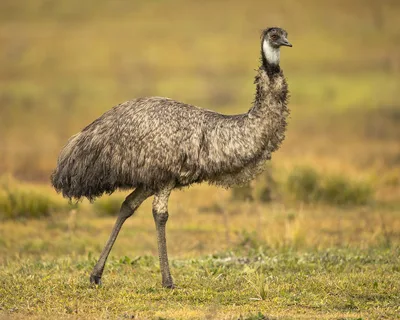
The two are close relatives in the same family. The cassowary is heavier, has a bony casque, red throat wattles and a blue neck. The emu is brown and has no casque.
Food web
Prey and food
- fallen fruit
- fungi
- insects
- snails
- vertebrates
- carrion
Food web
Predators
- none known
- feral pigs
- dogs
Ecological equivalents
Related species on this site
Emu (same order).