Sandpiper
Scolopacidae
Living individuals or members of this group exist today. This does not mean they are safe from extinction.
Sandpipers are diverse shorebirds. This account describes the spotted sandpiper (Actitis macularius), a small American species that searches shorelines for insects and other small prey.
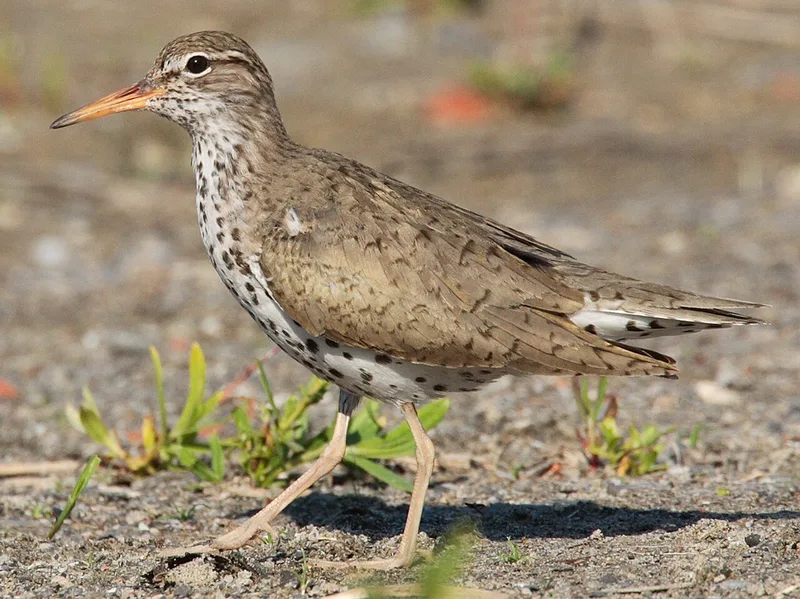
Representative species: Actitis macularius.
No machine-readable author provided. Factumquintus assumed (based on copyright claims). · CC BY-SA
At a glance
- Habitat
- Rivers and lakes, Coast, Wetlands
- Diet
- Carnivore
- Food
- Insects and other small animals.
Classification
- Common name
- Sandpiper
- Browse group
- Birds
- Scientific name or taxon
- Scolopacidae
- Taxon rank
- family
- Order
- Charadriiformes
- Family
- Scolopacidae
- Source classification
- Aves
Taxonomy checked against GBIF. For breeds and hybrids, this describes the listed parent taxon.
Three things to know
- Belly spots are most obvious in breeding plumage.
- Many migrate in small groups or alone.
- Males undertake much of the incubation.
Habitat and range
Spotted sandpipers breed across much of North America and winter farther south, including Central and South America. Stream banks, lake margins, marshes and coasts provide feeding habitat.
Appearance and adaptations
Brownish upperparts contrast with a white underside. Breeding adults have dark belly spots, while nonbreeding birds lack the prominent spotting that gives the species its name.
Diet and behaviour
Birds pick small animals from the ground, vegetation and water edges, sometimes pursuing flying insects. Many migrate singly or in small groups. Females can defend breeding territories, while males undertake much of the egg incubation.
Sources
- Animal Diversity Web: Actitis macularius
- A–Z Animals: Sandpiper · Directory entry
Explore birds
Browse all birds LC
Birds
Great egret
Ardea alba
The great egret is a tall white heron that hunts fish in shallow water on six continents.
Living
Birds
Duck
Anatidae
Ducks are waterbirds with many different feeding habits.
Living
Birds
Egret
Ardeidae
Egrets are herons known for pale plumage in several species.
Living LC
Birds
Great blue heron
Ardea herodias
The great blue heron is the biggest of the North American herons and a patient hunter of shallow water.
Living