Hammerhead Shark
Sphyrnidae
Living individuals or members of this group exist today. This does not mean they are safe from extinction.
Hammerhead sharks have unusually wide heads. This account describes the great hammerhead, a large warm-water predator with a tall curved dorsal fin and a diet that includes stingrays.
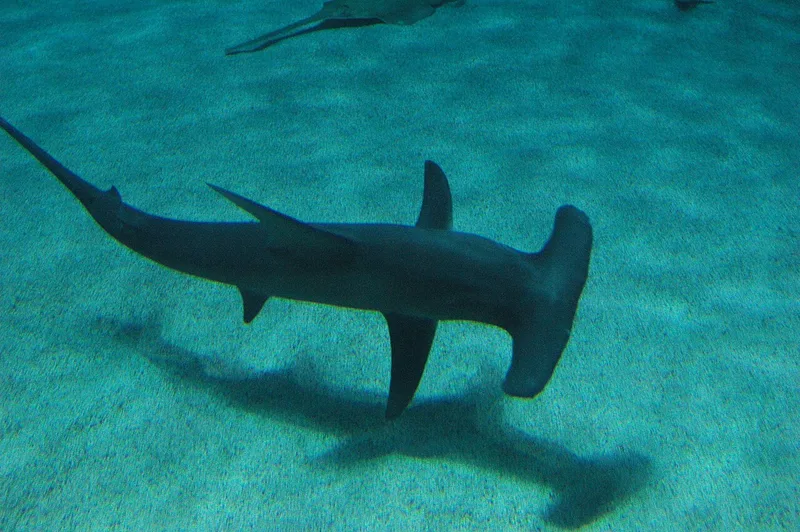
Great hammerhead (Sphyrna mokarran) photographed at the Georgia Aquarium.
At a glance
- Location
- Sphyrna mokarran is the representative used here. It occupies tropical and subtropical seas, using coastal shelves, reefs, bays and offshore water. Some populations make seasonal movements towards cooler latitudes.
- Habitat
- Coast, Coral reef, Open ocean
- Diet
- Carnivore
- Food
- Great hammerheads eat fishes, rays, other sharks and marine invertebrates.
Classification
- Common name
- Hammerhead Shark
- Browse group
- Fish
- Scientific name or taxon
- Sphyrnidae
- Taxon rank
- family
- Order
- Carcharhiniformes
- Family
- Sphyrnidae
- Source classification
- Chondrichthyes
Taxonomy checked against GBIF. For breeds and hybrids, this describes the listed parent taxon.
Three things to know
- It has a tall curved dorsal fin.
- Stingrays are among its prey.
- It often travels alone.
Habitat and range
Sphyrna mokarran is the representative used here. It occupies tropical and subtropical seas, using coastal shelves, reefs, bays and offshore water. Some populations make seasonal movements towards cooler latitudes.
Appearance and adaptations
The broad head carries widely separated eyes. A streamlined body is darker above and pale beneath, while the first dorsal fin is conspicuously tall and curved.
Diet and behaviour
Great hammerheads eat fishes, rays, other sharks and marine invertebrates. They are often solitary. Their broad heads and sensory systems help them search for prey in varied marine habitats.
Sources
- Animal Diversity Web: Sphyrna mokarran
- A–Z Animals: Hammerhead Shark · Directory entry
Explore fish
Browse all fish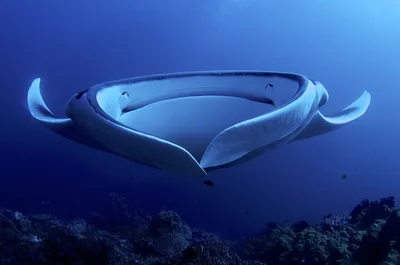
Fish
Manta Ray
Mobula
Mantas are large rays that filter small animals from seawater.
Living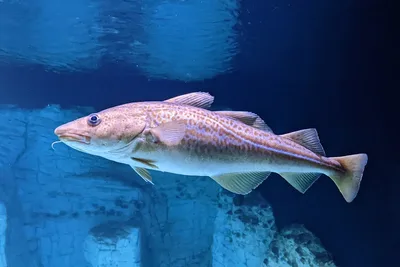
Fish
Atlantic Cod
Gadus morhua
The Atlantic cod is a cold-water fish of the North Atlantic.
Living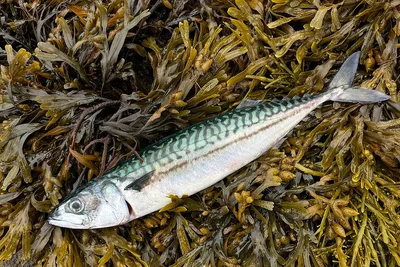
Fish
Atlantic mackerel
Scomber scombrus
Atlantic mackerel are streamlined schooling fishes of northern seas.
Living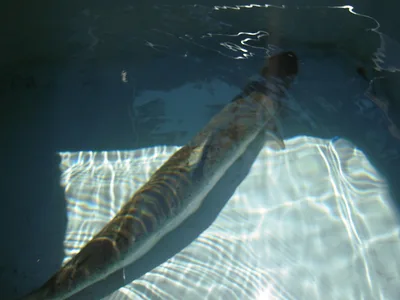 NT
Fish
Atlantic salmon
Salmo salar
The Atlantic salmon hatches in a river, grows up at sea, and returns to the same river to spawn.
Living