Atlantic Cod
Gadus morhua
Living individuals or members of this group exist today. This does not mean they are safe from extinction.
The Atlantic cod is a cold-water fish of the North Atlantic. Three dorsal fins, a pale lateral line and a single chin barbel help distinguish it from many other marine fishes.
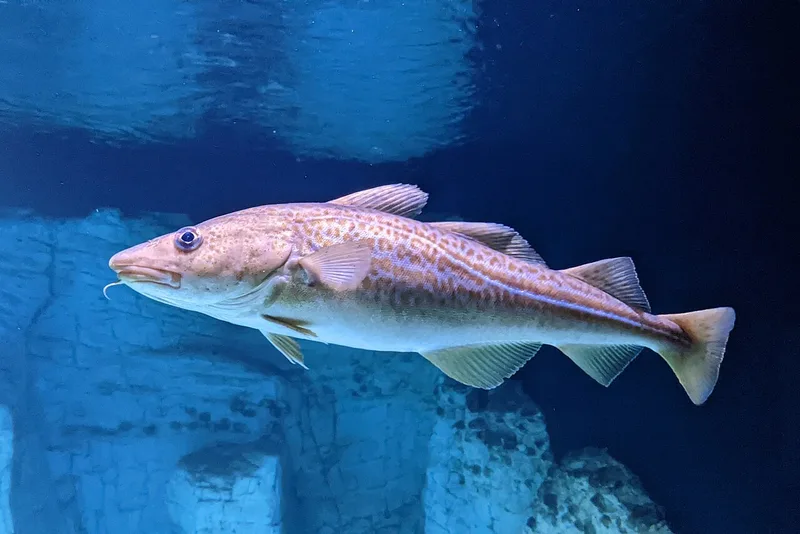
Atlantic cod (Gadus morhua), the representative described here.
At a glance
- Location
- Atlantic cod occur on both sides of the North Atlantic, from northeastern North America and Greenland to European shelf seas. They use coastal and offshore habitats and often feed near the bottom.
- Habitat
- Coast, Open ocean
- Diet
- Carnivore
- Food
- Young cod eat small crustaceans and other invertebrates; larger fish take a wider range of prey, including fishes and molluscs.
Classification
- Common name
- Atlantic Cod
- Browse group
- Fish
- Scientific name or taxon
- Gadus morhua
- Taxon rank
- species
- Order
- Gadiformes
- Family
- Gadidae
- Genus
- Gadus
- Source classification
- Actinopterygii
Taxonomy checked against GBIF. For breeds and hybrids, this describes the listed parent taxon.
Three things to know
- It has three dorsal fins.
- A barbel hangs below the chin.
- Its diet changes as it grows.
Habitat and range
Atlantic cod occur on both sides of the North Atlantic, from northeastern North America and Greenland to European shelf seas. They use coastal and offshore habitats and often feed near the bottom.
Appearance and adaptations
The mottled body varies from brownish to greenish or grey, with a paler underside. Three dorsal fins run along the back. A small barbel hangs beneath the chin.
Diet and behaviour
Young cod eat small crustaceans and other invertebrates; larger fish take a wider range of prey, including fishes and molluscs. Seasonal movements connect feeding and spawning areas.
Sources
- Animal Diversity Web: Gadus morhua
- A–Z Animals: Atlantic Cod · Directory entry
Explore fish
Browse all fish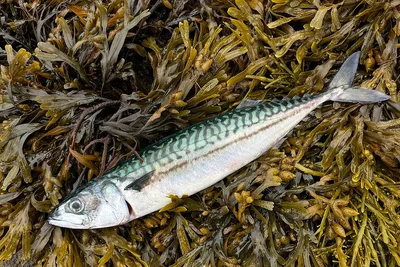
Fish
Atlantic mackerel
Scomber scombrus
Atlantic mackerel are streamlined schooling fishes of northern seas.
Living NT
Fish
Atlantic salmon
Salmo salar
The Atlantic salmon hatches in a river, grows up at sea, and returns to the same river to spawn.
Living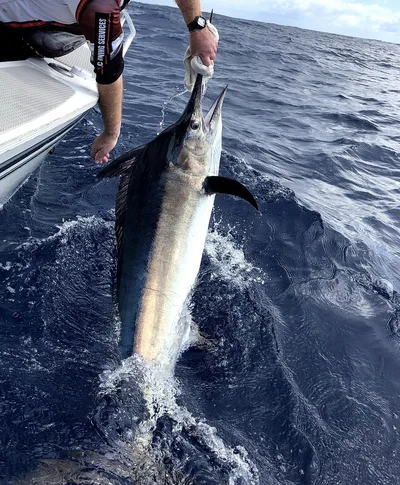
Fish
Black Marlin
Istiompax indica
The black marlin is a large predatory billfish of the Indo-Pacific.
Living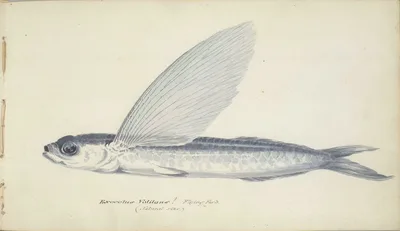
Fish
Flying Fish
Exocoetidae
Flyingfishes escape the water in gliding leaps.
Living