Flying fox
Pteropus
Living individuals or members of this group exist today. This does not mean they are safe from extinction.
Flying foxes are fruit bats with large eyes and fox-like faces. This account follows the large flying fox of Southeast Asia, which roosts in trees and feeds on fruit, flowers and nectar.
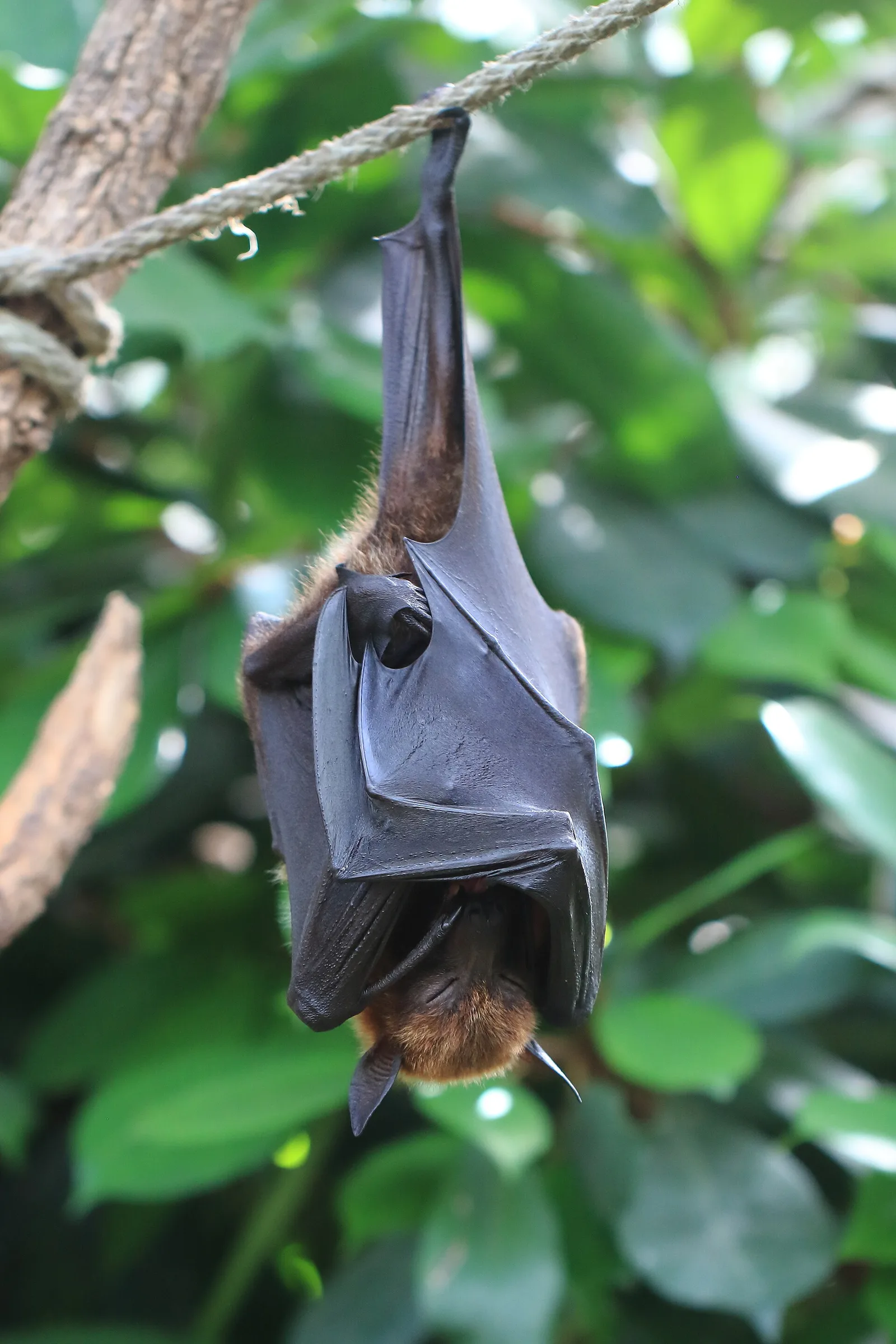
Large flying fox (Pteropus vampyrus), the representative described here, photographed at Wilhelma.
At a glance
- Location
- The representative here is the large flying fox, Pteropus vampyrus. It inhabits Southeast Asian forests and uses tree roosts, including mangrove areas. Its nightly feeding trips may also take it into orchards and other cultivated places.
- Habitat
- Rainforest, Wetlands
- Diet
- Herbivore
- Food
- Large flying foxes feed after sunset and return to communal tree roosts around dawn.
Classification
- Common name
- Flying fox
- Browse group
- Mammals
- Scientific name or taxon
- Pteropus
Three things to know
- The large flying fox roosts in trees during the day.
- It eats fruit, flowers and nectar.
- Roosting animals may wrap their wings around their bodies.
Habitat and range
The representative here is the large flying fox, Pteropus vampyrus. It inhabits Southeast Asian forests and uses tree roosts, including mangrove areas. Its nightly feeding trips may also take it into orchards and other cultivated places.
Appearance and adaptations
A long muzzle and pointed ears give this fruit bat its familiar fox-like appearance. Dark wings surround a furry body whose colour varies with age and sex. Its long tongue helps it take nectar and reach soft fruit.
Diet and behaviour
Large flying foxes feed after sunset and return to communal tree roosts around dawn. Fruit, flowers, nectar and pollen all contribute to the diet. Individuals can return repeatedly to productive feeding trees while food remains available.
Sources
- Animal Diversity Web: Pteropus vampyrus
- GBIF: Flying fox · Directory entry
Explore mammals
Browse all mammals
Mammals
African Forest Elephant
Loxodonta cyclotis
The African forest elephant moves through the rainforests of western and central Africa.
Living VU
Mammals
Sun bear
Helarctos malayanus
The sun bear is the smallest and most arboreal bear, a black bear of the Southeast Asian rainforest with an orange crescent on its chest.
Living
Mammals
Tapir
Tapiridae
Tapirs are large browsing mammals with short flexible snouts.
Living EN
Mammals
Tiger
Panthera tigris
The tiger is the largest living cat and the only one with stripes.
Living