Avocet
Recurvirostra
Living individuals or members of this group exist today. This does not mean they are safe from extinction.
Avocets are long-legged wading birds with upward-curving bills. The American avocet (Recurvirostra americana), described here, searches shallow North American wetlands for small food items.
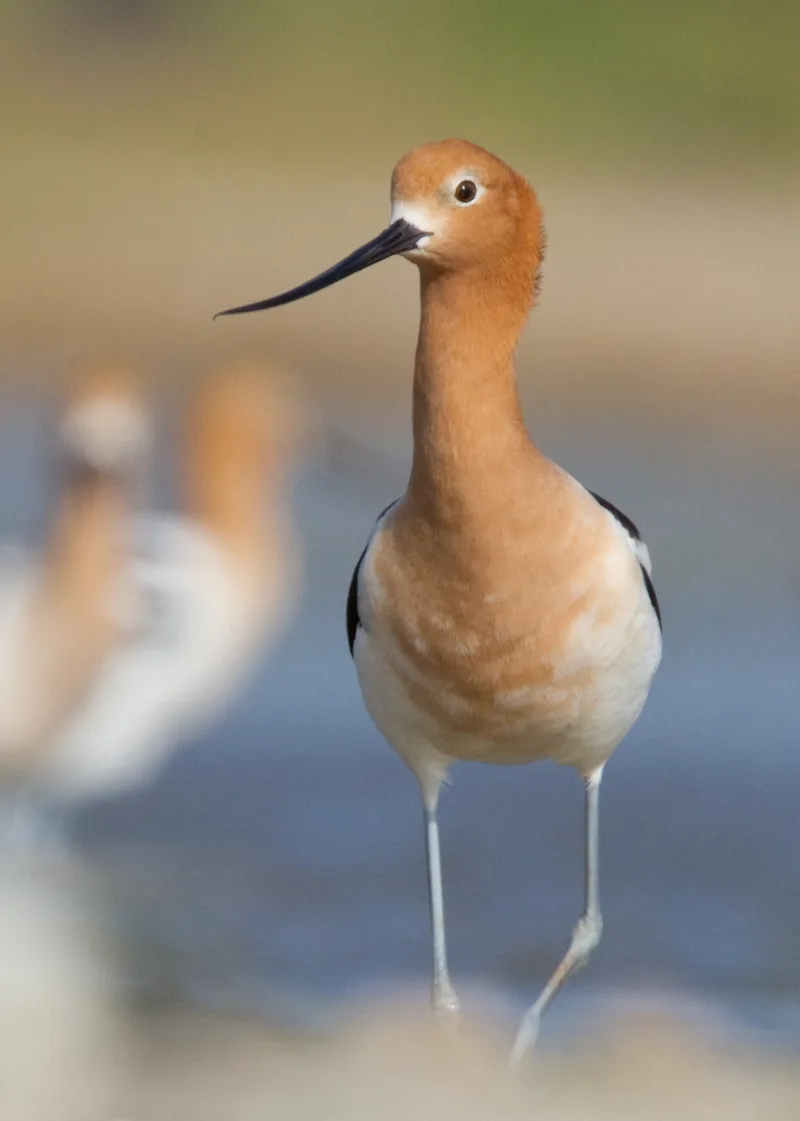
Representative species: Recurvirostra americana.
At a glance
- Location
- North American wetlands and coastal shallows.
- Habitat
- Wetlands, Rivers and lakes, Coast
- Diet
- Omnivore
- Food
- Aquatic insects, crustaceans and some plant material.
Classification
- Common name
- Avocet
- Browse group
- Birds
- Scientific name or taxon
- Recurvirostra
- Source classification
- Aves
Three things to know
- Breeding adults have rusty-coloured heads and necks.
- Both parents incubate the eggs.
- Chicks can feed themselves soon after hatching.
Habitat and range
American avocets use ponds, marshes, mudflats and shores. Many breed in western North America and move to milder coastal or southern wetlands for winter.
Appearance and adaptations
Blue-grey legs support a black-and-white body. The slender black bill curves upwards; its shape differs somewhat between males and females.
Diet and behaviour
A feeding avocet swings its partly open bill through shallow water, taking insects and other small organisms. It also eats seeds and aquatic vegetation. Pairs nest in shallow ground scrapes, often close to other avocets.
Sources
- Animal Diversity Web: Recurvirostra americana
- A–Z Animals: Avocet · Directory entry
Explore birds
Browse all birds
Birds
Duck
Anatidae
Ducks are waterbirds with many different feeding habits.
Living LC
Birds
Mallard
Anas platyrhynchos
The mallard is the green-headed dabbling duck of ponds, rivers and city parks across the northern world.
Living
Birds
Egret
Ardeidae
Egrets are herons known for pale plumage in several species.
Living LC
Birds
Great blue heron
Ardea herodias
The great blue heron is the biggest of the North American herons and a patient hunter of shallow water.
Living