Ant
Formicidae
Living individuals or members of this group exist today. This does not mean they are safe from extinction.
Ants have many different colony structures and diets. This account follows the black carpenter ant, a North American species that excavates nest spaces in wood but does not eat the wood itself.
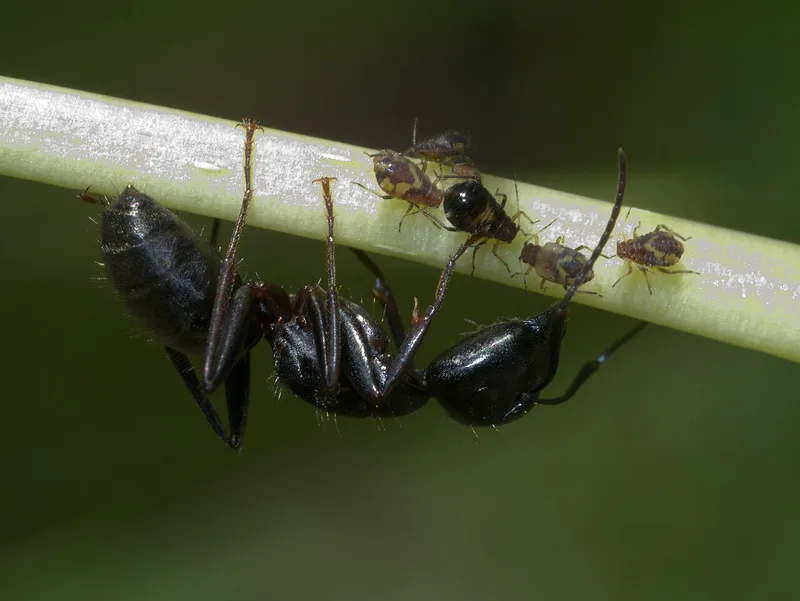
Black carpenter ant (Camponotus pennsylvanicus), the representative described here.
At a glance
- Location
- Camponotus pennsylvanicus is the representative used here. It occurs in eastern North America, nesting in trees, dead logs and sometimes wooden buildings. Those nest sites should not be confused with its food source.
- Habitat
- Temperate forest, Towns and cities
- Diet
- Omnivore
- Food
- Insects, aphid honeydew, nectar and other foods supply the colony.
Classification
- Common name
- Ant
- Browse group
- Insects
- Scientific name or taxon
- Formicidae
- Source classification
- Insecta
Three things to know
- It excavates wood but does not eat it.
- Workers differ in size.
- It shares liquid food within the colony.
Habitat and range
Camponotus pennsylvanicus is the representative used here. It occurs in eastern North America, nesting in trees, dead logs and sometimes wooden buildings. Those nest sites should not be confused with its food source.
Appearance and adaptations
Workers vary in size, while reproductive males and females develop wings. Queens lose their wings after founding a colony. Dark bodies and abdominal hairs are among this species' identifying features.
Diet and behaviour
Insects, aphid honeydew, nectar and other foods supply the colony. Workers share liquid food and carry out different tasks. Much foraging takes place at night.
Sources
- Animal Diversity Web: Camponotus pennsylvanicus
- A–Z Animals: Ant · Directory entry