Tiger Shark
Galeocerdo cuvier
Living individuals or members of this group exist today. This does not mean they are safe from extinction.
The tiger shark is a large warm-water predator with a broad snout and strongly serrated teeth. The dark markings that give it its name are especially conspicuous in young animals.
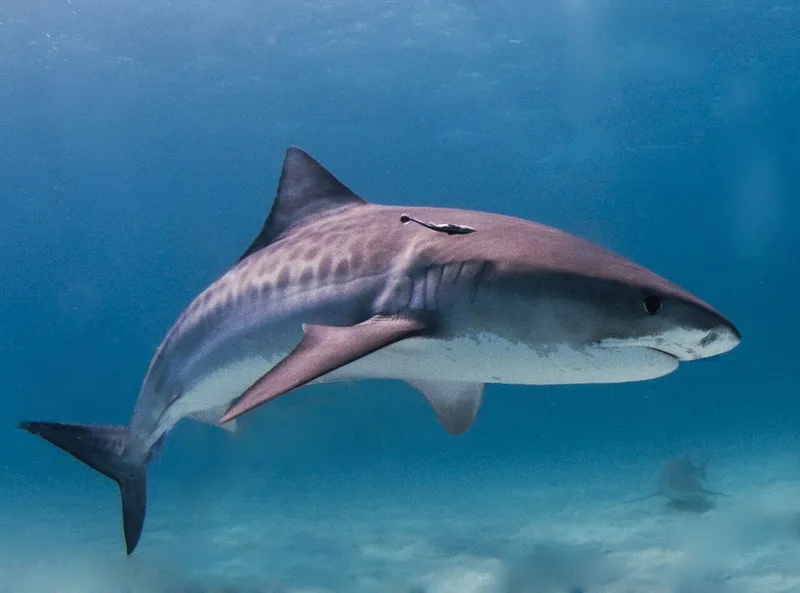
Tiger shark (Galeocerdo cuvier), the representative described here.
At a glance
- Location
- Galeocerdo cuvier occurs widely in tropical and subtropical seas. It uses coastal habitats, including seagrass areas, estuaries and harbours, but also moves offshore and into deeper water.
- Habitat
- Coast, Open ocean
- Diet
- Carnivore
- Food
- Tiger sharks take many kinds of animal food, including turtles, crustaceans and other marine prey.
Classification
- Common name
- Tiger Shark
- Browse group
- Fish
- Scientific name or taxon
- Galeocerdo cuvier
- Taxon rank
- species
- Order
- Carcharhiniformes
- Family
- Carcharhinidae
- Genus
- Galeocerdo
- Source classification
- Chondrichthyes
Taxonomy checked against GBIF. For breeds and hybrids, this describes the listed parent taxon.
Three things to know
- Young animals have strong dark markings.
- It also scavenges.
- Its teeth are strongly serrated.
Habitat and range
Galeocerdo cuvier occurs widely in tropical and subtropical seas. It uses coastal habitats, including seagrass areas, estuaries and harbours, but also moves offshore and into deeper water.
Appearance and adaptations
A broad blunt snout and large head give the shark a robust outline. Dark bars or blotches fade with age. The upper tail lobe is longer than the lower one.
Diet and behaviour
Tiger sharks take many kinds of animal food, including turtles, crustaceans and other marine prey. They also scavenge. Individuals are often solitary, although several may gather around a large food source.
Sources
- Animal Diversity Web: Galeocerdo cuvier
- A–Z Animals: Tiger Shark · Directory entry
Explore fish
Browse all fish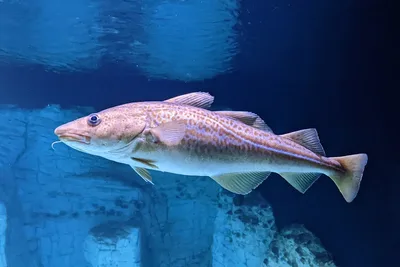
Fish
Atlantic Cod
Gadus morhua
The Atlantic cod is a cold-water fish of the North Atlantic.
Living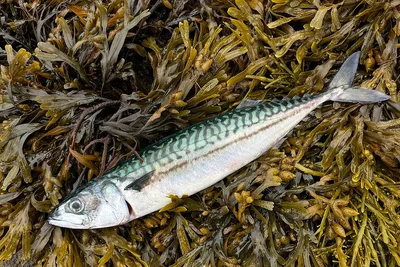
Fish
Atlantic mackerel
Scomber scombrus
Atlantic mackerel are streamlined schooling fishes of northern seas.
Living NT
Fish
Atlantic salmon
Salmo salar
The Atlantic salmon hatches in a river, grows up at sea, and returns to the same river to spawn.
Living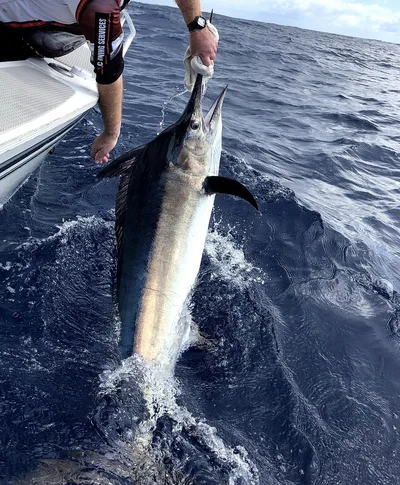
Fish
Black Marlin
Istiompax indica
The black marlin is a large predatory billfish of the Indo-Pacific.
Living