Sea Slug
Nudibranchia
Living individuals or members of this group exist today. This does not mean they are safe from extinction.
Sea slugs include many colourful marine snails without an adult external shell. This account describes the Spanish shawl (Flabellinopsis iodinea) of the northeastern Pacific.
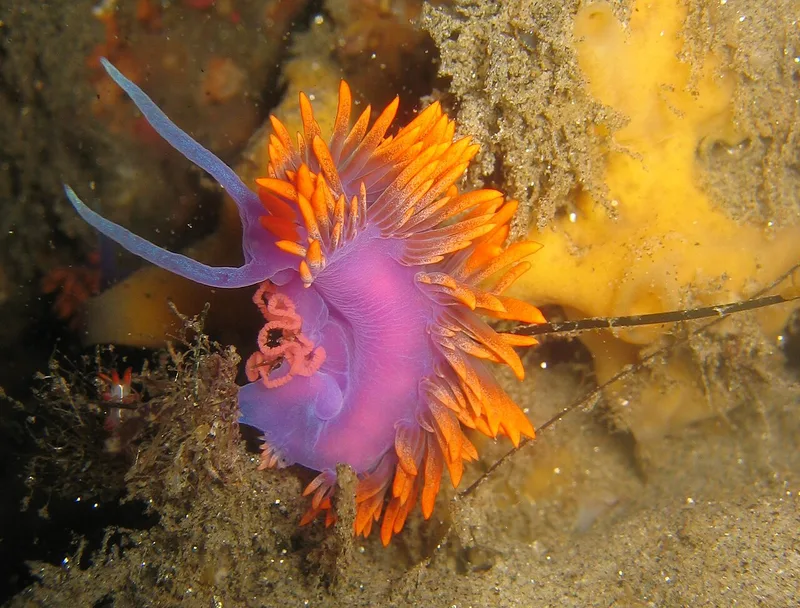
Flabellinopsis iodinea, the representative described in this account.
At a glance
- Location
- Spanish shawls occur on rocky shallow-water habitats, including the tide pools and kelp-associated communities described by Cabrillo National Monument in California.
- Habitat
- Coast
- Diet
- Carnivore
- Food
- Small hydrozoan colonies provide food.
Classification
- Common name
- Sea Slug
- Browse group
- Molluscs
- Scientific name or taxon
- Nudibranchia
- Taxon rank
- order
- Order
- Nudibranchia
- Source classification
- Gastropoda
Taxonomy checked against GBIF. For breeds and hybrids, this describes the listed parent taxon.
Three things to know
- Orange cerata cover the back.
- It feeds on hydrozoans.
- It can swim by flexing its body.
Habitat and range
Spanish shawls occur on rocky shallow-water habitats, including the tide pools and kelp-associated communities described by Cabrillo National Monument in California.
Appearance and adaptations
A translucent purple body carries bright orange fingerlike cerata. Red rhinophores help detect chemical cues from mates and prey in the surrounding water.
Diet and behaviour
Small hydrozoan colonies provide food. The slug can retain stinging cells from its prey for defence and can swim away by flexing its body rhythmically.
Sources
Explore molluscs
Browse all molluscs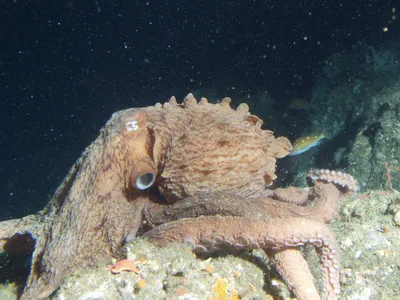 LC
Molluscs
Giant Pacific octopus
Enteroctopus dofleini
The giant Pacific octopus is the largest octopus.
Living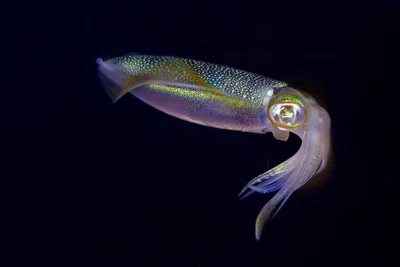
Molluscs
Bigfin Reef Squid
Sepioteuthis lessoniana
The bigfin reef squid lives in warm coastal waters around reefs and seagrass.
Living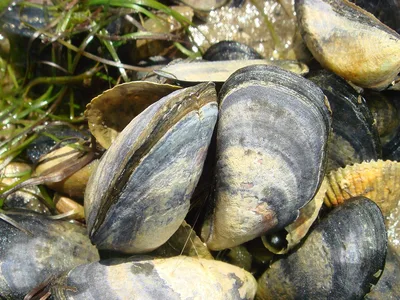
Molluscs
Blue mussel
Mytilus edulis
The blue mussel is a coastal bivalve that forms dense beds on suitable surfaces.
Living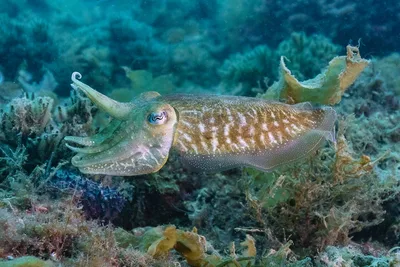
Molluscs
Cuttlefish
Sepiida
Cuttlefish are shell-bearing cephalopods with remarkable camouflage.
Living