Cuttlefish
Sepiida
Living individuals or members of this group exist today. This does not mean they are safe from extinction.
Cuttlefish are shell-bearing cephalopods with remarkable camouflage. This account describes the common cuttlefish (Sepia officinalis) of the eastern Atlantic and Mediterranean.
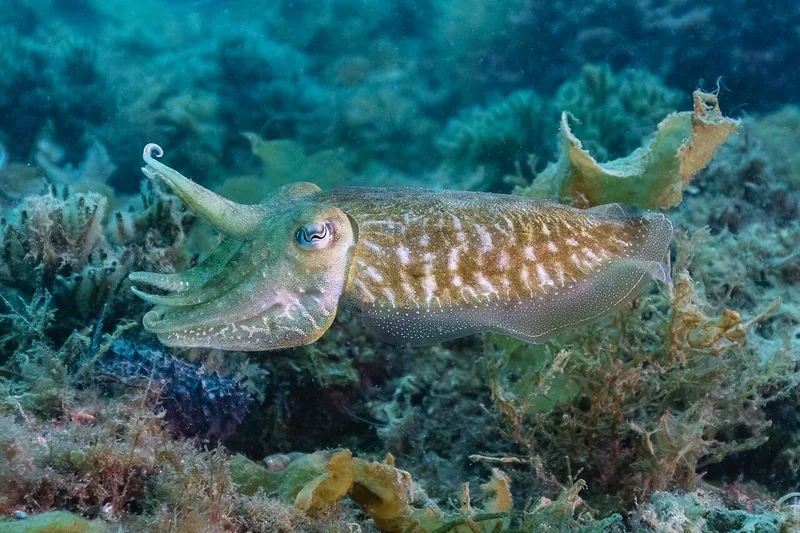
Sepia officinalis, the representative described in this account.
At a glance
- Location
- Common cuttlefish use coastal waters with sandy or muddy bottoms.
- Habitat
- Coast
- Diet
- Carnivore
- Food
- Fish and crustaceans are important foods.
Classification
- Common name
- Cuttlefish
- Browse group
- Molluscs
- Scientific name or taxon
- Sepiida
- Taxon rank
- order
- Order
- Sepiida
- Source classification
- Cephalopoda
Taxonomy checked against GBIF. For breeds and hybrids, this describes the listed parent taxon.
Three things to know
- It has an internal cuttlebone.
- Two feeding tentacles capture prey.
- Its skin can change colour rapidly.
Habitat and range
Common cuttlefish use coastal waters with sandy or muddy bottoms. They may move between shallower breeding areas and deeper seasonal habitats, often hiding against or within the seabed.
Appearance and adaptations
An internal cuttlebone supports the body and helps control buoyancy. Arms surround the mouth, while two longer feeding tentacles can extend rapidly towards prey.
Diet and behaviour
Fish and crustaceans are important foods. Skin colour and texture can change quickly as a cuttlefish hunts or signals. Undulating fins aid movement, and a siphon can provide rapid jet propulsion.
Sources
- Animal Diversity Web: Sepia officinalis
- A–Z Animals: Cuttlefish · Directory entry
Explore molluscs
Browse all molluscs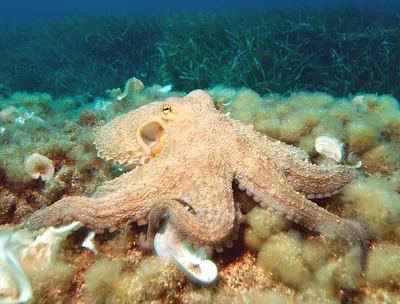
Molluscs
Octopus
Octopoda
Octopuses are eight-armed cephalopods.
Living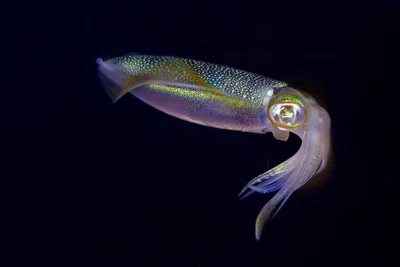
Molluscs
Bigfin Reef Squid
Sepioteuthis lessoniana
The bigfin reef squid lives in warm coastal waters around reefs and seagrass.
Living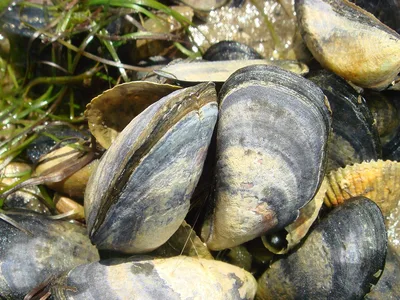
Molluscs
Blue mussel
Mytilus edulis
The blue mussel is a coastal bivalve that forms dense beds on suitable surfaces.
Living LC
Molluscs
Giant Pacific octopus
Enteroctopus dofleini
The giant Pacific octopus is the largest octopus.
Living