Octopus
Octopoda
Living individuals or members of this group exist today. This does not mean they are safe from extinction.
Octopuses are eight-armed cephalopods. This account describes the common octopus (Octopus vulgaris) using an older broad source, while focusing on eastern Atlantic and Mediterranean populations.
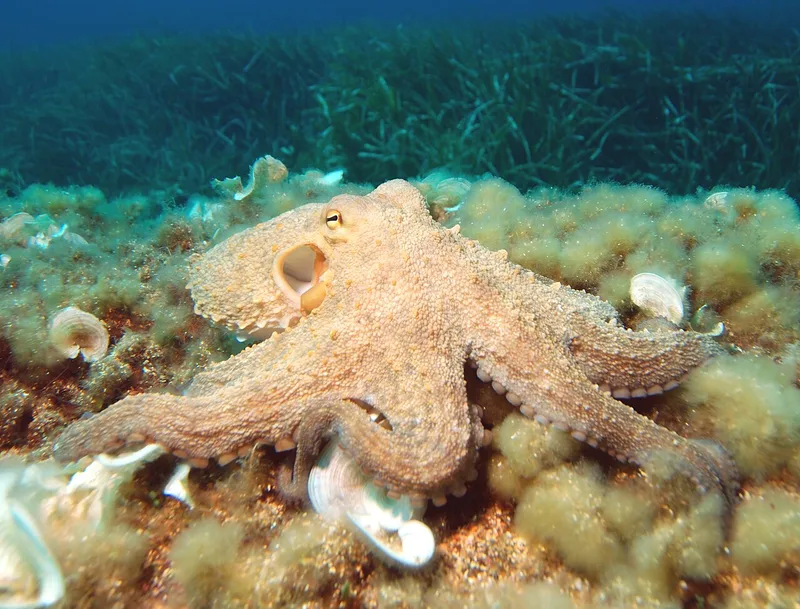
Octopus vulgaris, the representative described in this account.
At a glance
- Location
- Common octopuses use coastal seabeds and sheltered dens.
- Habitat
- Coast
- Diet
- Carnivore
- Food
- Molluscs and other marine animals provide prey.
Classification
- Common name
- Octopus
- Browse group
- Molluscs
- Scientific name or taxon
- Octopoda
- Source classification
- Cephalopoda
Three things to know
- It has eight sucker-bearing arms.
- The body lacks an external shell.
- A den provides shelter.
Habitat and range
Common octopuses use coastal seabeds and sheltered dens. The cited account historically combined populations from several oceans; its worldwide range is not presented here as a modern species map.
Appearance and adaptations
Eight flexible arms carry rows of suckers. The soft body lacks an external shell, and changing skin colour and texture helps the animal blend with surrounding surfaces.
Diet and behaviour
Molluscs and other marine animals provide prey. Arms handle food and explore crevices, while a hidden den offers shelter. Females protect their eggs in a suitable retreat.
Sources
- Animal Diversity Web: Octopus vulgaris
- A–Z Animals: Octopus · Directory entry
Explore molluscs
Browse all molluscs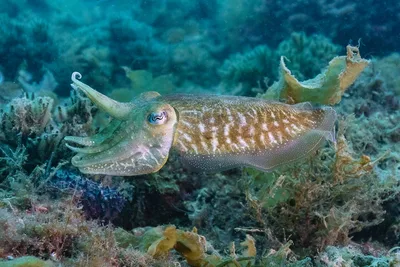
Molluscs
Cuttlefish
Sepiida
Cuttlefish are shell-bearing cephalopods with remarkable camouflage.
Living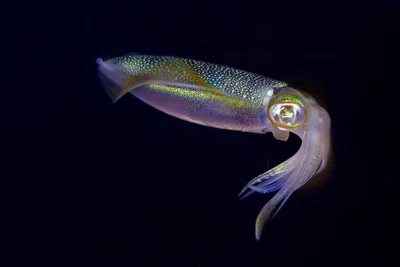
Molluscs
Bigfin Reef Squid
Sepioteuthis lessoniana
The bigfin reef squid lives in warm coastal waters around reefs and seagrass.
Living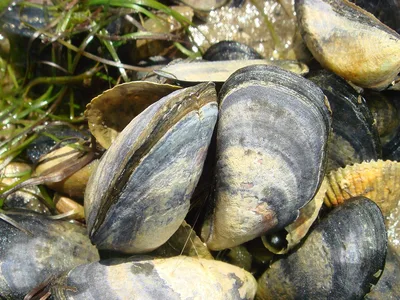
Molluscs
Blue mussel
Mytilus edulis
The blue mussel is a coastal bivalve that forms dense beds on suitable surfaces.
Living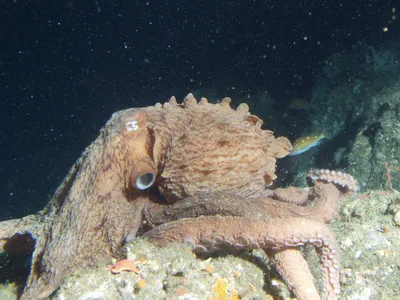 LC
Molluscs
Giant Pacific octopus
Enteroctopus dofleini
The giant Pacific octopus is the largest octopus.
Living