Hornbill
Bucerotidae
Living individuals or members of this group exist today. This does not mean they are safe from extinction.
Hornbills are tropical birds with large bills. This account describes the great hornbill (Buceros bicornis), a forest species with a prominent casque and an unusual enclosed nest.
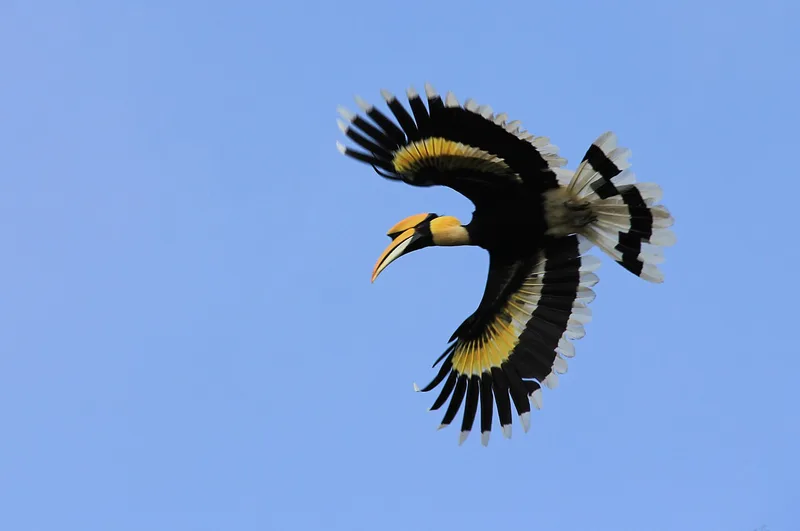
Representative species: great hornbill (Buceros bicornis).
At a glance
- Habitat
- Rainforest
- Diet
- Omnivore
- Food
- Mostly fruit, with small animals also eaten.
Classification
- Common name
- Hornbill
- Browse group
- Birds
- Scientific name or taxon
- Bucerotidae
- Taxon rank
- family
- Order
- Bucerotiformes
- Family
- Bucerotidae
- Source classification
- Aves
Taxonomy checked against GBIF. For breeds and hybrids, this describes the listed parent taxon.
Three things to know
- A tree cavity is used for breeding.
- Fruit is the principal food.
- Its casque is a hollow structure.
Habitat and range
Great hornbills inhabit forests in South and Southeast Asia. Tall mature trees matter especially because breeding requires a cavity large enough for the female and eggs.
Appearance and adaptations
Black and white plumage contrasts with the large bill and hollow casque. Tinted preen-gland oil can colour parts of the bill and feathers yellow or reddish.
Diet and behaviour
Fruit supplies most food, with small animals also taken. During breeding, the female is enclosed inside a tree cavity while a narrow opening allows food delivery. Birds gather at communal night roosts.
Sources
- Animal Diversity Web: Buceros bicornis
- A–Z Animals: Hornbill · Directory entry
Explore birds
Browse all birds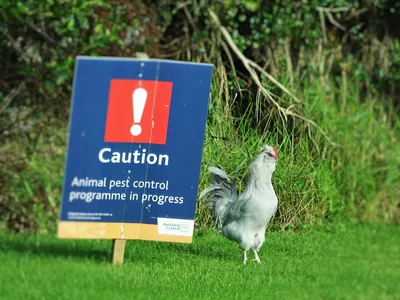 LC
Birds
Red junglefowl
Gallus gallus
The red junglefowl is a shy forest-edge bird of South and Southeast Asia, and the wild ancestor of the domestic chicken.
Living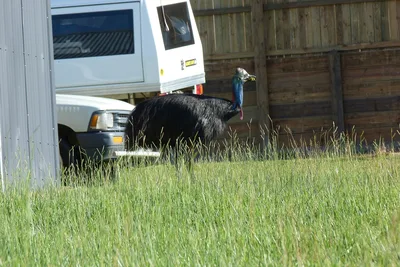 LC
Birds
Southern cassowary
Casuarius casuarius
The southern cassowary is a huge flightless bird of the rainforests of New Guinea and northeast Australia.
Living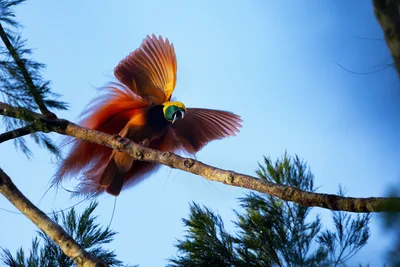
Birds
Bird of Paradise
Paradisaeidae
Birds-of-paradise are renowned for elaborate courtship displays.
Living CR
Birds
Philippine eagle
Pithecophaga jefferyi
The Philippine eagle is the longest eagle in the world, a crested forest hunter found on only four Philippine islands.
Living