Axolotl
The salamander that never leaves the water
Ambystoma mexicanum
Also called Mexican walking fish
Living individuals or members of this group exist today. This does not mean they are safe from extinction.
Meet the axolotl
The axolotl is a salamander that never grows up. It keeps its feathery gills and stays in the water for life, and it can regrow lost limbs, jaws and even parts of its heart.
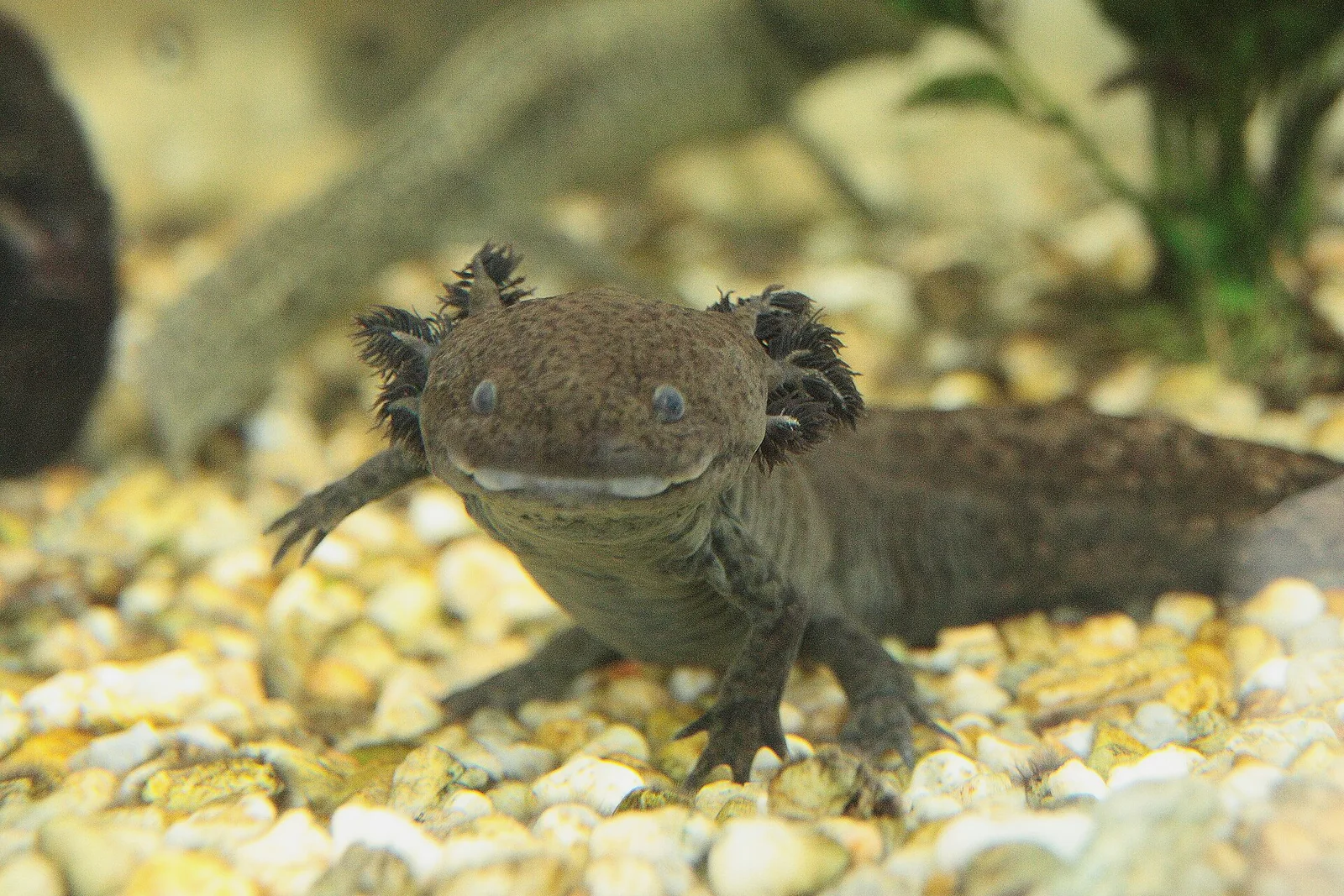
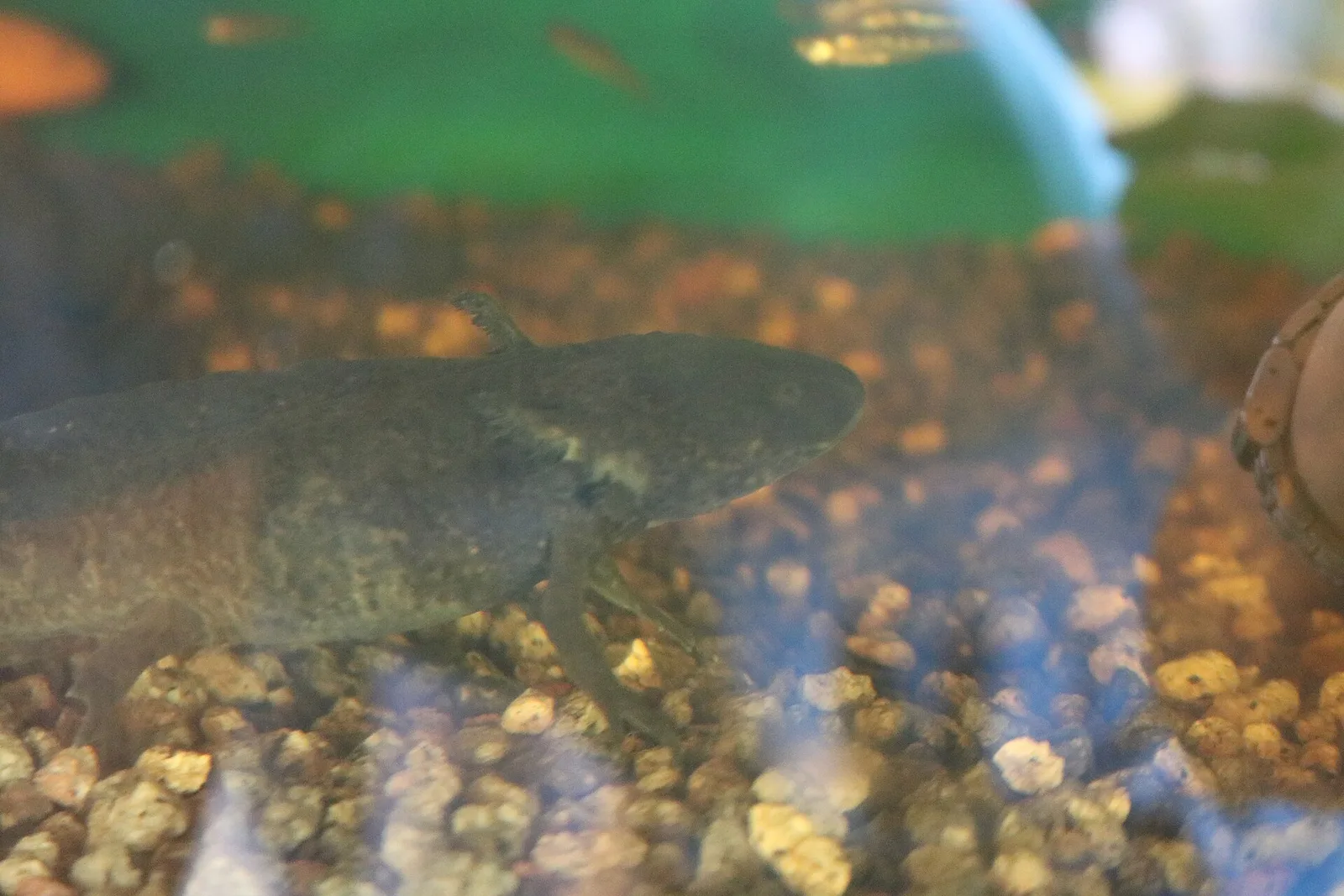
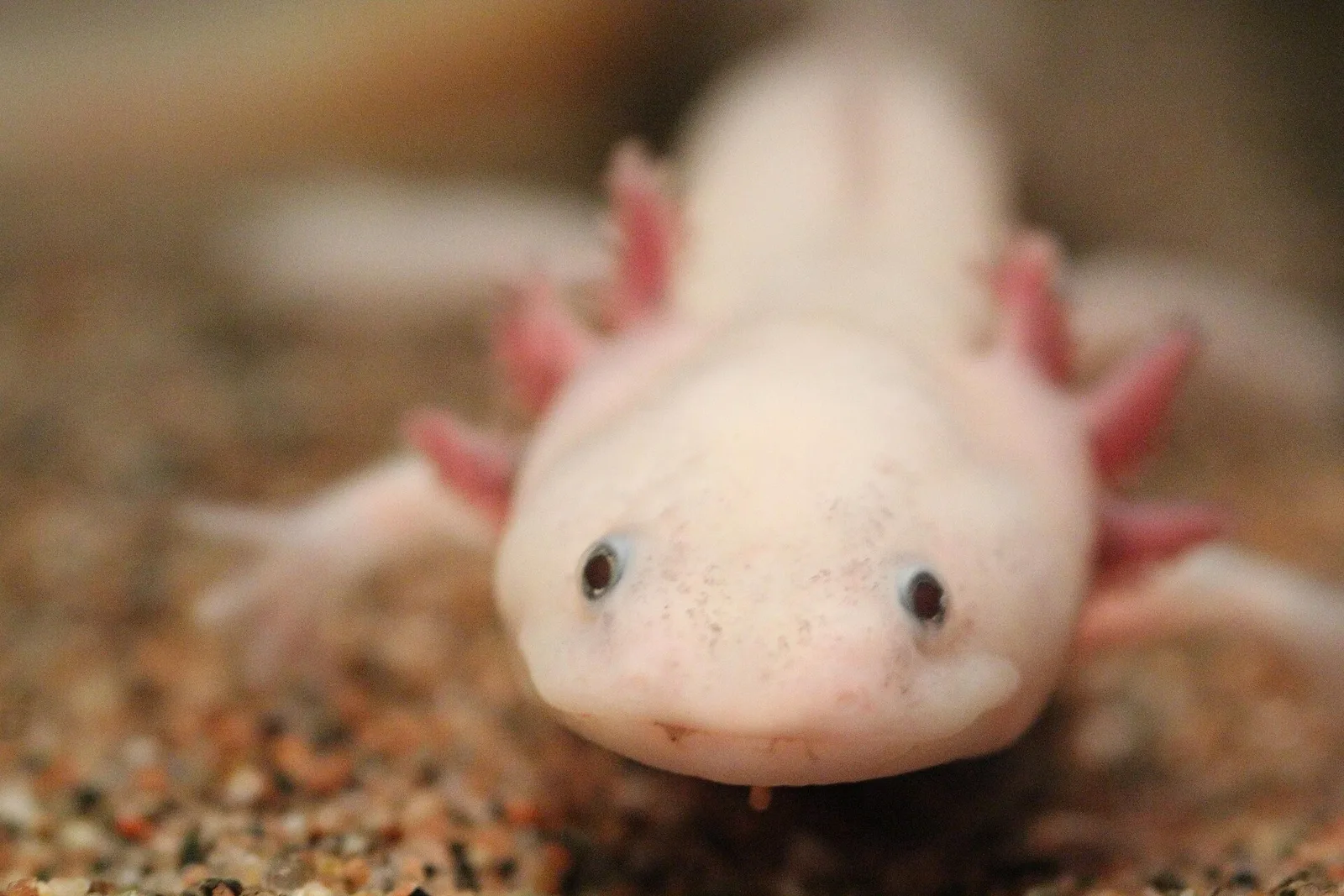
Images of the axolotl
Lifespan
5 to 6 years
Weight
60 to 110 g
Length
About 23 cm
Fact file
Axolotl
- Location
- Lake Xochimilco, Mexico City
- Habitat
- Rivers and lakes, Wetlands
- Diet
- Carnivore
- Prey / food
- Worms, insect larvae, small fish, crustaceans
- Predators
- Herons, introduced carp and tilapia
- Lifestyle
- Nocturnal
- Name of young
- Larva
- Incubation
- About 14 days of egg development
- Clutch size
- 300 to 1,000 eggs
- Population
- Fewer than 1,000 in the wild
- Biggest threat
- Water pollution and introduced fish in Lake Xochimilco
- Distinctive feature
- External feathery gills
- Colour
- Dark brown in the wild; pink or white in captivity
- Skin type
- Smooth, moist skin
Size
Next to a person
Measurements
Size and speed
- Length
- About 23 cm, up to 30 cm
- Weight
- 60 to 110 g
Typical adult ranges. Source: Animal Diversity Web.
Life cycle
Lifespan
- In captivity5 to 6, up to 15 years
- 015 years
The pale bar is the record. Source: Animal Diversity Web.
Appearance
Colour and coat
- Primary colours
- browntan
- Secondary colours
- goldpinkwhite
- Skin type
- smooth skin
- Male and female
- Slight. The male has a swollen cloaca with small papillae. The female has a smaller cloaca and a wider body when full of eggs.
Life cycle
Mating and family
- Mating system
- promiscuous, with a courtship dance and a spermatophore
- Social structure
- solitary
- Breeding
- one clutch of 300 to 1,000 eggs each spring
The wild breeding season runs from March to June. After a circling courtship dance the male drops a spermatophore, and the female picks it up with her cloaca. She lays 300 to 1,000 eggs singly on plants and rocks, and they hatch in 10 to 14 days. The larvae never metamorphose, and they breed in their larval body at about 1.5 years. Captive animals live 5 to 6 years, and some reach 15.
Classification
Taxonomy
- Kingdom
- Animalia
- Phylum
- Chordata
- Class
- Amphibia
- Order
- Urodela
- Family
- Ambystomatidae
- Genus
- Ambystoma
- Species
- Ambystoma mexicanum
Conservation
Red List status
- LC
- NT
- VU
- EN
- CR
- EW
- EX
Critically Endangered on the IUCN Red List
Range
Recorded in 1 country
Habitat layer: flooded grassland and savanna, mangrove.
Countries from 4 wild records on GBIF (iNaturalist research grade), filtered and checked by hand. Country shapes: Natural Earth. Habitat: RESOLVE Ecoregions 2017, CC BY 4.0. Basemap: Natural Earth.
Habitats
Three things to know
- 1
An axolotl can regrow a whole limb in a few months without scarring.
- 2
Wild axolotls survive only in a few canals of one lake.
- 3
The name comes from Nahuatl and means 'water monster'.
Did you know
Seven more facts
- 1
The name means something like water dog or water monster in Nahuatl.
- 2
It has tiny teeth that most salamanders only grow after metamorphosis.
- 3
A dose of thyroid hormone turns it into a land salamander, but the change is often fatal.
- 4
Almost every pet axolotl descends from one group of under 36 animals.
- 5
It keeps growing for its whole life.
- 6
Water above 24 °C stresses it and can kill it.
- 7
Mexico City chose it as the city's emoji in 2017.
Field notes
How it looks and acts
Field notes
Distinguishing features
- Three pairs of feathery external gills behind the head.
- A fin running along the back and tail.
- A wide flat head with lidless eyes.
- Weak legs with long thin toes.
- A body about 23 centimetres long, rarely over 30 cm.
- Brown, gold-speckled skin in the wild, pink or white in pets.
Field notes
Unique adaptations
- External gills draw oxygen from cool, still lake water.
- Lungs let it gulp air at the surface when the water is poor in oxygen.
- Electroreception and smell find prey in murky water.
- Regeneration replaces limbs lost to a bite, which probably helps a slow animal survive attacks.
- Staying larval avoids a risky life on land around a high lake.
Field notes
Interesting behaviours
- Rests on the bottom for most of the day.
- Snaps at any scent of food and sucks the prey in.
- Rises to gulp air when it needs more oxygen.
- Dances in a circle with its mate before it breeds.
- Lies still to avoid introduced fish.
Field notes
Temperament
- Solitary, and it ignores other axolotls outside the breeding season.
- Will bite and eat a smaller axolotl.
- Harmless to people.
Field notes
Communication
- Nudges a mate's cloaca to start courtship.
- Uses scent and posture during mating, and little else at other times.
- Senses electric fields from prey.
- Locates food mainly by smell.
Ecology
Ecological role
The axolotl was the top predator of the lakes of the Valley of Mexico.
- Ate snails, insects, crayfish and small fish, and so shaped the whole lake community.
- Kept its own numbers in check by eating smaller axolotls.
- Now competes with, and is eaten by, introduced carp and tilapia.
Stories
Myths and legends
- In Aztec tradition, the god Xolotl turned into an axolotl to escape sacrifice, and was caught in the water.
- In Aztec tradition, Xolotl was the twin of Quetzalcoatl and the god of fire, lightning, dogs and the dead.
- In Mexican tradition today, the axolotl stands for change and duality, and it appears on the 50-peso note.
- In Japanese popular culture, the animal is the wooper looper, a name from a 1980s noodle advert.
People
Relationship with humans
People
Living alongside us
The Aztecs ate the axolotl and took it as medicine. Since a shipment reached Paris in 1863, the species has bred in laboratories by the thousand. Its regeneration and its large embryo make it a standard research animal. It is also a common pet and a cultural symbol of Mexico. Its wild home has almost vanished under Mexico City.
- It has no venom and only tiny teeth.
- Animal Diversity Web records no harmful effect on people.
- It is thought to pose no risk even to a child who handles one, though handling harms the animal's skin.
People
Status, uses and products
- Domestication
- Wild
- As a pet
- Kept by some. A common aquarium pet, but it needs cool water at 16 to 18 °C, a tank of about 150 litres, and no gravel. Chlorine in tap water is harmful. Do not try to force metamorphosis.
- Uses
- scientific researchaquarium petzoo exhibitionfood (occasional)
- Products
- None recorded
The full account
About the axolotl
The axolotl, Ambystoma mexicanum, is a mole salamander from the lakes of the Valley of Mexico. Most salamanders lose their gills and move onto land as they mature. The axolotl keeps its feathery external gills, stays in the water, and breeds in its larval body. Biologists call this neoteny. A typical adult measures about 23 centimetres, and one over 30 cm is rare.
The animal can regrow a lost limb, a tail, and parts of its eye, heart and brain. That ability has made it one of the most studied animals in laboratories around the world. In the wild it is close to extinction. Only the canals of Lake Xochimilco, inside Mexico City, still hold it, and the IUCN rates it Critically Endangered. Estimates of the wild population run from 50 to 1,000 adults.
Name and taxonomy
The name comes from the Nahuatl word āxōlōtl. It has been translated as water dog, water monster, water servant or water twin. The word points to Xolotl, the Aztec god of fire, lightning and the dead, and the twin of Quetzalcoatl. In Spanish the animal is the ajolote, and GBIF also lists Mexican axolotl and Mexican salamander in English. The common name walking fish is wrong, because the axolotl is an amphibian, not a fish.
The species belongs to the family Ambystomatidae, the mole salamanders, in the order Urodela. Some writers prefer the name Mexican axolotl, because people also call the larvae of related species axolotls. In the wild it can be hard to tell from a tiger salamander larva or from a mudpuppy.
Evolution and relatives
The axolotl sits in the genus Ambystoma with the tiger salamander, and it belongs to the tiger salamander species complex. Its closest relative is the eastern tiger salamander of North America. A land-living tiger salamander also breeds in the same water as the axolotl. Many other Ambystoma species keep their larval form for life, or have populations that do. Sirens, mudpuppies and the cave olm are neotenic too, but no hormone can make them change.
Neoteny is thought to evolve where a high lake sits in country that is hostile to a land salamander. The axolotl lacks the hormone signal that tells the thyroid to make thyroxine, which drives metamorphosis. In laboratory animals the trait maps to a small region of one chromosome called met1. Those genes differ from the wild population, so complete neoteny in pets probably comes from artificial selection. The genome was published in 2018 at 32 billion base pairs, about ten times the size of a human's.
Appearance
The axolotl has a wide flat head, small eyes with no lids, and a fin that runs from behind the head to the vent. Three pairs of gill stalks stand out from the neck, each fringed with fine filaments. Four gill slits hide beneath them, lined with rakers that keep food out. The legs are small and weak, with long thin toes. The teeth are tiny and barely visible. Wikidata gives a length of 18 centimetres, which falls inside the range from other sources.
Adults range from 15 to 45 centimetres, with about 23 cm the usual size. Adults weigh about 0.06 to 0.11 kilograms. In the wild the skin is brown to tan, dusted with gold flecks over an olive tone. It can darken or lighten a little by changing its pigment cells, probably as camouflage. Captive animals come in leucistic pink, albino white, grey xanthic and near-black melanistic forms. Breeders often cross these, so a pink animal with pink eyes is common in the pet trade.
A male has a swollen cloaca lined with small papillae. A female has a smaller cloaca and a wide, rounded body when she carries eggs.
Habitat and range
The axolotl once lived across a linked system of lakes and wetlands in the highlands of central Mexico. It is known from Lakes Xochimilco and Chalco, and it probably lived in the larger Lakes Texcoco and Zumpango as well. The Aztecs began to drain these lakes, and the work sped up in the 20th century. Mexico City now covers most of the old lake bed.
Lake Chalco has been drained for drinking water and is gone. Lake Xochimilco survives only as a maze of canals and swamps at about 2,274 metres above sea level. The water there rarely rises above 20 °C and can fall to 6 or 7 °C in winter. The species prefers deep water and channels with thick water plants. A population also lives in the artificial lake in Chapultepec Park.
In 2019 the IUCN put the extent of occurrence at 467 square kilometres. GBIF holds records from 13 countries, but the records outside Mexico come from zoos, laboratories and pets.
Diet and hunting
The axolotl is a carnivore. In the wild it eats worms, snails, water insects, crayfish and small fish. It also eats other salamanders, including its own kind. Animal Diversity Web describes it as the top predator of its lake, which took anything it could catch.
It finds food by smell and snaps at anything that might be a meal. The mouth opens fast, and the drop in pressure sucks the prey in. As it sucks, the gill rakers lock together to close the gill slits. In captivity it takes trout pellets, bloodworms, earthworms and waxworms. Feeder fish can carry parasites, so keepers use them with care. Like other cold-blooded animals, it eats less in cool water because its metabolism slows.
Behaviour and social life
The axolotl is solitary. It may be active at any hour, though the site fields list it as nocturnal. It spends most of its time on the bottom. It breathes through its gills, and it can also rise to gulp air into its lungs. The gulp can push air straight to the lungs or send it back and forth in a four-stroke pattern.
It keeps growing all its life. Some researchers think this constant growth is part of why it regenerates so well. Where carp and tilapia have arrived, wild axolotls move less to avoid being eaten. That stillness costs them hunting and mating chances. Captive animals seem to swallow gravel, and some may use it to grind food, but the evidence is thin.
Communication and senses
Axolotls signal to each other almost only in the breeding season. Then they use sight and scent. For the rest of the year, Animal Diversity Web reports little or no contact between them. They are not known to make any call, which is typical of salamanders.
Their senses are built for dark, weedy water. They can detect the weak electric fields that other animals give off. They also use sight and chemical cues to find prey. Smell matters most in the hunt, and a hungry axolotl snaps at any scent of food. A 2025 study found a two-way signal path between the brain and the eye that is not known in other animals.
Reproduction and life cycle
Wild axolotls breed from March to June. Courtship follows the pattern of other mole salamanders. Each animal nudges the other's cloaca, and the pair then circle each other in a slow dance. The male moves off with his tail waving, and the female follows. He shakes his tail hard for about half a minute and drops a spermatophore, a cone of jelly with sperm on top. The female walks over it and picks it up with her cloaca.
She lays 300 to 1,000 eggs, one at a time, on rocks and water plants. Each egg sits in its own jelly coat, because it needs more oxygen than a frog egg in a clump. The eggs hatch after 10 to 14 days. The larvae are independent at once and get no care. Young from the last season are ready to breed by the next one. The generation length is about 5.5 years.
There is no metamorphosis in the wild. The larva simply grows, keeps its gills and fin, and matures at about 1.5 years, or 18 to 27 months in captivity. A hormone injection can force the change into a land salamander that looks like a plateau tiger salamander. Such an animal grows eyelids, loses its gills and fin, and regenerates far less well. Captive axolotls usually live 5 to 6 years, and some reach 15. Wikipedia gives a wild life expectancy of 10 to 15 years.
Predators and threats
Before people brought in fish, the axolotl had few enemies in its lake apart from larger axolotls. Now Nile tilapia and common carp eat its young and compete for its food. Herons take adults, and great egrets ate several captive-bred animals released in a 2025 study. Large fish are new to the lakes, and Animal Diversity Web blames them for much of the decline.
The larger threat is the water itself. Xochimilco is fed with partly treated wastewater, and its water is low in oxygen. Farm pesticides wash in and kill embryos and larvae, and the survivors show deformities and odd behaviour. The wild population has passed through several bottlenecks, so inbreeding is high and genetic diversity is low. The chytrid fungus has been found on axolotls, but the species resists it and the disease is not thought to threaten it.
Population and conservation
The IUCN lists the axolotl as Critically Endangered, and Mexico lists it as in danger of extinction. Surveys of Lake Xochimilco found 6,000 animals per square kilometre in 1998, 1,000 in 2003 and 100 in 2008. A four-month search in 2013 found none, though two turned up in nearby canals a month later. The wild population is now put at 50 to 1,000 adults. It sits on Appendix II of CITES, which controls trade.
Conservation now leans on captive breeding. Animals raised in semi-natural ponds can catch prey and escape predators with moderate success. The National Autonomous University of Mexico held 100 captive-bred axolotls in 2021, mostly for research. It plans a breeding population in a semi-artificial wetland on the campus. A 2025 release study found that recaptured animals had gained weight in the wild. Released animals may still meet the fate of the wild ones if pollution and invasive fish remain.
Laboratory axolotls carry some tiger salamander DNA, so they may not be a clean stock for reintroduction. Most captive animals descend from a single group of under 36 individuals. Few field studies exist, so the ecology of the wild animal is poorly known.
Relationship with humans
The Aztecs ate axolotls and used them as medicine. Alexander von Humboldt wrote that the conquered Mexicans fed on water plant roots, insects and this doubtful reptile. It is still eaten now and then, roasted or boiled, with the tail dipped in vinegar or cayenne. In 1863 a shipment of 34 adults reached the Jardin des Plantes in Paris. Auguste Duméril was startled when some turned into land salamanders, and the study of neoteny began there.
Vilém Laufberger in Prague first forced the change with thyroid hormone, and Julian Huxley repeated it with ground thyroid. Today the axolotl is a model organism for limb regeneration, heart defects, neural tube closure and stem cells. Its large embryo lets researchers watch a vertebrate develop from the first cell. It is also a popular pet, kept at 16 to 18 °C in a tank of about 150 litres with no gravel. iNaturalist holds 2,889 observations, most of them of captive animals.
In culture and myth
In Aztec myth the gods had to die to set the sun moving, and Xolotl refused. He hid as a maize plant, then as an agave, and at last as an axolotl, but he was caught in the water. The animal took his name and became a symbol of change and of doubleness. Xolotl also ruled over dogs, games, twins and ugly beings, which may explain the name water dog.
Axolotls appear in Diego Rivera's 1951 mural Water, the Origin of Life in Chapultepec Park, and on many walls in Mexico City. The city made the axolotl its official emoji in 2017. In 2021 Mexico put it on the new 50-peso note, which won Bank Note of the Year. By 2025 the Bank of Mexico reported that up to 50 million of the notes were being hoarded.
In Japan a 1980s Nissin Foods campaign named the animal the wooper looper, and the name stuck. The Pokémon Wooper, from 1999, is based on it, and Mudkip in 2002 borrows from it. Minecraft added axolotls in 2020 to draw attention to endangered species. Toothless, the dragon in How to Train Your Dragon, was modelled on the axolotl. Julio Cortázar wrote a short story called Axolotl set at the Paris aquarium, and a star in Cetus was named Axólotl in 2019.
A sentence with a dotted underline is inferred: it describes the group the animal belongs to, or is a reading of the sources, rather than a measured or reported fact about this species.
Questions
Axolotl questions, answered
What is an axolotl?
An axolotl is a salamander from Mexico that keeps its gills and stays in the water for life. It is an amphibian, not a fish. It breeds without ever changing into a land animal.
Are axolotls endangered?
Yes. The IUCN lists the axolotl as Critically Endangered. Only 50 to 1,000 adults are thought to survive in the canals of Lake Xochimilco.
Where do axolotls live in the wild?
Only in Lake Xochimilco and nearby canals in Mexico City, at about 2,274 metres above sea level. Lake Chalco, their other home, has been drained.
Can axolotls really regrow limbs?
Yes. A lost leg or tail regrows over a few months without a scar. Axolotls can also rebuild parts of the eye, heart and brain.
How big do axolotls get?
Most adults are about 23 centimetres long. Some reach 30 cm, and one longer than that is rare. They weigh about 0.06 to 0.11 kilograms.
How long do axolotls live?
In captivity they usually live 5 to 6 years, and some reach 15. Wikipedia puts the wild life expectancy at 10 to 15 years.
What do axolotls eat?
In the wild they eat worms, snails, water insects, crayfish and small fish. Pets take pellets, bloodworms and earthworms. They find food by smell and suck it in.
Why do axolotls never grow up?
They lack the hormone signal that makes the thyroid produce thyroxine, which drives metamorphosis. So they keep their gills and fin and breed as larvae. A hormone injection can force the change.
Can axolotls live on land?
Not normally. A hormone-treated axolotl can turn into a land salamander with eyelids and no gills, but the change is risky and often fatal.
Are axolotls good pets?
They are common pets, but they need cool water at 16 to 18 °C, a 150-litre tank, and no gravel that they might swallow. Tap water must be free of chlorine.
Why are axolotls pink?
Pet axolotls carry mutations in pigment genes. Leucistic animals are pink with black eyes, and albinos are white or pink with red eyes. Wild axolotls are brown with gold speckles.
What does the word axolotl mean?
It is Nahuatl and has been read as water dog, water monster or water servant. It refers to Xolotl, the Aztec god who turned into an axolotl to escape sacrifice.
Do axolotls have teeth?
Yes, but they are tiny and hard to see. Other salamanders only grow teeth at metamorphosis.
How do axolotls breathe?
Mainly through their three pairs of external gills. They also have lungs and can gulp air at the surface.
Are axolotls dangerous?
No. They have no venom and only tiny teeth. No source records any harm to a person.
Why is the axolotl on the Mexican 50-peso note?
Mexico put it on the new note in 2021 as a national symbol. The design won Bank Note of the Year, and by 2025 up to 50 million notes were being kept as collectables.
Food web
Prey and food
- worms
- insect larvae
- fish
- crustaceans
Food web
Predators
- herons
- carp
- tilapia
Ecological equivalents
Related species on this site
Tiger Salamander (same genus).