Clownfish
The reef fish that lives inside a stinging anemone
Amphiprion ocellaris
Also called Ocellaris clownfish, Clown anemonefish
Living individuals or members of this group exist today. This does not mean they are safe from extinction.
Meet the clownfish
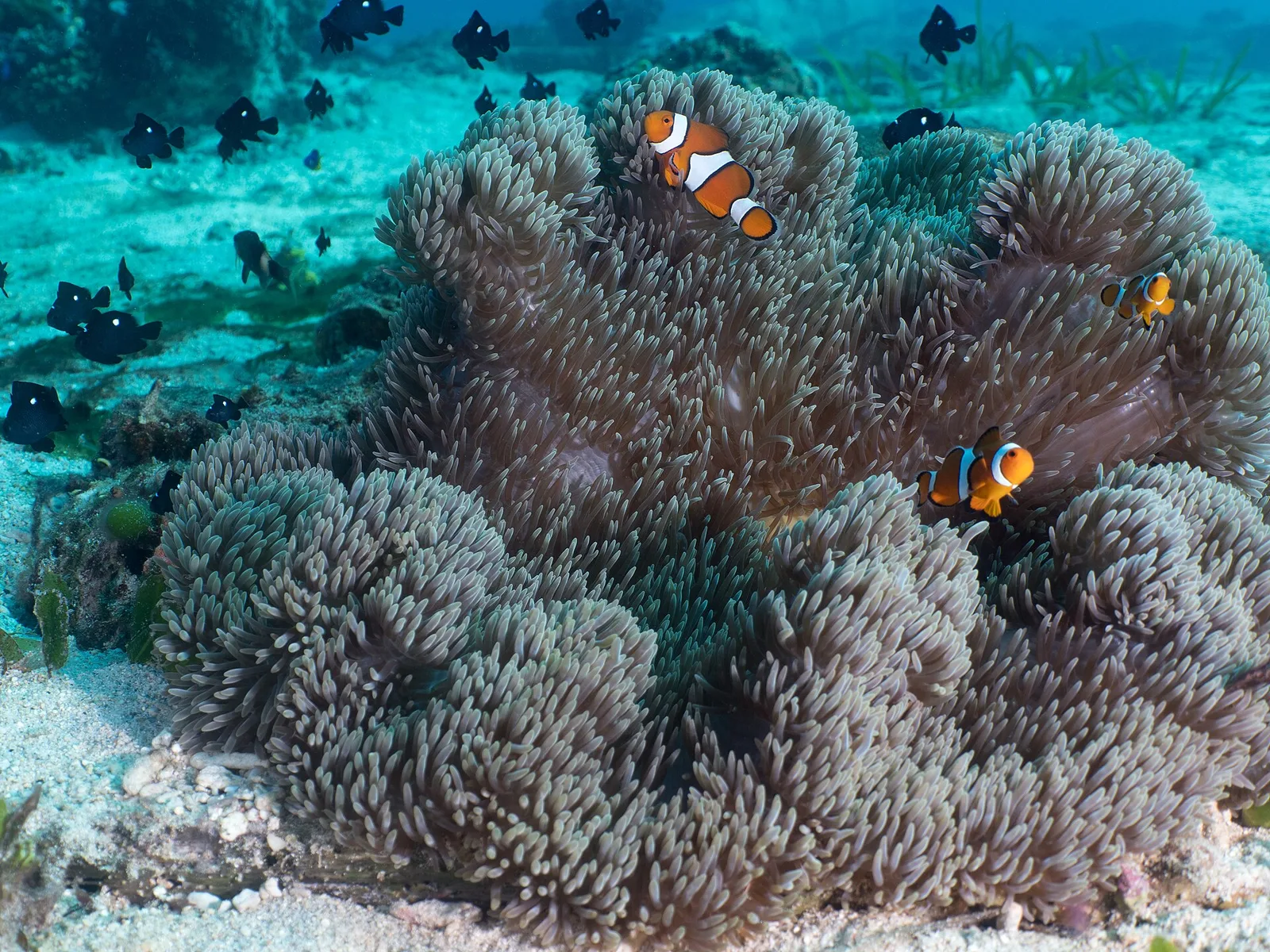
The clownfish lives inside the stinging tentacles of a sea anemone, which it cleans and defends in return. A group is always led by the largest fish, which is the only female.
Images of the clownfish
Lifespan in the wild
6 to 10 years
Length
About 8 cm
Fact file
Clownfish
- Location
- Reefs of the Indo-Pacific from Southeast Asia to northern Australia
- Habitat
- Coral reef
- Diet
- Omnivore
- Prey / food
- Algae, plankton, small crustaceans
- Predators
- Larger reef fish, eels
- Lifestyle
- Diurnal
- Group name
- School
- Name of young
- Fry
- Incubation
- 6 to 10 days of egg development
- Clutch size
- 100 to 1,000 eggs
- Biggest threat
- Coral bleaching and the aquarium trade
- Distinctive feature
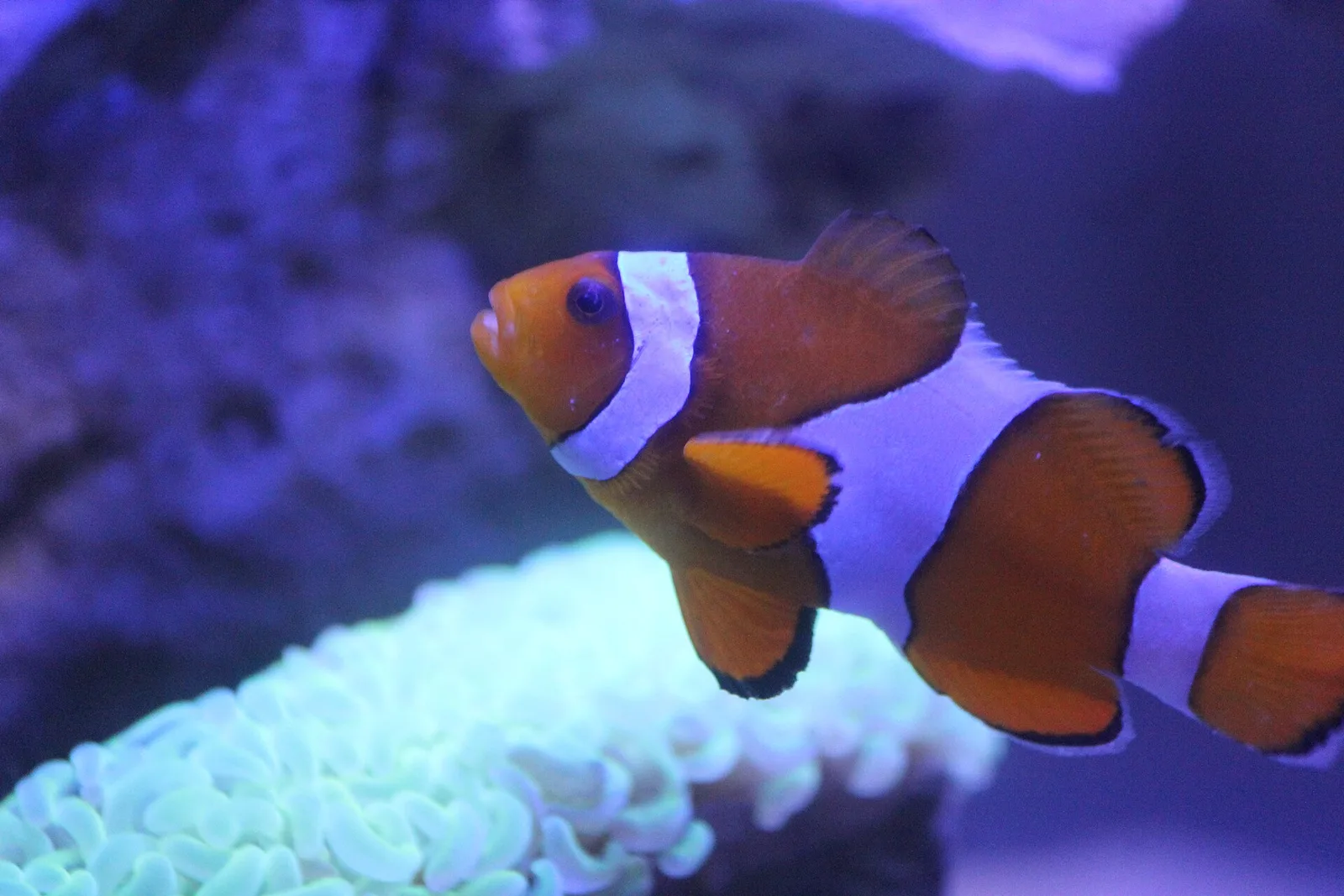
- Orange with three white bands edged in black
- Colour
- Orange, white and black
- Skin type
- Scales and a protective mucus coat
Size
Next to a person
Measurements
Size and speed
- Length
- About 8 cm, up to 11 cm
Typical adult ranges. Source: Animal Diversity Web.
Life cycle
Lifespan
- In the wild6 to 10 years
- 010 years
Source: Animal Diversity Web.
Appearance
Colour and coat
- Primary colours
- orange
- Secondary colours
- whiteblack
- Skin type
- scales and a protective mucus coat
- Male and female
- Females are larger than males. Colour is the same in both sexes.
Life cycle
Mating and family
- Mating system
- monogamous pairs
- Social structure
- one female, one breeding male and several juveniles in a strict size order inside one anemone
- Breeding
- clutches of 100 to 1,000 eggs, almost all year in the tropics
A pair holds one anemone for life. The male clears a nest on rock beneath the tentacles, and the female lays 100 to 1,000 eggs around the full moon. The male fans and guards them for 6 to 8 days. The larvae drift for 8 to 12 days, then settle and seek an anemone by smell. All fish mature as males, and the largest becomes female. Wild fish live 6 to 10 years.
Classification
Taxonomy
- Kingdom
- Animalia
- Phylum
- Chordata
- Class
- Fish (several classes)
- Order
- Blenniiformes
- Family
- Pomacentridae
- Genus
- Amphiprion
- Species
- Amphiprion ocellaris
Conservation
Red List status
- LC
- NT
- VU
- EN
- CR
- EW
- EX
Least Concern on the IUCN Red List
Range
Recorded in 13 countries
- Ashmore and Cartier Islands
- Indonesia
- India
- Japan
- Myanmar
- Malaysia
- Papua New Guinea
- Philippines
- Singapore
- Thailand
- East Timor
- Taiwan
- Vietnam
Countries from 2,482 wild records on GBIF (iNaturalist research grade), filtered and checked by hand. Country shapes: Natural Earth. Habitat: RESOLVE Ecoregions 2017, CC BY 4.0. Basemap: Natural Earth.
Habitats
Three things to know
- 1
All clownfish are born male; the dominant one changes into a female.
- 2
A mucus layer stops the anemone's stings from firing.
- 3
The father guards and fans the eggs until they hatch.
Did you know
Seven more facts
- 1
A clownfish has to rub itself on the tentacles before it can live in a new anemone without being stung.
- 2
Off northern Australia the fish is black and white instead of orange and white.
- 3
It has 11 dorsal spines, one more than its look-alike, the orange clownfish.
- 4
Spawning peaks around the full moon.
- 5
The father eats any egg that goes mouldy.
- 6
Brittle stars raid the nest at night when the father is off duty.
- 7
Anemones with a resident clownfish grow bulbs on their tentacle tips that may catch more sunlight.
Field notes
How it looks and acts
Field notes
Distinguishing features
- Orange body with three white bands edged in black.
- A black edge on every fin.
- A rounded tail fin.
- A stocky oval body about 8 centimetres long.
- A black form in the Northern Territory of Australia.
Field notes
Unique adaptations
- A mucus coat that hides it from the anemone's stinging cells.
- Sex change from male to female, so a group never lacks a breeder.
- Scent imprinting in the egg that leads the young to the right anemone.
- Growth suppression in low-ranked fish, which keeps the peace in a crowded anemone.
- Bright bands that probably let the fish recognise its own species at a glance.
Field notes
Interesting behaviours
- Lives inside an anemone and never strays more than a few metres.
- Chases off butterflyfish that would eat the anemone.
- Fans and cleans the eggs until they hatch.
- Bullies fish of lower rank in the group.
- Spawns in the morning around the full moon.
Field notes
Temperament
- Aggressively territorial around its anemone.
- The female is the most aggressive fish in the group.
- Timid in open water, where it swims poorly.
Field notes
Communication
- Chasing and nipping to enforce rank.
- Fin spreading, biting and chasing by the male in courtship.
- Scent, used by the young to find a host anemone.
Ecology
Ecological role
The clownfish is one half of a partnership that keeps its host anemone alive and healthy.
- Drives butterflyfish and turtles away from the anemone.
- Removes parasites from the anemone and fans water over it.
- May lure other fish into the tentacles as prey for the anemone.
- Feeds on plankton and algae, and feeds larger reef fish in turn.
Stories
Myths and legends
- In Western popular culture since Finding Nemo, the clownfish stands for a father's devotion, though a real Marlin would have become female.
- In Malay naming tradition, the fish is badut, the clown.
- In Japanese naming tradition, it is kakure-kumanomi, the hiding anemone fish.
People
Relationship with humans
People
Living alongside us
The clownfish is a mainstay of the marine aquarium trade and a common research fish because it breeds so easily. Finding Nemo made it famous in 2003 and drove up demand, which harmed some wild populations. Most fish sold today are captive-bred. It is harmless to people.
- The fish has no venom and cannot hurt a person.
- Its host anemone can sting a diver, but the fish itself probably does no more than nip at a hand near its nest.
- No source records any harm to a person.
People
Status, uses and products
- Domestication
- Wild
- As a pet
- Kept by some. One of the easiest marine fish to keep, and captive-bred stock is widely sold. It does not need an anemone in a tank, and it tolerates brackish water down to 15 parts per thousand.
- Uses
- aquarium petscientific researchdive tourism
- Products
- None recorded
The full account
About the clownfish
The clownfish, Amphiprion ocellaris, is a small orange reef fish with three white bands edged in black. It is also called the ocellaris clownfish, the false percula clownfish, or the common clownfish. A typical adult is about 8 centimetres long, and the largest reach 11 cm. It lives on coral reefs and in lagoons of the eastern Indian Ocean and western Pacific, from Southeast Asia to northern Australia and Japan.
The fish spends its whole adult life inside the tentacles of a sea anemone. A coat of mucus stops the anemone's stings from firing, and the anemone keeps predators away. Every clownfish matures as a male, and the largest fish in each anemone turns into the only female. The 2003 film Finding Nemo made it the most famous fish on the reef. The IUCN lists the species as Least Concern.
Name and taxonomy
Georges Cuvier described the species in 1830. It belongs to the damselfish family, Pomacentridae, in the anemonefish subfamily Amphiprioninae. The site fields place the family in the order Blenniiformes, while Wikidata's older chain puts it in Perciformes. The genus Amphiprion holds 28 species of clownfish. Its sister species is Amphiprion percula, the orange clownfish, which looks almost the same.
The name false percula clownfish comes from that likeness. The two are told apart by the width of the black outlines and by the fin count. A. ocellaris usually has 11 dorsal spines against 10 in A. percula. It also has 17 pectoral rays and a taller dorsal fin. GBIF lists names from Malay badut to Japanese kakure-kumanomi, and one English entry is simply Nemo. Wikidata gives common clownfish as the English name and records the IUCN status of Least Concern.
Evolution and relatives
Anemonefish are damselfish that took to living inside anemones. The ancestor of the group could stand the sting of only one kind of anemone. As the 28 species split apart, many learned to resist several anemone species each. The clownfish itself uses three hosts: Heteractis magnifica, Stichodactyla gigantea and Stichodactyla mertensii.
All anemonefish share the same sex change, from male to female, which probably arose once in their common ancestor. They also share the same nesting habits, so most of what is written about the clownfish's breeding comes from the group as a whole. Like other damselfish, it is a poor swimmer in open water and rarely leaves its patch of reef. The bond with the anemone is thought to have driven the group's spread across the Indo-Pacific, one host species at a time.
Appearance
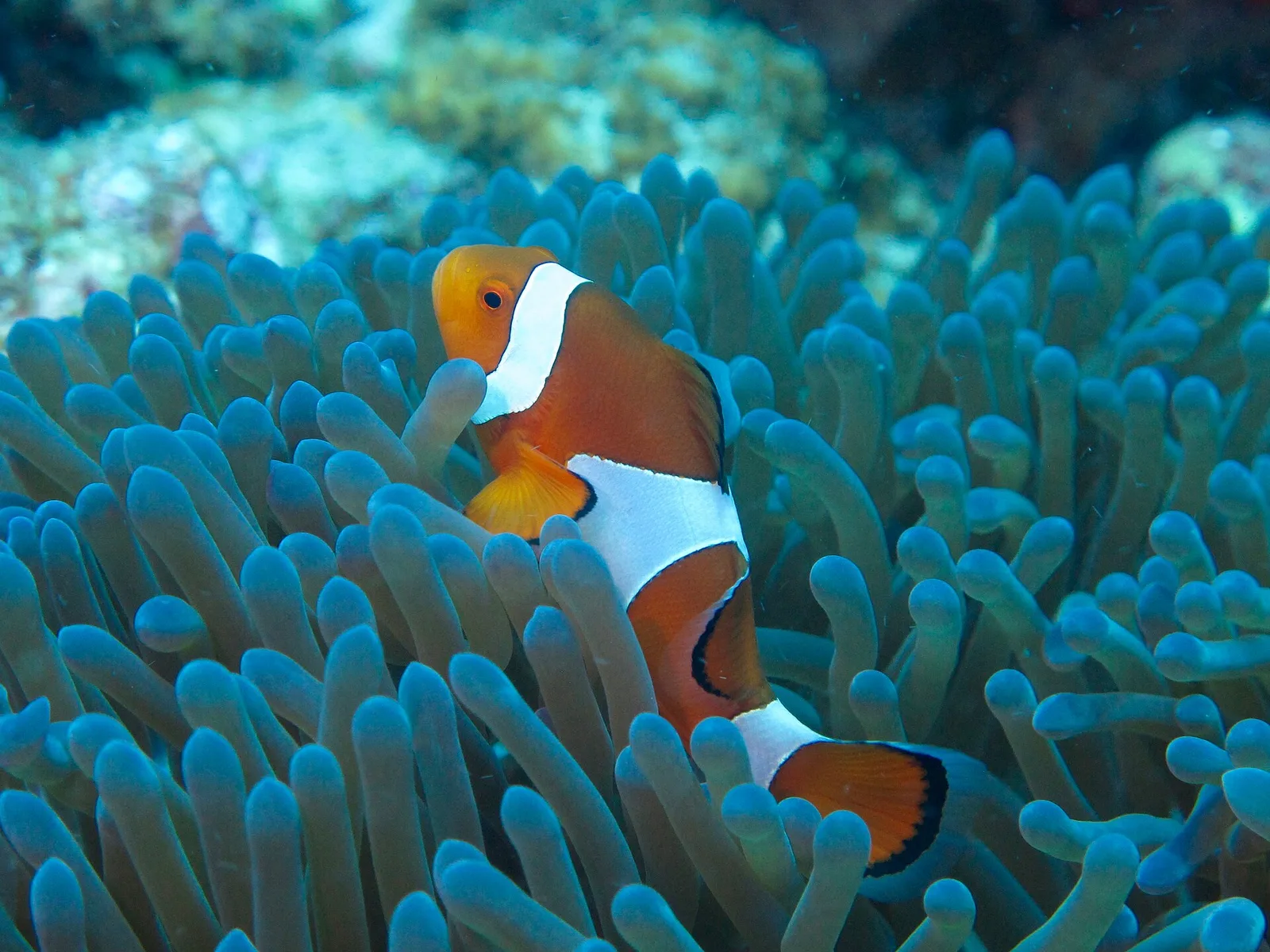
The body is stocky, oval and flattened from side to side. The base colour is orange to reddish brown. Three white bands cross it. The first sits just behind the eye, the second widens towards the head, and the third rings the base of the tail. Each band and every fin carries a fine black edge. The tail fin is rounded.
Adults are about 8 centimetres long, and the maximum is about 11 cm. Females are larger than males. Off the Northern Territory of Australia the fish is black where it would otherwise be orange, with the same white bands. Aquarium breeders have produced other patterns, and GBIF lists trade names such as frostbite and black ocellaris clown. The scales are covered by a thick mucus coat, which is the fish's shield against its host. A juvenile probably looks like a small adult, with the same bands from the day it settles.
Habitat and range
The clownfish lives in the eastern Indian Ocean and the western Pacific. Its range covers Southeast Asia, north-western Australia, and north as far as the Ryukyu Islands of Japan. GBIF holds records from 26 countries, led by Indonesia, the Philippines, Malaysia and Thailand. iNaturalist holds 4,964 observations.
It lives on outer reef slopes and in sheltered lagoons, no deeper than about 15 metres. Within that zone it lives only where one of its three host anemones grows. A group of clownfish never strays more than a few metres from its anemone. Young fish find a host by smell, using a scent they learned while still in the egg. Wikipedia also lists Hawaii among the places where the black form occurs, though it lies far outside the natural range. Records from there and from mainland North America probably come from aquarium fish.
Diet and feeding
The clownfish is an omnivore that eats roughly equal amounts of plants and animals. Its main foods are zooplankton, copepods and algae. It also picks parasites off its host anemone. It may eat scraps left from the anemone's own meals, as other anemonefish do.
Rank decides who eats well. The large dominant fish forage furthest from the anemone, though rarely more than several metres away. The small fish at the bottom of the order are harassed by the others and stay close to the tentacles, so they eat less. Leaving the anemone is also more dangerous for a small fish. So the female eats most and grows fastest, which keeps her at the top of the order.
Behaviour and social life
The clownfish is active by day and fiercely territorial. It depends entirely on its anemone for shelter and for a safe nest site. Before it can live among the tentacles it must acclimatise, brushing its belly and fins against the tentacle tips until the sting no longer fires. In return the fish drives off butterflyfish and even turtles that would eat the anemone. Its fanning improves water flow, and anemones with a resident fish do better than those without.
Each anemone holds a group in a strict size order: one female, one breeding male, and several non-breeding juveniles. The web notes give up to four juveniles. The female is the largest and the most aggressive, and she keeps the males in line. The breeding male bullies the juveniles and stops them from breeding. A lab study found that low-ranked fish grew more slowly and had different steroid levels, a sign that rank suppresses growth and breeding.
Researchers call these groups queues, because a fish rises in rank by outliving those above it. A newly arrived juvenile enters at the bottom, takes the most aggression, and may be chased out to search again. Group size tracks anemone size, mainly because a bigger anemone lets the female grow bigger. Her length then sets a ceiling on how many smaller fish fit beneath her in the queue. Some juveniles settle in short queues to rise faster, and others move between anemones after settling. Studies have found no clear difference between the fish that stay and the fish that switch.
Communication and senses
Rank is communicated by aggression: the larger fish chase and nip the smaller ones. A male courts the female by spreading his fins, biting and chasing. During spawning he grows more aggressive still. Outside courtship, Animal Diversity Web records little signalling other than these displays of rank.
Smell guides the most important journey of a clownfish's life. While still in the nest, the embryo imprints on the scent of the host anemone. After its days as plankton, the young fish follows that scent to the sea floor and to an anemone of the right species. Like other reef fish, it also relies on sight to spot predators and to read the colour bands of its own kind.
Reproduction and life cycle
Clownfish pair for life, and the pair defends its anemone. In the tropics they breed almost all year, though winter limits the northern populations. Spawning clusters around the full moon and usually happens in the morning. Strong currents at that time may help scatter the larvae, and invertebrates spawning at the same time provide food. Brighter nights may also help the parents see the nest.
The male clears a patch of bare rock beside the anemone so the tentacles hang over the nest. He chases the female to it, and she lays orange eggs over one to two hours. A clutch holds 100 to 1,000 eggs, each 3 to 4 millimetres, fixed to the rock by a fine thread. The male then passes over them and fertilises them. He does most of the care: fanning the eggs and eating any that are infertile or mouldy.
The eggs hatch after 6 to 8 days, longer in cooler water. The larvae drift near the surface as plankton for 8 to 12 days. They then change into juveniles, usually within a day, and drop to the bottom to find an anemone. Every fish matures as a male. When the female dies, her mate changes sex within weeks, and the largest juvenile steps up to breed with her. Wild clownfish are thought to live 6 to 10 years.
Predators and threats
The anemone keeps most predators away from an adult. Out in open water, though, the clownfish is a weak swimmer and easy prey for larger reef fish and eels. The eggs are the weak point. Other damselfish and wrasses raid them by day, and brittle stars take them at night when the male is not on guard. Larvae drifting in the plankton have no defence and die in huge numbers. A juvenile that cannot find a free anemone probably dies too, because it has nowhere to hide.
The larger threats reach the whole reef. Sediment, nutrient pollution and warming seas damage coral and the anemones that grow among it. Collection for the aquarium trade has thinned some local populations. Only certain colour forms are in demand, so collectors take a narrow slice of the population.
Population and conservation
The IUCN lists the clownfish as Least Concern. No global count exists, and the species is common across a wide range. Animal Diversity Web warns that reef damage could make it threatened in the future. Coral bleaching, which kills the host anemones as well as the coral, is the biggest long-term risk.
Trials have moved captive fish back onto depleted reefs, and small fish survive the move better than large ones. The species breeds easily in tanks, so most fish sold today are captive-bred rather than wild-caught. That takes pressure off wild reefs. Studies of reef fish trade note that the demand for rare colour forms still falls on wild stock. Protecting the anemones matters as much as protecting the fish, because neither does well alone.
Relationship with humans
The clownfish is one of the mainstays of the marine aquarium trade. It breeds readily in captivity and is used in research for the same reason. In a tank it will accept anemones it never meets in the wild, such as Entacmaea quadricolor, and even corals as a stand-in host. It lives in full seawater at 35 parts per thousand in nature but tolerates brackish water down to 15 parts per thousand in captivity.
Demand jumped after Finding Nemo in 2003. Over-collection followed in some places, which pushed the trade towards captive breeding. The fish is harmless to people. Divers and snorkellers seek it out, and it is thought to be the reef fish most people can name. Its easy breeding also made it a subject for restocking trials on depleted reefs.
In culture and myth
Marlin, Nemo and Coral in the 2003 Disney Pixar film Finding Nemo are ocellaris clownfish. The film made the species famous worldwide and set off a surge in aquarium sales of all clownfish. Its premise is wrong on one point of biology. After Coral's death, Marlin, the breeding male, would have turned into a female. Nemo, as the only juvenile, would then probably have become her mate.
Older folklore about this fish is scarce in the sources read here. Its names show how people see it. English says clownfish for the bands, Malay says badut, the clown, and Japanese says kakure-kumanomi, the hiding anemone fish. In Western popular culture it now stands for the reef, for loyalty between a parent and a child, and for the anemone partnership itself.
A sentence with a dotted underline is inferred: it describes the group the animal belongs to, or is a reading of the sources, rather than a measured or reported fact about this species.
Questions
Clownfish questions, answered
Do clownfish really change sex?
Yes. Every clownfish matures as a male, and the largest fish in the anemone becomes the female. Should she die, her mate turns into a female and the biggest juvenile takes his place.
Why doesn't the anemone sting the clownfish?
A thick coat of mucus on the fish's skin stops the anemone's stinging cells from firing. A fish new to an anemone must first brush against the tentacles until it is safe.
What do clownfish eat?
Zooplankton, copepods and algae in roughly equal amounts. They also pick parasites off their host anemone.
How big do clownfish get?
A typical adult is about 8 centimetres long, and the largest reach about 11 cm. Females are bigger than males.
How long do clownfish live?
About 6 to 10 years in the wild, though lifespan there has not been fully studied.
Where do clownfish live?
On coral reefs and in lagoons of the eastern Indian Ocean and western Pacific, from Southeast Asia to northern Australia and southern Japan. They stay within a few metres of a host anemone, no deeper than about 15 metres.
Are clownfish endangered?
No. The IUCN lists them as Least Concern. Reef damage and aquarium collection have thinned some local populations.
Is Nemo a real clownfish?
Yes. Marlin and Nemo in Finding Nemo are ocellaris clownfish. The film skips one fact: after Nemo's mother died, Marlin would have changed into a female.
Can clownfish live without an anemone?
In the wild, no. They are poor swimmers and need the anemone for shelter and a nest site. In an aquarium they do fine without one and may adopt a coral as a substitute.
How many eggs do clownfish lay?
A female lays 100 to 1,000 eggs, each 3 to 4 millimetres, on bare rock beside the anemone. They hatch after 6 to 8 days.
Who looks after clownfish eggs?
The father. He fans the eggs, guards them by day, and eats any that are infertile or mouldy.
What is the difference between an ocellaris and a percula clownfish?
They look almost identical. The ocellaris has thinner black outlines, a taller dorsal fin and usually 11 dorsal spines against 10 in the percula.
Are clownfish good pets?
Yes, they are among the easiest marine fish to keep. Buy captive-bred fish, which are widely available. They do not need an anemone in a tank.
Are there black clownfish?
Yes. Off the Northern Territory of Australia the ocellaris clownfish is black with white bands instead of orange. Breeders also sell dark forms.
How does a young clownfish find an anemone?
By smell. It learns the scent of its parents' anemone while still in the egg. After about 8 to 12 days drifting as plankton, it follows that scent to the bottom.
Food web
Prey and food
- algae
- plankton
- crustaceans
Food web
Predators
- reef fish
- eels
Ecological equivalents
Related species on this site
Damselfish (same family).