Atlas Moth
Attacus atlas
Living individuals or members of this group exist today. This does not mean they are safe from extinction.
The atlas moth is a large silk moth of Asian tropical and subtropical forests. Its adult life depends on energy stored by the leaf-eating caterpillar, because the adult does not feed.
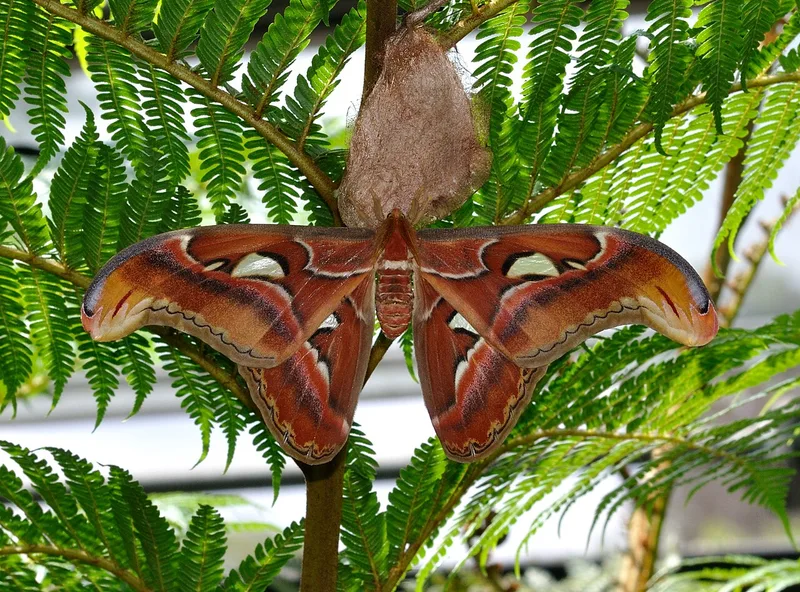
Atlas moth (Attacus atlas), the representative described here.
At a glance
- Location
- Attacus atlas occurs across parts of southern and southeastern Asia, with island populations in the wider region. Rainforest trees provide places for eggs, feeding larvae and cocoons.
- Habitat
- Rainforest
- Diet
- Herbivore
- Food
- Caterpillars eat leaves and accumulate reserves for later stages.
Classification
- Common name
- Atlas Moth
- Browse group
- Insects
- Scientific name or taxon
- Attacus atlas
- Taxon rank
- species
- Order
- Lepidoptera
- Family
- Saturniidae
- Genus
- Attacus
- Source classification
- Insecta
Taxonomy checked against GBIF. For breeds and hybrids, this describes the listed parent taxon.
Three things to know
- Adults do not feed.
- Caterpillars eat leaves.
- Females are generally larger than males.
Habitat and range
Attacus atlas occurs across parts of southern and southeastern Asia, with island populations in the wider region. Rainforest trees provide places for eggs, feeding larvae and cocoons.
Appearance and adaptations
Broad patterned wings carry reddish-brown, pale and dark markings. Females are generally larger than males. The conspicuous adult differs completely from the leaf-feeding caterpillar.
Diet and behaviour
Caterpillars eat leaves and accumulate reserves for later stages. Adults do not take food. Males locate females using chemical signals, detected with their large feathery antennae.
Sources
- Animal Diversity Web: Attacus atlas
- A–Z Animals: Atlas Moth · Directory entry
Explore insects
Browse all insects NE
Insects
Leafcutter ant
Atta cephalotes
Leafcutter ants carry pieces of leaf back to the nest, but they do not eat them.
Living
Insects
Rhinoceros beetle
Dynastinae
Rhinoceros beetles include many horned species.
Living
Insects
Silkworm
Bombyx mori
The domestic silkworm is the caterpillar of Bombyx mori.
Living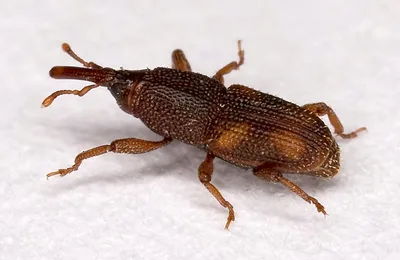
Insects
Weevil
Curculionoidea
Weevils are beetles with distinctive snouts.
Living