Rattlesnake
Crotalini
Living individuals or members of this group exist today. This does not mean they are safe from extinction.
Rattlesnakes are venomous pit vipers with a tail rattle. This account describes the western diamondback (Crotalus atrox), a heavy-bodied snake of the southwestern United States and Mexico.
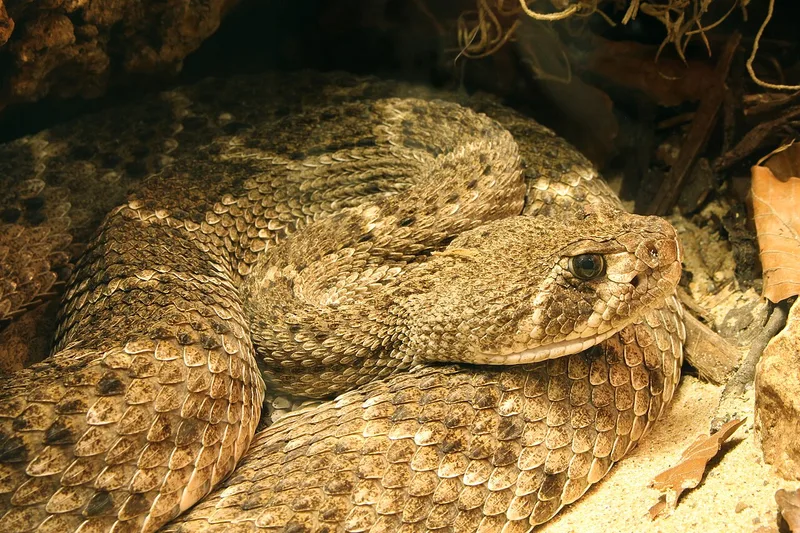
Representative species: Crotalus atrox.
At a glance
- Habitat
- Desert, Grassland
- Diet
- Carnivore
- Food
- Small mammals and other vertebrates.
Classification
- Common name
- Rattlesnake
- Browse group
- Reptiles
- Scientific name or taxon
- Crotalini
- Source classification
- Reptilia
Three things to know
- Heat-sensitive pits help locate prey.
- The tail rattle is a defensive signal.
- Small mammals are important food.
Habitat and range
Western diamondbacks inhabit dry rocky and shrub-covered country in the southwestern United States and Mexico. Crevices, burrows and vegetation provide concealment and temperature refuges.
Appearance and adaptations
Diamond-like back markings and contrasting tail bands distinguish typical adults. Heat-sensitive pits between the eyes and nostrils help detect warm-bodied prey.
Diet and behaviour
Small mammals form a major part of the diet, with birds and other animals also taken. Venom subdues prey. The rattle is used in defensive signalling, while concealment and retreat remain important parts of everyday survival.
Sources
- Animal Diversity Web: Crotalus atrox
- A–Z Animals: Rattlesnake · Directory entry
Explore reptiles
Browse all reptiles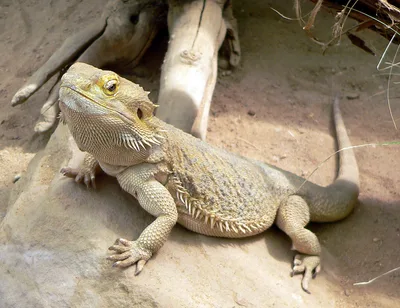
Reptiles
Bearded dragon
Pogona
Bearded dragons are Australian lizards.
Living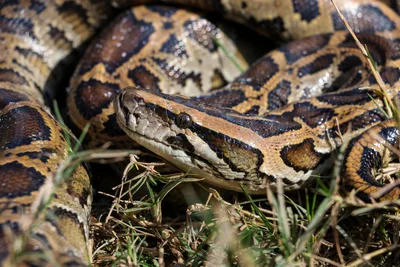
Reptiles
Burmese Python
Python bivittatus
The Burmese python is a large Asian constrictor with dark blotches.
Living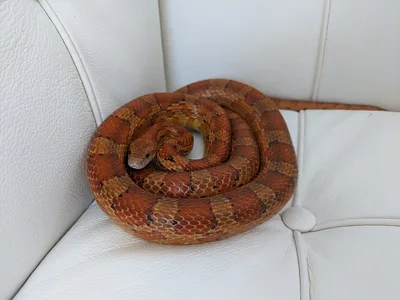
Reptiles
Corn Snake
Pantherophis guttatus
The corn snake is a nonvenomous American snake with large back markings and a chequered belly.
Living
Reptiles
Garter Snake
Thamnophis
Garter snakes are adaptable North American snakes.
Living