Prawn
Decapoda
Living individuals or members of this group exist today. This does not mean they are safe from extinction.
Prawns include many decapod crustaceans. This account follows the giant river prawn, Macrobrachium rosenbergii, as treated in the cited FAO aquaculture profile.
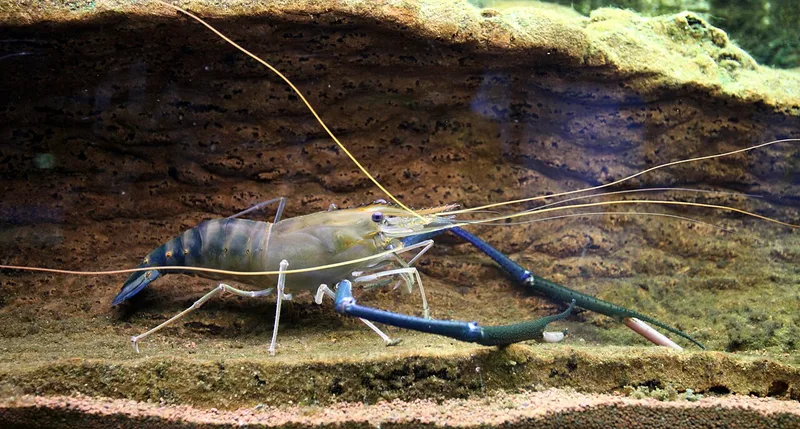
Macrobrachium rosenbergii, the representative described in this account.
This illustration was made by Citron You must credit this : Citron / CC-BY-SA-3.0 · CC BY-SA
At a glance
- Location
- Giant river prawns inhabit tropical freshwater connected to brackish estuaries.
- Habitat
- Rivers and lakes, Coast
- Diet
- Omnivore
- Food
- Adults eat both plant and animal material.
Classification
- Common name
- Prawn
- Browse group
- Crustaceans
- Scientific name or taxon
- Decapoda
- Taxon rank
- order
- Order
- Decapoda
- Source classification
- Malacostraca
Taxonomy checked against GBIF. For breeds and hybrids, this describes the listed parent taxon.
Three things to know
- Large males can have blue claws.
- Adults are omnivores.
- Larvae require brackish water.
Habitat and range
Giant river prawns inhabit tropical freshwater connected to brackish estuaries. The FAO source uses a historical species treatment and also describes farmed populations beyond the original range.
Appearance and adaptations
A long rostrum projects from the head, and large males may develop exceptionally elongated blue claws. Long antennae and stalked eyes explore the surroundings.
Diet and behaviour
Adults eat both plant and animal material. Females release larvae in brackish water, while later stages move towards a bottom-dwelling freshwater life.
Sources
- FAO: Giant river prawn
- A–Z Animals: Prawn · Directory entry
Explore crustaceans
Browse all crustaceans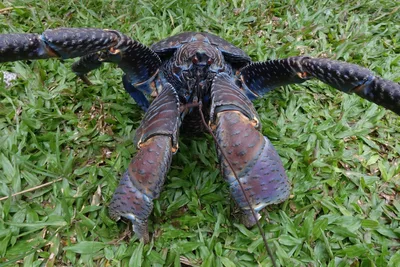 VU
Crustaceans
Coconut crab
Birgus latro
The coconut crab is the largest land-living arthropod.
Living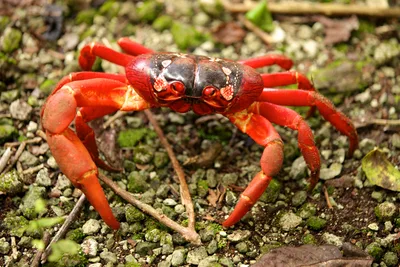
Crustaceans
Christmas Island Red Crab
Gecarcoidea natalis
The Christmas Island red crab is a land crab that spends most of its life on the forest floor.
Living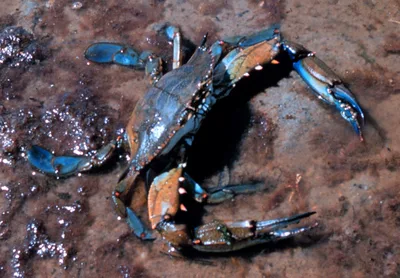
Crustaceans
Crab
Brachyura
True crabs include many forms.
Living
Crustaceans
Crayfish
Decapoda
Crayfish are freshwater crustaceans.
Living