Mite
Acari
Living individuals or members of this group exist today. This does not mean they are safe from extinction.
Mites have many lifestyles. This account follows the twospotted spider mite (Tetranychus urticae), a tiny plant feeder found on a wide range of crops and garden plants.
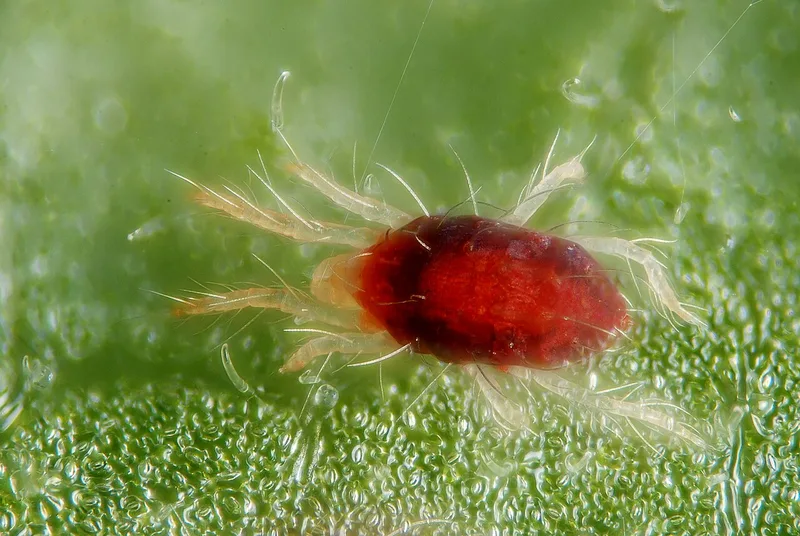
Magnified photograph of Tetranychus urticae, the representative described here.
At a glance
- Location
- Twospotted spider mites originated in Eurasia and now occur widely.
- Habitat
- Towns and cities
- Diet
- Herbivore
- Food
- Piercing plant tissue allows the mites to take cell contents, leaving pale stippling on leaves.
Classification
- Common name
- Mite
- Browse group
- Arachnids
- Scientific name or taxon
- Acari
Three things to know
- Adults have eight legs.
- Larvae have six legs.
- Feeding can leave pale leaf stippling.
Habitat and range
Twospotted spider mites originated in Eurasia and now occur widely. They live on leaves of many plant species, including cultivated trees, vegetables and ornamental plants.
Appearance and adaptations
Adults have eight legs and can vary from greenish to reddish. Dark body spots are often visible, but colour alone is not a reliable identification feature.
Diet and behaviour
Piercing plant tissue allows the mites to take cell contents, leaving pale stippling on leaves. Eggs hatch into six-legged larvae before later eight-legged stages develop.
Sources
- NC State Extension: Twospotted spider mite
- GBIF: Mite · Directory entry
Explore arachnids
Browse all arachnids
Birds
Pigeon
Columbidae
Pigeons include a wide variety of birds.
Living
Insects
Weevil
Curculionoidea
Weevils are beetles with distinctive snouts.
Living LC
Birds
Barn swallow
Hirundo rustica
The barn swallow is the most widespread swallow on earth, with a steel blue back and a deeply forked tail.
Living
Arachnids
Black Widow Spider
Latrodectus
Black widows include several related spiders.
Living