Daphnia
Daphnia
Living individuals or members of this group exist today. This does not mean they are safe from extinction.
Daphnia are small freshwater crustaceans rather than fleas. This account follows Daphnia magna, whose transparent body and jumping swimming movements make it a familiar microscope subject.
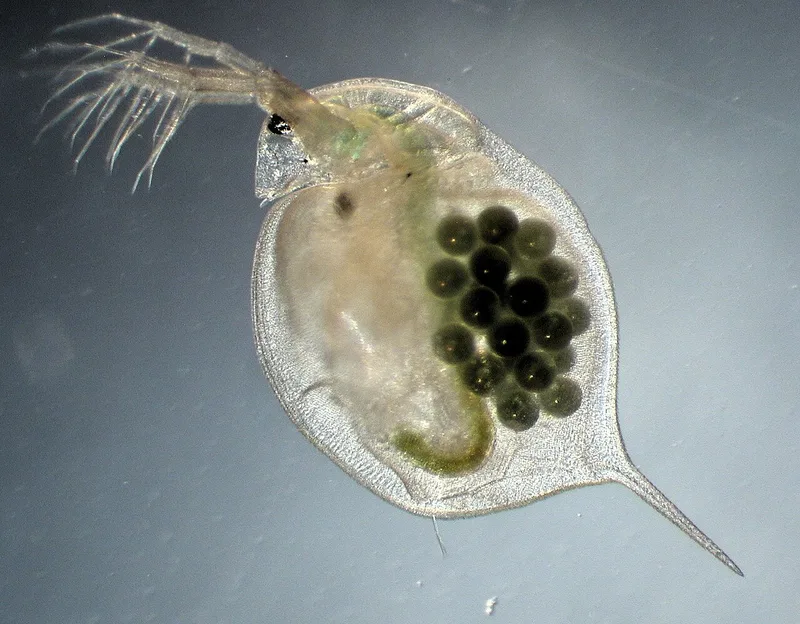
Magnified photograph of Daphnia magna, the representative described here.
At a glance
- Location
- Daphnia magna inhabits ponds, temporary pools and some other inland waters, including mildly brackish sites.
- Habitat
- Rivers and lakes
- Diet
- Filter feeder
- Food
- Filtering limbs collect tiny algae, bacteria and other particles.
Classification
- Common name
- Daphnia
- Browse group
- Crustaceans
- Scientific name or taxon
- Daphnia
- Taxon rank
- genus
- Order
- Diplostraca
- Family
- Daphniidae
- Genus
- Daphnia
- Source classification
- Branchiopoda
Taxonomy checked against GBIF. For breeds and hybrids, this describes the listed parent taxon.
Three things to know
- Branched antennae power swimming.
- It filters tiny food particles.
- Its life cycle includes resting eggs.
Habitat and range
Daphnia magna inhabits ponds, temporary pools and some other inland waters, including mildly brackish sites. Populations occur in Europe and parts of North America.
Appearance and adaptations
A transparent carapace encloses much of the body. Large branched antennae power swimming, while leaflike limbs beneath the shell move water towards the feeding apparatus.
Diet and behaviour
Filtering limbs collect tiny algae, bacteria and other particles. Females can reproduce without mating under favourable conditions; sexual reproduction also produces protected resting eggs that survive difficult periods.
Sources
- Animal Diversity Web: Daphnia magna
- GBIF: Daphnia · Directory entry