Copperhead
Agkistrodon contortrix contortrix
Living individuals or members of this group exist today. This does not mean they are safe from extinction.
The southern copperhead is a venomous North American pit viper. Brown crossbands and a copper-toned head help it blend into fallen leaves.
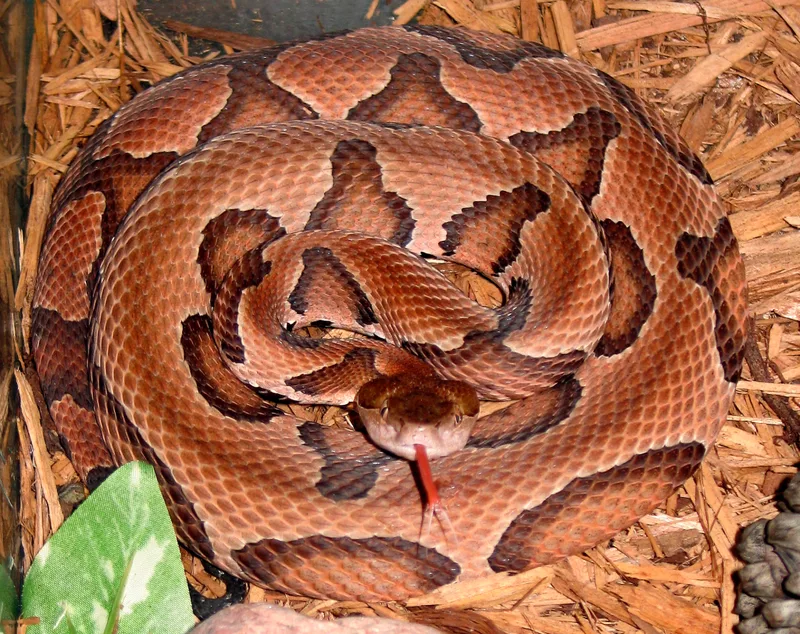
Southern copperhead (Agkistrodon contortrix contortrix), photographed for the US Centers for Disease Control and Prevention.
At a glance
- Location
- Southern copperheads occupy woodland in the southeastern United States, including damp lowland forest. Rocks, fallen timber and other sheltered places provide cover. The cited account treats copperheads more broadly than the subspecies named on this page.
- Habitat
- Temperate forest, Wetlands
- Diet
- Carnivore
- Food
- Adults eat small mammals and other available prey; younger snakes also take amphibians, lizards and insects. Camouflage allows a snake to wait for passing food. Activity shifts toward cooler evening hours in hot weather.
Classification
- Common name
- Copperhead
- Browse group
- Reptiles
- Scientific name or taxon
- Agkistrodon contortrix contortrix
- Taxon rank
- subspecies
- Family
- Viperidae
- Genus
- Agkistrodon
- Source classification
- Reptilia
Taxonomy checked against GBIF. For breeds and hybrids, this describes the listed parent taxon.
Three things to know
- It is a pit viper.
- Young snakes have a yellowish tail tip.
- Adults often hunt by ambush.
Habitat and range
Southern copperheads occupy woodland in the southeastern United States, including damp lowland forest. Rocks, fallen timber and other sheltered places provide cover. The cited account treats copperheads more broadly than the subspecies named on this page.
Appearance and adaptations
A heavy body carries reddish-brown crossbands, and the head is copper-brown. Heat-sensitive facial pits help detect warm prey. Young copperheads have a yellowish tail tip that can serve as a lure.
Diet and behaviour
Adults eat small mammals and other available prey; younger snakes also take amphibians, lizards and insects. Camouflage allows a snake to wait for passing food. Activity shifts toward cooler evening hours in hot weather.
Sources
- Animal Diversity Web: Agkistrodon contortrix
- A–Z Animals: Copperhead · Directory entry
Explore reptiles
Browse all reptiles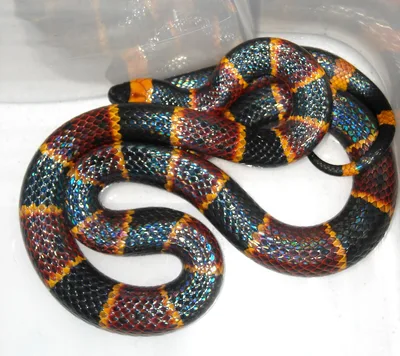
Reptiles
Coral Snake
Micrurus
Coral snakes include many species of venomous elapids.
Living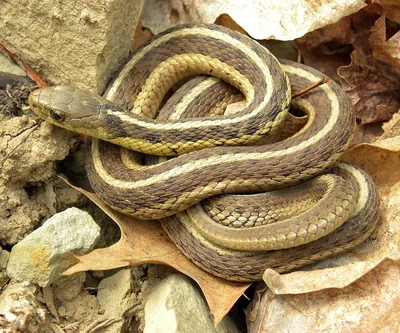
Reptiles
Garter Snake
Thamnophis
Garter snakes are adaptable North American snakes.
Living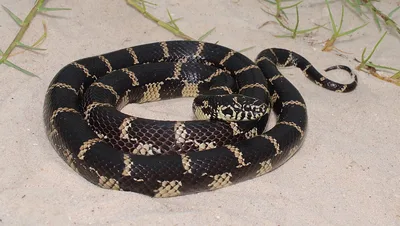
Reptiles
King Snake
Lampropeltis
Kingsnakes are nonvenomous constrictors.
Living
Reptiles
Box Turtle
Terrapene
Box turtles are land-dwelling North American turtles.
Living