Angelfish
Pomacanthidae
Living individuals or members of this group exist today. This does not mean they are safe from extinction.
Marine angelfishes differ from the freshwater aquarium fishes with the same common name. This account follows the French angelfish, an Atlantic reef fish whose appearance changes markedly as it grows.
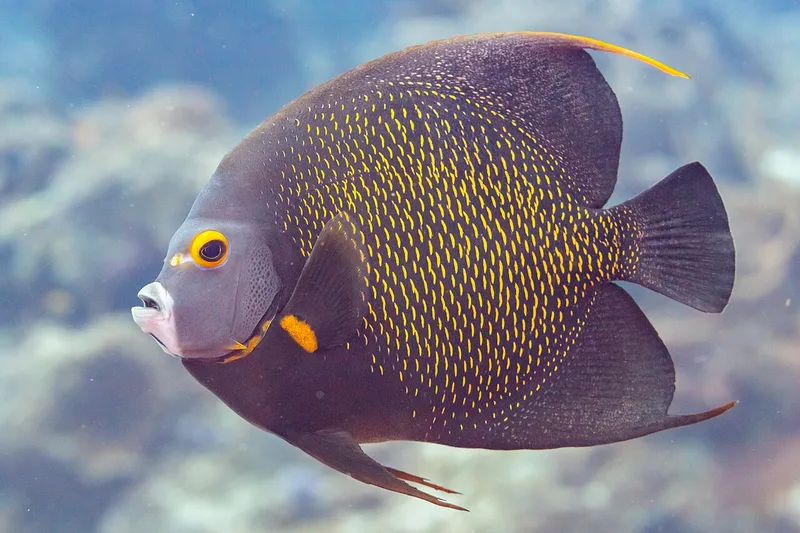
French angelfish (Pomacanthus paru), the representative described here.
At a glance
- Location
- Pomacanthus paru is the representative here. It uses Atlantic coral reefs and nearby rocky or grassy areas with hiding places. Crevices provide shelter at night.
- Habitat
- Coral reef, Coast
- Diet
- Omnivore
- Food
- Young French angelfish clean parasites from other fishes.
Classification
- Common name
- Angelfish
- Browse group
- Fish
- Scientific name or taxon
- Pomacanthidae
- Taxon rank
- family
- Order
- Perciformes
- Family
- Pomacanthidae
- Source classification
- Actinopterygii
Taxonomy checked against GBIF. For breeds and hybrids, this describes the listed parent taxon.
Three things to know
- Juveniles have yellow body bands.
- Young fish can act as cleaners.
- Sponges are important adult foods.
Habitat and range
Pomacanthus paru is the representative here. It uses Atlantic coral reefs and nearby rocky or grassy areas with hiding places. Crevices provide shelter at night.
Appearance and adaptations
Juveniles have conspicuous yellow bands on a dark body. Adults develop yellow-edged dark scales and a paler face. A strong spine near the gill cover distinguishes marine angelfishes from butterflyfishes.
Diet and behaviour
Young French angelfish clean parasites from other fishes. Adults eat many attached reef animals, especially sponges, and often move about in pairs. Feeding and sheltering are organised around the reef.
Sources
- Animal Diversity Web: Pomacanthus paru
- A–Z Animals: Angelfish · Directory entry
Explore fish
Browse all fish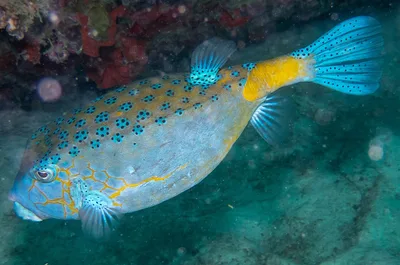
Fish
Boxfish
Ostraciidae
Boxfishes have unusually rigid bodies.
Living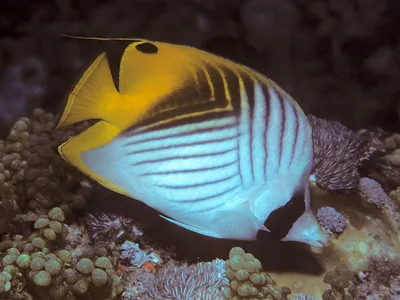
Fish
Butterfly Fish
Chaetodontidae
Butterflyfishes are conspicuous reef inhabitants with flattened bodies.
Living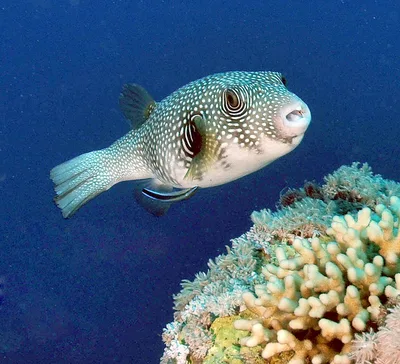
Fish
Pufferfish
Tetraodontidae
Pufferfishes include many marine and freshwater species.
Living
Fish
Barracuda
Sphyraenidae
Barracudas are streamlined predators with conspicuous teeth.
Living