Barracuda
Sphyraenidae
Living individuals or members of this group exist today. This does not mean they are safe from extinction.
Barracudas are streamlined predators with conspicuous teeth. The great barracuda described here lives in warm seas and hunts smaller fishes around reefs and nearby coastal habitats.
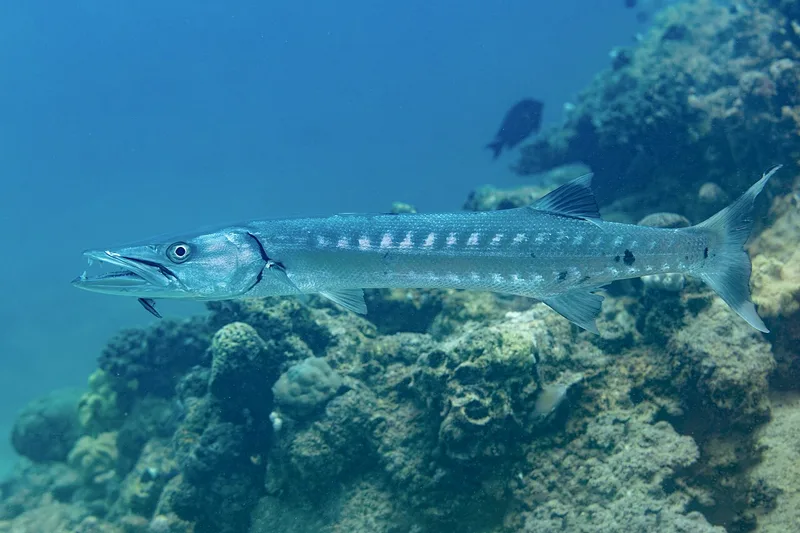
Great barracuda (Sphyraena barracuda), the representative described here.
At a glance
- Location
- Sphyraena barracuda is the representative used here. It occurs widely in warm Atlantic and Indo-Pacific waters. Adults often use reef margins, while sheltered coastal areas are important to young fish.
- Habitat
- Coral reef, Coast
- Diet
- Piscivore
- Food
- Great barracudas capture fishes using both waiting and active hunting.
Classification
- Common name
- Barracuda
- Browse group
- Fish
- Scientific name or taxon
- Sphyraenidae
- Taxon rank
- family
- Order
- Perciformes
- Family
- Sphyraenidae
- Source classification
- Actinopterygii
Taxonomy checked against GBIF. For breeds and hybrids, this describes the listed parent taxon.
Three things to know
- It has two separated dorsal fins.
- Large pointed teeth grip fish.
- Adults can occur alone or in groups.
Habitat and range
Sphyraena barracuda is the representative used here. It occurs widely in warm Atlantic and Indo-Pacific waters. Adults often use reef margins, while sheltered coastal areas are important to young fish.
Appearance and adaptations
The long silvery body has two widely separated dorsal fins. A projecting lower jaw and large pointed teeth surround the broad mouth. Dark patches and bars vary with age.
Diet and behaviour
Great barracudas capture fishes using both waiting and active hunting. They may occur alone or in schools. Their narrow outline and reflective sides can make an approaching predator difficult for prey to detect.
Sources
- Animal Diversity Web: Sphyraena barracuda
- A–Z Animals: Barracuda · Directory entry
Explore fish
Browse all fish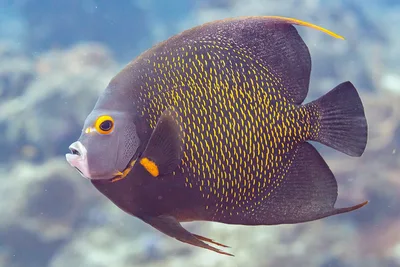
Fish
Angelfish
Pomacanthidae
Marine angelfishes differ from the freshwater aquarium fishes with the same common name.
Living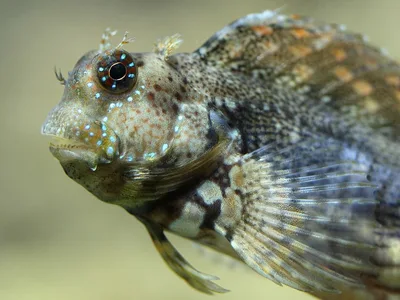
Fish
Blenny
Blenniiformes
Blennies include many small fishes living close to the bottom.
Living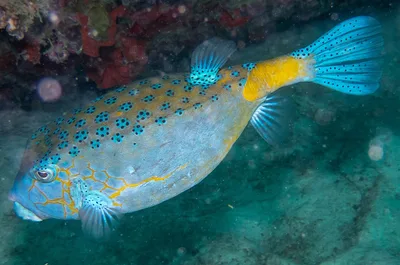
Fish
Boxfish
Ostraciidae
Boxfishes have unusually rigid bodies.
Living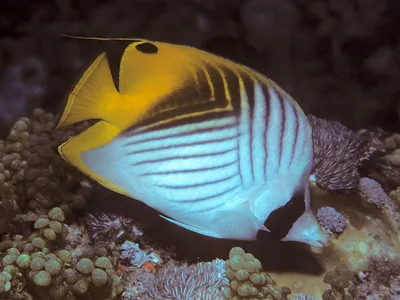
Fish
Butterfly Fish
Chaetodontidae
Butterflyfishes are conspicuous reef inhabitants with flattened bodies.
Living