Vampire Squid
Vampyroteuthis infernalis
Living individuals or members of this group exist today. This does not mean they are safe from extinction.
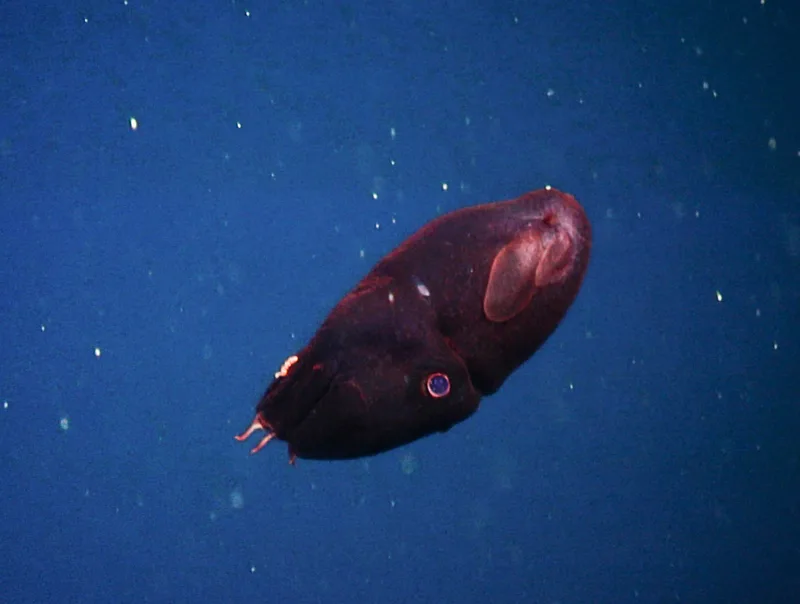
The vampire squid collects drifting organic debris in dim, oxygen-poor ocean water. Its webbed arms and glowing defences make it unusual among living cephalopods.
At a glance
- Location
- Tropical and temperate oceans, especially oxygen-poor midwater at roughly 600 to 900 metres deep.
- Habitat
- Open ocean
- Diet
- Detritivore
- Food
- Marine snow and some small zooplankton.
Classification
- Common name
- Vampire Squid
- Browse group
- Molluscs
- Scientific name or taxon
- Vampyroteuthis infernalis
- Taxon rank
- species
- Order
- Vampyromorpha
- Family
- Vampyroteuthidae
- Genus
- Vampyroteuthis
- Source classification
- Cephalopoda
Taxonomy checked against GBIF. For breeds and hybrids, this describes the listed parent taxon.
Measurements
Size and speed
- Length
- Up to 30 cm total length
Typical adult ranges. Source: Monterey Bay Aquarium Research Institute.
Three things to know
- Marine snow makes up much of its diet.
- It can turn its webbed arms outward when threatened.
- Its defences include bioluminescent fluid.
Habitat and range
Tropical and temperate oceans, especially oxygen-poor midwater at roughly 600 to 900 metres deep.
Appearance and adaptations
Eight webbed arms surround the mouth. Two long, sticky filaments gather particles, and light-producing structures help it confuse potential predators.
Diet and behaviour
It gathers sinking organic remains instead of relying on active hunting. Mucus binds the food before it reaches the mouth, conserving energy in low-oxygen water.
Sources
- MBARI: Vampire squid
- A–Z Animals: Vampire Squid · Directory entry
Explore molluscs
Browse all molluscs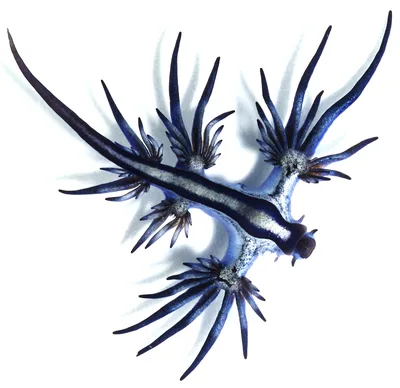
Molluscs
Blue Dragon Sea Slug
Glaucus atlanticus
The blue dragon sea slug floats upside down at the ocean surface.
Living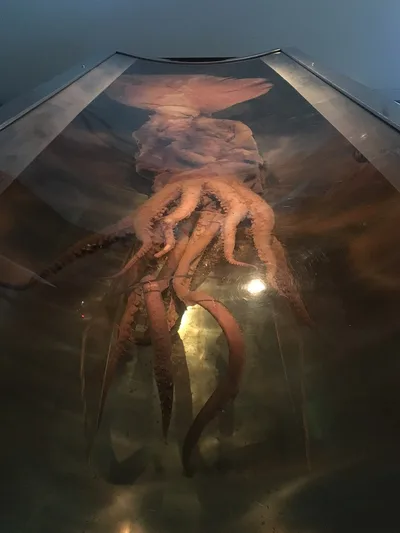
Molluscs
Colossal Squid
Mesonychoteuthis hamiltoni
The colossal squid is a deep-water cephalopod of Antarctic and subantarctic seas.
Living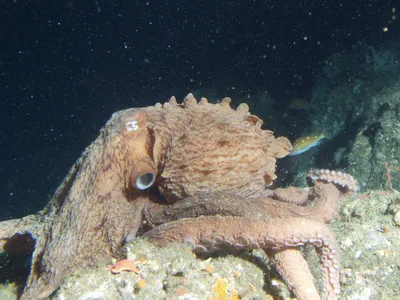 LC
Molluscs
Giant Pacific octopus
Enteroctopus dofleini
The giant Pacific octopus is the largest octopus.
Living
Molluscs
Giant squid
Architeuthis dux
The giant squid is an elusive deep-water cephalopod with exceptionally long feeding tentacles.
Living