Blue-tongued skink
Tiliqua
Living individuals or members of this group exist today. This does not mean they are safe from extinction.
Blue-tongued skinks are stocky lizards with conspicuous blue tongues. This account focuses on the eastern blue-tongued skink (Tiliqua scincoides).
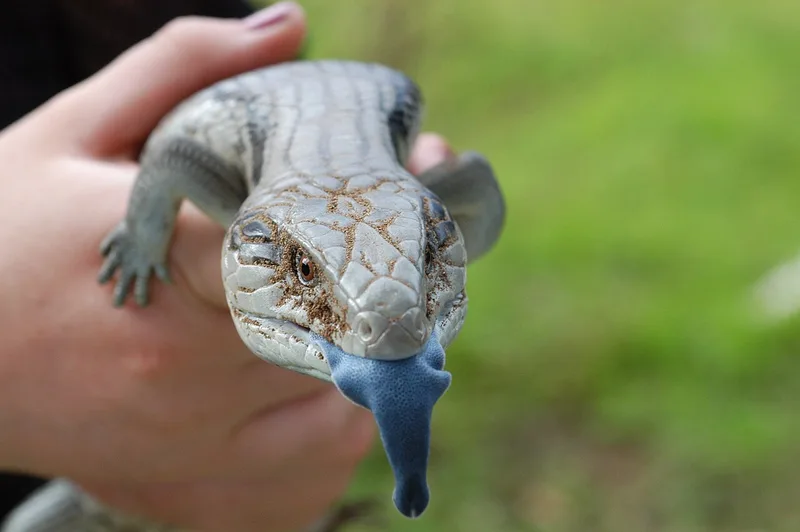
Eastern blue-tongued skink (Tiliqua scincoides), the representative species, being held while showing its tongue in New South Wales, Australia.
At a glance
- Location
- Eastern blue-tongued skinks live in Australia, using woodland, scrub and relatively dry country. Hollow logs and ground debris provide places to hide; this account does not describe every species of Tiliqua.
- Diet
- Omnivore
- Food
- These skinks eat both animal and plant foods, including insects and fruit. They forage during the day and shelter near the ground. Females give birth to live young rather than laying eggs outside the body.
Classification
- Common name
- Blue-tongued skink
- Browse group
- Reptiles
- Scientific name or taxon
- Tiliqua
- Taxon rank
- genus
- Family
- Scincidae
- Genus
- Tiliqua
- Source classification
- Squamata
Taxonomy checked against GBIF. For breeds and hybrids, this describes the listed parent taxon.
Three things to know
- Its tongue is bright blue.
- It eats both plants and small animals.
- Females give birth to live young.
Habitat and range
Eastern blue-tongued skinks live in Australia, using woodland, scrub and relatively dry country. Hollow logs and ground debris provide places to hide; this account does not describe every species of Tiliqua.
Appearance and adaptations
A long, cylindrical body rests on short legs. Overlapping scales cover the skin, and dark bands or blotches mark the back. A threatened skink may gape, hiss and expose its blue tongue.
Diet and behaviour
These skinks eat both animal and plant foods, including insects and fruit. They forage during the day and shelter near the ground. Females give birth to live young rather than laying eggs outside the body.
Sources
- Animal Diversity Web: Tiliqua scincoides
- GBIF: Blue-tongued skink · Directory entry
Explore reptiles
Browse all reptiles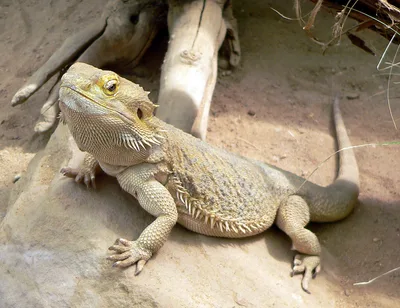
Reptiles
Bearded dragon
Pogona
Bearded dragons are Australian lizards.
Living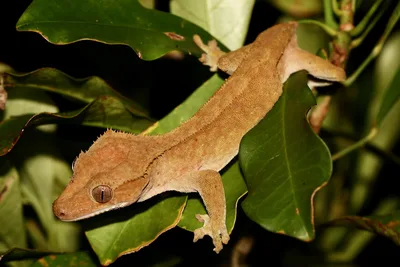
Reptiles
Crested Gecko
Correlophus ciliatus
The crested gecko is a nocturnal lizard native to New Caledonia.
Living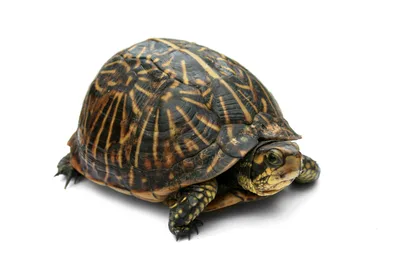
Reptiles
Box Turtle
Terrapene
Box turtles are land-dwelling North American turtles.
Living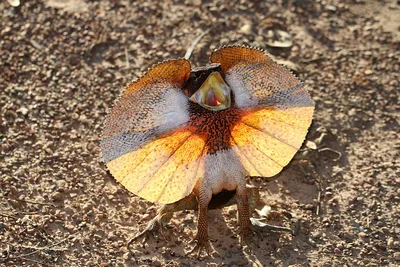
Reptiles
Frilled Lizard
Chlamydosaurus kingii
The frilled lizard is a tree-dwelling reptile of northern Australia and southern New Guinea.
Living